
Maker, model, serial, photos, nameplates, drawings, quantity, port and ETA.
Pumps & Pump Spares
Marine Pump
Marine Pump
Spare Parts Supplier
Engine-room marine pump spare parts supply for cooling, fuel, lube oil, ballast, cargo and sewage pump components.
Request context is structured before supplier routing or quotation work.
OEM route or verified alternative route can be reviewed where appropriate.
Commercial request is prepared for clearer supplier review and buyer reply.
Pump systemsCooling, fuel, lube, ballast, cargo, sewage
OEM + verified alternativesRoute review by requirement
Technical ID reviewMaker, model, serial, nameplate, drawings
Port-aware deliveryUrgency, ETA and handover planning
Pump spare parts supplier
Marine pump parts sourced around the installed system.
Vessel Core supplies purchasing teams, superintendents, marine engineers, repair yards and maritime agents with pump spares across engine-room and ship service systems.
The request can include a complete part number, or it can start from the pump maker, model, serial number, installed system, nameplate photo, drawing position or component photos. The aim is to structure the RFQ quickly enough for commercial review without losing technical accuracy.
Supply scope
Pump systems and spare parts we can structure into an RFQ.
Commercially useful spare parts supply coverage for planned maintenance, time-critical repairs and engine-room supply review.
Cooling water pumps
Impellers, wear rings, mechanical seals, shafts, bearings, gaskets and overhaul parts.
Fuel pumps
Gear sets, rotors, casings, relief valve parts, seals, couplings, filters and gasket kits.
Lube oil pumps
Pump internals, shaft seals, bearings, coupling elements, strainers and service kits.
Ballast pumps
Impellers, mechanical seals, casing parts, bearing housings, shafts, wear parts and gaskets.
Cargo pumps
Critical pump components, sealing parts, shafts, couplings, bearings and overhaul kits.
Sewage pumps
Cutters, impellers, seals, gaskets, motor-related components, valves and service parts.
Mechanical seals
Seal assemblies, O-rings, gasket sets and related shaft sealing components.
Overhaul kits
Grouped service items for maintenance jobs where multiple wear components are replaced together.
Model index
65 models in this category, filterable.
Start typing a designation, a maker or a part and the rows filter as you go. The full list across the whole site lives on the maker reference page. Full index across every category and maker.
65 models
| Model | Series | Maker | Typical parts |
|---|---|---|---|
| Pump, coupling and driver on a baseplate | Complete units | Allweiler | Many shipboard installations are supplied as a mounted set. Coupling elements, guards, baseplate hardware and the driver identity are worth listing separately, since a vibration complaint is often a coupling or alignment matter rather than a pump matter. |
| Single-helix rotor in a double-helix stator | Eccentric screw · AE series | Allweiler | Allweiler's AE range eccentric screw pumps run a chromed rotor inside an elastomer stator, driven through a jointed drive shaft. The stator carries twice the rotor pitch and one lobe more, which is what forms the sealed cavities that travel along the axis. On sludge, bilge, waste oil and chemical dosing duty the stator is the consumable — and its compound, not the pump size, sets the replacement interval. |
| SN series — three-screw, fuel and lube oil duty | Three-screw · SN series | Allweiler | One driving spindle meshing with two idler spindles inside a close-fitted bore. Seen on heavy fuel supply and circulating duty and equally on lube oil service, since the pumped oil is also the film that carries the idlers. |
| SNS series — three-screw, alternative bearing and sealing execution | Three-screw · SNS series | Allweiler | A three-screw build differing in bearing arrangement, sealing execution and mounting rather than in application; it turns up on lube oil circulation, stern tube service, hydraulic power packs and fuel duty alike. Quiet running and virtually pulsation-free flow is the reason it is chosen, and the reason wear is noticed late. |
| Standardised single-stage units | Centrifugal · NB, NIS, NISO | Allweiler | Allweiler's NB, NIS and NISO ranges follow the EN 733 dimension standard, which is why a bearing bracket sometimes interchanges and a seal chamber does not. State the type code and the actual impeller diameter — these pumps leave the works with the impeller machined down to the ordered duty point, so the trim is not recoverable from the model name. |
| Transfer and bunkering duty | Three-screw · larger frames | Allweiler | Larger screw frame sizes handle fuel transfer between tanks and bunker lines — high delivered volume at modest differential pressure. Pressure capability comes from the number of sealing chambers along the spindle, so on these frames it is the condition of the flanks and the bore, rather than the driver rating, that decides whether rated capacity is still reached. |
| AN and BOB series | Centrifugal · long-coupled baseplate | Azcue | Baseplate-mounted single-stage units driven through a flexible coupling, AN covering heavy duty service to about 700 m³/h. Requests cover the impeller, the wear-ring pair, the seal assembly, drive-end and non-drive-end bearings and the coupling element. |
| BT-HM / BT-LV series | Positive displacement · triple screw | Azcue | Triple screw pumps on fuel oil transfer, MDO and LSGO service, and low- and high-viscosity lube oil duty — BT-HM close-coupled, BT-LV vertical in-line. Component requests centre on the screw set (power rotor and idler screws), the insert or liner, shaft seal, bearings and the built-in relief valve spring and seat. |
| CA series | Centrifugal · self-priming | Azcue | Horizontal self-priming single-stage centrifugal. The inlet sits high on the casing so liquid is retained after the first prime, allowing repeated priming on bilge, ballast, deck wash and grey water duty and dry running up to roughly 30 minutes. Reaches about 300 m³/h and 105 m and passes soft solids to 10 mm. Built close-coupled with a lantern bracket or as a bare-shaft head, in cast iron GG25, bronze or AISI 316. Wear parts: impeller — closed or semi-open depending on the build, so state which is fitted — casing and cover wear rings, mechanical seal, shaft sleeve and casing gasket. |
| CM, LN and VM/VR series | Centrifugal · vertical in-line | Azcue | Vertically arranged in-line pumps used where deck and flat space is tight — cooling circuits, transfer and pressure sets. CM is long-coupled and reaches roughly 1500 m³/h, LN is close-coupled, VM and VR are rigid-coupled. Shaft, sleeve, seal seat and bearing bracket components dominate the wear list. |
| CP series | Centrifugal · close-coupled | Azcue | Small close-coupled (monobloc) single-stage centrifugal, DN25 to DN80, up to about 75 m³/h and 50 m, with lantern bracket and back pull-out design so the motor comes off without breaking pipework. Requests typically cover the impeller, wear-ring pair, mechanical seal, pump shaft and bearings. |
| Fire, bilge and sanitary sets | Statutory service | Azcue | Pumps serving fire main, bilge and sanitary systems usually carry documentation expectations beyond the mechanical fit. Flag those duties in the request so the route and paperwork question is settled before quotation. |
| MA, MO/BR, RA, KL/KB and RKZ | Side channel and eccentric screw | Azcue | The MA, MO/BR and RA side channel ranges self-prime and keep pumping gas-laden liquid on tank stripping and priming duty, with a stage code carried in the model number. KL and KB eccentric screw units and RKZ vertical piston pumps handle viscous and sludge media. State the stage count and the medium so stage components, rotor and stator can be scoped. |
| MN series | Centrifugal · monobloc to DIN 24255 | Azcue | Horizontal close-coupled (monobloc) single-stage centrifugal built to the DIN 24255 footprint — the workhorse range on cooling, ballast and general service up to about 500 m³/h and 10 bar, dropping into existing DIN 24255 pipework. Impeller, casing and cover wear rings, mechanical seal and shaft sleeve dominate the wear list. |
| Ballast, bilge & fire line | Duty context | DESMI | Ballast, bilge and fire-line installations where suction conditions are harsh and running is intermittent. Seal arrangement, priming provision and driver data must be stated with the pump identity. |
| Casing gaskets and covers | Static sealing | DESMI | Casing gaskets, cover O-rings and drain plug seals are cheap to include and expensive to omit once the pump is open. They belong on the same RFQ as the rotating parts, listed against the same pump serial. |
| Coupling elements and alignment | Drive | DESMI | Flexible coupling elements degrade with heat, oil contact and misalignment, and a worn element accelerates seal and bearing wear downstream. Note the coupling make, size and element type — these are frequently not the pump maker's own part. |
| DSL series | Centrifugal · SL programme | DESMI | Consult the plate — the SL designations separate suction and coupling arrangement, which changes the impeller, wear ring and bearing spares. Whether the unit in front of you is a double-suction build (no single suction-side wear ring, different impeller) has to be confirmed against the pump manual, not inferred from the three letters on the casing. |
| ESL series | Centrifugal · SL programme | DESMI | Another SL designation separated by suction and coupling arrangement rather than by size. Seal face pairs, elastomer kits, impellers and rolling-element bearings recur on the line list, but an end-suction build brings its own bearing bracket, pump shaft and coupling spacer, so confirm the arrangement before a wear ring is matched. |
| Impeller erosion and cavitation | Hydraulics | DESMI | Leading edges thin out and vane suction faces show pitting just behind the leading edge, often carrying into the shroud. Pitting there points to suction-side conditions — strainer, sea chest or NPSH — so a like-for-like impeller alone may not settle the fault. Where a bronze impeller runs in a cast iron casing, the casing and casing wear ring are the anodic parts and lose metal first: inspect the ring bore and casing faces, not only the impeller, and note any sacrificial anodes fitted in the covers and their condition. Record the trimmed diameter that came out, because it rarely equals the nominal diameter of the family. |
| Modular pump builds | Centrifugal · Modular | DESMI | Pumps assembled from shared hydraulic, sealing and bearing modules. Identification depends on the module combination recorded on the plate and in the order documents, so the family name alone is not enough to fix a spare. |
| NSL series | Centrifugal · Vertical in-line | DESMI | Single-stage vertical in-line centrifugal pumps bolted directly into cooling and general-service pipe runs, with the driver carried above the casing. The high-head variant (NSLH) carries a different plate designation and different hydraulic spares — read the plate rather than assuming NSL. Requests usually cover the casing wear ring, impeller, mechanical seal cartridge, shaft sleeve, motor stool/lantern and the seal chamber components. Long-coupled variants add a bearing bracket and coupling spacer — state which build is fitted, because the two carry different spares. |
| ROTAN internal gear pumps | Positive displacement · Internal gear | DESMI | DESMI's ROTAN internal gear pumps on fuel oil, lube oil and viscous transfer duty, where a centrifugal would lose prime or shear the medium. Line items typically cover the rotor and idler set, idler pin and bushings, front cover and gasket, mechanical seal or packing set, and relief valve parts. State the bushing material with the request: a fuel-duty build and a sludge-duty build of the same frame size take different ones. |
| Seal faces and face pairing | Sealing | DESMI | Seawater carries sand, silt and marine growth straight into the seal chamber. The pairing wears, weeping appears at the seal chamber drain and a salt crust builds on the lantern/motor stool below it. The face material combination and elastomer grade decide the replacement — the seal size alone does not. |
| Seawater cooling service | Duty context | DESMI | Seawater pumps serving the central cooler and the SW cooling line, and the fresh-water circulating pumps on the closed jacket and low-temperature circuits. The two duties are built in different wetted materials, so the circuit must be stated with the pump identity: a bronze or duplex build cannot be replaced from a fresh-water parts list of the same nominal size. |
| Self-priming units | Priming | DESMI | Self-priming pumps and separately mounted priming units on bilge, ballast and stripping duty. Vacuum unit elements, priming valves, non-return components and seal kits are requested as sets. |
| Shafts, sleeves and bearings | Rotating assembly | DESMI | Fretting under the seal, corrosion at the sleeve shoulder and bearing housing bore wear usually surface together. When a shaft is ordered, state whether the sleeve, key, lock nut and bearing set are being renewed with it. |
| Wear ring clearance opening up | Clearances | DESMI | As the casing ring and impeller neck ring lose their fit, recirculation grows and the pump quietly falls below its duty point while sounding mechanically healthy. Ring bore, ring width and the matching impeller neck dimension should be measured before the RFQ is sent. |
| Anti-Heeling Pumps | Stability system | Framo | Submerged pumps able to run in both directions, so heel is corrected by reversing the pump rather than by a changeover valve arrangement. Enquiries usually mix pump wear parts with heel-sensor and control-system components. |
| Cofferdam Barrier and Drain Arrangement | Barrier system | Framo | The dry barrier space between hydraulic oil and cargo, drained to a shut-off valve and collecting point at deck level. Cofferdam drain lines, drain valves and deck drain-point fittings, with the purging connection used to clear the line. |
| Hydraulic Motor Assemblies | Hydraulic drive | Framo | The motor on top of each pump head. Piston and cylinder-block wear, valve plate scoring, shaft seal leakage and bearing play are the usual reasons a unit is landed for overhaul. |
| Hydraulic Power Packs | Hydraulic drive | Framo | Engine-driven or electrically driven pack feeding a constant-pressure ring line through pressure-compensated main pumps that destroke on demand. Feed and main pump elements, pressure and return filter elements, relief valves, oil coolers and header-tank components. |
| SB Series Submerged Ballast Pumps | Ballast duty | Framo | Hydraulically driven ballast pumps — SB125, SB200, SB300 — in segregated ballast tanks and on anti-heeling service. Seawater duty changes the corrosion picture: bearing wear, impeller erosion and shaft sleeve condition dominate the parts list, alongside seal kits and hydraulic motor service components. |
| SD Series Submerged Cargo Pumps | Submerged cargo | Framo | Single-stage centrifugal cargo pumps hung in the tank on the discharge pipe, designated as series plus size — SD100, SD125, SD150, SD200, SD250, SD300. The series covers full cargo tanks down to slop and small parcel tanks. Impeller and wear ring, top and bottom bearings, cofferdam seal arrangements, hydraulic motor internals. |
| TK Series Portable Hydraulic Pumps | Portable equipment | Framo | Hose-fed TK80, TK100 and TK150 units used for stripping, residue and washings removal, dewatering and emergency transfer, driven from the ship's hydraulic system or a portable power pack. Service kits, quick-couplings, hose sets, impeller and seal components are the recurring items. |
| ACD — high-capacity frames | IMO ACD Series | IMO AB | Double-suction construction feeds both rotor ends and discharges in the centre, which doubles displacement for a given rotor size and cancels axial thrust between the two halves rather than raising differential pressure. Typical duties are high-flow, moderate-pressure lube oil and transfer service. High-pressure hydraulic duty is met by single-suction frames with a short rotor lead and more sealed closures in series. |
| ACE — transfer and booster frames | IMO ACE Series | IMO AB | Compact single-suction three-screw pumps on fuel oil transfer, separator feed, burner supply and hydraulic power pack duty, where a short rotor lead and more sealed closures in series carry the high differential pressure. Requests commonly resolve to a matched rotor set, the idler bearing surfaces, the pump insert, or a mechanical seal and bearing kit. |
| ACG — lube oil service frames | IMO ACG Series | IMO AB | Larger single-suction frames on four-stroke and geared plants for engine and gearbox lubricating oil circulation, on stern tube and prelube service across ship types, and on heavy fuel booster and hydraulic power pack duty. On large two-stroke installations the main LO circulating pumps are centrifugal; the screw pumps sit on stern tube, prelube, transfer and purifier feed. Housing liners, cartridge assemblies and relief valve internals are the recurring lines on this family. |
| Built-in relief and bypass valves | Protection device | IMO AB | Spring, cone or piston, seat and adjusting parts of the integral relief valve. It is an over-pressure protection device for a positive displacement pump — not a flow regulator — and its condition is worth stating in the request. |
| Mechanical seal variants | Sealing arrangement | IMO AB | The seal execution is encoded in the designation suffix, not the size figure — two ACG pumps of identical bore can carry different faces and elastomers because one was built for heated HFO at the booster and the other for distillate transfer. Give the suffix characters and the working temperature; where the plate is gone, the medium and the line temperature substitute for them. |
| Pump inserts and cartridges | Rotating assembly | IMO AB | IMO supplies the rotating assembly as a unit on most ACE and ACG frames: matched rotors in their liner, dropped into the casing that is already bolted to the foundation. Ordering at insert level reduces the clearance guesswork of rebuilding a worn body around new rotors, and on a pump whose casing is welded into a fuel line it is often the only route that does not need the pipework broken. |
| Ballast service | Vertical centrifugal | Naniwa | Intermittent, high-flow duty with sediment and shell growth in the water. Over service life, wear ring clearance and impeller eye erosion decide how much of the rated duty the pump still delivers. Within a single deballasting operation the limit is different — as tank level falls, available NPSH drops and the pump approaches cavitation or loses suction, which is why ballast sets are commonly backed by a vacuum priming system for stripping. |
| Bilge & general service | Self-priming | Naniwa | Recirculation chamber lets the pump clear air from a lifted suction line. Failure to prime is usually traced to loss of the liquid charge in the priming chamber, air ingress at suction line joints, mud box covers or valve glands, or a leaking gland and scored sleeve. Worn impeller front clearance also matters directly here — in a self-priming pump that clearance is what generates the vacuum, so it is checked before the pump is condemned. |
| Central fresh water cooling | Vertical centrifugal | Naniwa | Closed-circuit duty running near-continuously. Wear is slower than on the sea water side, so the recurring items are the mechanical seal, bearings and casing gasket rather than the hydraulic parts. |
| Close-coupled vs separately coupled | Drive arrangement | Naniwa | Some units carry the impeller on an extended motor or stub shaft; others use an intermediate shaft, rigid coupling and its own bearing housing on the pump. The two arrangements need different shafts, sleeves and bearing covers even at the same hydraulic size. |
| Fire & emergency fire | Vertical centrifugal | Naniwa | Class-surveyed duty tested against a required pressure at a stated number of jets. Restoring a failed pressure test is generally a wear ring, impeller and seal question, and the survey context decides which route is acceptable. Note the split: the main fire pump sits in the machinery space, while the emergency fire pump is a separate unit sited outside it with an independent driver and its own priming arrangement, so its parts list and its survey context are not the same. |
| Packed gland vs mechanical seal | Sealing arrangement | Naniwa | Older units frequently left the yard with a packed gland and lantern ring; many have since been converted to a cartridge mechanical seal. Confirm what is actually installed — the conversion changes the sleeve and the stuffing box parts, not only the seal. |
| Sanitary & domestic water | Self-priming / centrifugal | Naniwa | Small-frame units cycling on a pressure switch. Frequent starts load the bearings and seal faces, so ball bearings, seal kits and the lip seals and O-rings in the bearing covers are the common replacements. Short-cycling on this duty usually points at a waterlogged hydrophore tank rather than the pump. |
| Sea water cooling | Vertical centrifugal | Naniwa | Motor mounted on top of a lantern-type motor stool, single-stage impeller drawing from the sea chest line. Typically a cast iron casing with bronze (BC6 / CAC406) impeller and wear rings, stainless steel shaft, and a renewable sleeve through the stuffing box. Some sea water builds are all-bronze or aluminium-bronze — confirm from the nameplate or the section drawing. Impeller vane erosion and wear ring opening dominate the overhaul list. |
| Ballast service | Duty | Shinko | Intermittent, heavily loaded, often run with air entrained during stripping. Seal faces and shaft sleeves take the damage, and wear ring clearance opens faster than the running hours alone would suggest. |
| Bilge and general service | Duty | Shinko | Solids in the pumped medium score seal faces and sleeves. Many of these units still run gland packing, so packing rings, the lantern ring and the sleeve are listed together with the gland studs and nuts. |
| Cooling seawater service | Duty | Shinko | The hardest life of any pump on board. Bronze impellers suffer cavitation and erosion-corrosion at the vane inlet edges and in the suction eye, wear rings open up, and seal faces suffer from silt drawn through the sea chest. Casing material on the nameplate must be read before any wetted part is requested. |
| Fire service | Duty | Shinko | Rarely run, surveyed regularly, and expected to reach rated head on demand. Requests are usually driven by a survey finding on capacity or on gland leakage, so the head and capacity figures on the nameplate belong in the RFQ. |
| Fresh water cooling service | Duty | Shinko | Cleaner water, longer intervals, but seal faces still glaze and coupling rubbers still harden with engine-room heat. Requests here are typically seal kit, gasket set and bearings rather than complete hydraulic components. |
| Horizontal single-stage designations | Horizontal | Shinko | Horizontal single-stage set on a bedplate with a flexible coupling to the motor. Bearings sit in a separate bracket and the set is back pull-out, so the rotating element, sleeve and bearings can be withdrawn with the casing and pipework left connected. Casing and cover gaskets are usually renewed at the same opening. Designations vary across the horizontal range, so the code cast or stamped on the machine is read from the pump rather than assumed from the duty. |
| KV designation | Vertical | Shinko | Vertical arrangement with the shaft carried on bearings in the bracket above the casing. Where the design includes a priming arrangement, the priming chamber joints, the non-return valve and the air separator internals belong in the same request; whether they apply is read from the pump section drawing rather than assumed. Seal face condition, wear ring clearance and bearing bracket wear drive most of the requests raised against these pumps. |
| RVP designation | Vertical in-line | Shinko | Motor mounted above the casing on a spacer bracket, suction and discharge on a common horizontal axis. Chosen where floor plate space is short. Wear parts move as a group: impeller, casing wear ring, mechanical seal, shaft sleeve and coupling rubbers. |
| 15 ppm bilge alarm and oil-content meter | Taiko separator line · monitoring | Taiko Kikai | The measuring cell, its optics or sensing window, and the alarm unit form their own identity on board, usually with a separate plate and a separate type approval certificate from the separator itself. |
| Solenoid and three-way valve group | Taiko separator line · control group | Taiko Kikai | Automatic oil discharge to the sludge tank, flushing-water admission where the arrangement includes it, and the overboard-or-recirculate decision run through this group. The automatic stopping device that returns flow to the bilge holding tank on a 15 ppm alarm sits here too. Coil voltage, port size and body material must be read from the fitted item, not inferred. |
| Taiko cooling circulation unit | Taiko pump line · jacket and central cooling | Taiko Kikai | A jacket or central cooling unit runs continuously, so its request pattern is bearings, seal and coupling insert on a running-hours interval rather than hydraulic wear. Send running hours since the last seal change and say whether the weep shows at the seal or at the casing joint — that single observation decides whether the shaft sleeve goes into the request alongside the seal. |
| Taiko fire and combined bilge/fire unit | Taiko pump line · fire and emergency | Taiko Kikai | On a Taiko fire or combined bilge/fire unit the number that decides the job is not rated head but the pressure held at the two most remote hydrants during the drill, because that is the figure the attending surveyor writes down. Ring clearance is what erodes it between drills. Send the drill pressure reading with the ring and impeller request and the scope usually settles in one exchange. |
| Taiko self-priming unit on bilge and drain duty | Taiko pump line · bilge and drain | Taiko Kikai | Self-priming construction clears air from a dry suction line only as long as the priming chamber holds its liquid charge. So the request here is almost never the impeller: it is the priming-chamber internals, the non-return seat and the casing joint gasket — a Taiko unit on drain duty loses prime through a weeping joint long before it loses hydraulic performance. Send the suction lift the unit is asked to hold and the priming time recorded at the last test. |
| Taiko single-stage seawater centrifugal on ballast and GS duty | Taiko pump line · ballast and general service | Taiko Kikai | The renewable ring pair is what an overhaul on this line consumes, not the impeller. Record the diametral ring clearance measured at the last opening and the shaft diameter at the seal from the Taiko sectional drawing — those two figures alongside the plate capacity in m³/h close a ring-and-impeller request with no part number at all. |
| US series 15 ppm bilge separator | Taiko separator line · US series | Taiko Kikai | Coalescer-type 15 ppm bilge separator: gravity stage, coalescing stage, oil-collecting space, level sensing and an automatic oil drain to the sludge tank. Rated throughput is read from the plate, because element sizing and cartridge count follow it. The series designation on the fitted unit is taken from the plate photograph rather than from the spares list. |
| USH series 15 ppm bilge separator | Taiko separator line · USH series | Taiko Kikai | The same 15 ppm bilge discharge task under a second Taiko series designation. What the suffix encodes is confirmed against the maker's own literature for the fitted unit rather than inferred here, and rated throughput is again read from the plate because element sizing and cartridge count follow it. |
Nothing matches. Send the designation from the nameplate — we also quote items that are not listed here.
This list indicates coverage. It is not stock on hand and not a claim of affiliation with any manufacturer.
In the field
Rarely one pump. Usually a row of them.


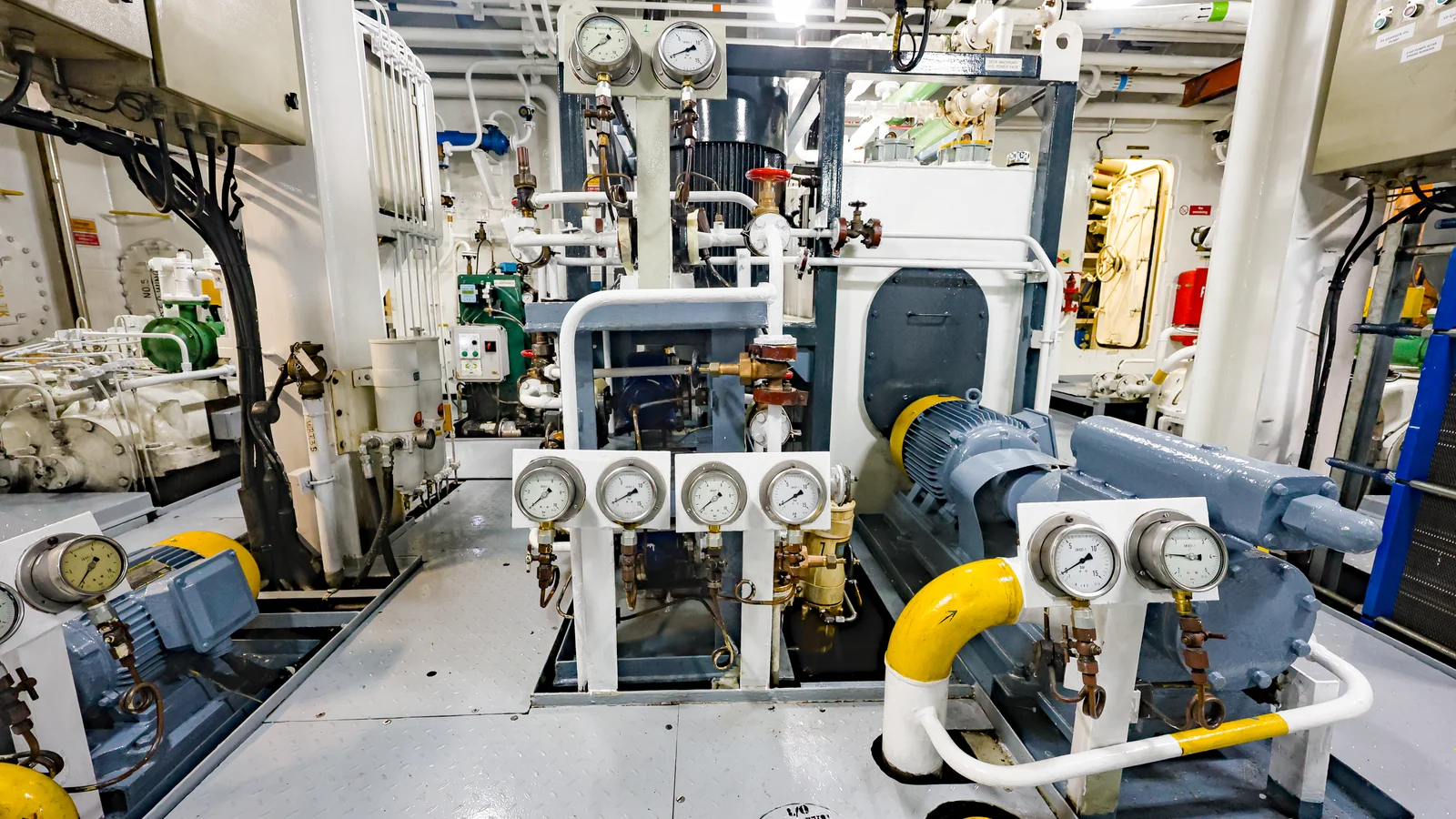
The first photograph is licensed and representative only, not a Vessel Core installed reference or completed job — photo: NAC, Wikimedia Commons, CC BY-SA 4.0. The second and third are Vessel Core's own, taken aboard a vessel during a yard visit in July 2026 and published with the owner's permission. No manufacturer is identified in any of the three: the stencilled markings give a service and a unit number, not a maker, and no maker plate is legible at published resolution. None of this is a claim that Vessel Core supplied or worked on the equipment shown.
What to send
Send enough context to identify the pump and the operating system.
Part numbers are helpful but not always available. A nameplate photo, pump drawing, manual page or installed pump photo can be enough to begin technical cross-checking before supply routes are reviewed.
Vessel and timing
- Vessel name / IMO
- Company name
- Urgency level
- Port / ETA
Pump reference
- Maker
- Model
- Serial number
- System served
Part request
- Part number
- Description
- Quantity
- OEM / alternative / both
Attachments
- Photos
- Nameplate
- Drawing
- Excel list
Related categories
Connect pump RFQs to the wider engine-room supply scope.
Pump RFQ FAQ
Short answers for technical buyers.
Can you quote without a pump part number?
Yes. Send maker, model, serial number, pump nameplate, installed pump photos, drawings or manual pages. The request can be structured from technical context.
Can you handle time-critical pump failures?
Time-critical requests should include vessel / IMO, port, ETA and system criticality. That allows the supply route, availability and documentation work to be aligned with timing.
Can Vessel Core review OEM-route and verified alternative supply?
Yes. The supply route can be reviewed by approval needs, lead time, budget logic and equipment criticality. The offer can clarify which route is being proposed.
Send pump RFQ
Have a pump spare parts request?
Send pump maker, type/model, system, part number or description, quantity and port/ETA. If part numbers are missing, send photos, nameplates, drawings or an Excel list directly to sales@vesselcore.eu.

