
Hamworthy Marine
Equipment Spare Parts
Freshwater generators · Sewage treatment · Inert gas · Serck Como internals
Hamworthy equipment families a spare parts RFQ can reference
The Hamworthy name has been on cargo pumps, sewage plants, freshwater generators, ballast water systems, inert gas generators, burners, valves and starting air compressors, and those businesses no longer sit together. Naming the family is what routes the enquiry, so the groups below are written to be quoted from rather than read as a catalogue. The designations are how the machines are described on board, not a maker parts list.
DL, DW, DWK/P, DWG, CKL and Dolphin
The identity here is a letter code, not a size, and the suffix encodes the cargo. DWK/P is the variant for nitric acid and VCM; DWG carries an inducer and is for ammonia and gases. DL and CKL are line-shaft driven with a dedicated discharge pipe, CKL being the higher-capacity line, while DW is line-shaft driven with discharge through the column and is also the design Svanehøj builds for liquefied gas. Dolphin is a pump brand that left with the pumps business in 2018. Whatever the letters, the machine is less a pump than a pipe stack: a cargo pipe, an oil-filled drive shaft column running in slide bearings, and a deck arrangement with an integrated lubricating oil tank, the upper drive shaft bearing and the purging and stripping connections, with the explosion-proof motor on deck. The pump head at the bottom of the tank carries a double mechanical shaft seal, and the cofferdam between the two seals is piped to deck for purging.
CGA 50/65 · CGB 80/100 · CGC 125/150 · CGD 200/250 · CGE 300/350
The vertical in-line, single-stage centrifugal range. The current Hamworthy Pumps engine-room range under Svanehøj describes CG as a single-stage pump with a single-suction impeller and a radially split casing, for ballast, fire, fresh and sea water cooling, sewage and general service, and lists beside it C2G, CGX in CGL, CGM and CGH builds, the double-suction, axially split CA and CB, and NCM — so copy every letter after the C, and the execution suffix, exactly as stamped. Impeller, casing and cover wear rings, the mechanical seal assembly, shaft and sleeve, and drive-end and non-drive-end bearings are the wear set; on the larger frames the coupling element and the driver identity are worth listing separately from the pump. Which drawing the parts come from is decided by the pump serial rather than the frame size, and on these pumps a worn wear ring is felt as lost delivery before it is heard.
Eureka, Thune Eureka and Kværner Eureka
CG pumps were sold under several plates as the business changed hands, and parts lists for the family are shared across those names. A CG casing carrying a Eureka or Thune plate is the same pump identity for RFQ purposes, so send the plate as it reads and the CG code beside it rather than choosing between the names.
Super Trident and Ultra Trident
Super Trident is the long-running sewage treatment plant name; the maker lists it for black and grey water, with gravity or vacuum collection, chemical disinfection with dechlorination and a solids-handling centrifugal discharge pump. Its model strings are published — strings such as STC-01-13 in the small STC-13 series and STC-20-14 in the large STC-14 series, with a small STC0-23 series and a retrofit series beside them — so copy the STC string from the plate exactly. The membrane bioreactor is a separate Hamworthy product, and Ultra Trident MBR is the new-generation membrane plant unveiled at SMM in September 2026, described as the first major new system since the company became independent in June 2026. Vacuum collection systems, vacuum toilets and incinerators are named alongside the plants.
Serck Como — MSF, HiTE and reverse osmosis
A maker name nested inside a maker name. Serck Como was founded in Hamburg in 1841, began with distillers and heat exchangers, and produced its first evaporator for sea-going vessels in 1894; the business sits at Geesthacht in Germany and was acquired by Hamworthy in 2006. The technologies named are the Multi Stage Flash Evaporator, the Horizontal Inner Tube Evaporator, water-cooled steam condensers and reverse osmosis plants. Hamworthy has since ended manufacture of its traditional evaporator ranges — MSF, SSD (single-stage) and HiTE — and states that aftermarket support, technical service and spare parts support for installed freshwater systems remain in place, while reverse osmosis is now offered case by case.
Aquarius and Aquarius UV
Aquarius is the ballast water management system name, and the current company lists three lines: Aquarius UV, Aquarius UVX and Aquarius UV with Manta. All three treat in two stages — a backflushing filter, then a medium-pressure UV reactor whose quartz sleeve is kept clean by a mechanical wiper. UVX is the hazardous-area build for Zone 1 installation, with pneumatic instead of electric actuators and a purged UV chamber; the Manta version uses Manta filtration and is aimed at newbuild and retrofit installation. What governs a renewal inside the treatment train is the type approval certificate and the system design limitations recorded in it, not the plant name, so the certificate reference belongs in the request.
Moss, Mult-Inert and reliquefaction
Inert gas generators for gas carriers and offshore inert gas packages carry the Moss name, built and tested at Moss in Norway, and the lineage runs Hamworthy Moss to Wärtsilä Moss. Mult-Inert is a named system variant. LNG reliquefaction and boil-off gas handling also carried the Wärtsilä Hamworthy name. This whole line moved with the Gas Solutions business, so a Moss-plated generator and a Trident sewage plant on the same ship now belong to two different companies.
2TM and 2TF
The designations that appear on enquiries are 2TM, with variants such as 2TM6, 2TM62, 2TM63, 2TM67 and 2TM68, and 2TF, with 2TF5 and 2TF54; these come from third-party parts listings rather than from maker documentation. The support lineage runs from Hamworthy KSE to Hatlapa to MacGregor, so a Hamworthy-plated starting air compressor has not been a Hamworthy product for many years — the public dates for that transaction do not agree and are given in full below. Work on those machines is covered on the Hatlapa compressor parts page rather than here.
A plate that says Hamworthy no longer says who supports the machine
Every other maker page on this site describes one company that still exists. This one describes an estate that was cut up and sold, and the piece holding the name today covers a fraction of the equipment carrying it. The map below is the page.
The business began in 1911 as Hall's Engineering, a marine engine and boat repair shop started by Percy Francis Hall, and was incorporated in 1914 as Hamworthy Engineering Company Limited, taking its name from the parish of Hamworthy in Poole, Dorset; both the 1911 and 1914 dates appear in the sources and both are given here rather than one being chosen. Pumps and compressors for marine use came early and continued through the Second World War. Powell Duffryn plc acquired the business in 1962. Williams and James, compressor makers, were bought in 1986, and Belliss and Morcom came from Rolls-Royce Engineering in 1995. Svanehøj International A/S of Denmark was acquired in the late 1980s or early 1990s — the two surviving accounts disagree, and neither is asserted here. The ships' equipment division of the Norwegian Kværner Group followed in 1998, and that is where the Hamworthy KSE name comes from. Nikko Principal Investments advised and financed the purchase of Powell Duffryn in 2000, after which the group shed lower-growth activities and refocused on fluid handling for marine and offshore. On 31 January 2012 a Scheme of Arrangement became effective and control of Hamworthy plc passed to Wärtsilä.
Then it came apart, business by business. The starting air compressor and Schilling rudder businesses left Hamworthy KSE for Hatlapa and Becker Marine Systems of Hamburg: public sources give 2003 and 2016 for that transaction and do not agree, so both are recorded and neither is stated as the date — Hatlapa itself became a MacGregor brand within Cargotec in 2013. Combustion went next and went early: a merger completed on 20 May 2011 put the Hamworthy Combustion Group into the hands of affiliates of John Zink Company and Coen Company, both Koch companies, and it trades as John Zink Hamworthy Combustion with a UK operation at Poole. Note the ordering — that happened before Wärtsilä bought Hamworthy plc, so combustion was never a Wärtsilä business. Marine pumps were divested on 31 October 2018 to Solix Group, carrying the Svanehøj, Hamworthy Pumps, Eureka and Dolphin brands; Svanehøj Group A/S was established as the parent, and in January 2024 it was acquired by ITT Inc. The valves business, holding Shipham, Robert Cort and John Mills, went to an affiliate of Evergreen Capital L.P. of New York on 1 October 2020. Gas Solutions — gas handling in maritime transport, inert gas systems including the former Hamworthy Moss, gas-to-power, liquefaction and biogas — was announced for divestment to Mutares SE & Co. KGaA on 22 December 2025 and completed on 1 June 2026. Water and Waste was announced for divestment to Solix Group AB on 5 February 2026 and completed on the same date as Gas Solutions, 1 June 2026.
On that date the name went home: Hamworthy launched as an independent specialist in marine water and waste systems under its own historic name, covering wastewater treatment, freshwater generation, ballast water and solid waste, with Serck Como continuing inside it as a Hamworthy company and keeping its German base. The announcement states that existing systems, service agreements, support structures, engineering teams and lifecycle commitments remain fully in place. Two cautions go with that. First, the company's own site lags its own news: at the time of writing, in September 2026, the corporate about page still described the business as part of Wärtsilä's Portfolio Business while the news page on the same domain described it as independent, which is why every statement on this page is dated rather than written as timeless. Second, Wärtsilä's own Hamworthy product list still carries Compressors, Exhaust Gas Cleaning and oil separation with no divestment note, and it does not say which compressor family "Compressors" means; the Wärtsilä Hamworthy compressor material describes gas compression rather than starting air, and whether that retained line sat inside or outside the Gas Solutions transfer on 1 June 2026 could not be established. So on a Hamworthy compressor the word air or gas does more work than the plate does.
What gets ordered against a Hamworthy plate
Grouped by machine and listed in the order each is worked on — the deepwell cargo pump from the deck down through the column to the wet end, then the sewage plant, the freshwater generator and the ballast water train. These are the items that come up on this equipment class rather than a maker parts list, and the wording on your own plate always takes precedence over the wording here.
- Deck-end seal arrangement and its housing
- Motor stool parts and holding-down fasteners
- Lubricating oil header tank fittings, sight glasses and level switches
- Thrust bearing and thrust bearing housing at the deck end
- Drive shaft sections and intermediate shaft couplings
- Slide bearings in the shaft column, with their carriers
- Column pipe joints, spacers and centralising parts
- Cargo pipe flange gaskets and stack joint sets
- Pump-head double mechanical shaft seal, cofferdam purge connections and casing wear rings at the foot of the stack
- Inducer parts on DWG builds for ammonia and gases
- Cargo-specific seal and gasket materials on DWK/P builds
- Stripping arrangement parts — DW multisuction, and the automatic systems on DL and CKL
- Aeration diffusers and blower wear parts
- Membrane modules on MBR plants
- Macerator and comminutor cutters
- Transfer and discharge pump parts
- Level and float switches
- Vessel and hatch gaskets, and disinfection consumables
- Stage internals and joint sets on MSF units
- Tube-side items on HiTE units
- Membranes and prefilter cartridges on reverse osmosis plants
- UV lamps and quartz sleeves on Aquarius UV
- Wiper seals and UV sensors
- Filter elements and their seals
Starting air compressor parts are deliberately not listed here. Those machines left the group for Hatlapa and are covered on the Hatlapa compressor parts page, which is where a 2TM or 2TF enquiry belongs.
What has to be sent before a Hamworthy line is quotable
On this maker, identification takes two steps and the second is not on the plate. The plate gives a name and a serial, but the name can be Hamworthy, Hamworthy Engineering, Hamworthy KSE, Hamworthy Svanehøj, Hamworthy Moss, Serck Como, Wärtsilä Hamworthy or plain Wärtsilä, and none of those says who holds the records now. What routes the enquiry is the product family, and that is something the buyer has to say in words.
- A photograph of the whole nameplate, not just the model line — and of any second plate on the same machine, because motors, monitors and skid frames often carry their own
- The maker name written out exactly as it appears, including which of the eight variants above it is
- The serial number character by character, including any letter prefix, and the build year
- The product family: cargo or ballast pump, sewage treatment plant, fresh water generator, ballast water system, inert gas generator, gas compressor, or starting air compressor
- If it is a compressor, one word saying whether it compresses air or cargo gas
- The ship's build year and building yard — equipment fitted before 31 January 2012 predates Wärtsilä ownership and will not carry Wärtsilä branding
- On a deepwell cargo pump: the tank number and pump position, the cargo the tank carries, the pipe stack length from the manual, and whether the cargo discharges through the column itself (the DW design) or through a separate cargo pipe beside it (DL and CKL)
- On a deepwell pump, what the ship actually reports — falling column oil level, cargo or oil showing at the cofferdam purge between the pump-head shaft seals, failure to strip, deck-end leakage or noise — because each points at a different part of the stack
- On a sewage plant: the plant name and the STC model string as written on it, whether it is a Super Trident, a membrane bioreactor or a retrofit unit, and on a membrane plant the number of membrane modules actually fitted
- On a fresh water generator: whether the unit is MSF, HiTE, single-stage or reverse osmosis, and whether a Serck Como plate is present anywhere on the unit or its frame
- On a ballast water system: the Aquarius line as written — UV, UVX or UV with Manta — a photograph of the filter's own plate, the type approval certificate reference, and the system design limitations recorded in it
- Who last supplied parts for this unit, and under what quotation or order reference
- Whether the unit has been retrofitted or re-rated since delivery, and roughly when — a membrane retrofit or a motor change leaves the original plate in place and the original parts list wrong
- Whether the ship still holds the original manual, with its document number, and the survey the work is timed against with its date
Tools for this equipment: the mechanical seal material code and the flange identifier for a cargo or ballast pump, and the shore connection flanges page for the discharge flange of a sewage plant. On a UVX ballast water system, where the actuators are pneumatic, the pneumatic cylinder air calculator gives the free air each one takes per stroke.
OEM route and verified alternative on Hamworthy equipment
The complication on this maker is that the OEM route is not one route. It is six, and which one applies is decided by the equipment class rather than by the name on the plate.
Before a line can be put on either route it has to be assigned to an owner, and that assignment is done from the family and the build year rather than from the serial. A deepwell cargo pump goes one way, a Trident plant another, an inert gas generator a third, and a starting air compressor leaves this page altogether. We do not assume that any successor company holds records reaching back to the original build across five or six changes of ownership; whether it does is checked for the unit in front of us, not presumed. The freshwater side shows why the alternative route matters here rather than being a price question: Hamworthy has ended manufacture of the MSF, SSD and HiTE evaporator ranges while keeping aftermarket and spare parts support for installed systems, and once a part for a discontinued plant stops being made, a dimensional review from the removed part is the realistic way to keep a working plant running.
The split within a list follows what is approval-bounded and what is not. A sewage treatment plant is type-approved as an arrangement and the ship carries an International Sewage Pollution Prevention certificate, so renewals inside the treatment boundary are looked at against that approval rather than crossed on dimensions. The same applies on a ballast water system, where the type approval certificate and the system design limitations govern what may be fitted inside the treatment train, and lamp and sensor renewals on a UV line touch the approved configuration. On deepwell cargo pumps the cargo suitability of the pump — DWK/P for nitric acid and VCM, DWG with its inducer for ammonia and gases — sits in the ship's cargo compatibility documentation and is not a free choice at ordering time. What is left over is purely dimensional and is where a verified alternative is worth reviewing once it has been measured: column slide bearings, shaft sections and couplings, column and flange joints, fasteners, filter elements, switches, and the gasket and seal materials, provided the material is confirmed against the cargo rather than against the old part's appearance.
Hamworthy parts — questions buyers ask
My plate says Hamworthy. Which company supports my equipment now?
That depends entirely on what the machine does, not on what the plate says. Marine pumps went to Solix Group in 2018 and now sit with Svanehøj under ITT; starting air compressors left for Hatlapa, now a MacGregor brand, on a date the public sources put at either 2003 or 2016; burners went to affiliates of John Zink and Coen, both Koch companies, in May 2011. Valves went to an Evergreen Capital affiliate in 2020, gas and inert gas systems to Mutares on 1 June 2026, and water and waste to Solix Group AB on that same date — which is where the Hamworthy name itself now lives, as an independent company again. Tell us the equipment class first and the plate second, and the enquiry stops bouncing.
Is Hamworthy still a company, or just a brand on old plates?
Both, and that is the difficulty. Hamworthy relaunched as an independent company on 1 June 2026, following the divestment of Wärtsilä Water and Waste to Solix Group AB, and it covers wastewater treatment, freshwater generation, ballast water and solid waste, with Serck Como continuing inside it. In September 2026 it launched the Ultra Trident wastewater treatment system at SMM, described as its first major new system since becoming independent. But that company covers only the water and waste side. A Hamworthy cargo pump, a Hamworthy burner and a Hamworthy starting air compressor carry the same name and belong to three other organisations entirely.
Why does the build year matter for a Hamworthy part?
Because the branding on the equipment tracks the ownership of the day it was built. Wärtsilä took control of Hamworthy plc on 31 January 2012, so anything delivered before that date carries a Hamworthy plate with no Wärtsilä mark on it. Anything delivered between 2012 and the relevant divestment may carry a Wärtsilä plate for a product line Wärtsilä has since sold. The year on the plate therefore narrows which company's records the unit is likely to sit in, which is often the difference between a documented part number and a reconstruction from photographs. Send the ship's build year and yard alongside it, because a yard package dates the equipment even when the plate does not.
Can you work from photographs if the plate is corroded or overpainted?
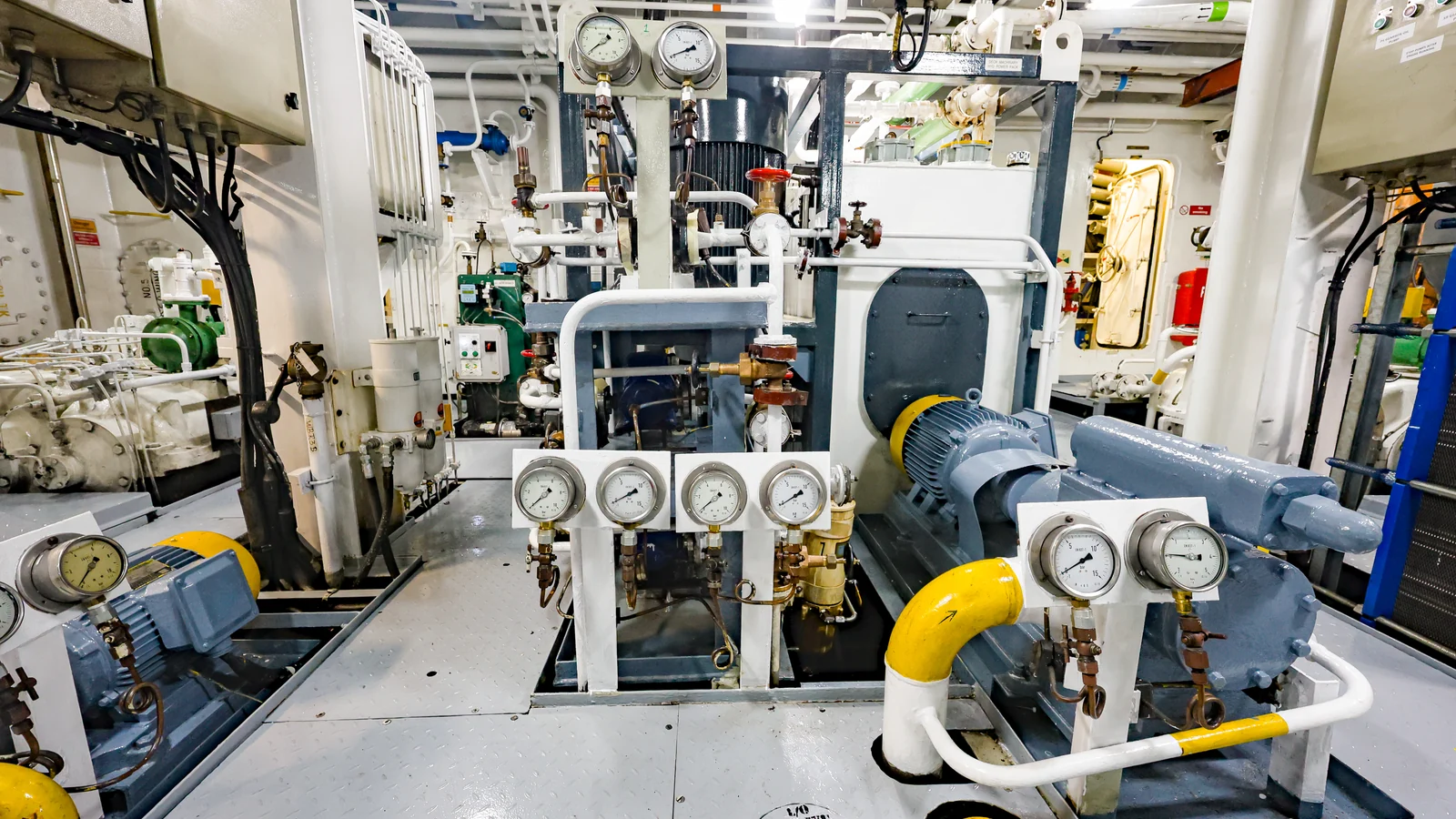
Usually. On the deepwell pump side the useful evidence is the deck arrangement — motor stool, lubricating oil header tank, the shaft column and its bearings — together with the tank the pump serves and the cargo it handles, and all of that is visible without a legible plate. On the water and waste side the evidence is the plant type, the number of membrane modules actually fitted, and the certificate the ship holds. Photograph any second plate on the machine as well, since motors, monitors and skid frames often carry their own. Where the photographs are not conclusive we say so in writing rather than choose the likeliest answer and move on.
My burner says Hamworthy but the enquiry keeps going to marine suppliers. Why?
Because two separate Hamworthy businesses exist and a third trades under the name on land. The combustion business was sold to affiliates of John Zink and Coen, both Koch companies, in a merger completed on 20 May 2011 — before Wärtsilä bought Hamworthy plc — and trades today as John Zink Hamworthy Combustion. Quite separately, Hamworthy Heating in Poole makes commercial boilers and water heaters for buildings and has been owned by Groupe Atlantic since 2008; it has nothing to do with ships. Write "marine boiler burner" or "commercial heating boiler" in the first line of the enquiry and the routing sorts itself out.
Is Vessel Core connected to Hamworthy or its successor businesses?
No, and there is no agreement of any kind. Vessel Core holds no dealership, distribution, representation or partnership agreement with Hamworthy or the companies that now hold its product lines, and quoting a component against one of their designations implies no approval by the maker and no claim of interchangeability.
Submit your RFQ now.
Send your Hamworthy request — the equipment type and plate as it reads (pump size and execution suffix, or compressor/plant designation), the serial number, and the components you expect to renew. Vessel Core reviews the supply route and prepares a structured supply quotation.
