
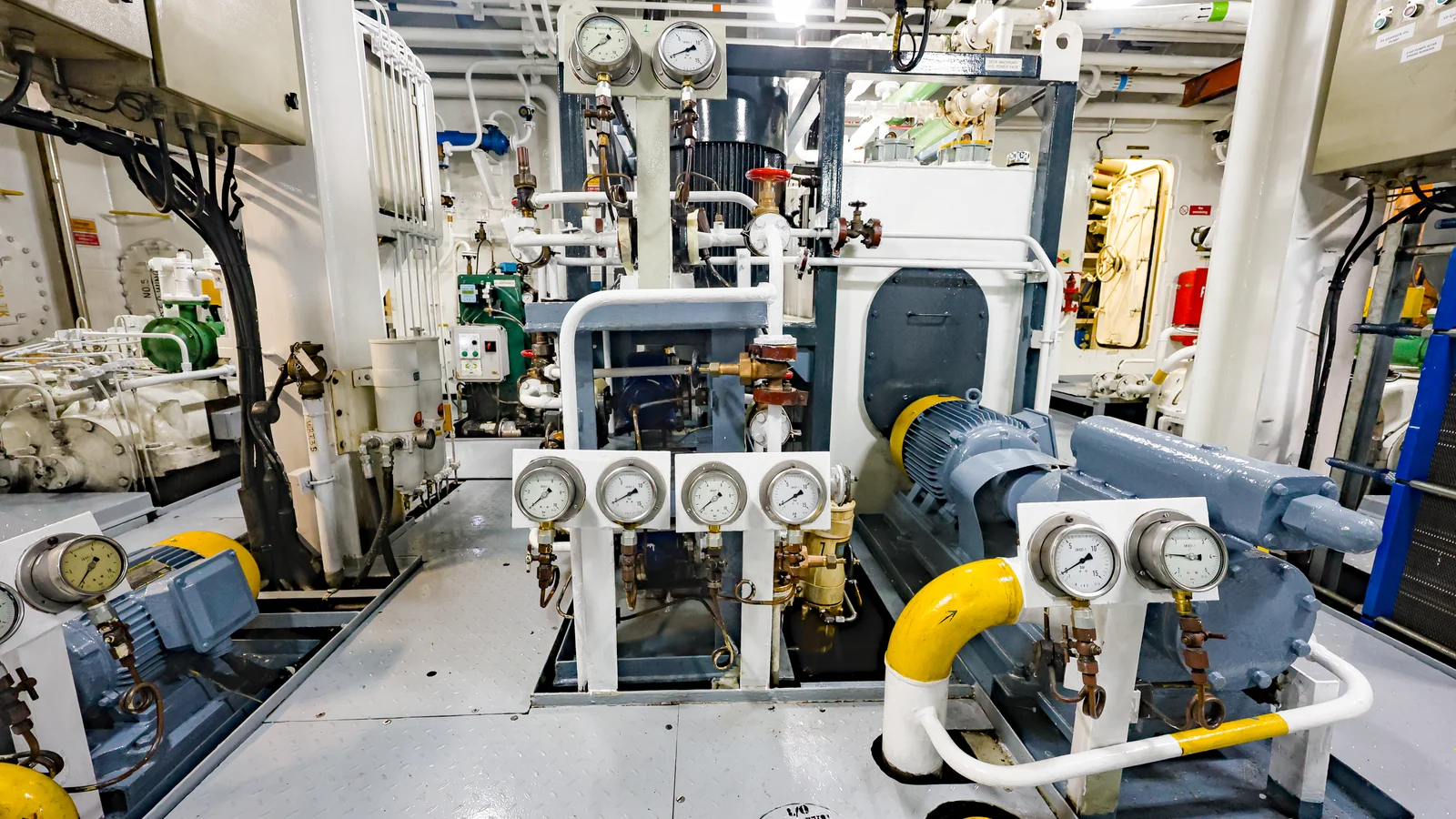
A named line list: maker, model, part reference, quantity and the place the goods have to reach.
Selling to Vessel Core
Suppliers
Suppliers
and Stockists
What goes out in an enquiry, what an offer has to state before it can be compared, and how a quotation turns into an order.
Price basis, lead time, condition, packing and validity stated line by line, not in a covering note.
The accepted lines are confirmed with an order reference, and the document set is agreed before collection.
Your invoice carries that order reference and is settled on the terms fixed at award, not renegotiated after.
Independent buyerNo dealership or distribution ties
Buying against ordersEnquiries follow customer commitments
One reference per lineEnquiry number carried through to invoice
EU counterpartyEstonian company, registry 17028043
For suppliers
What Vessel Core is on the buying side, and what it is not.
Vessel Core OÜ buys engine-room spare parts to fill requirements that shipowners, technical managers and superintendents have already put in writing. There is no warehouse behind the company, no catalogue of its own, and no dealership, distribution or representation right held from any equipment maker. Behind every enquiry that leaves the desk there is a vessel, a machine and a date somebody on board is working to.
That shape has practical consequences for anyone quoting into it. Enquiries are narrow rather than exploratory: they name a component, a quantity and a delivery place, and nothing is bought on speculation to hold and resell later. If your business model depends on a buyer taking a batch off your hands and warehousing it, this is not that buyer. If it depends on turning a specific line quickly at a stated price, it is.
The second consequence is comparison. An offer is read against a requirement that already exists on paper, alongside offers from other sources for the same line, and it is passed on to the end customer with the supply route named. An offer that cannot be read that way is not rejected on price — it simply cannot be put in front of anybody. The section below sets out, item by item, what makes the difference.
Quoting back
Eight things an offer has to state to be usable.
None of this is unusual paperwork. It is the information a purchasing department on the other end will ask for anyway, and stating it in the first reply removes the round of questions that costs a supplier the order more often than price does.
The reference as it is marked
Quote the number the way it is physically marked on the item, the tag or the maker's parts list, and say which of the three you read. Where your own record shows a superseded number or an internal code, give both and say which is which. A number silently translated into your system is the most common cause of a wrong part reaching a vessel.
Description and grade
Put the item in plain words next to the number: cylinder liner, fuel injection component, bearing shell, seal kit, shaft. Where a material or a grade applies, quote it as the certificate states it rather than as a general class, and say whether the certificate is in your hands or is expected from a third party.
Condition and origin
New and unused, reconditioned, surplus, or removed from service — and where the item came from: the maker's own commercial chain, a component manufacturer, a workshop rebuild, a vessel removal, a dismantled unit. Condition and origin decide whether the line can be offered onward at all, so an unclear answer here stops the line before price is even read.
Quantity and packing
How many are physically on hand at the quoted price, whether that quantity is held for this enquiry or shared with another buyer, and how the goods are packed: carton, crate, seaworthy case, palletised, with or without preservation. If part of the quantity is on order rather than on the shelf, split the line and price each part separately.
Lead time measured from a named event
A lead time is only usable when the clock has a start. Give the number of working days and say what starts them: a written order, cleared payment, release of material, or the end of a hold placed by another customer. Where the item is ex stock, say ex stock from which town, not from which country. A figure with no starting event cannot be planned against a port call.
Price basis and currency
State the currency, and state whether the price is ex works from a named address or delivered to a named place, with the Incoterms rule and the place spelled out in the offer. A bare figure carrying no basis cannot be compared with a second figure that includes carriage, and the safe reading of an unqualified price is the one least favourable to the seller.
HS code, weight and dimensions
Give the HS classification you use, the gross weight and the packed dimensions for each line. These three decide freight cost, clearance treatment and whether the consignment can travel with a port call at all. Supplying them with the offer means the buying side is not re-measuring your crate at the moment a decision is due.
Validity and exclusions
Say how many days the price holds, and say what is outside it: packing, export documents, testing, certification, bank charges, minimum order value. Exclusions that appear only after award are the single most reliable way to be left off the next enquiry, and they do more damage to a supplier relationship than a high price openly quoted.
After the offer
Award, documents and payment from your side of the trade.
An accepted line is confirmed in writing with an order reference, and that reference is the thread through everything that follows: the documents, your invoice, and any question raised months later when the part is filed against a maintenance record. Nothing is treated as ordered on the strength of a phone call.
On award, the document set is agreed before the goods move rather than assembled at the loading bay. What is asked for depends on the line and on what the end customer has to satisfy, but the request is made once, in writing, and it does not grow afterwards. Payment terms are fixed at the same moment and are not reopened after collection. Where bank details on an invoice differ from the details already held, the change is verified by voice on a number established independently before anything is released — a precaution that protects the supplier at least as much as the buyer.
What takes an offer out of consideration is worth stating plainly, because none of it is about price. A quotation is set aside when the reference has been changed without a word, when condition or origin is described in language that could mean three different things, when the price carries no basis and no validity, when the item turns out to be photographed rather than held, and when a cost that was always going to apply appears only after acceptance. Any one of those makes the line unusable in front of the end customer; the last one also decides whether the next enquiry goes out to somebody else.
What an enquiry carries
- Maker, model and serial context
- Part reference and description
- Quantity and delivery place
- The date the customer works to
Asked for on award
- Invoice quoting the order reference
- Packing list with weights and sizes
- Certificates already in your hands
- Photographs of the marked item
Payment
- Terms fixed at award
- Bank details from your letterhead
- Changed details verified by voice
- One reference on every document
What ends a quotation
- A price with no stated basis
- A reference altered without saying so
- Condition or origin left vague
- Costs surfacing after acceptance
Related pages
How the buying side of the same order works.
Supplier FAQ
Short answers before you spend time on an offer.
Does Vessel Core buy to hold?
No. Purchasing is done against requirements already placed by end customers, so a line is bought when there is an order behind it and not in order to warehouse goods and resell them later. A seller looking to move a large mixed lot in one transaction is better served by a stockholding buyer.
How often do enquiries go out, and how is the list kept?
Enquiry volume follows customer demand rather than a fixed schedule, so it is uneven from month to month, and a supplier is approached when a line matches what it actually deals in rather than as a mass circulation. There is no standing panel to be admitted to and no periodic review to wait for: an enquiry is sent because a particular line looks like yours, and the way to stay on that list is to answer the ones you can and say plainly when you cannot.
Will Vessel Core describe my company as a partner or representative?
No. Vessel Core is an independent supplier and does not hold or claim dealership, distribution or representation rights, and it does not describe its own sources in those terms either. Where an offer is passed to the end customer, the supply route is named for what it is.
Get on the enquiry list
Tell us what you actually deal in.
Send the equipment groups and makers you handle, the town where your stock physically sits, the countries you can deliver to, and one sample quotation in your normal format so the reading is quick. A short, honest scope is worth more than a long capability list. It is also worth looking at the request form our customers use, because what they put into it is what you will be reading when an enquiry reaches you.

