
ABB Turbocharger
Spare Parts Supplier
Engine-room turbocharger spare parts supply for A100 · A200 · TPL · VTR Series
ABB turbocharger models covered
The ABB turbocharging programme is not one family but four generations trading at the same time: the axial A100-L and A200-L machines on low-speed two-stroke main engines, the axial TPL series that preceded them and still runs on both two-stroke and four-stroke engines, the mixed-flow TPS machines on smaller medium-speed and high-speed engines, and the earlier VTR and VTC generation that is still in service in large numbers. They share a naming logic and almost nothing else. That is why an ABB request is read series first, frame second.
ABB Turbocharging has traded as the independent company Accelleron since the spin-off completed on 3 October 2022, and the A100, A200, TPL and VTR lines carry that name today. Nameplates on turbochargers already in service still read ABB, so both names are used on this page.
Axial machines for low-speed two-stroke main engines
The current two-stroke line. Accelleron applies the A100-L and A200-L pair from engines of about 30 cm bore up to multiple-turbocharger arrangements on bores up to about 95 cm; the series was first introduced in 2009 and expanded in 2013. On the A100-L side the frames run A165-L, A170-L, A175-L, A180-L, A185-L and A190-L. ABB published exchange intervals for the series of roughly 36,000 operating hours for bearings and roughly 100,000 for rotating parts, and an emergency lube oil system integrated into the bearing casing.
The axial two-stroke line the A series replaced
TPL-B was designed primarily for large two-stroke marine engines, in five frame sizes — TPL73-B, TPL77-B, TPL80-B, TPL85-B and TPL91-B. It pairs a radial compressor with axial wide-chord turbine blades, runs uncooled casings with no water connections, and uses internal plain bearings lubricated by the engine lube oil. TPL85-B and TPL91-B carry an integrated emergency lube oil system, and on TPL91-B the rotor assembly is designed to come out as a cartridge unit for service work.
Axial machines for four-stroke medium-speed engines
TPL-A covers four-stroke medium to large diesel and gas engines, in frames TPL65, TPL69, TPL73 and TPL77, with variable turbine geometry offered on TPL65-A and a bearing assembly built around a free-floating thrust disc with squeeze oil damping. TPL-C is the later four-stroke machine, in frames TPL67-C, TPL71-C, TPL76-C and TPL79-C; the gas outlet flange is round on TPL67-C and TPL71-C, while TPL76-C and TPL79-C take a rectangular-to-round adapter piece and are supplied only with a suction branch. Casing detail of that kind changes the parts list, so it belongs in the RFQ.
Mixed-flow machines for smaller medium-speed and high-speed engines
The TPS machines carry a mixed-flow turbine with a nozzle ring for constant-pressure and pulse applications, and a radial compressor. TPS-D and TPS-E run in frames TPS48, TPS52, TPS57 and TPS61; TPS-F covers five frames from TPS44 to TPS61, in three series reaching full-load pressure ratios of about 4.75, 5.0 and 5.2, on the same outline dimensions as TPS-D and TPS-E. The bearing casing is a single oil- or water-cooled piece with internal plain bearings, and the clamp connection flanges are what make casing orientation flexible on these frames.
The four-stroke A series and two-stage arrangements
On the four-stroke side the A100-M and A100-H radial machines reach single-stage pressure ratios up to 5.8, in frames A130, A135, A140, A145 and the two larger A150-M and A155-M, with installation dimensions compatible with earlier TPS-F models. Accelleron also lists an A100-M with an axial turbine for large four-stroke medium-speed engines. Power2 is the two-stage arrangement for large medium-speed diesel, gas and dual-fuel engines, the Power2 800-M among them; on a two-stage installation each stage has to be identified separately.
The earlier generation, still in service
The VTR..4 series was built for two-stroke low-speed and four-stroke medium-speed heavy-duty diesel and gas engines, in frames VTR214, VTR254, VTR304, VTR354, VTR454, VTR564 and VTR714, with P and D executions alongside them. It is a single-stage axial turbine with a radial compressor, and its defining feature is the bearing arrangement: spring-mounted rolling-contact bearings, external, reachable from either end of the rotor, each with its own lubricating and oil-cooling arrangement. Older frames survive as the VTR..0 and VTR..1 series — VTR160, VTR200, VTR250, VTR320, VTR400 and their ..1 counterparts. VTC is the compact companion, in VTC254 and VTC304, and it uses internal plain bearings fed from the engine lube oil system instead.
ABB turbocharger spare parts supply scope
An ABB machine is quoted across the rotating assembly, the hot gas path, the air path, the bearing and oil arrangement that keeps both alive, and the cleaning and instrumentation fitted around them. A request grouped that way stays readable when one docking covers a two-stroke main engine machine and an auxiliary turbocharger from a different generation on different overhaul records.
- Rotor shaft assemblies, balanced as one unit
- Turbine blades and blade sets, with the damping arrangement where the build has one
- Compressor wheels and impellers matched to the frame and version code
- Inducers and inducer casing parts
- Nozzle rings and guide vane segments
- Diffusers and diffuser rings for the compressor air path
- Air inlet casings and air outlet casings
- Gas inlet casings — axial and radial, single and multiple entry
- Gas outlet casings, outlet elbows and adapter pieces
- Heat-insulating partition walls, heat shields and casing insulation
- Bearing casings, including the single-piece oil-cooled type used on TPS and TPL
- Internal plain bearings — radial bearing bushes and squeeze oil film damper parts
- Free-floating thrust discs and axial location hardware
- Rolling-contact bearings for VTR frames, compressor side and turbine side
- Bearing covers, oil pumps, sight glasses and oil system parts on self-lubricating VTR frames
- Header tank and emergency lube oil system components where the build has one
- Labyrinth seals, shaft seal rings and sealing air arrangements
- Cartridge assemblies on the frames supplied as a cartridge
- Filter-silencers, silencer bodies and suction filter elements
- Suction branches, air intake screens and clamp connection flange hardware
- Turbine and compressor washing devices, washing nozzles and their connections
- Speed sensors and pressure and temperature measuring connections
- Burst protection rings and containment hardware where fitted
- Overhaul and repair kits — gaskets, O-rings, bearings and seal rings
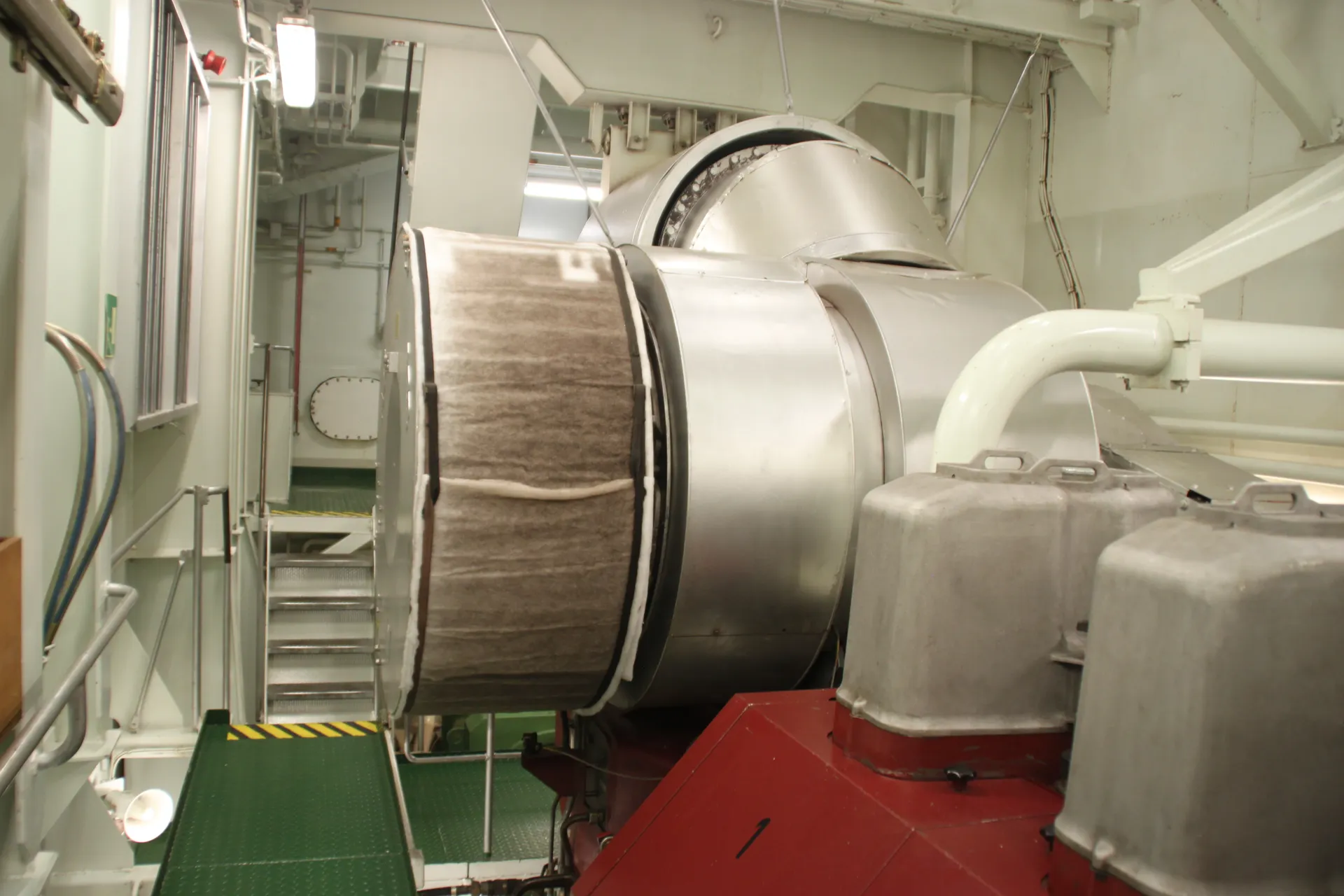
Marine turbocharger — general arrangement
A licensed photograph of ABB turbocharging equipment was not available at publication, so this technical reference illustrates the general arrangement shared by this equipment class.
Illustrative technical reference, not a photograph of ABB or Accelleron equipment or a Vessel Core installed reference — a licensed photo of this maker's equipment was not available. Vessel Core has no dealership, distribution, representation or partnership agreement with ABB or Accelleron; it operates as an independent spare parts supplier.
The plate data that makes an ABB turbocharger line quotable
An ABB machine is identified by series and frame together, and the same frame number recurs across series that share no overhaul item. Rotors are supplied balanced, casings are indexed at the build, and the bearing arrangement changes between series, so the plate and a few photographs usually settle more than a partial number copied from an old requisition.
- Designation exactly as stamped — series letters, frame number and any execution code together, for example TPL77-B, A175-L35, VTR564 or TPS52-F
- Machine serial or manufacturing number from the rating plate
- The engine the machine serves — make, type and engine number, and whether it is the two-stroke main engine or a four-stroke main or auxiliary engine
- The bearing arrangement — external rolling-contact bearings with their own oil pumps, as on VTR frames, or internal plain bearings fed from the engine lube oil system
- Whether the gas casing is water-cooled or uncooled, because the VTR..4 exists in both forms and the casing and connection parts differ
- Direction of rotation, stated with the end it is viewed from
- Casing orientation — the angular position of gas inlet, gas outlet and air outlet, which on a VTR is set at the build in steps of 15 or 30 degrees
- The compressor and turbine version letters where the plate carries them — the D, E or F on a TPL or TPS, the P or D on a VTR
- Whether the rotor has been overhauled, re-bladed or renewed before, and by whom
- Photographs of the rating plate, of the impeller and diffuser on the air side, and of the nozzle ring and turbine blades on the gas side — the views that separate compressor-side fouling from gas-side fouling
- Running hours since the last overhaul, clearance records, and surge or vibration notes if held
Structured supply route review for ABB turbocharger overhauls.
An ABB line is worked backwards from the machine rather than forwards from the requisition — series first, frame second, execution code and rotation third, then the item. ABB OEM-route options and verified alternative supply paths are reviewed together, with technical identification support where part numbers are not available.
Breakdown lines reviewed first
When the machine is open and the vessel is waiting, surging and fouling symptoms are read back against the air side or the gas side first, so the rotor, nozzle ring, bearing and blading lines need not wait while casing hardware, filter elements and washing device parts are still being priced.
Which ABB lines survive an alternative route
A rotor shaft assembly, a nozzle ring or a blade set going back into a class-surveyed machine normally stays on the OEM route, because the balance record and the drawing revision have to travel with the part. Filter-silencer elements, casing hardware, gaskets, O-rings and seal rings are where a verified alternative is usually worth reviewing on price and availability. Whichever route is offered, the line states the balance grade and rotation hand it was matched against, and where no acceptable alternative exists the line is quoted OEM only and said so.
The series letter is read before the frame number
TPL73 exists as a four-stroke TPL73-A and a two-stroke TPL73-B; VTR320 and VTR321 are the same frame in two different series; A175-L appears with more than one execution code. The series and the code are confirmed back to you before anything is priced. Model designation, serial number and a component description are enough to begin; photographs of the plate or the installed part are also accepted, and a full part number helps but is not always required to start.
Handover reviewed against the docking window
A rotor assembly or a cartridge for a large frame is a balance-sensitive item before it is a freight item — crate dimensions, weight and whether the yard has the lift are checked against vessel ETA, port context and documentation needs before a handover point is written down. Supply route, handover option and freight timing are reviewed against confirmed RFQ details, vessel ETA, port context, documentation needs and part availability before quotation, and nothing about the date is treated as settled until it is in the quotation.
Ranges listed here are RFQ context
The ABB series, frame numbers and published output ranges on this page describe the equipment a request may concern. They do not imply holdings, compatibility between frames or series, or any status with the manufacturer.
EU-registered counterparty
A rotor assembly or a nozzle ring for a main engine turbocharger is an order most purchasing departments want the counterparty checked against before it is raised. Estonian registry 17028043 and VAT EE102773714 are open entries, and the buyer-verification page carries the documents a vetting request usually asks for.
ABB turbocharger parts — common questions
Can Vessel Core review OEM-route and verified alternative routes for ABB turbochargers?
Yes. We review OEM-route and verified alternative routes for ABB marine turbocharger requests across A-series, TPL, TPS and VTR equipment. A rotor assembly, nozzle ring or blade set going back into a class-surveyed machine normally stays on the OEM route, because the balance record and drawing revision have to travel with the part; filter-silencer elements, casing hardware, gaskets, O-rings and seal rings are where an alternative is usually worth reviewing. Alternative routes are evaluated case by case for technical equivalence, documentation and approval context, and where no acceptable alternative exists the line is quoted OEM only and said so.
Which ABB turbocharger models do you cover?
Requests may reference the axial A100-L and A200-L machines for low-speed two-stroke engines, with frames such as A165-L, A170-L, A175-L, A180-L, A185-L and A190-L; the TPL series in its two-stroke form TPL73-B to TPL91-B and its four-stroke forms TPL65 to TPL77 in the A family and TPL67-C to TPL79-C in the C family; the mixed-flow TPS machines from TPS44 to TPS61; the radial A100-M and A100-H frames A130 to A155; Power2 two-stage arrangements; and the earlier VTR and VTC generation, VTR214 to VTR714 in the VTR..4 series and the older VTR..0 and VTR..1 frames. Exact designation, serial number, rating plate data, installed configuration and part evidence are required before a supply route is confirmed.
Can you supply ABB turbocharger parts for time-critical breakdown situations?
Yes. Time-critical ABB turbocharger RFQs are handled with priority supply route review. Critical components including rotor assemblies, nozzle rings, blade sets, bearings and cartridge assemblies are checked against supplier availability, documentation needs and freight options, and the rotating-assembly lines are reviewed before casing hardware and filter elements so the open machine is not waiting on the slowest item in the list. Availability, route and handover are confirmed in the quotation rather than before it.
Can you identify ABB turbocharger parts from the nameplate or model designation alone?
Yes. If part numbers are not available, our technical supply team can identify the correct ABB components from the turbocharger model designation, serial number, and component description or photographs. Read the whole designation rather than the number alone: the frame is a size class, the letters are the series and duty, and any trailing digits are an execution code, so TPL73-A and TPL73-B, or VTR320 and VTR321, are different machines. Nameplate data and drawings from the engine technical file are also accepted as reference.
Why the maker name appears on this page
Maker names help identify equipment and prepare an RFQ. They do not imply any dealership, distribution, representation or partnership agreement between Vessel Core and the manufacturers named on this page; there is none. ABB, ABB Turbocharging and Accelleron, and the A100, A200, TPL, TPS, VTR and VTC designations, are referenced solely so that a buyer can describe the machine on board and the component required.
Send the plate, then the list.
Give the full designation as it reads on the plate — series letters, frame number and any execution code, for example ABB TPL77-B, A175-L or VTR454 — with the machine serial number, the engine the turbocharger serves, the direction of rotation and the components concerned: rotor assembly, casing, nozzle ring, bearings, seals, impeller, diffuser or blading. Add the port and the yard window. The series and the execution code are read back to you before anything is priced, so a line written as "turbine blade" does not come back quoted as one blade when the machine needs a set.

