
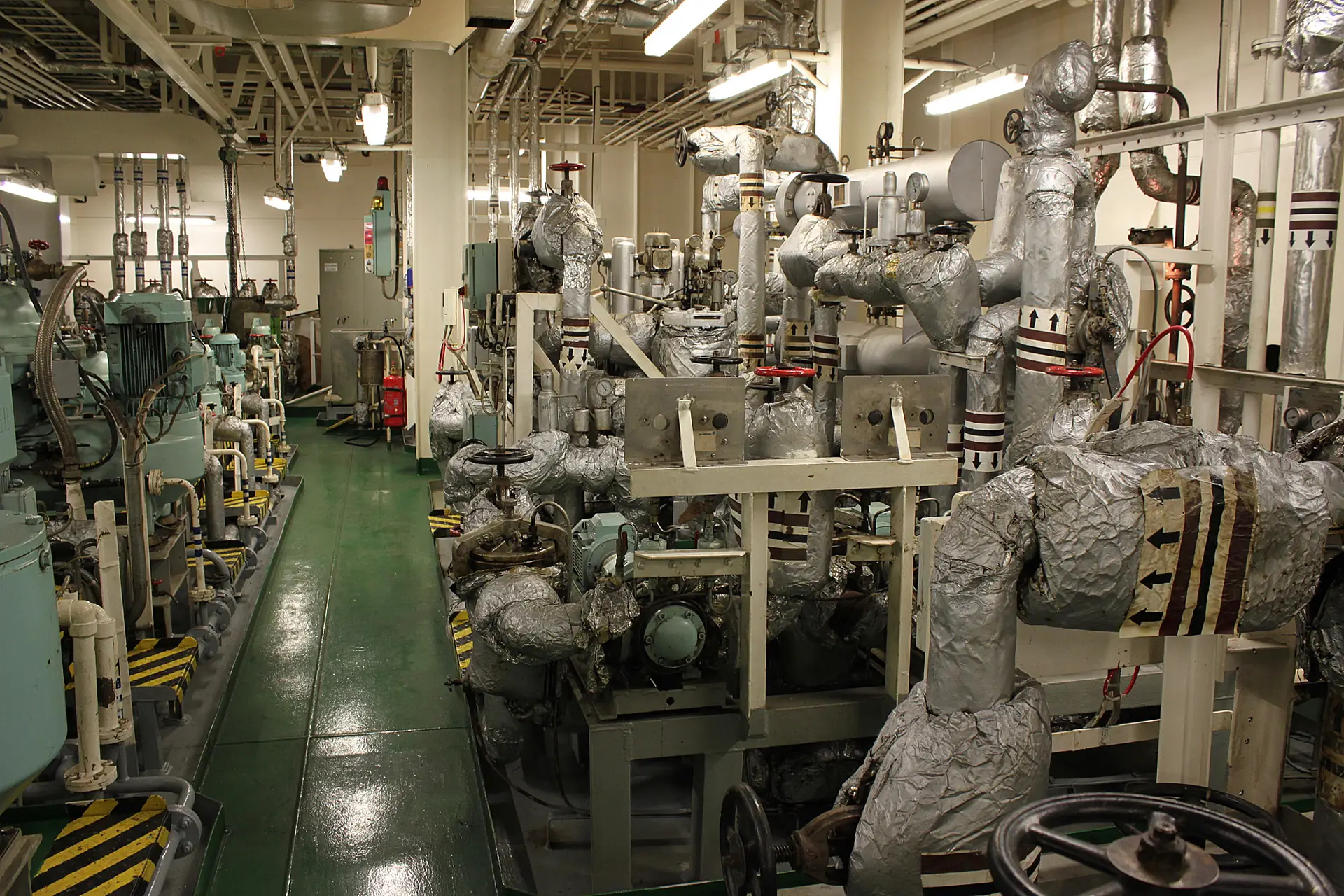
Hamann Sewage Treatment Plant
Spare Parts Supplier
Engine-room sewage plant parts for HL-CONT Compact · HL-CONT Plus flotation units and OceanCruise · RiverCruise systems
Hamann sewage equipment seen in engine-room enquiries
HAMANN AG has supplied marine sewage treatment equipment since 1972 and designs and builds its products in Hollenstedt, Germany. One feature of its plants shapes every parts list: the HL-CONT Compact and HL-CONT Plus ranges treat black water and grey water together by maceration, dissolved air flotation with a flocculant, and UV disinfection. The maker's process for these plants has no biological stage, and no filter or membrane to renew. Biology appears only in the OceanCruise and RiverCruise systems, and there it sits between two flotation units. Around the plant the maker also builds the tank-side equipment — grease separators, transfer, aeration, circulation, discharge and vacuum systems.
HL-CONT Compact
The maker's smallest flotation plant, built in one size, 0125, in two layouts: A as delivered, B for minimum depth such as wall mounting. A macerator is an option, since most toilet systems on vessels of this size already macerate.
HL-CONT Plus
The all-round flotation plant in sizes 0125, 025, 05, 10, 20, 40 and 80, built in a standard IMO/EU-MED/UK-MER execution and a USCG execution. It can be delivered dismounted for assembly on board, and a macerator is part of the plant from size 05 upwards.
HL-CONT Plus OceanCruise
Two flotation units with two moving bed biofilm reactors between them, installed as four separate modules that can sit on different decks. Built for discharge in the Baltic Sea special area and in Alaskan waters; ship's tanks may be converted into the reactor modules.
HL-CONT Plus RiverCruise
Two flotation units and one moving bed biofilm reactor in three separate modules, certified for inland waterway vessels under Commission Directive 2012/49/EU and to ES-TRIN.
GS Compact
Stainless steel gravity grease separators that work without mechanical parts or additives, with a built-in heater that keeps the collected fat liquid for draining, so galley water reaches the grey water system without its fat.
TS Compact · TS Plus
Pumps, motor-operated valves and level sensors run from a control cabinet that move grey water into the sewage mixing tank: one way on TS Compact, and on TS Plus also between holding tanks and overboard, with a touch display showing the level of every tank.
TA BW · TA SL · TC
Tank aeration by air blower for black water (BW) and sludge (SL) holding tanks against hydrogen sulphide, and tank circulation (TC) that keeps the sludge tank pumpable, run together with a HAMANN discharge system.
DS Compact · DS Plus · VS
Discharge systems in single or dual pump setups, DS Plus with discharge rates programmed to the vessel's discharge table; and VS vacuum systems built on a frame around Jets or Evac vacuum generators, so the generator is identified under its own maker's name.
BlueFloc
The maker's ready-to-use aluminium-based flocculant with polymers. HAMANN states that flocculant is required to operate its HL-CONT plants and its OceanCruise and RiverCruise systems.
Where a flotation sewage plant loses its effluent quality
A flotation plant does not fail the way a biological plant does. There is no bacterial culture to keep alive and no aeration stage to recover — but the separation depends on chemistry, dissolved air and a clean UV stage, and each of those has a mechanical part behind it. The points below follow the process the maker describes, from the mixing tank to the sludge tank.
Flocculant supply and dosing
The flocculant is what lets air bubbles and suspended particles form the larger flakes that rise as sludge foam; without it, solids stay in the clear phase. An empty container, a blocked dosing line or a tired dosing pump therefore shows up downstream as cloudy effluent and a UV stage working against a load it was not meant to see. The flocculant dosing station is the first place to look, and its pump items belong on the list together with the flocculant.
Saturator and pressure release valve
The micro-bubbles that lift the solids come from air dissolved under pressure in the saturator and released through the pressure release valve into the flotation tank. If the working air supply falls off, or the release valve is fouled or worn, the bubbles come out coarse or not at all and the foam layer thins. Release valve internals, saturator joints and the air supply items are worth checking before anything larger is ordered.
Macerator and feeding pump
Rags, wipes and fibrous material reach the macerator first, and a worn cutting set passes them on to the feeding pump and the flotation tank. The feeding pump starts on the filling level in the sewage mixing tank, and the maker's process diagrams show dry-running protection on it. On HL-CONT Compact and on HL-CONT Plus 0125 and 025 the macerator is optional, so state whether one is fitted at all.
UV unit
The UV stage is the last barrier before overboard discharge, and it only works on water the flotation stage has already clarified. Lamp ageing and fouling around the lamps can reduce the dose without any visible sign at the plant, so lamp items are best ordered on running hours, with the lamp marking photographed.
Grease, sediment and hydrogen sulphide upstream
The maker is explicit about the tank side: fat from galley water can block pipes and sensors, sediment from the lower layers of a holding tank can clog the plant's valves, sensors and pipes, and anaerobic conditions and sedimentation both reduce treatment performance. A plant that keeps blocking is often reporting on the grease separator, the tank aeration or the transfer system rather than on itself, and feed-side level sensors and valves wear for the same reason.
Sludge foam and the sludge tank
Throughout operation, sludge foam spills from the sludge compartment and goes to the ship's sludge tank, where, the maker notes, the lower layers soon settle and stop being pumpable unless the tank is circulated. Sludge pump, circulation and discharge items therefore belong to the plant's running scope, not to a separate system.
Wear parts and service items on a Hamann plant
The list follows the maker's process order — feed, maceration, flotation, dosing, disinfection, sludge — and then the tank-side systems. HAMANN does not publish a wear-parts list, so the lines are typical items for the components the maker names, to be confirmed against the plant manual. On the smallest HL-CONT sizes several of these components stand apart from the main unit, so each line should name the unit it comes from.
- Macerator cutting sets and macerator seals
- Feeding pump wear parts, mechanical seals and dry-running protection items
- Saturator joints, gaskets and O-rings
- Pressure release valve internals
- Clear phase pump and sludge pump wear parts
- Flocculant dosing station items — dosing pump diaphragms, valves and suction lines
- BlueFloc flocculant, as named in the plant manual
- UV unit lamps, and quartz sleeves and lamp power supply items where fitted
- Level sensors, solenoid valves and cleaning-water line items, where fitted
- Control cabinet components of the plant and of the TS transfer system
- Tank circulation and discharge pump wear parts
- Grease separator heater items and tank aeration blower items
Plate and certificate data that makes a Hamann enquiry quotable
On a Hamann plant the number alone is not enough. Size code 0125 exists in both the HL-CONT Compact and the HL-CONT Plus range, and the codes from 05 to 80 recur across HL-CONT Plus, OceanCruise and RiverCruise, which work differently. Send the range name and the code together, exactly as written. Where the plate has gone under paint, the ship's ISPP certificate records the type of plant and the name of the manufacturer, and states whether the plant is certified including or excluding section 4.2 of MEPC.227(64). How a plate photograph becomes a priced list is set out on the how we work page.
- Range name and size code exactly as written, e.g. HL-CONT Plus 05 or HL-CONT Compact 0125
- Serial number, as written on the plant
- Year of build
- Execution: standard IMO/EU-MED/UK-MER version or USCG version
- ISPP certificate entry: type of plant, manufacturer and the section 4.2 line
- Which separate units are fitted — control cabinet, feeding pump, flocculant dosing station, UV unit — and any plate on each
- Whether a macerator is fitted, and its own plate if it is
- Maker and type of each pump in the feed, clear phase and sludge lines
- Software version on the control panel, where it is displayed
- Photograph of the removed part beside the plant plate, and of the flotation tank surface in operation
Tools for this equipment: the shore connection flanges page for the MARPOL sewage discharge flange.
Supply route review for Hamann sewage treatment plants.
A sewage treatment plant is type-approved as a process, and the ship's ISPP certificate names it. That splits a Hamann parts list in two: items that define the treatment — flotation, dosing, disinfection, control — and items made by others that sit inside the frame with their own plates. Each half is read on its own terms, and an OEM-route reference or a verified alternative is proposed line by line, never for the list as a whole.
Process items on the maker's reference
Saturator, pressure release valve, UV unit and control software sit inside the approved treatment process. For these the HAMANN reference is the one to ask for, and no equivalent is proposed where the plant's certification depends on the part.
Bought-in components on their own plates
Pumps, motors, mechanical seals, solenoid valves, level sensors and O-rings can be bought-in items that carry their own maker markings. For these an equivalent-source path can be examined against the component plate, subject to what the buyer's approval list allows.
Flocculant read as named
HAMANN states that flocculant is required to run its plants and supplies its own, BlueFloc. A flocculant line is read as a request for the product named in the plant manual; changing the chemistry of the flotation step is the operator's decision, not a supply substitution.
The range name before the size code
Because size codes repeat across ranges, the first question back on an incomplete request is which range is on the plate. A 0125 from the Compact range and a 0125 from the Plus range are not read as the same plant.
Certificates as a cross-check
The maker refers buyers to GISIS for IMO certificates, CGMIX for USCG certificates and MarED for EU-MED certificates of specific models. When the plate and the paperwork disagree, the certificate reference settles which execution is on board.
Tank-side work in the same review
Grease separator, transfer, aeration, circulation and discharge items are read with the plant rather than after it, because a feed-side blockage usually starts in the tanks. A request limited to UV lamps is answered as one — and a dosing pump with the same running hours is named in the reply rather than added to it.
Hamann sewage plant parts — questions from the engine room
Which Hamann sewage plants can be reviewed at RFQ stage?
Enquiries can reference the HL-CONT Compact and HL-CONT Plus sewage treatment plants, the HL-CONT Plus OceanCruise and HL-CONT Plus RiverCruise advanced wastewater treatment systems, and the tank-side GS Compact, TS, TA, TC, DS and VS equipment. Send the range name and size code exactly as written on the plate, the serial number and the year of build so the supply route can be set against the right plant.
Why is the size code not enough to identify a Hamann plant?
Because the maker uses the same codes in more than one range. 0125 exists as both HL-CONT Compact 0125 and HL-CONT Plus 0125, and codes from 05 to 80 appear in the HL-CONT Plus, OceanCruise and RiverCruise ranges, which differ in process: the last two add biological reactors between two flotation units. The range name decides which parts apply.
Does a Hamann HL-CONT plant use membranes, filters or a biological stage?
Not on HL-CONT Compact and HL-CONT Plus. These plants treat black and grey water together by maceration, dissolved air flotation with a flocculant and UV disinfection, and the maker states that the process needs no filters or membranes. Moving bed biofilm reactors appear only in the OceanCruise and RiverCruise systems. The running consumable is the flocculant, which HAMANN states is required for operation.
Can Hamann plant parts be identified without a part number?
Often yes. The range name and size code, the serial number, the execution (standard or USCG), the plates of any separate units such as the control cabinet, feeding pump, dosing station and UV unit, and a photograph of the removed part beside the plant plate are usually enough to begin. A page from the plant manual, or a previous order for the same serial, serves just as well.
What if the plant plate is painted over or missing?
The ship's International Sewage Pollution Prevention certificate records the type of sewage treatment plant and the name of the manufacturer, and states whether the plant is certified including or excluding section 4.2 of MEPC.227(64). On a Hamann installation that line separates an HL-CONT Plus, certified excluding section 4.2, from an OceanCruise system built for the Baltic Sea special area.
Is Vessel Core connected to Hamann?
No, and there is no agreement of any kind. Vessel Core holds no distribution, representation or partnership agreement with Hamann, and quoting a component against one of its designations implies no approval by the maker and no claim of interchangeability.
Send the plant plate and the ISPP line — the list starts there.
Send the range name and size code (for example HL-CONT Plus 05), the serial number, which execution is fitted, which component came out of which unit, and the port or ETA. Each line is then read back against the stage of the process it belongs to — feed, flotation, dosing, disinfection or sludge — before a reference is fixed against it.
