
Allweiler Pump
Spare Parts Requests
Three-screw SN & SNS · progressive cavity · centrifugal units
The Allweiler machines behind most engine-room enquiries
Allweiler builds pumps in Radolfzell, Germany, and its marine range reaches ships mainly through three working principles: rotary three-screw pumps for oil duty, eccentric-screw (progressive cavity) units for thick or solids-laden fluid, and standardised centrifugal units for water and general transfer. Each principle wears differently, so each needs different evidence in the request. Series letters describe the build, not the duty: the same series appears on fuel supply, booster, lube oil and hydraulic service, and only the full type designation identifies which execution is in front of you.
SN series — three-screw, fuel and lube oil duty
One driving spindle meshing with two idler spindles inside a close-fitted bore. Seen on heavy fuel supply and circulating duty and equally on lube oil service, since the pumped oil is also the film that carries the idlers.
SNS series — three-screw, alternative bearing and sealing execution
A three-screw build differing in bearing arrangement, sealing execution and mounting rather than in application; it turns up on lube oil circulation, stern tube service, hydraulic power packs and fuel duty alike. Quiet running and virtually pulsation-free flow is the reason it is chosen, and the reason wear is noticed late.
Transfer and bunkering duty
Larger screw frame sizes handle fuel transfer between tanks and bunker lines — high delivered volume at modest differential pressure. Pressure capability comes from the number of sealing chambers along the spindle, so on these frames it is the condition of the flanks and the bore, rather than the driver rating, that decides whether rated capacity is still reached.
Single-helix rotor in a double-helix stator
Allweiler's AE range eccentric screw pumps run a chromed rotor inside an elastomer stator, driven through a jointed drive shaft. The stator carries twice the rotor pitch and one lobe more, which is what forms the sealed cavities that travel along the axis. On sludge, bilge, waste oil and chemical dosing duty the stator is the consumable — and its compound, not the pump size, sets the replacement interval.
Standardised single-stage units
Allweiler's NB, NIS and NISO ranges follow the EN 733 dimension standard, which is why a bearing bracket sometimes interchanges and a seal chamber does not. State the type code and the actual impeller diameter — these pumps leave the works with the impeller machined down to the ordered duty point, so the trim is not recoverable from the model name.
Pump, coupling and driver on a baseplate
Many shipboard installations are supplied as a mounted set. Coupling elements, guards, baseplate hardware and the driver identity are worth listing separately, since a vibration complaint is often a coupling or alignment matter rather than a pump matter.
Where a three-screw pump quietly loses its pressure
In a three-screw pump the two idler spindles are not gear-driven, and they are not driven through the flanks by the power spindle either. The idlers are rotated by the pressure differential of the pumped liquid acting across their helices, and are held centred in their bores by a hydrodynamic film of that same liquid. They act as rotating seals rather than as power-transmitting members — which is why flank contact loading is low, and why the loss of the fluid film is the failure that matters. That single design fact explains most of the failures seen on board. When the film thins, metal comes closer to metal, and the sealing line formed by the meshing flanks and the housing bore stops holding differential pressure.
The usual trigger on modern ships is fuel. A pump sized and built for heated residual fuel at a given viscosity is then run on low-sulphur distillate at a fraction of that viscosity, sometimes hot from a mistuned viscosity controller. Slip across the sealing line rises immediately; scuffing of the spindle flanks and polishing or scoring of the bore follows over the weeks after. Delivered capacity falls at unchanged speed as slip rises, and once the pump can no longer meet demand this shows on board as falling pressure at the consumers; the pump also becomes noisier, and the relief valve — set for the original duty — starts to influence the delivery it was never meant to regulate.
The second common trigger is what the pump swallows. Weld spatter, tank scale, catalyst fines carried past a bypassed strainer or water slugs after a tank change all mark the flanks and the bore. Because the parts are so closely fitted, a scratch is a leakage path, not cosmetic damage. The third is thermal: a mechanical seal chosen for a given face pairing and elastomer will coke and weep if the pump sits hot and static, and a gland-packed older unit will score its shaft sleeve if the packing is over-tightened to stop that weep.
Diagnosis matters before ordering, because two very different faults read the same on a gauge. A worn relief valve seat recirculates internally and drops delivery pressure exactly as worn spindles do. Checking and, if needed, renewing the valve cone, seat and spring is far less involved than opening the pump for a rotating set. Journal bushes on the idler spindles of larger frames, and the bearings locating the drive spindle, give their own signature: knocking, axial movement of the shaft end, or metal in the drained oil. Axial thrust in these pumps is balanced hydraulically rather than carried by the bearing, so a worn balancing bush shows up as axial float at the shaft end and takes the locating bearing with it.
Allweiler pump components that appear on RFQ lines
The groups below follow the order of an Allweiler sectional drawing — rotating set, housing and bore, sealing arrangement, bearings, relief valve — so each RFQ line can carry the drawing item number beside the description.
- Matched spindle sets — drive spindle plus two idlers
- Housing bore liners & insert bushings
- Housing bodies with integral bore, and covers carrying the relief-valve seat
- Balancing pistons and balancing bushes
- Pressure-relief valve cones, seats & springs
- Mechanical seals — component and cartridge type
- Gland packing sets & shaft sleeves on older units
- Deep-groove ball bearings (angular-contact on some executions)
- Journal bearing bushes for idler spindles
- Bearing covers, circlips, shims & lock nuts
- Eccentric-screw stators in NBR, EPDM or FKM
- Eccentric-screw rotors & joint assemblies
- Joint pins, sleeves & retaining bands
- Centrifugal impellers, wear rings & shaft sleeves
- Housing-cover joints, shaft-seal O-rings & relief-valve bonnet gaskets
- Flexible coupling elements and lantern housings for baseplate-mounted sets
Centrifugal pump — general arrangement
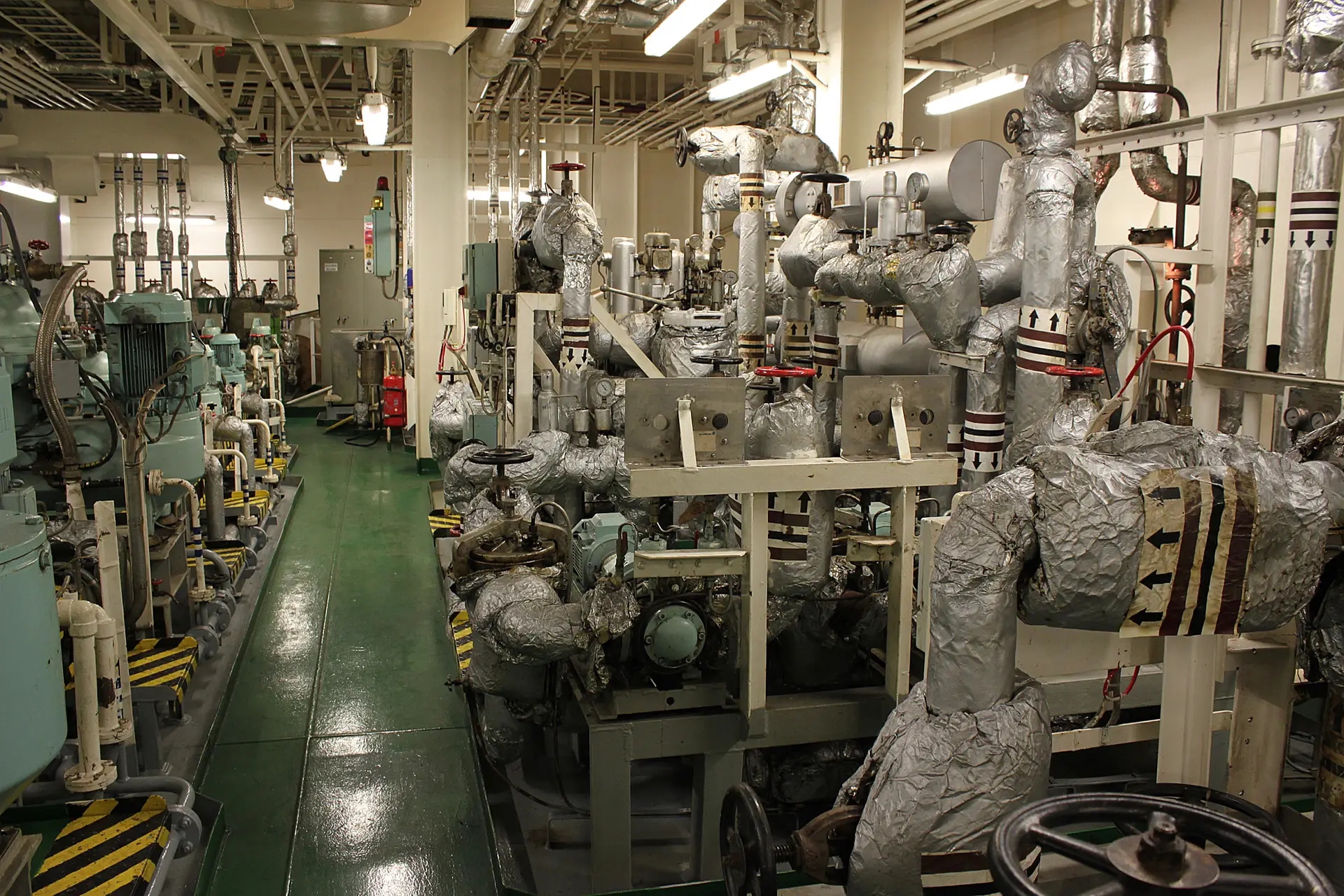
A licensed photograph of Allweiler equipment was not available at publication, so this technical reference illustrates the general arrangement shared by this equipment class.
Illustrative technical reference, not a photograph of Allweiler equipment or a Vessel Core installed reference — a licensed photo of this maker's equipment was not available. Vessel Core has no dealership, distribution or partnership agreement with Allweiler; it operates as an independent spare parts supplier.
Turning an SN designation into a quotable line
An Allweiler type designation is a compressed build specification, not just a name. The series letters are followed by a nominal size, then suffix groups that encode rotation, spindle pitch, sealing execution and bearing arrangement. Two pumps sharing the same nominal size can take different spindle sets because they were built for different viscosity bands, so the full string matters — every letter and digit of it.
- Complete type designation with all suffix characters
- Works number line from the Allweiler rating plate, photographed square-on
- Rated capacity in m³/h and rated speed in rpm
- Differential or discharge pressure in bar
- Viscosity range in mm²/s and design temperature
- Pumped medium and its temperature in service
- Direction of rotation seen from the drive end
- Section-drawing item numbers from the pump manual
- Spindle flanks and housing bore photographed under raking light
- Stator elastomer marking on eccentric-screw units
Matched components ask more of an enquiry than loose parts do.
Screw pump geometry is unforgiving in a way that a bearing or a gasket is not. The parts are finished against each other, so the request has to describe a set and a fit, not a shelf item. What follows is how those two facts — a rotating set finished as one, and idlers carried by the fluid rather than by gears — change the questions asked before any Allweiler item is quoted.
Spindles quoted as a set
Drive and idler spindles are treated as one line item unless the manual for that frame size says otherwise. Requests that name a single idler are queried back before any supplier outreach, because the answer changes both the specification and the outcome on board.
Viscosity band before pitch
Spindle pitch follows the viscosity the pump was built for. The medium, its service temperature and the viscosity figures on the plate are asked for early, since they decide which execution of a given nominal size is the right one.
Bore condition assessed with the set
New spindles running in a scored bore recover only part of the lost pressure. Where the housing carries a replaceable liner, that liner is put on the same enquiry; where the bore is machined into the casing, the choice between reconditioning and a casing is raised openly.
Relief valve checked first
Because a worn valve seat and worn spindles look identical on a discharge gauge, the valve internals are raised as a separate, much smaller line before an assumption is made about the rotating parts.
Seal execution stated, not assumed
Face materials, elastomer grade and whether the pump carries a cartridge seal, a component seal or gland packing are confirmed from the drawing or a photograph. Hot standby service and distillate service point to different seal executions on the same pump.
Elastomer chosen against the fluid
On eccentric-screw units the stator compound decides service life. Sludge, waste oil, chemical dosing and hot water each argue for a different grade, so the fluid and temperature are confirmed before a stator is specified.
Allweiler pump enquiries — recurring questions
Can a single worn idler spindle be replaced on an Allweiler three-screw pump?
Normally not on its own. The drive spindle and the two idler spindles are finished and paired as a set, and the running clearance between the spindle flanks and the housing bore is what limits internal slip. Mixing a new idler with worn mating flanks usually restores neither the sealing line nor the hydraulic balance, so RFQs for screw pumps are quoted as a matched spindle set unless the pump manual states otherwise for that frame size.
What nameplate data is needed for an Allweiler SN pump enquiry?
The complete type designation including all suffix groups, the works or serial number, the year of build, and the rated capacity, speed, differential pressure, viscosity range and design temperature shown on the plate. Direction of rotation and the pumped medium matter as well, because the same nominal size is built in more than one spindle pitch for different viscosity bands.
Why does an Allweiler fuel pump lose discharge pressure after a change to low-viscosity distillate?
The idler spindles in a three-screw pump are carried hydraulically by the pumped fluid rather than by gears. Thin, low-lubricity distillate reduces the film between the spindle flanks and the bore, so slip across the sealing line rises and flank or bore scuffing can begin. Delivered capacity falls at unchanged speed as slip rises, and once the pump can no longer meet demand this shows on board as falling pressure at the consumers; a worn relief-valve seat reads the same way on a gauge and should be checked before a spindle set is ordered.
Can Vessel Core identify Allweiler progressive cavity parts without a part number?
Often yes. For a progressive cavity unit the pump type designation, the serial number, the elastomer grade marked on the stator, the pumped medium and clear photographs of the rotor, joint assembly and stator ends are usually enough to begin identification. Section-drawing item numbers from the pump manual remove most of the remaining ambiguity.
Send the nameplate and the measurements.
List the pump type designation, works number, medium and viscosity, the components required and the port. The spindle set, the relief-valve internals and the stator are then quoted as separate lines, so the ship can decide what to open now and what to carry as a running spare.

