
Taiko Kikai Pump and
Separator Spare Parts
Ballast · bilge · fire · cooling pumps and US / USH 15 ppm oily water separators
Taiko Kikai pumps and Taiko 15 ppm separators are not one parts problem
Taiko Kikai Industries of Japan builds marine pumps and oily water separators, and a spare-parts request touching the two behaves nothing alike. A pump request is a dimensional and metallurgical problem: clearances, seal faces, shaft fits. A separator request is a documentary problem as much as a mechanical one, because the unit was type-approved as an arrangement and a survey will look at what went back inside it.
Taiko single-stage seawater centrifugal on ballast and GS duty
The renewable ring pair is what an overhaul on this line consumes, not the impeller. Record the diametral ring clearance measured at the last opening and the shaft diameter at the seal from the Taiko sectional drawing — those two figures alongside the plate capacity in m³/h close a ring-and-impeller request with no part number at all.
Taiko self-priming unit on bilge and drain duty
Self-priming construction clears air from a dry suction line only as long as the priming chamber holds its liquid charge. So the request here is almost never the impeller: it is the priming-chamber internals, the non-return seat and the casing joint gasket — a Taiko unit on drain duty loses prime through a weeping joint long before it loses hydraulic performance. Send the suction lift the unit is asked to hold and the priming time recorded at the last test.
Taiko fire and combined bilge/fire unit
On a Taiko fire or combined bilge/fire unit the number that decides the job is not rated head but the pressure held at the two most remote hydrants during the drill, because that is the figure the attending surveyor writes down. Ring clearance is what erodes it between drills. Send the drill pressure reading with the ring and impeller request and the scope usually settles in one exchange.
Taiko cooling circulation unit
A jacket or central cooling unit runs continuously, so its request pattern is bearings, seal and coupling insert on a running-hours interval rather than hydraulic wear. Send running hours since the last seal change and say whether the weep shows at the seal or at the casing joint — that single observation decides whether the shaft sleeve goes into the request alongside the seal.
US series 15 ppm bilge separator
Coalescer-type 15 ppm bilge separator: gravity stage, coalescing stage, oil-collecting space, level sensing and an automatic oil drain to the sludge tank. Rated throughput is read from the plate, because element sizing and cartridge count follow it. The series designation on the fitted unit is taken from the plate photograph rather than from the spares list.
USH series 15 ppm bilge separator
The same 15 ppm bilge discharge task under a second Taiko series designation. What the suffix encodes is confirmed against the maker's own literature for the fitted unit rather than inferred here, and rated throughput is again read from the plate because element sizing and cartridge count follow it.
15 ppm bilge alarm and oil-content meter
The measuring cell, its optics or sensing window, and the alarm unit form their own identity on board, usually with a separate plate and a separate type approval certificate from the separator itself.
Solenoid and three-way valve group
Automatic oil discharge to the sludge tank, flushing-water admission where the arrangement includes it, and the overboard-or-recirculate decision run through this group. The automatic stopping device that returns flow to the bilge holding tank on a 15 ppm alarm sits here too. Coil voltage, port size and body material must be read from the fitted item, not inferred.
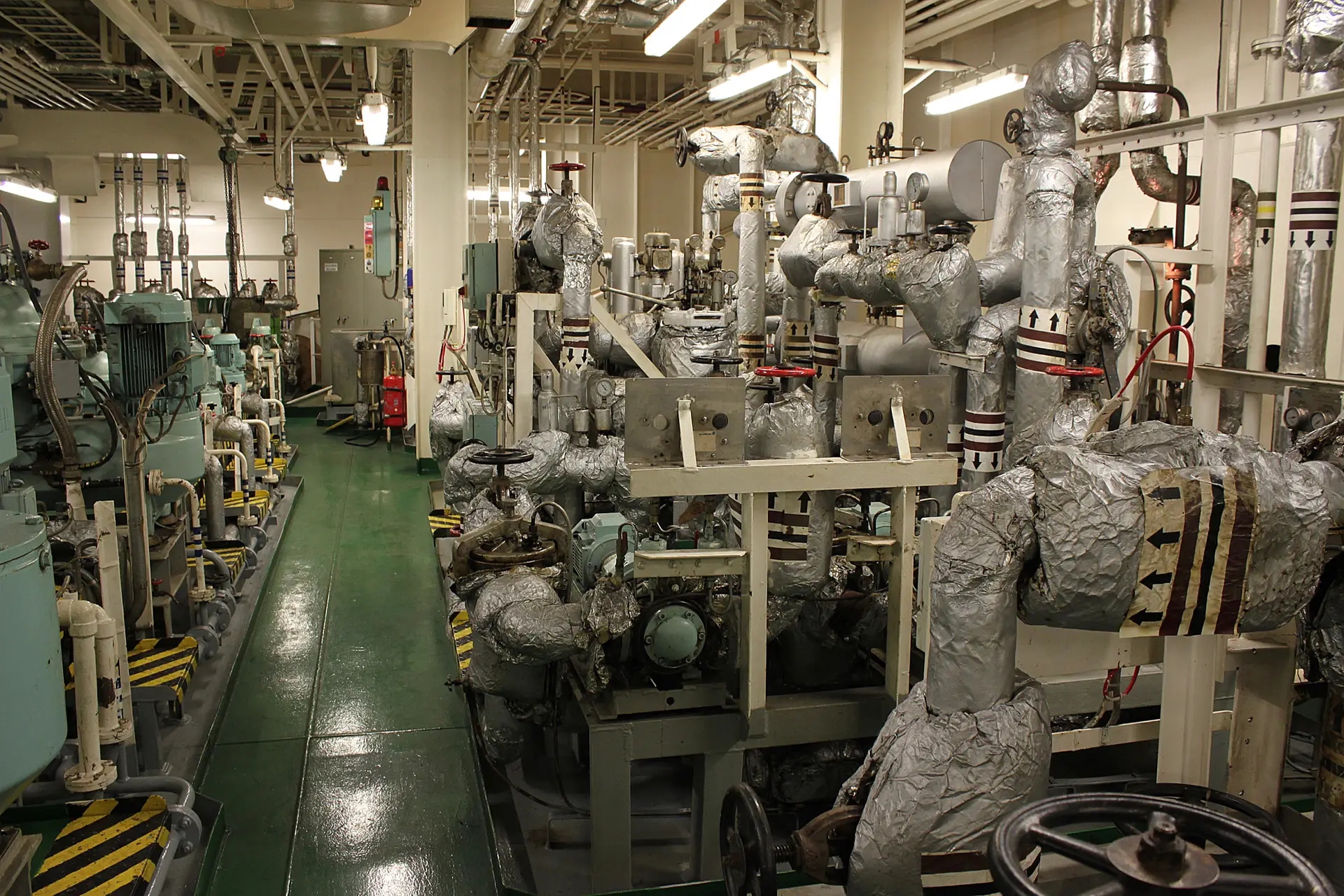
Centrifugal pump — general arrangement
A licensed photograph of Taiko Kikai equipment was not available at publication, so this technical reference illustrates the general arrangement shared by this equipment class.
Illustrative technical reference, not a photograph of Taiko Kikai equipment or a Vessel Core installed reference — a licensed photo of this maker's equipment was not available. Vessel Core has no dealership, distribution or partnership agreement with Taiko Kikai; it operates as an independent spare parts supplier.
The Taiko pump plate and the US / USH separator plate ask for different things
Taiko pump and separator plates are compact, and every field on them does work — but a good half of what closes a request was never stamped on a plate at all. The two lists below keep them apart, because asking a duty engineer to read a seal type off a nameplate only produces a dead end.
- Pump model designation as cast or stamped
- Pump serial number and build year
- Rated capacity in m³/h
- Rated total head in metres
- Rated rotational speed
- Separator model and serial from the separator's own plate
- Separator rated throughput in m³/h
- Oil-content meter type and its own serial
- Direction of rotation from the arrow cast or painted on the Taiko casing
- Mechanical seal type from the Taiko section drawing or the seal's own plate
- Shaft diameter measured at the seal with the pump open
- Driver plate values, noting whether the motor is the original Taiko-supplied unit or a later replacement
- Coupling insert size stamped on the Taiko coupling hub
- Duty and suction source — sea chest, bilge main, drain tank or FW cooling loop
- Type Approval Certificate reference for the separator, and the separate certificate for the 15 ppm bilge alarm
- IMO resolution the separator was approved against: MEPC.107(49), or the earlier MEPC.60(33) on older installations
- IOPP Supplement Form B entry for the oil filtering equipment
- Number of coalescer elements actually fitted in the unit
Where a plate is corroded or painted over, photographs of the plate, of the coupling end and of the element housing are normally enough to begin. The request without a part number route and the evidence checklist set out what substitutes for a missing number.
What a Taiko overhaul consumes: pump wear parts and separator elements
The split below follows the two lines, because a buyer opening a pump and a buyer opening a separator are holding entirely different consumables.
- Closed and semi-open impellers
- Casing wear rings & impeller wear rings
- Mechanical seals, seats & secondary elastomers
- Pump shafts & shaft sleeves
- Radial and thrust bearing sets with the Taiko bearing housings and covers
- Coupling inserts to the size stamped on the Taiko coupling hub
- Casing joint gaskets, O-rings and drain plugs to Taiko sectional-drawing item numbers
- Priming-chamber and non-return components
- Second-stage coalescer element sets to the fitted element count
- Filter cartridges & pre-filter media
- 15 ppm monitor measuring cells, sensing windows and cleaning brushes
- Automatic stopping device and oil-discharge valve rebuild kits
- Solenoid coils & three-way valve bodies
- Oil-level probes, electrodes & sight glasses
- Separator vessel gaskets, seal kits & sludge-line fittings
How a Taiko pump and a 15 ppm separator each tell you they need parts
Naming the symptom in the request narrows the scope faster than naming a component, because the same complaint points to different items on a pump and on a separator.
Head falls away, amperage does not
Classic wear-ring story. Clearance opens, flow recirculates inside the casing instead of leaving it, so the impeller keeps working on the same or more liquid while less of it reaches the discharge. Power stays near normal against a falling delivery — the energy is going into the leak path. The ring pair, and often the impeller hub it runs against, come as a set in the request.
Head and amperage both falling away
A different story from ring wear, and it belongs on the suction side: a throttled or choked suction, a valve not fully open, a strainer packed solid, air drawn in at a joint, or a casing partly vapour-bound. Less liquid is reaching the impeller, so it does less work and draws less power. Nothing inside the casing needs renewing until the suction has been cleared and the reading repeated.
Weeping seal after a dry-running episode
Bilge and drain duty punishes seal faces whenever the suction runs empty. The seal is rarely the only item: the sleeve it ran against is usually grooved, and replacing the seal alone puts a new face on an old track.
Priming lost, suction line will not fill
First question is whether the priming chamber still holds its liquid charge — on a hot standby unit it is regularly just drained down, evaporated or siphoned back. If the charge is there, this points at the recirculation chamber, the non-return arrangement or an air path that has opened somewhere in the casing joint. Gasket and priming components are read together, not separately.
Separator effluent creeping toward the alarm point
The coalescing stage has stopped coalescing — media loaded with sludge, solids, rust and free oil, or a stabilised emulsion the coalescer cannot break, usually from detergent carried in with engine-room and tank-top washings. Rising effluent with no rise in differential pressure points at the emulsion; rising differential pressure points at loading. Element renewal usually travels with a filter cartridge set and a fresh vessel gasket kit.
Monitor drifting or alarming on clean water
An oil-content-meter cell that has fouled, scaled or clouded reports what it can no longer see. The cell, its seals and sometimes the sensing window are the item — not the separator itself, which may be behaving perfectly.
Automatic oil discharge stuck or cycling
Level probes coated with sludge, or a solenoid and valve body that no longer seats cleanly on the drain to the sludge tank. Coil voltage and body connection size have to be taken from the fitted valve before a replacement is proposed.
The separator side changes how a request is answered
Pump items are assessed on fit and material. Separator items are assessed on fit, material and on what the installed approval expects to find inside the unit at the next inspection.
Approval boundary respected
A 15 ppm separator is type-approved as an arrangement, not as a bag of loose parts. Items inside that boundary — coalescer media, monitor cell, the automatic stopping device that returns flow to the bilge holding tank on alarm — are handled conservatively, and the Type Approval Certificate reference is read before any alternative is discussed.
Open items separated from constrained items
Bearings, coupling inserts, gaskets and shaft seals on a cooling or ballast pump are ordinary mechanical goods and are reviewed openly for verified alternatives. That freedom is not carried across to the separator's certified interior.
Identification from what the ship actually has
Taiko element end caps usually carry a moulded or stamped identity long after the paper label has washed off. An end-cap photograph, the shaft diameter measured at the seal face, and the throughput figure from the separator plate are the three things that close most requests on this page. Part numbers are welcome, but on a twenty-year-old Taiko installation the plate, the end cap and a vernier reading outrank the spares list every time.
Survey timing named early
Say whether the renewal is timed against an IOPP Certificate renewal or a MARPOL Annex I Regulation 14 inspection. A 15 ppm separator opened before survey needs its element and monitor-cell documentation gathered with the parts and matched to the type approval the unit was certified against — MEPC.107(49) on later builds, the earlier MEPC.60(33) on older ones. Reconstructing that after the carton is open means reopening the job.
What actually ships: element cartons or a crated impeller
A coalescer element set is bulky, light and easy to crush; an impeller with its ring pair is small, heavy and needs no special handling. The two are packed and freighted differently, and for a separator renewal the element documentation has to travel inside the carton rather than follow by email a week later. Route and handover are settled once the item list is confirmed, never promised at the opening of a request.
Who the 15 ppm paperwork is issued by
A coalescer element or monitor cell fitted to an approved separator has to arrive with an invoice and delivery note a surveyor can tie to a real trading entity. Vessel Core OÜ is an Estonian company — registry 17028043, VAT EE102773714 — and the documentation travelling with a Taiko element set carries those identifiers rather than a broker alias. Verification routes are published at company verification.
Questions that come up on Taiko pump and separator jobs
What nameplate data is needed to identify a Taiko Kikai pump part?
The pump nameplate carries the model designation, serial number, rated capacity in cubic metres per hour and rated head in metres. Those four fields, plus the motor plate and the duty the unit performs on board, are what allow an impeller, wear ring or mechanical seal to be tied to the correct build. Seal type, shaft diameter at the seal and direction of rotation are not plate fields — they come from the section drawing, a measurement taken with the pump open, and the arrow on the casing. A photograph of the plate is accepted where the spares list is incomplete.
Why does the type approval reference matter on a US or USH separator request?
An oily water separator is type-approved as an assembled arrangement. The approval is issued by the flag Administration, or by a recognised organisation acting for it, under the IMO resolution the unit was built against — MEPC.107(49) on later units, the earlier MEPC.60(33) on older installations — and it is recorded on the Type Approval Certificate rather than reliably on the plate. The 15 ppm bilge alarm carries its own separate certificate. Coalescer elements, filter cartridges and oil-content-meter cells should correspond to the configuration named in that approval, so Vessel Core asks for the certificate reference at request stage rather than after delivery.
Can a request be prepared for a Taiko separator when the element part number is unreadable?
Usually yes. The separator model and serial, the separator's rated throughput, photographs of the element end caps and of the oil-content meter housing normally narrow an element or cell down without the original number. Where the evidence is not conclusive, that is stated in the reply rather than resolved by assumption.
Are OEM-route and alternative components both reviewed for Taiko Kikai equipment?
Both are reviewed item by item. Bearings, shaft seals and gaskets on a cooling or ballast pump are frequently open to verified alternatives. Components inside the approved boundary of a 15 ppm separator — coalescer media, monitor cell, the automatic stopping device — are treated conservatively, and the approval and documentation context is checked before any alternative is proposed.
Send the plate and the symptom.
A workable request carries the pump or separator model and serial, the rated capacity from the plate, the type approval reference where an oily water separator is involved, the components you expect to renew, and the port and window you are working toward. Vessel Core reads the two lines against different rules — pump items on fit and material, separator items on fit, material and approval boundary — and replies in writing with what is identified, what is still open, and exactly which photograph or measurement closes the gap.

