
IMO AB Three-Screw
Pump Spare Parts
ACE · ACG · ACD rotary screw pumps on fuel oil, lube oil and hydraulic service
Inside a three-screw pumping element
IMO AB, the Swedish rotary pump works now within CIRCOR, builds three-screw pumps that move oil axially instead of throwing it outward. Understanding that difference is what makes an IMO parts request behave unlike a centrifugal pump parts request.
A driven power rotor meshes with two idler rotors that turn in closely fitted bores. The meshing threads close off a chain of sealed cavities, and those cavities travel from the suction end to the discharge end without changing volume. Nothing is accelerated radially, so flow leaves the pump smooth and almost pulsation-free, torque stays even, and the delivered volume barely moves when discharge pressure changes. That behaviour is why these pumps sit on boiler and diesel fuel supply and booster duty, on main and auxiliary engine lube oil service, on stern tube and gearbox circulation, and on hydraulic packs for deck machinery, hatch covers and ramps, and on replenishing and servo duty alongside the piston pumps of a steering gear.
Two construction details govern everything downstream in a spare parts request. The first is hydraulic balance: discharge pressure is led to the back face of each idler so that axial thrust is carried on an oil film rather than by a thrust bearing. The driven power rotor is balanced the same way, by a balance piston or drum at the discharge end, with only the small residual thrust taken by the ball bearing that also locates the shaft. That is why a worn balance piston or balance bush shows up as bearing distress rather than as a flow complaint. Running clearance in the idler bores is therefore not slack to be tolerated — it is a working dimension inside the pressure balance. Once wear opens it, the pump can still shift oil at low backpressure while quietly losing delivery at rated pressure.
The second is the matched set. Power rotor and idlers are ground and matched as one set and carry a common set identity. They are not interchangeable items picked individually from a shelf, which is why an engineer reporting one scored idler is, in supply terms, reporting a rotor set. On many ACE and ACG frames the manufacturer goes further and packages the rotating assembly as a pump insert — rotor set inside its liner or bore sleeve, dropped into the existing outer casing — or as a cartridge that adds the shaft seal and bearing already fitted. For a centrifugal pump the natural order line is an impeller and a wear ring; for an IMO screw pump the natural order line is often the module.
ACE, ACG and ACD frames we see in RFQs
Requests reaching Vessel Core usually name a series and a size figure, sometimes only a photograph of a corroded plate. ACE bodies dominate transfer and separator-feed lines, ACG the lube and booster circuits, ACD the high-flow duties — and the frame family is what decides whether a request lands on a rotor set, an insert or a full cartridge.
ACE — transfer and booster frames
Compact single-suction three-screw pumps on fuel oil transfer, separator feed, burner supply and hydraulic power pack duty, where a short rotor lead and more sealed closures in series carry the high differential pressure. Requests commonly resolve to a matched rotor set, the idler bearing surfaces, the pump insert, or a mechanical seal and bearing kit.
ACG — lube oil service frames
Larger single-suction frames on four-stroke and geared plants for engine and gearbox lubricating oil circulation, on stern tube and prelube service across ship types, and on heavy fuel booster and hydraulic power pack duty. On large two-stroke installations the main LO circulating pumps are centrifugal; the screw pumps sit on stern tube, prelube, transfer and purifier feed. Housing liners, cartridge assemblies and relief valve internals are the recurring lines on this family.
ACD — high-capacity frames
Double-suction construction feeds both rotor ends and discharges in the centre, which doubles displacement for a given rotor size and cancels axial thrust between the two halves rather than raising differential pressure. Typical duties are high-flow, moderate-pressure lube oil and transfer service. High-pressure hydraulic duty is met by single-suction frames with a short rotor lead and more sealed closures in series.
Pump inserts and cartridges
IMO supplies the rotating assembly as a unit on most ACE and ACG frames: matched rotors in their liner, dropped into the casing that is already bolted to the foundation. Ordering at insert level reduces the clearance guesswork of rebuilding a worn body around new rotors, and on a pump whose casing is welded into a fuel line it is often the only route that does not need the pipework broken.
Mechanical seal variants
The seal execution is encoded in the designation suffix, not the size figure — two ACG pumps of identical bore can carry different faces and elastomers because one was built for heated HFO at the booster and the other for distillate transfer. Give the suffix characters and the working temperature; where the plate is gone, the medium and the line temperature substitute for them.
Built-in relief and bypass valves
Spring, cone or piston, seat and adjusting parts of the integral relief valve. It is an over-pressure protection device for a positive displacement pump — not a flow regulator — and its condition is worth stating in the request.
Wear parts an ACE, ACG or ACD overhaul consumes
The recurring consumables of a three-screw pump overhaul, ordered as the pump comes apart — bracket and cover first, then the rotating parts, then the valve — so the list can be walked against an IMO sectional drawing without jumping between sheets.
- Matched screw sets — power rotor with paired idlers
- Idler bearing surfaces — separate bushings or the housing bores themselves, depending on build
- Pump inserts (rotor set with liner)
- Complete cartridge assemblies
- Housing liners & bore sleeves
- Mechanical seals & seal faces
- Shaft seals, lip seals & sealing rings
- Drive-end ball bearings, lock nuts & bearing covers
- Relief valve springs, cones & seats
- Bypass valve internals & adjusting screws
- Balance piston & balance bush components
- Shaft keys, coupling halves & alignment shims
- Casing and cover joint sets, O-rings for insert seating
- Bearing bracket covers, drive-end caps & insert retaining fasteners
What wears first, and what the symptom tells you
Screw pumps rarely fail suddenly. They lose differential pressure while still turning, and the pattern of loss points at the part. Each pattern below points at a different part, and naming the pattern narrows an IMO request faster than a part number copied off a requisition from the last overhaul — which, on a pump that has had its insert changed, may not describe what is now in the casing.
- Abrasive scoring. Two sources, two stories. Catalytic fines carried over from a purifier that is overloaded, mis-set or bypassed are fine enough to pass any suction strainer and lap the screw flanks and idler bores. Coarse rust and scale from a tank or a line, past a holed or bypassed suction strainer, cuts more locally and leaves visible tracking. In both cases flow at zero backpressure looks normal while delivery at rated pressure falls away. Rotor set plus bearing surfaces, usually.
- Viscosity collapse. A change to low-sulphur distillate or an over-heated fuel line thins the film separating rotor from liner. Polished bearing surfaces, bright bore marks, gradual pressure decay — often the real cause behind a pump that was "worn out" twice in a year.
- Dry running and air ingress. Seconds of running dry can pick up an idler in its bore and wreck the seal faces. A leaking suction joint produces the same damage more slowly, with noise and a swinging pressure gauge.
- Inlet starvation and cavitation. Cold heavy fuel, a choked filter or an undersized suction line stops the pump filling — at high viscosity the pump cannot draw against the NPSH it needs, and dissolved air and gas come out of solution and collapse. On distillate the same conditions produce true vapour cavitation. Either way the damage sits at the suction end: rattling noise, pitted screw crests and erosion at the liner inlet.
- Continuous relief valve recirculation. Using the integral valve to throttle output sends hot oil round in a loop, thinning it and accelerating every wear mode above. Chattered springs and hammered seats are the visible half of the problem.
- Seal and bearing distress. Fuel dilution, thermal shock and coupling misalignment show up as cracked carbon faces, leakage at the drive end, and ball bearings that spall and howl before they seize. Spalling and cage wear point at misalignment or diluted oil; true brinelling points at a hammered-on coupling or a spell of vibration in lay-up, and is worth reporting separately because it changes what else needs inspecting.
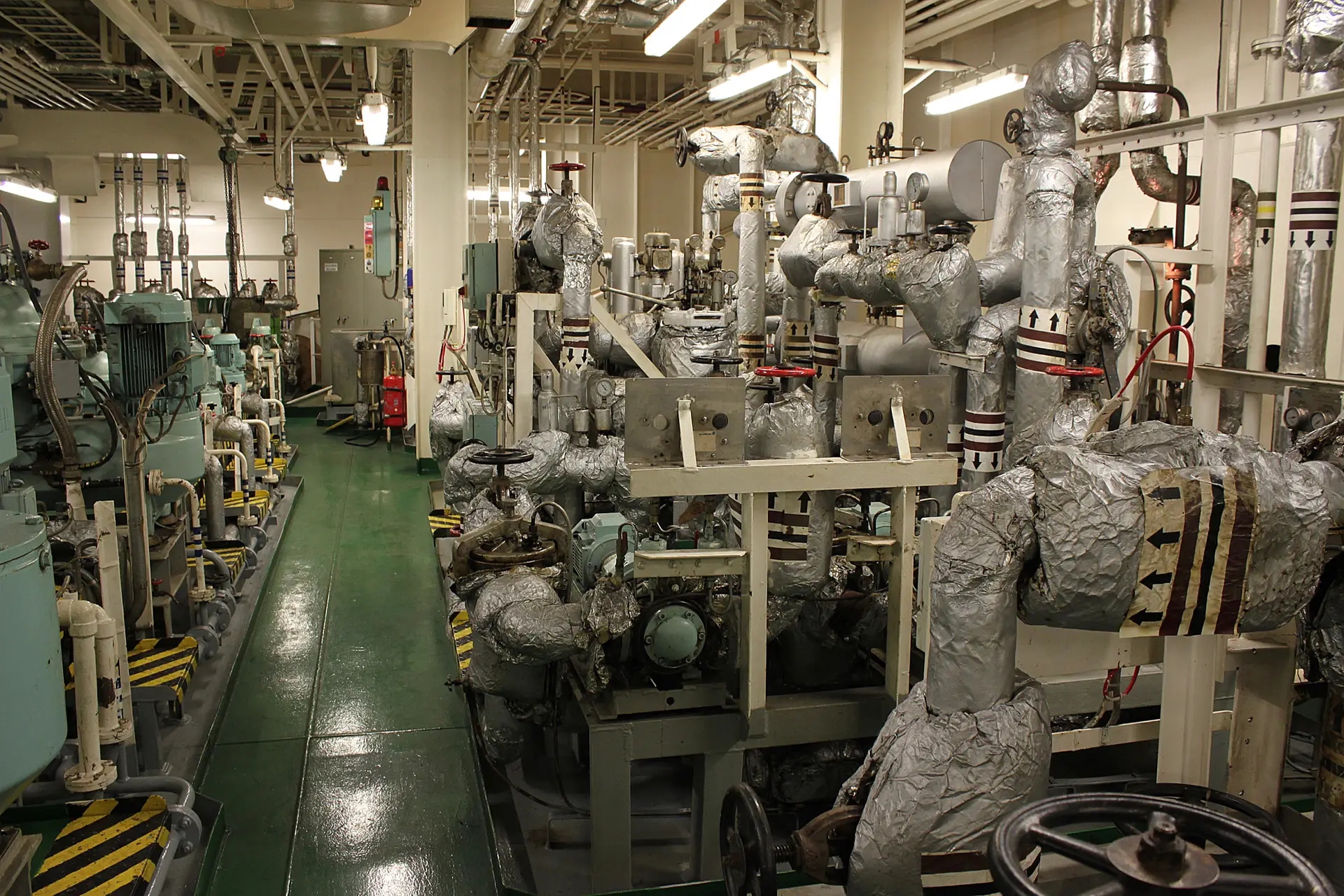
Centrifugal pump — general arrangement
A licensed photograph of IMO AB equipment was not available at publication, so this technical reference illustrates the general arrangement shared by this equipment class.
Illustrative technical reference, not a photograph of IMO AB equipment or a Vessel Core installed reference — a licensed photo of this maker's equipment was not available. Vessel Core has no dealership, distribution or partnership agreement with IMO AB; it operates as an independent spare parts supplier.
Reading the plate before the request goes out
An IMO pump is identified by a designation string plus duty data, not by the equipment tag painted on the foundation. Six fields carry almost all of the resolving power.
- Full designation. Series letters — ACE, ACG or ACD — followed by the size figure, which is the nominal power-rotor diameter in millimetres and therefore tracks capacity directly, and then the character block that encodes rotor lead together with material and seal execution. Copy the whole string, including trailing letters; we decode it against the maker's key rather than guessing from the size figure alone.
- Serial number. The build identity. Two pumps of the same size figure can carry different rotor sets and seal executions across build years.
- Direction of rotation. Seen from the drive end, and marked by an arrow on the bearing bracket. Thread handing fixes which port is suction, and a rotor set of the wrong hand does not fail quietly — it reverses the pump. The suction line becomes the pressure side, so tank line, strainer and filter housing see a pressure they are not rated for with the built-in relief valve on the wrong side to protect them, the discharge line is drawn down instead of fed, and the shaft seal, which normally runs at suction pressure, can be blown out on the first start.
- Rated viscosity. The viscosity range the rotor and bearing clearances were selected for, in cSt at working temperature. It decides bearing material and clearance grade.
- Rated differential pressure. The bar figure the balance arrangement was built for. It separates otherwise identical frames and governs the relief valve spring.
- Duty and mounting. Fuel oil, lubricating oil or hydraulic; horizontal or vertical; port orientation and coupling type. Photographs of the plate, the drive end and the removed part cover the gaps when the plate is corroded.
With those fields present, a request can be assessed at the right level — matched rotor set, insert, cartridge or individual wear item — instead of returning as a question. Whether the idlers run in separate bushings or directly in the housing bores varies by series and build, so the designation and serial decide that before a line is quoted. Where the plate is corroded past reading, the RFQ workspace takes a photograph of the pump body, the drive-end bracket arrow and the removed idler, which between them recover rotation, size figure and wear state; how we work covers what is done with that evidence.
What an IMO ACE, ACG or ACD line gets checked against
These are the checks an IMO line passes before it becomes a quotation request, and they follow from the matched-set and insert construction described above.
Set integrity before component picking
A line reading "one idler screw" is flagged, not processed. Rotors are supplied as a matched set, and mixing a new idler into a worn trio reproduces the original clearance fault within a running period.
Module or component decision
Insert, cartridge or loose parts is a technical choice driven by liner condition and the tooling available on board. We put both routes in front of the buyer with the evidence each one needs, rather than assuming the cheaper line.
Rotation and port handing check
Handing is confirmed from the plate or the bracket arrow before any rotor set, insert or cartridge line is progressed. It is the single most common source of a rejected screw pump part.
Duty and viscosity match
A frame built for heated heavy fuel and one built for thin distillate can share a designation prefix and differ in bearing material and clearance grade. The pumped medium and its working temperature are treated as identifying data.
Consolidated overhaul lines
Pulling an ACE or ACG insert breaks the shaft seal and the drive-end bearing whether or not they were the fault, so both are quoted alongside the rotating parts by default. The relief valve spring and seat are added when the reported symptom involves recirculation, because that valve is opened in the same strip-down and is the one item crews routinely leave on the pump.
Balance arrangement condition
On frames where axial thrust is carried by a balance piston and bush rather than by the idler back-face oil film alone, a worn balance bush produces the same falling delivery as a worn rotor set. We ask whether the balance parts were measured before a rotor set is quoted, because replacing rotors against a worn balance bush repeats the fault.
IMO screw pump parts — what buyers ask
Can a single worn screw be replaced on an IMO three-screw pump?
Normally not. The power rotor and its two idler rotors are ground and matched as one set during manufacture, and their running clearances set both the internal slip and the oil film that supports the idlers in their bores. A request for one scored idler is therefore reviewed as a request for a matched rotor set, or for the complete pump insert, depending on the condition of the housing liner and the idler bearing surfaces.
What is the difference between an IMO pump insert and a cartridge?
An insert is the rotating assembly — matched rotor set inside its liner or bore sleeve — supplied as one module that is fitted into the existing outer casing. A cartridge extends that module with the shaft seal and bearing already assembled. Which of the two applies to a given ACE or ACG frame depends on the pump designation and build, so both options are checked against the nameplate before an RFQ line is progressed.
Which nameplate data is needed to identify IMO ACE or ACG pump parts?
The full designation string including series letters and size figure, the pump serial number, the direction of rotation seen from the drive end, the rated viscosity range and the rated differential pressure. Duty — fuel oil, lubricating oil or hydraulic — port orientation and seal arrangement should be added where the plate is unreadable, together with photographs of the pump and the drive end.
Why does direction of rotation matter when ordering screw pump parts?
The thread handing of the rotor set fixes which port is suction and which is discharge. A rotor set of the wrong hand does not fail quietly — it reverses the pump. The suction line becomes the pressure side, so tank line, strainer and filter housing see a pressure they are not rated for with the built-in relief valve on the wrong side to protect them, the discharge line is drawn down instead of fed, and the shaft seal, which normally runs at suction pressure, can be blown out on the first start. Rotation is confirmed from the nameplate or the arrow on the bearing bracket before any rotor set, insert or cartridge line is quoted.
Send the plate and the symptom.
Give the designation and serial from the pump plate, the direction of rotation, the pumped medium, and a line describing how the pump is behaving. Photographs of the plate and of the removed rotors or idlers are accepted in place of part numbers.

