
Naniwa Marine Pump
Spare Parts Supplier
Vertical centrifugal & self-priming engine-room pumps — cooling · ballast · bilge · fire · sanitary
Where Naniwa pumps sit in the engine room
Naniwa builds vertical centrifugal and self-priming pump sets that recur across Japanese-built bulk carriers, tankers and general cargo tonnage. Because a single pump size is fitted to several different duties with different materials and clearances, the duty a pump serves is part of its identity — not a footnote to it.
Sea water cooling
Motor mounted on top of a lantern-type motor stool, single-stage impeller drawing from the sea chest line. Typically a cast iron casing with bronze (BC6 / CAC406) impeller and wear rings, stainless steel shaft, and a renewable sleeve through the stuffing box. Some sea water builds are all-bronze or aluminium-bronze — confirm from the nameplate or the section drawing. Impeller vane erosion and wear ring opening dominate the overhaul list.
Central fresh water cooling
Closed-circuit duty running near-continuously. Wear is slower than on the sea water side, so the recurring items are the mechanical seal, bearings and casing gasket rather than the hydraulic parts.
Bilge & general service
Recirculation chamber lets the pump clear air from a lifted suction line. Failure to prime is usually traced to loss of the liquid charge in the priming chamber, air ingress at suction line joints, mud box covers or valve glands, or a leaking gland and scored sleeve. Worn impeller front clearance also matters directly here — in a self-priming pump that clearance is what generates the vacuum, so it is checked before the pump is condemned.
Ballast service
Intermittent, high-flow duty with sediment and shell growth in the water. Over service life, wear ring clearance and impeller eye erosion decide how much of the rated duty the pump still delivers. Within a single deballasting operation the limit is different — as tank level falls, available NPSH drops and the pump approaches cavitation or loses suction, which is why ballast sets are commonly backed by a vacuum priming system for stripping.
Fire & emergency fire
Class-surveyed duty tested against a required pressure at a stated number of jets. Restoring a failed pressure test is generally a wear ring, impeller and seal question, and the survey context decides which route is acceptable. Note the split: the main fire pump sits in the machinery space, while the emergency fire pump is a separate unit sited outside it with an independent driver and its own priming arrangement, so its parts list and its survey context are not the same.
Sanitary & domestic water
Small-frame units cycling on a pressure switch. Frequent starts load the bearings and seal faces, so ball bearings, seal kits and the lip seals and O-rings in the bearing covers are the common replacements. Short-cycling on this duty usually points at a waterlogged hydrophore tank rather than the pump.
Close-coupled vs separately coupled
Some units carry the impeller on an extended motor or stub shaft; others use an intermediate shaft, rigid coupling and its own bearing housing on the pump. The two arrangements need different shafts, sleeves and bearing covers even at the same hydraulic size.
Packed gland vs mechanical seal
Older units frequently left the yard with a packed gland and lantern ring; many have since been converted to a cartridge mechanical seal. Confirm what is actually installed — the conversion changes the sleeve and the stuffing box parts, not only the seal.
Wear parts that come off a Naniwa pump at overhaul
A pump strip-down produces a short, predictable list. These are the items most often written onto a Naniwa RFQ, grouped the way they come out of the casing.
- Impellers — closed and semi-open patterns
- Casing wear rings & impeller rings
- Mechanical seals & cartridge seal kits
- Gland packing sets & lantern rings
- Pump shafts & intermediate shafts
- Shaft sleeves & sleeve O-rings
- Ball bearings & angular-contact pairs
- Bearing covers, lip seals & deflectors
- Casing gaskets & cover joint sets
- Impeller nuts, keys & locking washers
- Coupling elements & coupling bolts
System-side items often renewed with the pump — suction non-return/check valves, mud box and sea chest strainer elements. These belong to the piping, not to the pump, so they are identified and quoted separately from the pump parts above.
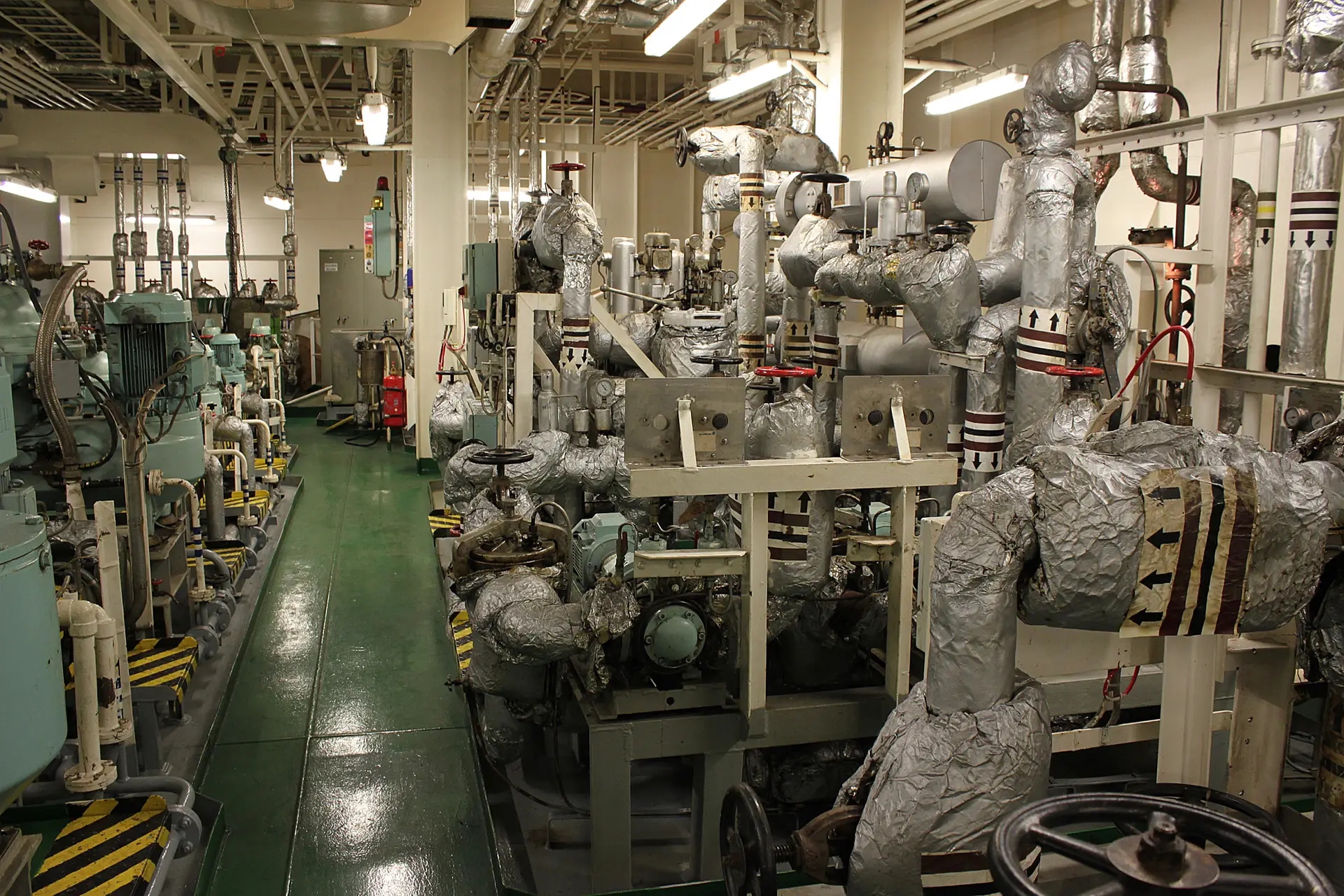
Centrifugal pump — general arrangement
A licensed photograph of Naniwa equipment was not available at publication, so this technical reference illustrates the general arrangement shared by this equipment class.
Illustrative technical reference, not a photograph of Naniwa equipment or a Vessel Core installed reference — a licensed photo of this maker's equipment was not available. Vessel Core has no dealership, distribution or partnership agreement with Naniwa; it operates as an independent spare parts supplier.
Nameplate data that turns a Naniwa enquiry into a quotable RFQ
Pump wear parts are dimensional, not descriptive. "Impeller for sea water pump" cannot be quoted; an impeller for a stated model, serial and duty can. The following evidence closes almost every open question on a Naniwa request.
Pump nameplate
Model designation and serial number first, then rated capacity in cubic metres per hour, total head in metres, rated speed and build year. A single legible photograph of the plate answers more questions than a paragraph of description.
Motor plate and drive data
Kilowatts, pole count, frame size, voltage and frequency. The same wet end is supplied against several driver ratings, so the motor plate narrows the candidate impeller diameter band — it does not fix it. The trim is confirmed from the measured impeller outside diameter or the section drawing.
Shipyard hull number
For legacy units with thin documentation, the yard, hull number and build year let the machinery file, section drawing and item-numbered parts list be traced when the copy of the maker's instruction book carried on board is long gone.
Measured evidence from the worn part
Impeller outside diameter, eye (inlet) diameter, and hub bore with keyway width; wear ring inner and outer diameter with its axial width; shaft diameter under the sleeve, sleeve length, packing cross-section and ring count; and the bearing designation and clearance code etched on the bearing inner or outer ring face (e.g. 6310 C3).
Flange and rotation details
Suction and discharge bore with the flange standard and pressure rating, plus direction of rotation viewed from the driver. On Japanese-built machinery the JIS flange rating is a routine mismatch point when a casing or cover is replaced.
Symptom notes
Falling discharge pressure at unchanged speed, gland leakage that will not tighten out, rising bearing temperature, or a fire pump that no longer holds its test pressure. Each points at a different part of the list and narrows what actually needs quoting.
Supply route review for Naniwa pump overhauls.
A Naniwa parts list splits in two before anything else is decided. Impellers, wear rings, shafts and sleeves are cast or turned to a drawing belonging to one pump size and one duty. Gland packing cross-section, an O-ring size, a bearing designation off the ring face — those are stock numbers anyone can cross. We keep the two halves apart from the first review, because they do not carry the same route requirements.
Hydraulic parts reviewed separately from hardware
Impellers, casing wear rings, shafts and sleeves are fit-specific and normally raised on an OEM-route review. Bearings, packing, O-rings and gaskets are size-and-material items where a verified alternative route can often be assessed once dimensions are confirmed.
Clearance-driven scoping
Replacing an impeller without renewing the mating casing wear ring leaves the original clearance problem in place. Where the evidence supports it, we flag the paired items so the RFQ reflects the whole restored fit rather than one visible part.
Legacy units with thin documentation
Older Naniwa sets often arrive with no manual and a painted-over plate. Hull number, section drawing item numbers and measured evidence from the removed part are accepted as the working identification basis for review.
Duty-aware material review
Confirm the duty and the material question narrows itself — cast iron and bronze on the sea water side, a different elastomer on bilge, potable-water constraints on the sanitary set. Listing a duty here says what the pump does; it does not imply stock, compatibility or authorised-dealer status.
Osaka-origin supply and port handover
Pattern-cast impellers and wear rings from Japanese sources move on quite different timing to catalogue bearings and packing, so a mixed Naniwa list usually splits into two consignments. Which items travel together and which are sent ahead to catch the vessel is settled against your port and the pump duty — a sanitary set can wait, a fire pump under survey normally cannot. Timing is confirmed only in the quotation.
EU-registered entity
Vessel Core OÜ is the EU buyer of record (Estonian Reg. 17028043, VAT EE102773714). Japan-origin pump parts are invoiced through one EU entity with EU VAT treatment and origin documentation prepared with the consignment, instead of the technical superintendent opening a Japan-side purchase directly. The RFQ handling process is published.
Naniwa pump parts — questions buyers ask
What nameplate data is needed to quote a Naniwa pump part?
The pump nameplate normally carries the model designation, serial number, rated capacity in cubic metres per hour, total head in metres and rated speed. Photograph it together with the motor plate — kilowatts, pole count, frame size and frequency — because impeller diameter and duty determine the driver rating, so the motor plate is a useful cross-check on which variant was fitted. Where the plate is painted over or missing, suction and discharge flange bores, impeller outside diameter, shaft diameter under the sleeve and the installed duty are workable substitutes.
Why is the shipyard hull number useful for older Naniwa pumps?
Naniwa supplies its own instruction book with a sectional drawing and item-numbered parts list, but on yard-package supply that book is filed inside the ship's machinery documentation rather than kept with the pump. Where the copy on board has been lost, the yard name, hull number and build year let the correct section drawing and item-numbered parts list be traced, which in turn resolves impeller pattern, wear ring dimension and seal size.
Can a Naniwa pump be quoted from a worn part rather than a part number?
Yes. Photographs of the removed component against a rule, the markings cast or stamped on it, and measured dimensions — impeller outside diameter, eye (inlet) diameter, and hub bore with keyway width, wear ring inner and outer diameter, sleeve length, packing cross-section, and the bearing designation and clearance code etched on the bearing inner or outer ring face (e.g. 6310 C3) — are enough to open an identification review. A part number shortens the review but is not a precondition for starting it. Our RFQ evidence checklist lists the same fields in submission order.
Do you review OEM-route and verified alternative options for Naniwa pump wear parts?
Yes. Bearings, gland packing, O-rings and casing gaskets are catalogue items that can often be reviewed on a verified alternative route once the size and material are confirmed. Impellers, casing wear rings, shafts and shaft sleeves are pattern- and fit-specific, so OEM-route review is normally raised alongside any alternative. Which route applies is decided per item and per duty — a bronze impeller for a 1980s yard-fit sea water pump is a different question from the ball bearing sitting directly above it in the same bracket.
Send the pump plate and the strip-down list.
Send the pump nameplate photograph with model and serial, the installed duty, and the items off the strip-down list with any dimensions you took — impeller outside diameter, eye diameter and hub bore, wear ring inner and outer diameter, shaft diameter under the sleeve. If the plate is painted over, the yard and hull number will usually do instead. We work back from that evidence to the section-drawing item numbers before a quotation is prepared. Add your port or ETA so the handover can be reviewed with it.

