
Napier Turbocharger
Spare Parts Supplier
Axial-flow machines on medium-speed and high-speed engines, marine and power generation · NA 7 Series · NT1 · NT2
Napier ranges a turbocharger RFQ can reference
The NA 7 Series and NT1 machines are axial. Exhaust gas passes straight through an axial turbine stage instead of turning inward through a radial wheel, and that construction choice shapes the whole spare parts conversation: blading, nozzle geometry and rotor balance dominate, and the unit is usually requested at assembly level rather than as a handful of loose items. Napier also builds radial machines in the SIT/NTR range and two-stage NT2 sets — confirm which architecture the plate describes before assuming an axial parts breakdown.
NA axial machines
The long-running axial family — NA297, NA307, NA357 and NA397 — found on both propulsion and generator duty. Requests usually open with a rotor assembly, turbine blading, a nozzle ring or a bearing set rather than a single fastener.
NT axial machines
A separate, later axial product line (NT1-10, NT1-12, NT1-14), not a continuation of the 7-Series frames. Higher pressure ratios and its own sizing and drawing set — nothing crosses over from an NA machine. Copy the NT designation exactly as stamped, including the size suffix, for example NT1-12.
297 frames
297-frame requests arrive written as NA297 or simply as “297” copied from a stores list. The 297 and 357 frames belong to the NA 7 Series (NA297, NA307, NA357, NA397); Napier’s NT machines are designated differently (NT1-10, NT1-12, NT1-14, NT2-26, NT2-28), so confirm the full designation as stamped before a rotor, cartridge or nozzle ring line is quoted.
357 frames
Larger-frame 357 requests are typically overhaul-driven: blade sets, nozzle rings, thrust arrangements and casing hardware quoted together against one docking window.
Multi-engine gensets and propulsion sets
Where several medium-speed engines in one machinery space carry the same frame, state whether the RFQ covers one machine or the full set, and whether the units carry different build or rotation records after earlier renewals.
Medium-speed auxiliary sets
Auxiliary and propulsion four-stroke installations. Provide the engine make and type alongside the turbocharger plate — the same frame is built to different specifications for different engine applications.
Complete cartridge requests
A cartridge line covers the balanced rotor with its bearing housing and seals as one package. Exchange or core-return conditions attached to that route are read line by line during review.
Older and out-of-production frames
Machines no longer in current production are reviewed against the evidence the vessel actually holds: plate photographs, old overhaul reports and clearance records rather than assumed catalogue continuity.
What actually wears in an axial Napier stage
Most Napier requests we see are driven by one of four physical stories, and knowing which one applies usually decides whether the answer is a blade set, a nozzle ring, a bearing kit or a complete cartridge. Describing the symptom in the RFQ — fouling, vibration, oil in the gas path, falling charge air pressure — narrows the technical review far faster than a part number alone.
Blading and nozzle ring
Heavy fuel ash and unburnt residue build on the turbine blades and on the nozzle ring vanes, then erode them. Thermal cycling adds cracking at the vane trailing edges and root fillets. Blades sit in machined roots with locking hardware, so a damaged set is normally treated as a set, not as a single replacement blade.
Compressor wheel and diffuser
Oil mist, salt and dust glaze the compressor wheel and the diffuser passages, blunting the blading and pushing the machine toward surging. Tip rub after a bearing problem leaves witness marks on the shroud line. Wheel and diffuser are matched to the frame build, so both are usually reviewed together.
Journal and thrust bearings, seals
Plain journal bearings and the thrust arrangement depend on clean, uninterrupted oil. Contamination, a short oil interruption on shutdown or a blocked supply line shows up as bearing wear, rising vibration and then rotor contact. Worn labyrinth seals let oil migrate toward the gas path or exhaust gas into the bearing space.
Filter silencer and casing hardware
A loaded filter silencer starves the machine of air and drags efficiency down before anything mechanical fails. On the hot side, gas-inlet and gas-outlet casings suffer distortion, gasket-face erosion and stud damage over repeated overhauls, and casing hardware is worth listing in the same RFQ as the rotating parts.
Component groups quoted on Napier machines
An axial Napier is quoted in four zones — the balanced rotating assembly, the hot gas path through nozzle ring and blading, the air path from filter silencer to diffuser, and the oil supply that keeps the journals alive. A request grouped that way stays readable when one docking covers three or four machines with different build records.
- Rotor assemblies — turbine disc, shaft and compressor wheel, balanced as one assembly
- Complete cartridge assemblies, read against the machine build record
- Turbine blade sets with root locking strips and lacing wire
- Nozzle ring assemblies — full rings and segmented vane repairs
- Compressor impellers matched to the frame build record
- Compressor inlet casings, inserts and air-side insert hardware
- Diffuser vane rings for the NA and NT air path
- Labyrinth seal bushes and rotor air-sealing bushes
- Journal bearing bushes and thrust pads, quoted to the clearance record
- Thrust collars and rotor axial-location hardware
- Rotor balance and re-blading exchange lines
- Gas-inlet expansion bellows and hot-side stud sets
- Gas-inlet and gas-outlet casings with gasket-face hardware
- Filter silencer bodies and replacement silencer elements
- Lube oil pumps, supply pipework and oil-system fittings
- Overhaul packs — gaskets, O-rings, casing studs and blade locking hardware
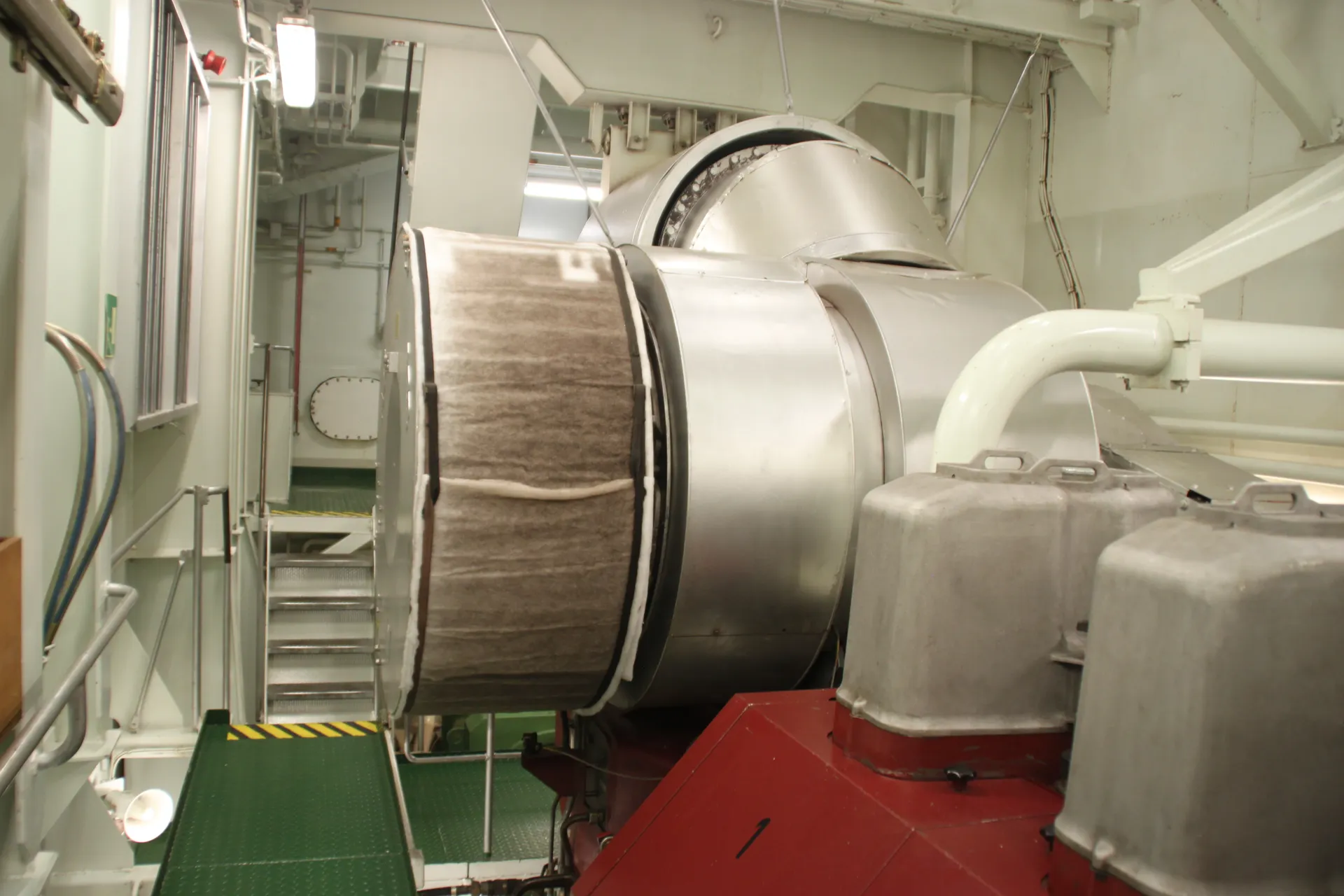
Marine turbocharger — general arrangement
A licensed photograph of Napier equipment was not available at publication, so this technical reference illustrates the general arrangement shared by this equipment class.
Illustrative technical reference, not a photograph of Napier equipment or a Vessel Core installed reference — a licensed photo of this maker's equipment was not available. Vessel Core has no dealership, distribution or partnership agreement with Napier; it operates as an independent spare parts supplier.
The plate data that makes a Napier line quotable
Napier machines are identified by designation plus frame size, and the same frame number can appear on units built to different specifications for different engines. Two details are asked for more often on Napier RFQs than on radial machines: the exact prefix on the plate, and the direction of rotation.
- Designation and frame size exactly as stamped (NA or NT, plus the frame number)
- Machine serial number from the nameplate
- Engine make, type and installed duty — main, auxiliary or propulsion
- Direction of rotation, stated with the end it is viewed from
- Casing arrangement, inlet and outlet orientation
- Whether the rotor has been re-bladed or renewed before
- Photographs of the nameplate, of the blade root and locking hardware, and of the nozzle vane trailing edges — the three views that decide between a blade set, a nozzle ring and a full cartridge
- Clearance records, overhaul reports or vibration readings if held
How a Napier turbocharger RFQ is handled.
A Napier line is worked backwards from the machine rather than forwards from the requisition — plate first, rotation second, then the item. Where an old part number exists it is treated as a clue, not as the answer.
Assembly-level reading of the request
A line written as “turbine blade” is read back to you as what it really is on an axial machine — a blade set, a re-bladed rotor or a cartridge — so the quotation answers the actual repair rather than the wording of the requisition.
Which Napier lines survive an alternative route
A re-bladed rotor or a nozzle ring going back into a class-surveyed machine normally stays on the OEM route, because the balance certificate and the blade-root drawing have to travel with the part. Filter silencer elements, casing studs, gaskets and O-rings are where an alternative route is usually worth reviewing. Whichever route is offered, the balance grade and the rotation hand it was matched against are written into the line.
Breakdown lines reviewed first
When a machine is opened and the vessel is waiting, the rotating and gas-path items can be reviewed ahead of the casing and consumable lines, so the rotor, blade set and nozzle ring need not wait while the casing studs, gaskets and silencer elements are still being priced.
Ranges listed here are RFQ context
NA, NT, 297 and 357 references on this page describe the equipment a request may concern. They do not imply holdings, compatibility between frames, or any status with the manufacturer.
Handover reviewed against the docking window
A complete cartridge ships crated on its own balance-preserving supports, and a 357-frame rotor is a lifting item before it is a freight item — crate dimensions, weight and whether the yard has the lift are checked against the docking window before a handover point is written down. Nothing about the date is treated as settled until it is in the quotation.
EU-registered counterparty
A Napier rotor or complete cartridge is an order most purchasing departments want the counterparty checked against before it is raised. Estonian registry 17028043 and VAT EE102773714 are open entries, and the buyer-verification page carries the documents a vetting request usually asks for.
What buyers ask before sending a Napier list
Which Napier turbocharger ranges can Vessel Core quote?
Vessel Core can quote and review common Napier marine turbocharger spare parts RFQs for the NA 7 Series (NA297, NA307, NA357, NA397) and for the NT1 and NT2 ranges. State the designation and frame size exactly as stamped, the machine serial number, the engine the unit is fitted to and the direction of rotation before a rotor, cartridge or nozzle ring line can be priced.
Do I need a Napier part number, or is the nameplate enough to start?
A nameplate photograph, the NA or NT designation with frame size and a plain description of the damaged item are enough to open technical review. Napier rotors and cartridges are balanced assemblies, so serial number and rotation direction usually carry more weight in the review than a partial number copied from an old requisition.
Can a complete Napier cartridge be quoted instead of separate blades and bearings?
Both routes can be reviewed. A complete cartridge is supplied as a balanced rotor, bearing housing and seal package, while a component route covers blade sets, nozzle rings, journal and thrust bearings and labyrinth seals separately. Core or exchange conditions attached to a cartridge route are checked line by line during RFQ review.
Napier sits in a group with other turbocharger names — can those parts be substituted?
No substitution is assumed. Shared ownership between turbocharger names does not make drawings, blade root forms or bearing dimensions interchangeable. Every Napier line is reviewed against the plate on that machine, and any OEM-route or verified alternative option is presented with the evidence it was matched on.
Send the plate, then the list.
Give the NA or NT designation with frame size, the machine serial number, the engine it serves, the direction of rotation and the components concerned — rotor, cartridge, blading, nozzle ring, bearings, seals or casing items — plus the port and yard window. The designation, frame number and rotation note are read back to you before anything is priced, so a line written as “turbine blade” does not come back quoted as one blade when the machine needs a set.

