
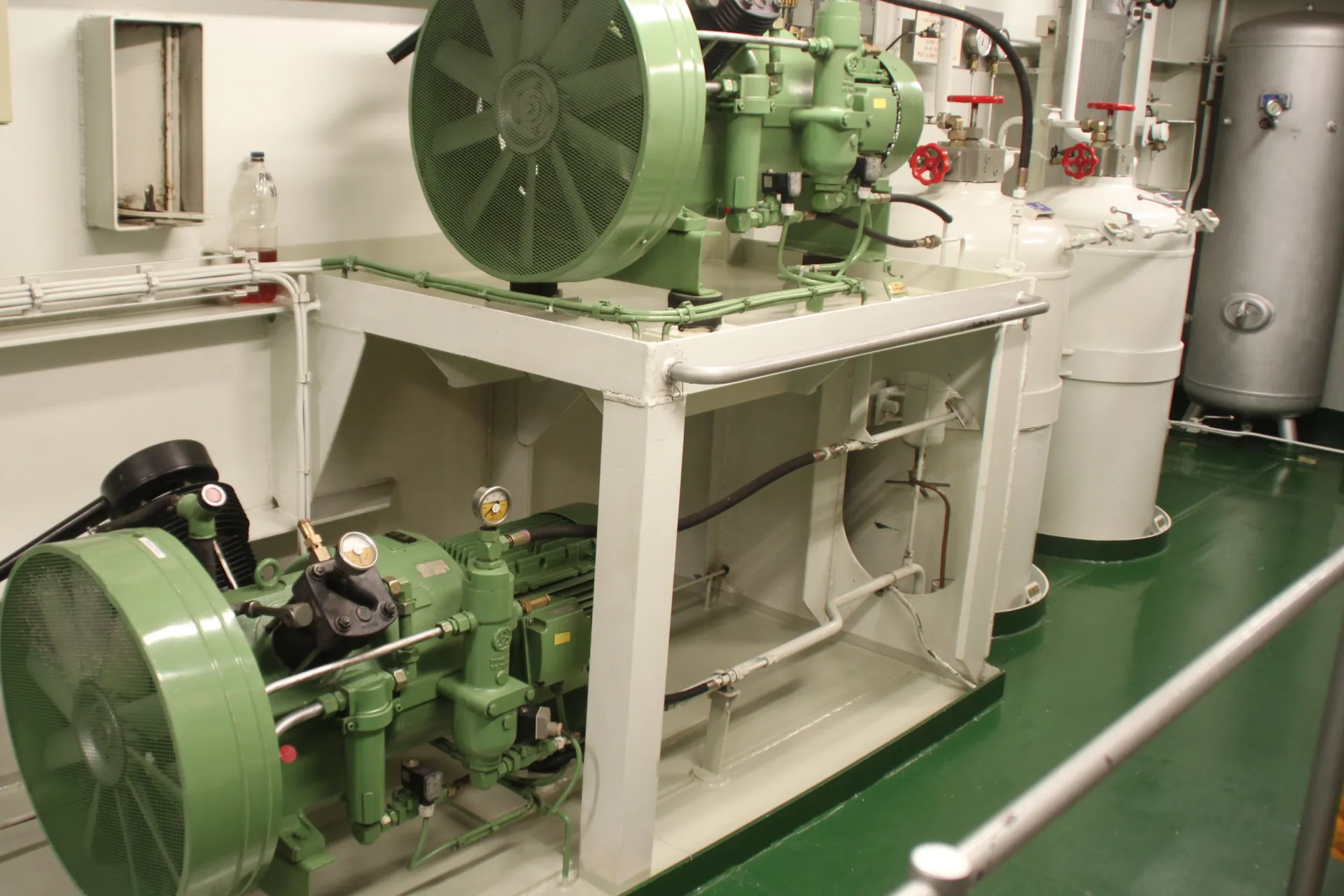
GEA Grasso Compressor
Parts Supplier
V · VT open-drive reciprocating machines on larger refrigeration plant
What a GEA Grasso compressor plate actually names
GEA Grasso's V and VT open-drive reciprocating machines are identified from the type and serial stamped on the compressor's own plate, not from the refrigeration plant they are fitted to.
V and VT open-drive reciprocating machines
The V and VT series are open-drive reciprocating machines met on larger refrigeration plant. The V line is numbered by size — GEA's current table runs from V 300-2 to V 1800-2 for single-stage machines and from V 300T-2 to V 1800T-2 for the two-stage VT, with four to ten cylinders — so the size figure, the T and every suffix on the plate belong in the request. Shaft seal, valve plates, piston and ring sets, connecting rod bearings and the oil pump are the recurring lines; on ammonia plant the refrigerant and the approval paperwork held aboard belong with the request. Quote from the compressor type and serial stamped on its own plate rather than from the plant nameplate, since one plant can carry more than one machine.
Why a V or VT machine carries a shaft seal
A semi-hermetic compressor keeps its motor inside the casing, so there is nothing passing through it and no shaft seal to renew. On the V and VT open-drive series the motor sits outside and the crankshaft exits through a seal, which is why that item sits on the request beside the valve plate, piston and ring sets rather than being assumed from them. On ammonia duty a worn seal is also a matter for the approval paperwork held aboard, not only a parts question.
Reading a GEA Grasso compressor plate
Grasso traces its name to Willem Grasso's 1858 forge and steam-engine workshop in 's-Hertogenbosch, Netherlands, and was building compressors for ammonia refrigeration early in the twentieth century. The business joined GEA Group in the early 1990s, and manufacturing continues in 's-Hertogenbosch to this day. On board, the compressor type and serial stamped on its own plate are what identify the specific V or VT machine and its spare-parts range.
A GEA Grasso open-drive machine is quoted by its own plate, not the plant
V and VT machines share the same open-drive principle, and the plate reading that opens the enquiry works the same way on either.
A GEA Grasso compressor is identified from the type and serial stamped on its own plate, not from the refrigeration plant it serves. Because the motor sits outside the compressor body, the shaft seal belongs on the request as its own line, alongside the valve plate, piston and ring sets — not assumed from them. On ammonia plant, the refrigerant and the approval paperwork held aboard belong with the request as well.
GEA builds the V series in single-stage and two-stage form, driven either directly or through V-belts, and presented a second generation of the series in 2024. Those three points — stage, drive and generation — are settled from the plate and a photograph of the drive end before a shaft seal, valve plate or coupling is matched.
What a GEA Grasso V or VT request resolves to
Grouped by wear group, because a shaft seal is ordered differently from a valve plate even on the same compressor.
- Shaft seal for the open-drive crankshaft passage
- Valve plates for the V and VT series
- Piston and ring sets
- Connecting rod bearings
- Oil pump items
- Coupling elements or V-belts, by the drive fitted
- Complete overhaul kits by compressor type and serial
The shaft seal and the valve plate are what an inspection checks first on a V or VT machine — naming the compressor type and serial before the rest of the list keeps a request from returning with a question.
Plate data that makes a GEA Grasso enquiry quotable
The compressor's own plate is the most direct route to a correct match. With the items below an enquiry can usually be priced in one pass; without them it comes back with a clarifying question first.
- Compressor type exactly as stamped — size figure, the T of a two-stage machine and any suffix, as in V 1100-2 or V 1100T-2
- Serial number stamped on the plate, and the year of build where shown — GEA presented a second-generation V series in 2024, so the year places the machine before or after it
- Refrigerant in use
- Drive arrangement — direct coupled or V-belt — since coupling elements and belts follow the drive fitted
- Photograph of the compressor plate and of the part being requested
Tools for this equipment: the refrigerant number reader for the refrigerant named on the plant and compressor plates.
A shaft seal and a piston ring are not answered alike
Requests naming GEA Grasso compressor components arrive mixed, and the review differs by whether the shaft seal or the ammonia-plant approval paperwork is what the request actually names.
The shaft seal, and on ammonia plant the approval paperwork held aboard, are what a type approval or classification review is most likely to ask about, and these go to an OEM-route review by default.
Valve plates, piston and ring sets, connecting rod bearings and oil pump items are ordinary supply questions, and a verified alternative can be reviewed on them where a buyer's approval requirements allow, with dimensional and material documentation checked at RFQ stage. Vessel Core is an independent spare parts supplier and marks the proposed route against each line on the list, so a mixed request naming both kinds of item is answered by line, not as one blanket route.
GEA Grasso compressor parts — questions from the engine room
What are the V and VT series from GEA Grasso?
The V and VT series are open-drive reciprocating compressors met on larger refrigeration plant, where the motor is separate from the compressor and the crankshaft passes through a shaft seal.
Why does a V or VT machine need the shaft seal ordered as its own line?
A semi-hermetic compressor keeps its motor inside the casing and has no shaft seal to renew. On the open-drive V and VT series the crankshaft exits through a seal, so it belongs on the request beside the valve plate, piston and ring sets rather than being assumed from them.
What parts are ordered on a GEA Grasso compressor request?
Shaft seal, valve plates, piston and ring sets, connecting rod bearings and the oil pump are the recurring lines; on ammonia plant the refrigerant and the approval paperwork held aboard belong with the request.
Where does the GEA Grasso name come from?
Grasso traces its name to Willem Grasso's 1858 forge and steam-engine workshop in 's-Hertogenbosch, Netherlands, and was building compressors for ammonia refrigeration early in the twentieth century. The business joined GEA Group in the early 1990s, and GEA states that its reciprocating compressors are manufactured in 's-Hertogenbosch today.
Can a GEA Grasso compressor part be identified without a part number?
Often yes. The decisive evidence is the frame designation and serial number stamped on the compressor's own plate, whether the machine is a V or VT open-drive build, and a photograph of the removed item beside the nameplate. A part-book page or an earlier order line for the same unit is equally usable as reference.
Is Vessel Core connected to GEA Grasso?
No, and there is no agreement of any kind. Vessel Core holds no dealership, distribution, representation or partnership agreement with GEA Grasso, and quoting a component against one of its designations implies no approval by the maker and no claim of interchangeability.
Submit your RFQ now.
Send your GEA Grasso V or VT compressor request — the model and serial from the machine plate, the refrigerant in service, and the components you expect to renew (shaft seal, valve plates, piston and ring sets, bearings). Vessel Core reviews the supply route and prepares a structured supply quotation.
