
Fuel oil separators
Purifier parts and service items for fuel treatment systems on commercial vessels.
Engine-room separator spare parts supply for fuel oil and lube oil purifier components, service kits and filtration items.
Vessel Core supplies ship managers, purchasing teams, superintendents, repair yards and maritime agents with fuel oil and lube oil separator spare parts.
The request can start from a complete part number, service kit reference, separator nameplate, drawing position, old part photo or manual page. We structure the RFQ so technical matching and supply route review happen before the commercial offer is prepared.
Useful spare parts supply coverage for planned purifier maintenance, time-critical separator faults and engine-room supply review.
Purifier parts and service items for fuel treatment systems on commercial vessels.
Components for lube oil purifier maintenance, overhaul and troubleshooting.
Bowl-related items, discharge components, spindles, covers and operating parts.
Disc stack references, bowl internals and matched purifier service items.
Bowl hoods, locking rings, bowl bodies and related assembly components.
Seal rings, O-rings, gasket sets and overhaul sealing items.
Filter elements, strainers and filtration consumables around separator systems.
Grouped maintenance kits and overhaul items by maker/model and service interval.
Start typing a designation, a maker or a part and the rows filter as you go. The full list across the whole site lives on the maker reference page. Full index across every category and maker.
22 models
| Model | Series | Maker | Typical parts |
|---|---|---|---|
| MAB 103 / MAB 104 | Alfa Laval MAB / MMB | Alfa Laval | Older MAB series fuel oil clarifiers. Disc stacks, bowl components, spindle bearings, and seal kits for service and overhaul. |
| MAPX 207 / MAPX 309 | Alfa Laval MAPX | Alfa Laval | Marine lube oil purifiers. Disc stacks, bowl liner, operating water valves, spindle assemblies, and full service kits. |
| MAPX 313 | Alfa Laval MAPX | Alfa Laval | Larger MAPX lube oil purifier. Bowl assemblies, paring disc, solenoid valves, bearing housings, seals, and overhaul gasket sets. |
| MMB 304 · MMB 305 · PureNOx | Alfa Laval MMB / PureNOx | Alfa Laval | MMB lube oil separators and PureNOx scrubber wash water separator. Bowl assemblies, disc stacks, solenoid valves, and overhaul kits. |
| S831 | Alfa Laval ALCAP | Alfa Laval | ALCAP fuel oil and lube oil purifier. Disc stack assemblies, bowl liner, operating water valve, spindle assembly, O-ring kits. |
| S861 / S867 | Alfa Laval ALCAP | Alfa Laval | Larger ALCAP S-series separators. Bowl assemblies, paring discs, solenoid valves, seals, bearings, and complete overhaul gasket sets. |
| WHPX 405 / WHPX 407 | Alfa Laval WHPX | Alfa Laval | High-performance fuel oil purifiers. Disc stacks, bowl liner sets, operating water valves, spindle bearings, and seal kits. |
| WHPX 410 / WHPX 413 | Alfa Laval WHPX | Alfa Laval | Larger WHPX series units. Complete bowl assemblies, paring discs, solenoid valve kits, bearing sets, and overhaul O-ring sets. |
| Bowl bottom, bowl hood and lock ring | 02 | GEA Westfalia | Erosion at the solids ports and fretting on the lock ring thread are the usual findings on high-hours heavy fuel machines. These are heavy rotating parts machined as a balanced group — the stamped marking on the hood and the machine number must both appear on the RFQ. |
| Clarifier configuration | Bowl configuration | GEA Westfalia | Clarifier configuration closes off the heavy-phase outlet with a clarifier disc or sealing ring in place of the regulating ring, and uses a different top disc. OSD and OSE bowls are rigged both ways, so state whether the machine is currently running as clarifier or purifier — the bowl parts differ between the two. |
| Disc stack and bowl discs | 01 | GEA Westfalia | The stack is a matched set. Disc count, caulk height and total stack height determine how the lock ring seats and how much compression the stack carries. Mixing new discs into a worn stack gives uneven caulk spacing and an altered stack height, disturbing flow distribution between the discs and the compression the lock ring applies. A stack worn throughout instead loses height and leaves the bowl short of correct clamping. Record the number of discs removed and the measured stack height before ordering. |
| Discharge system | Solids handling | GEA Westfalia | Sliding piston, closing chamber, nozzles and the operating water valve block. This subassembly is where most partial-discharge and bowl-not-closing complaints originate. |
| eagleclass | Separator class | GEA Westfalia | A GEA marine separator class designation that appears on the plate alongside the type code — read as a marine separator eagleclass, type OSE 20, for instance. Quote it together with the type designation rather than in place of it, and note the hardware and software revision recorded in the machine file where a control input is involved. |
| Gear parts and coupling elements | 06 | GEA Westfalia | Worm wheel and worm shaft wear shows as noise, metal in the gear oil and a slow rise to bowl speed. Friction coupling pads glaze and slip. Gear oil condition and the recorded run-up time are useful evidence to include when these parts are requested. |
| Operating water valve and seal rings | 04 | GEA Westfalia | Bowl opening and closing depend on clean operating water at the right pressure reaching the closing chamber. A scaled valve seat or a perished sliding piston sealing ring leaves a bowl that will not close after discharge. An eroded or enlarged nozzle bleeds closing water away faster than it is replaced, giving continuous leakage at the solids ports or discharges that fire without command; a blocked nozzle traps closing water and leaves a bowl that will not open at all. |
| OSA / OSB / OSC bowls | Legacy self-cleaning | GEA Westfalia | Earlier self-cleaning bowl generations still in service on smaller auxiliaries. Bowl discs, lock rings and spindle parts for these often need identification from the stamped bowl marking rather than a catalogue reference. |
| OSD series | Self-cleaning purifier | GEA Westfalia | The workhorse marine purifier line — sizes such as OSD 6, OSD 18 and OSD 35 handle heavy fuel and lube oil duty with a hydraulically actuated sliding piston and a full bowl-periphery solids ejection. |
| OSE series | Self-cleaning purifier | GEA Westfalia | Separators covering the sizes OSE 5, OSE 10, OSE 20 and OSE 40, with bowl internals and the operating water block differing from the OSD equivalents even where the throughput rating looks similar. |
| Regulating ring (gravity disc) | 03 | GEA Westfalia | On conventional purifiers without unitrol interface control, the regulating ring bore sets the position of the oil–water interface in the bowl. Too large a bore moves the interface outward toward the bowl periphery, breaking the water seal and losing oil to the water side; too small a bore moves it inward, letting water carry over into the clean oil. Denser fuel, a higher separating temperature or a lower throughput all point toward a smaller bore. The correct figure follows from fuel density at 15 °C, separating temperature and actual throughput, not from what was fitted last time. |
| Spindle, top and bottom bearings | 05 | GEA Westfalia | Rising vibration and a changed run-up time are the early signs. The top bearing sits in its damping assembly with springs or elastic elements that must be renewed together with the bearing; the bottom bearing is matched to the spindle seat. Bearing renewal without checking bowl balance rarely cures the vibration on its own. |
| unitrol / unitrolplus | Interface control | GEA Westfalia | These systems replace the regulating ring altogether, holding the oil–water interface in position electronically from a water-content transducer signal, and they also handle discharge timing, water feed and alarms. Sensors, solenoid pilot valves and the transducer itself are the parts most often requested from this side of the machine. |
| Worm gear drive | Drive assembly | GEA Westfalia | Horizontal shaft, worm and worm wheel, friction coupling pads and the vertical spindle. Ratio and worm wheel tooth count vary with bowl speed, so drive parts are machine-specific rather than family-wide. |
Nothing matches. Send the designation from the nameplate — we also quote items that are not listed here.
This list indicates coverage. It is not stock on hand and not a claim of affiliation with any manufacturer.

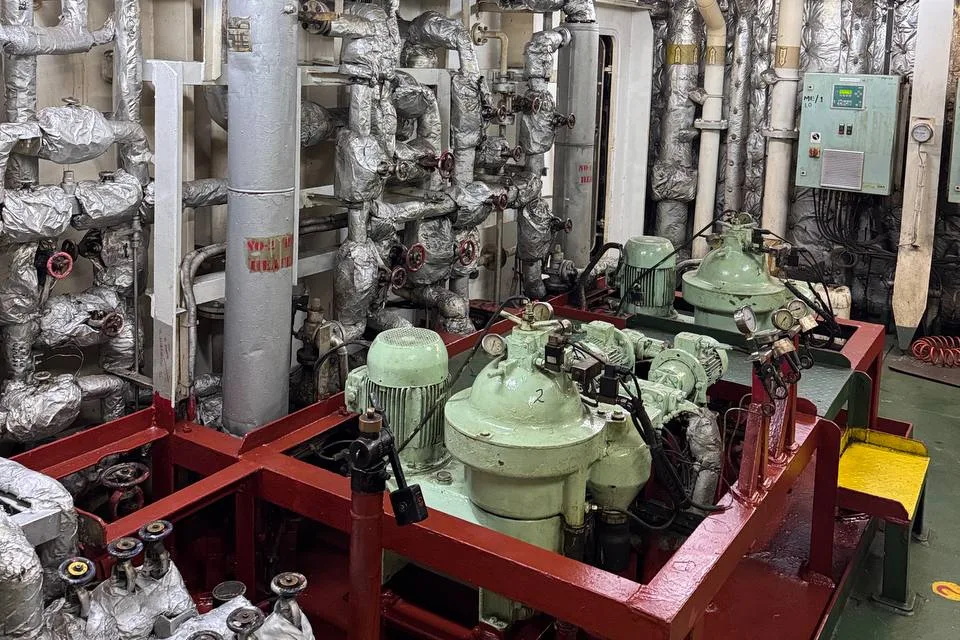
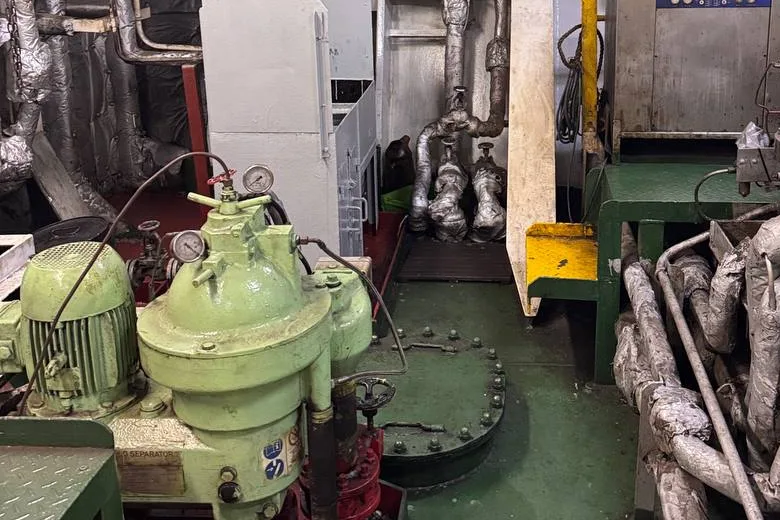
The first photograph is licensed and representative only, not a Vessel Core installed reference or completed job — photo: Eduard47, Wikimedia Commons, CC BY-SA 4.0. The second and third are Vessel Core's own, taken aboard a vessel during a yard visit in July 2026 and published with the owner's permission. No manufacturer is identified in any of the three, and none of this is a claim that Vessel Core supplied or worked on the equipment shown.
A separator RFQ can begin even without a clean part number. Nameplate photos, service kit pages, bowl drawings or old component photos help confirm the installed purifier and reduce mis-supply risk.
Yes. Send the maker, model, serial number, service kit reference, nameplate photo, bowl photo, drawing or manual page. The RFQ can be structured from technical context.
Yes. Time-critical requests should include vessel / IMO, port, ETA and the separator application so availability and logistics can be reviewed around the vessel schedule.
Yes. Use the general separator page for mixed requests or the dedicated Alfa Laval separator parts page for brand-specific RFQs.
Send separator maker, model, serial number, part number or service kit reference, quantity and port/ETA. Photos, nameplates, drawings or Excel lists are welcome.

