
Spare Parts for
Azcue Pumps
Centrifugal · self-priming · screw and side channel ranges on seawater, ballast, bilge, fire and fuel duties
Maker names on this page identify equipment and support an RFQ; they do not imply that Vessel Core is an authorised dealer, representative or partner of Bombas Azcue.
Azcue pump ranges found on European tonnage
Bombas Azcue of Spain builds marine centrifugal, self-priming, screw and side channel pumps that sit throughout the machinery space of coastal, short-sea and offshore vessels. The same casing size appears in several impeller, material and seal builds, so the range name alone is rarely enough — the size code and the works number decide which wear parts fit.
CA series
Horizontal self-priming single-stage centrifugal. The inlet sits high on the casing so liquid is retained after the first prime, allowing repeated priming on bilge, ballast, deck wash and grey water duty and dry running up to roughly 30 minutes. Reaches about 300 m³/h and 105 m and passes soft solids to 10 mm. Built close-coupled with a lantern bracket or as a bare-shaft head, in cast iron GG25, bronze or AISI 316. Wear parts: impeller — closed or semi-open depending on the build, so state which is fitted — casing and cover wear rings, mechanical seal, shaft sleeve and casing gasket.
CP series
Small close-coupled (monobloc) single-stage centrifugal, DN25 to DN80, up to about 75 m³/h and 50 m, with lantern bracket and back pull-out design so the motor comes off without breaking pipework. Requests typically cover the impeller, wear-ring pair, mechanical seal, pump shaft and bearings.
MN series
Horizontal close-coupled (monobloc) single-stage centrifugal built to the DIN 24255 footprint — the workhorse range on cooling, ballast and general service up to about 500 m³/h and 10 bar, dropping into existing DIN 24255 pipework. Impeller, casing and cover wear rings, mechanical seal and shaft sleeve dominate the wear list.
CM, LN and VM/VR series
Vertically arranged in-line pumps used where deck and flat space is tight — cooling circuits, transfer and pressure sets. CM is long-coupled and reaches roughly 1500 m³/h, LN is close-coupled, VM and VR are rigid-coupled. Shaft, sleeve, seal seat and bearing bracket components dominate the wear list.
AN and BOB series
Baseplate-mounted single-stage units driven through a flexible coupling, AN covering heavy duty service to about 700 m³/h. Requests cover the impeller, the wear-ring pair, the seal assembly, drive-end and non-drive-end bearings and the coupling element.
BT-HM / BT-LV series
Triple screw pumps on fuel oil transfer, MDO and LSGO service, and low- and high-viscosity lube oil duty — BT-HM close-coupled, BT-LV vertical in-line. Component requests centre on the screw set (power rotor and idler screws), the insert or liner, shaft seal, bearings and the built-in relief valve spring and seat.
MA, MO/BR, RA, KL/KB and RKZ
The MA, MO/BR and RA side channel ranges self-prime and keep pumping gas-laden liquid on tank stripping and priming duty, with a stage code carried in the model number. KL and KB eccentric screw units and RKZ vertical piston pumps handle viscous and sludge media. State the stage count and the medium so stage components, rotor and stator can be scoped.
Fire, bilge and sanitary sets
Pumps serving fire main, bilge and sanitary systems usually carry documentation expectations beyond the mechanical fit. Flag those duties in the request so the route and paperwork question is settled before quotation.
Azcue wet-end and drive-end components, grouped the way the pump comes apart
Azcue pump requests divide cleanly into the wetted hydraulic components — everything the pumped medium touches — and the drive end that carries the shaft. Grouping a request the same way keeps clearances matched and stops half-overhauls where a new impeller runs against worn rings.
- Closed and semi-open impellers for CA and CP casings, bronze, cast iron or AISI 316, matched to the size-code nominal diameter
- Casing and cover wear-ring pairs, bore held to the size code rather than the range letters
- Mechanical seals, seal seats & elastomer sets rated for the duty — seawater, hot fresh water or fuel
- Gland packing and lantern rings where a packed stuffing box has been fitted in place of the standard mechanical seal — confirm from the pump before requesting
- Pump shafts & renewable sleeves for MN monobloc and CM/LN vertical in-line arrangements
- Drive-end & non-drive-end bearing pairs with retainers for AN and BOB baseplate units
- Casing gaskets, cover gaskets & O-ring kits for CA self-priming casings
- Impeller nuts, keys & lock washers across the centrifugal ranges
- Power rotor and idler screws, inserts or liners & bushings on the BT screw range
- Relief valve springs and seats, suction and discharge covers on BT units
- Flexible coupling elements, spiders & coupling halves on long-coupled AN and BOB sets
- Bearing brackets, lantern pieces & support feet across the monobloc ranges
Centrifugal pump — general arrangement
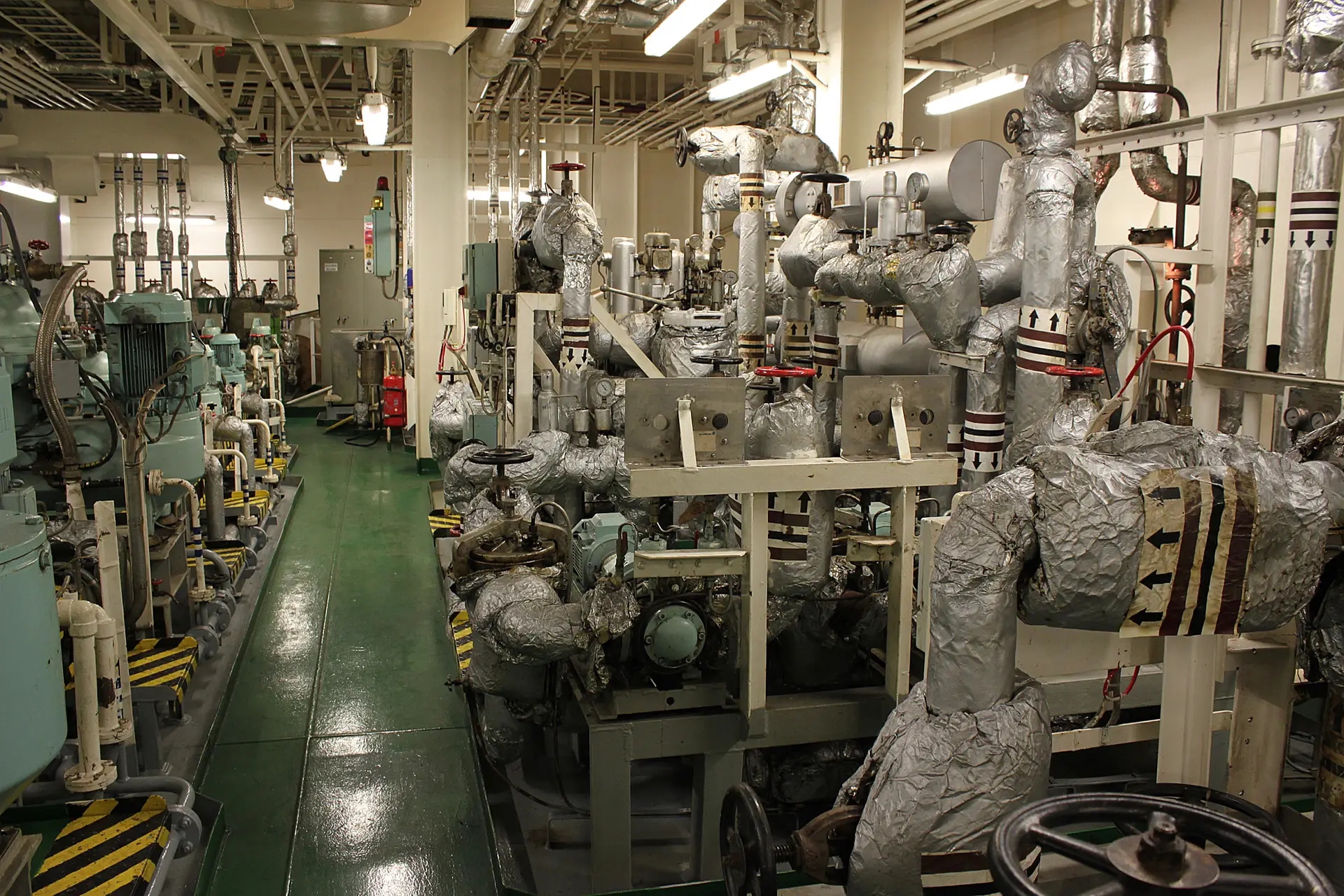
A licensed photograph of Azcue equipment was not available at publication, so this technical reference illustrates the general arrangement shared by this equipment class.
Illustrative technical reference, not a photograph of Azcue equipment or a Vessel Core installed reference — a licensed photo of this maker's equipment was not available. Vessel Core has no dealership, distribution or partnership agreement with Azcue; it operates as an independent spare parts supplier.
Reading an Azcue nameplate before the request leaves the ship
Azcue nameplates carry the information that lets a request be reviewed without a follow-up round. The model designation carries the series letters, any priming code (VP vacuum priming or EP electric priming), then the discharge flange bore and the nominal impeller diameter — MN 50-250 is a DN50 discharge with a 250 mm impeller. That number pair, not the range letters, sets wear-ring bore and impeller fit. Side channel models add a stage code (MO 20-RR is two stages with a secondary bearing), while screw pumps encode central screw diameter, pressure range, screw lead and casing and seal material. The works number ties the unit to its build, which matters where a pump has been rebuilt to a different material specification during its service life.
- Series letters plus the complete size code — discharge bore and nominal impeller diameter, the pair that actually decides ring bore
- Any priming code carried in the designation, VP or EP
- Works number, which ties the unit to its original build and reveals any mid-life material change
- Duty point: rated m³/h against rated metres head, plus the actual operating point if it differs
- Speed and direction of rotation viewed from the drive end
- Material combination stated separately for casing, impeller and shaft — mixed rebuilds are common on seawater duty
- Whether the build is self-priming (CA), monobloc (CP, MN), vertical in-line (CM, LN) or baseplate with a flexible coupling (AN, BOB)
- Motor frame and mounting, since a close-coupled replacement is motor-dependent
- Machinery tag from the vessel spare parts list
- Photographs of the nameplate and the removed component
- Measured impeller outside diameter and shaft diameter at the sleeve seat
How Azcue centrifugal, self-priming and screw units actually wear out
Most Azcue requests arrive after a specific symptom, and the symptom usually points at a small group of components. Because the same Azcue casing size ships in several impeller, seal and material builds, the symptom often identifies the build faster than the paperwork does — a pump that has lost head but not current is telling you the ring pair has opened up, whatever the part book says is fitted.
Head falling away at constant speed
Opening wear-ring clearance lets flow recirculate from discharge back to the impeller eye. Discharge pressure sags at unchanged speed while absorbed power holds up or creeps higher — efficiency, not power, is what collapses, so rising kWh per cubic metre delivered is the better indicator. Falling motor current usually points at a restricted suction instead. Ring pair and impeller are normally renewed together, since a new impeller inside worn rings restores very little.
Cavitation damage at the vane inlet
A fouled sea chest strainer or a throttled suction drops the NPSH available below the pump's NPSH required at that flow. The pitting shows on the vane leading edges and shroud rather than the outer diameter, and the pump runs noisy under load. Renewing the impeller without clearing the suction restriction simply repeats the failure.
Seal weeping and sleeve grooving
Mechanical seal faces wear, elastomers harden on hot fresh-water and fuel duties, and the drain begins to drip. By the time the seal is changed the shaft sleeve often carries a groove at the seal track. Treating seal and sleeve as a pair in the request is the usual way to keep the job from being reopened shortly afterwards.
Bearing noise after coupling hardening
On the long-coupled AN and BOB sets, a flexible coupling element that has hardened — or alignment that has shifted on a settled baseplate — throws the load onto the drive-end bearing, which starts to run warm and noisy. Coupling element, both bearings and the shaft should be assessed together rather than chasing the bearing alone. Monobloc CP and MN units have no coupling to blame, so the same symptom there points at the motor bearing or the impeller balance.
BT screw pump losing delivery on transfer duty
On the triple screw range, wear between the power rotor, the idler screws and the insert opens the sealing line along the screw set. Delivery falls off at unchanged speed and the built-in relief valve begins to chatter. Screw set, insert or liner, bushings and the valve spring and seat form the natural request group, and the pumped medium with its temperature and viscosity should be stated so seal and material can be matched.
Self-priming unit that will not pull prime
Impeller-to-casing and wear-ring clearance, the liquid volume retained in the casing, casing joint tightness, diffuser condition and air ingress at the shaft seal all govern whether the unit still recovers prime — plus the suction line itself, which is where air is most often drawn in. Foot and non-return valves sit in the piping rather than in the pump, so they belong in a separate line of the request. Say how long the unit takes to prime, if at all — it narrows the component list considerably.
Galvanic and erosion loss on seawater duty
On seawater duty the cast iron casing, wear ring and joint faces are anodic to a bronze impeller and waste preferentially — graphitisation of the casing and ring bore is the usual finding, while the bronze impeller is cathodically protected and loses metal instead by erosion-corrosion at the vane tips. A rebuild that mixes alloys changes which part is sacrificial, so state the existing casing, impeller and ring material combination rather than letting a replacement be specified in a different alloy.
Packed gland running hot on older CA and CP builds
On units still fitted with gland packing rather than a mechanical seal, the lantern ring has to stay lined up with the flush connection or the packing loses its water. Silted flush lines on seawater duty are the usual cause: the packing carbonises, the gland is tightened to stop the drip, and the sleeve is scored inside a watch. State whether the build is packed or seal-fitted — the two share a shaft but almost nothing else in the wear group.
Azcue pump parts — questions buyers ask
What nameplate data does an Azcue pump RFQ need?
Send the series letters with any priming code and the complete size code — the discharge flange bore and the nominal impeller diameter, as in MN 50-250 — together with the works number, rated capacity in cubic metres per hour, rated head in metres, rotational speed, and the material combination for casing, impeller and shaft. Motor data and the machinery tag from the vessel spare parts list help match the correct build when several similar pumps sit in the same compartment.
Which Azcue pump wear parts are usually requested together?
A centrifugal overhaul normally groups the impeller, the casing and cover wear rings, the mechanical seal with its elastomers, the shaft sleeve, both bearings and the casing gasket. Screw pump work groups the screw set — power rotor and idler screws — the insert or liner, bushings, shaft seal and bearings. Requesting the set together lets clearances be restored as a matched assembly rather than one component at a time.
Can Vessel Core work from a worn part and a photograph instead of a part number?
Yes. Where the part book is not on board, the pump nameplate, a photograph of the removed component, measured impeller outside diameter, seal face diameter and shaft diameter at the sleeve seat are enough to begin identification review. What comes back is a proposed match with the measurements it was derived from shown alongside it — impeller outside diameter, ring bore, sleeve seat — so the ship's engineer can check the figures against the pump in front of them before anything is ordered.
Do you review OEM-route and alternative components for Azcue pumps?
Both routes can be reviewed against the evidence supplied, and on Azcue pumps they split along a component line. Seal faces, bearing pairs and coupling elements are bought-in catalogue items from third-party makers in the first place, so an equivalence review on those is normally straightforward. Impellers and wear rings are the opposite case — bore and outside diameter have to be held against the size code, and a ring pair machined to the wrong nominal simply reopens the clearance the overhaul was meant to close. Those stay on the OEM route unless the buyer's own reviewer accepts a measured drawing. OEM-route review also suits class-surveyed fire and bilge duties or documentation-sensitive work.
Why Bombas Azcue is named on this page
Azcue pumps are identified on this page by series letters, size code and works number because that is the only reliable way to reach the correct wear-ring bore and impeller fit. Maker names help identify equipment and prepare an RFQ. They do not imply that Vessel Core is an authorised dealer, representative or partner of Bombas Azcue or of any other manufacturer named on this page. Models and component descriptions listed here are identification context and do not by themselves establish compatibility, availability or approval for a particular installation.
Send the nameplate and the symptom.
Include the Azcue series and the full size code as cast on the nameplate, the works number, the duty point in m³/h against metres head, the casing, impeller and shaft material combination, and the system the pump serves — seawater cooling, ballast, bilge, fire main, sanitary or fuel transfer. Where the part book left the ship with a previous crew, a nameplate photograph together with the measured impeller outside diameter and the shaft diameter at the sleeve seat is enough to open the file. What comes back is the wear-part group scoped as a matched set — rings and impeller together, seal and sleeve together — rather than a line-by-line pick list that leaves half the clearances worn.

