
Shinko Marine Pump
Spare Parts Supplier
Vertical in-line and horizontal single-stage centrifugal engine-room pumps · RVP and KV designations among others
Shinko pump configurations found on Japanese-built tonnage
Shinko Ind. Ltd. builds vertical and horizontal centrifugal pumps, single-stage and multi-stage, that sit across almost every seawater and fresh-water circuit of a Japanese-built engine room. The designations covered on this page are the single-stage centrifugal families. The configuration matters more than the duty label: it decides how the shaft is supported, how the seal is reached and which wear parts move together during an overhaul.
RVP designation
Motor mounted above the casing on a spacer bracket, suction and discharge on a common horizontal axis. Chosen where floor plate space is short. Wear parts move as a group: impeller, casing wear ring, mechanical seal, shaft sleeve and coupling rubbers.
Horizontal single-stage designations
Horizontal single-stage set on a bedplate with a flexible coupling to the motor. Bearings sit in a separate bracket and the set is back pull-out, so the rotating element, sleeve and bearings can be withdrawn with the casing and pipework left connected. Casing and cover gaskets are usually renewed at the same opening. Designations vary across the horizontal range, so the code cast or stamped on the machine is read from the pump rather than assumed from the duty.
KV designation
Vertical arrangement with the shaft carried on bearings in the bracket above the casing. Where the design includes a priming arrangement, the priming chamber joints, the non-return valve and the air separator internals belong in the same request; whether they apply is read from the pump section drawing rather than assumed. Seal face condition, wear ring clearance and bearing bracket wear drive most of the requests raised against these pumps.
Cooling seawater service
The hardest life of any pump on board. Bronze impellers suffer cavitation and erosion-corrosion at the vane inlet edges and in the suction eye, wear rings open up, and seal faces suffer from silt drawn through the sea chest. Casing material on the nameplate must be read before any wetted part is requested.
Fresh water cooling service
Cleaner water, longer intervals, but seal faces still glaze and coupling rubbers still harden with engine-room heat. Requests here are typically seal kit, gasket set and bearings rather than complete hydraulic components.
Ballast service
Intermittent, heavily loaded, often run with air entrained during stripping. Seal faces and shaft sleeves take the damage, and wear ring clearance opens faster than the running hours alone would suggest.
Bilge and general service
Solids in the pumped medium score seal faces and sleeves. Many of these units still run gland packing, so packing rings, the lantern ring and the sleeve are listed together with the gland studs and nuts.
Fire service
Rarely run, surveyed regularly, and expected to reach rated head on demand. Requests are usually driven by a survey finding on capacity or on gland leakage, so the head and capacity figures on the nameplate belong in the RFQ.
Centrifugal pump — general arrangement
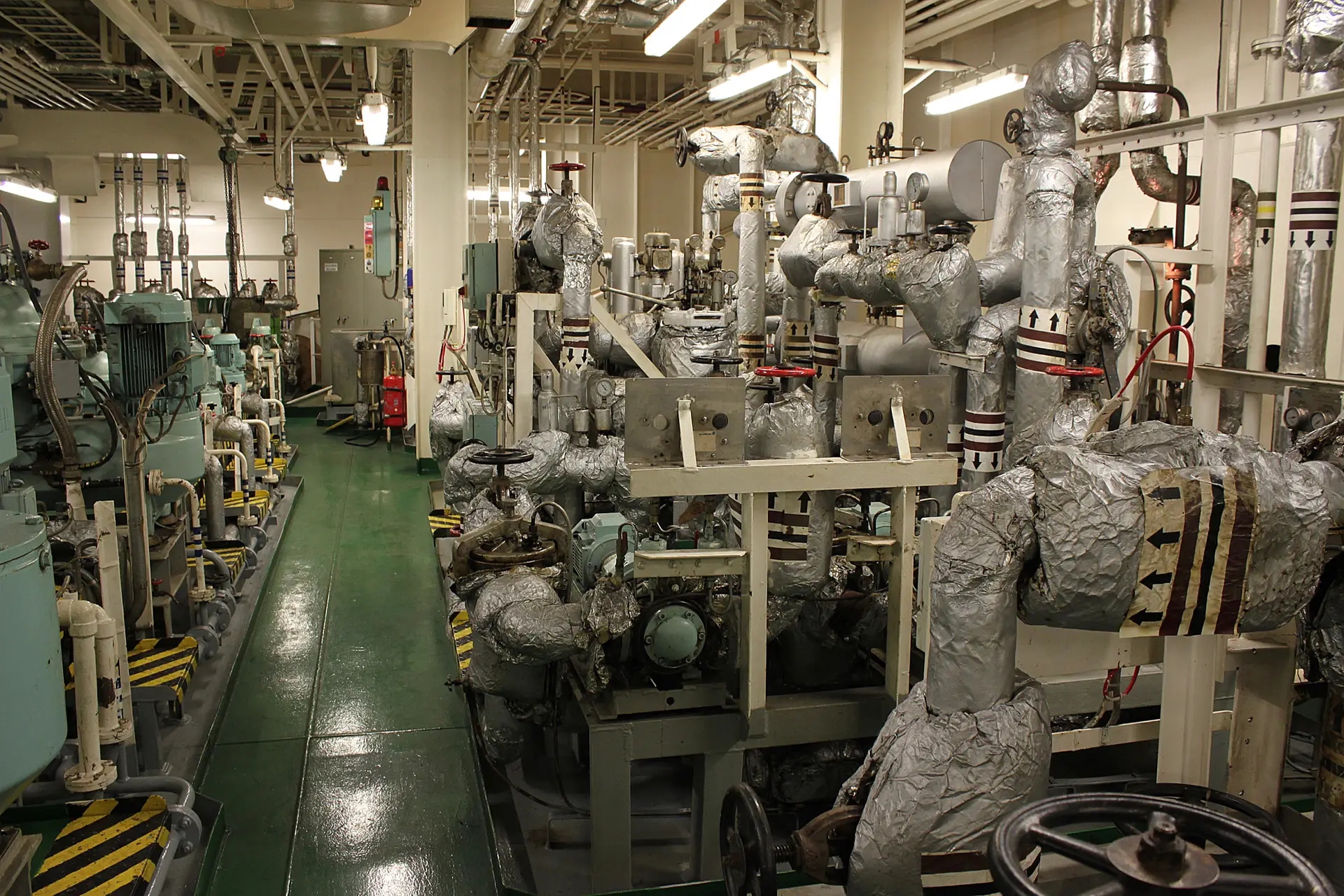
A licensed photograph of Shinko equipment was not available at publication, so this technical reference illustrates the general arrangement shared by this equipment class.
Illustrative technical reference, not a photograph of Shinko equipment or a Vessel Core installed reference — a licensed photo of this maker's equipment was not available. Vessel Core has no dealership, distribution or partnership agreement with Shinko; it operates as an independent spare parts supplier.
Reading a Shinko pump before the request is written
One designation was built in several hydraulic sizes and in more than one material specification, so a designation alone rarely closes an identification. The plate on the casing or bearing bracket carries the fields below; photograph it before the pump is stripped, because it is easy to lose under paint and lagging once work starts.
- Model designation exactly as cast or stamped
- Pump serial number and build year
- Rated capacity in m³/h and total head in metres
- Rotation speed in rpm and direction of rotation
- Motor rating in kW, pole count and supply frequency
- Casing and wetted-part material — cast iron, gunmetal or aluminium/Ni-Al bronze
- Impeller material and measured outside diameter
- Suction and discharge flange sizes and standard
- Shaft sealing type — mechanical seal or gland packing
- Seal maker and seal type designation, with shaft or sleeve diameter at the seal
- Measured wear ring clearance, if the pump is open
What gets renewed when a Shinko casing comes apart
Requests raised against these machines cluster tightly around the wet end and the shaft. Grouping them into one RFQ keeps the opened pump from waiting on a single missing joint or rubber.
- Impellers — closed type, with semi-open where the design uses it
- Casing wear rings & impeller wear rings
- Mechanical seals & seal seat assemblies
- Gland packing rings & lantern rings
- Pump shafts & shaft sleeves
- Bearing-bracket ball and roller bearings with shaft lock nuts and tab washers
- Casing joint and bearing cover gaskets, casing O-rings and seal chamber elastomers
- Coupling rubbers & coupling bushes
- Bearing brackets & bracket covers
- Impeller keys, sleeve keys, water deflectors and shaft retaining rings
- Gland followers, studs & nuts
- Casing drain and vent plug sets
Supply route review built around pump wear behaviour.
A centrifugal pump rarely fails in one place. Clearance, sealing and shaft support degrade together, and a request that covers only the visibly damaged component tends to come back within the year. Which route suits an item depends on where it sits in the machine. A casing wear ring turned to a measured clearance is a different sourcing problem from a bronze impeller of a specific hydraulic size, and both are different again from a coupling rubber. Each line of the request is reviewed on its own terms against the drawings, the survey context and the date the pump has to be back together.
Wear Ring Clearance Drives Capacity Loss
As the casing and impeller rings open up, leakage recirculates from discharge back to the impeller eye. Delivered capacity and pump efficiency fall while absorbed power and motor current rise for the same delivered flow — the classic signature of ring clearance beyond limit. Where the impeller carries a renewable ring, casing ring and impeller ring are renewed as a pair and the impeller is retained. Where the design runs the impeller shroud directly against the casing ring, or the impeller is eroded past its machining limit, the impeller goes into the same request. Which case applies is read from the pump section drawing.
Seal Faces And Sleeves Fail Together
A scored shaft sleeve destroys a new mechanical seal within days, and an over-tightened gland does the same to a packed pump. Sleeve condition should be measured while the pump is open so seal, sleeve and secondary elastomers can be reviewed as one item group. The seal itself is a bought-in item on these pumps, so the seal maker, the seal type designation and the shaft or sleeve diameter at the seal are what actually close the identification.
Vertical In-Line Access Planning
On a vertical in-line unit the spacer element of the coupling is withdrawn to expose the seal and upper bearing, so the motor normally stays in place. Because the machine is opened once, coupling rubbers, casing joints and bearings are worth reviewing in the same request even when only the seal is leaking. Where a design has no spacer coupling, the motor does have to come off, and the lifting arrangement is worth settling before the pump is opened.
Material Specification Is Part Of The Identification
Casing and wetted-part material — cast iron, gunmetal or aluminium/Ni-Al bronze — separates two units of the same designation more sharply than anything else on the plate. A seawater duty pump carries gunmetal or aluminium bronze wetted parts where a fresh-water unit may be cast iron. Material is confirmed from the nameplate and, where needed, from the pump section drawing in the vessel technical file before any wetted component is reviewed.
The Opening Window, Not The Box Size
A wear ring set, a seal cartridge and a sleeve weigh very little, so freight is rarely what sets the date on a Shinko job — the constraint is the port stay itself. The pump has to come apart, the ring clearance and the sleeve diameter have to be measured, and the casing has to close again before the vessel sails. Route and handover point are therefore built backwards from the intended opening, not forwards from a warehouse. Availability and route are confirmed in the quotation; no delivery date is fixed before the measured dimensions come back from the opened pump.
Gland-Packed Units Are Still In Service
A large share of bilge and general service Shinko sets were delivered with a packed gland rather than a mechanical seal, and many are still running that way decades later. Where the gland is being kept, packing rings, the lantern ring, the follower and the sleeve belong in one request. Where the vessel wants to convert to a mechanical seal, the sleeve diameter and the stuffing box depth have to be measured first, because a conversion is not a drop-in on every hydraulic size of the same designation.
What buyers ask before opening a Shinko pump
What Shinko pump data is needed before a wear part can be identified?
The casing or bracket nameplate carries the model designation and the pump serial number, and those two fields anchor everything else. Add rated capacity in cubic metres per hour, total head in metres, rotation speed, motor rating and the casing material, because the same designation was built in several hydraulic and material variants.
Does a class-surveyed fire pump have to go the OEM route?
Not automatically, but the survey file is what decides it. Where a surveyor has raised a finding against capacity or gland leakage, the paperwork behind the impeller and the rings usually needs to be the tightest available. On cooling and general service duties the picture is different — packing, bearings, coupling rubbers and joint material are routinely reviewed on alternative routes, because equivalence there can be demonstrated from dimensions and material specification rather than from a maker document.
How does the vertical in-line arrangement affect a Shinko pump spare parts request?
On a vertical in-line unit the spacer element of the coupling is withdrawn to expose the seal and upper bearing, so the motor normally stays in place. Because the machine is opened once, coupling rubbers, casing joints and bearings are worth reviewing in the same request. Requests for these machines are usually prepared as one seal-and-bearing set, so the opened pump is not left waiting on a second item.
Can a Shinko impeller or wear ring be requested without a part number?
Yes. Identification can begin from the pump designation, serial number, measured impeller outside diameter, eye and bore dimensions, keyway width and the measured wear ring clearance. Photographs of the nameplate and of the removed component are accepted as reference evidence at RFQ stage.
How the Shinko name is used on this page
RVP and KV are Shinko Ind. Ltd. designations, and they are printed here for one reason: a buyer standing in front of an engine-room pump needs a word for the machine before anyone can identify a part for it. Maker names help identify equipment and prepare an RFQ. They do not imply that Vessel Core is an authorised dealer, representative or partner of the manufacturers named on this page. Designations shown here are used to describe the machine a buyer is working on; they do not imply stock, compatibility or affiliation, and every item is confirmed against the evidence supplied with the request. Nothing on this page should be read as a claim of affiliation with Shinko Ind. Ltd., and a designation shown here does not assert that any alternative part is interchangeable with a Shinko original.
Send the nameplate, then the wear list.
Send the pump designation and serial number, the rated capacity and head, the casing and impeller material, the sealing arrangement with the seal maker and seal type designation, and the wear items you intend to renew. If the pump is already open, add the measured wear ring clearance and the sleeve diameter at the seal — those two figures decide whether the impeller has to be renewed together with the rings or can go back into service. A route review and an itemised quotation follow from that evidence.

