
Teikoku Marine Pump
Spare Parts Supplier
Canned motor pump ranges, no shaft seal — VCS · VCD · BF/TVC/VCB/TVD · CSM · MS/MSS
Teikoku canned motor pump ranges seen in engine-room enquiries
The Teikoku name on a marine pump plate belongs to Teikoku Machinery Works of Osaka (Teikoku Kikai Seisakusho, founded 1909), which builds centrifugal, condensate and piston pumps for large ships. Period listings give a 150 VCB-A-NV as a self-priming fire and general service pump and a 125-2VCS-A-NV as a self-priming emergency fire pump. These are conventional motor-driven pumps, not the canned motor pumps of the separate Teikoku Corporation, and their designations are read as a full string rather than a family name alone. On several of these ranges the size figure is written in front of the letters instead of after them, and a suffix on the same string separates one execution from another — both are easy to drop when a request is written short, and both change which internal parts fit.
2VCS · VCS · 2VSR
On these pumps the size figure is written in front of the code, as in 250-2VCS or 200 VCS, and the whole string is the identity. A period listing gives a 125-2VCS-A-NV as a self-priming emergency fire pump, with the execution letters after the code. As on any self-priming centrifugal pump, the recurring items are the impeller and wear rings, the shaft seal or gland packing with its sleeve, the bearings and the priming components.
300 VCD · 350 VCD-B2 · 450 VCD-A
VCD units are met on central cooling fresh water duty, and the suffix after the code separates executions. The recurring lines are those of a conventional centrifugal pump: impeller, wear rings, shaft seal and sleeve, bearings and casing gaskets. Quote the suffix, because a VCD-A and a VCD-B2 are not the same build.
BF · TVC · VCB · TVD
Four neighbouring codes in the same programme, met with the size figure in front and an execution suffix behind. A period listing gives a 150 VCB-A-NV as a self-priming fire and general service pump. The internal parts follow the exact string rather than the family, so a code shortened by one letter routinely reaches the wrong impeller or ring set.
CSM 50 · CSM 65 · CSM 80
A compact family written with the size after the letters. No Teikoku source found describes its construction, so the scope is taken from the plate string, the sectional drawing and photographs of the opened pump rather than assumed in advance.
40X25 MSS · 50 MSS-J · 100 MSS-BH1M · MS · MSN
The MS group is written in several forms, including a two-figure inlet and outlet pair in front of the letters. Copy the string exactly as it stands on the plate: the suffixes on this group are long, and they carry the execution the internal parts follow.
Reading a Teikoku string
Unlike the designations on most pump plates, a Teikoku designation often puts the size figure ahead of the letters rather than after them, and a suffix behind the letters marks a distinct execution rather than a footnote. The whole string, read in the order it is stamped, is the identity — no single segment of it names the pump on its own.
Where a Teikoku pump enquiry actually gets stuck
Most enquiries that reach us on this equipment trace back to a string read the wrong way round or shortened by a piece that looked unimportant. Several Teikoku ranges write the size figure ahead of the letters rather than after them, which a request copied from habit can silently reverse; the BF/TVC/VCB/TVD and MS/MSS groups carry long execution suffixes that a code shortened by even one character can drop; and VCD-A versus VCD-B2 is a different build, not a variant, despite differing only in the suffix. The wear list itself is that of a conventional centrifugal pump: impeller, wear rings, shaft seal or gland packing, sleeve and bearings, plus the priming parts on the self-priming fire and general service sets.
- Plain bearings & thrust surfaces
- Impellers, wear rings & shaft sleeves
- Mechanical seals or gland packing
- Priming components on self-priming sets
- Liners
- Gasket sets
- Complete overhaul kits by full string
A Teikoku engine-room pump is a conventional shaft-driven centrifugal pump, so its seal or gland packing, sleeve, impeller and wear rings are renewed as on any other marine pump. What has to be settled first is the full string, read in the order it is stamped.
Canned motor pump — general arrangement
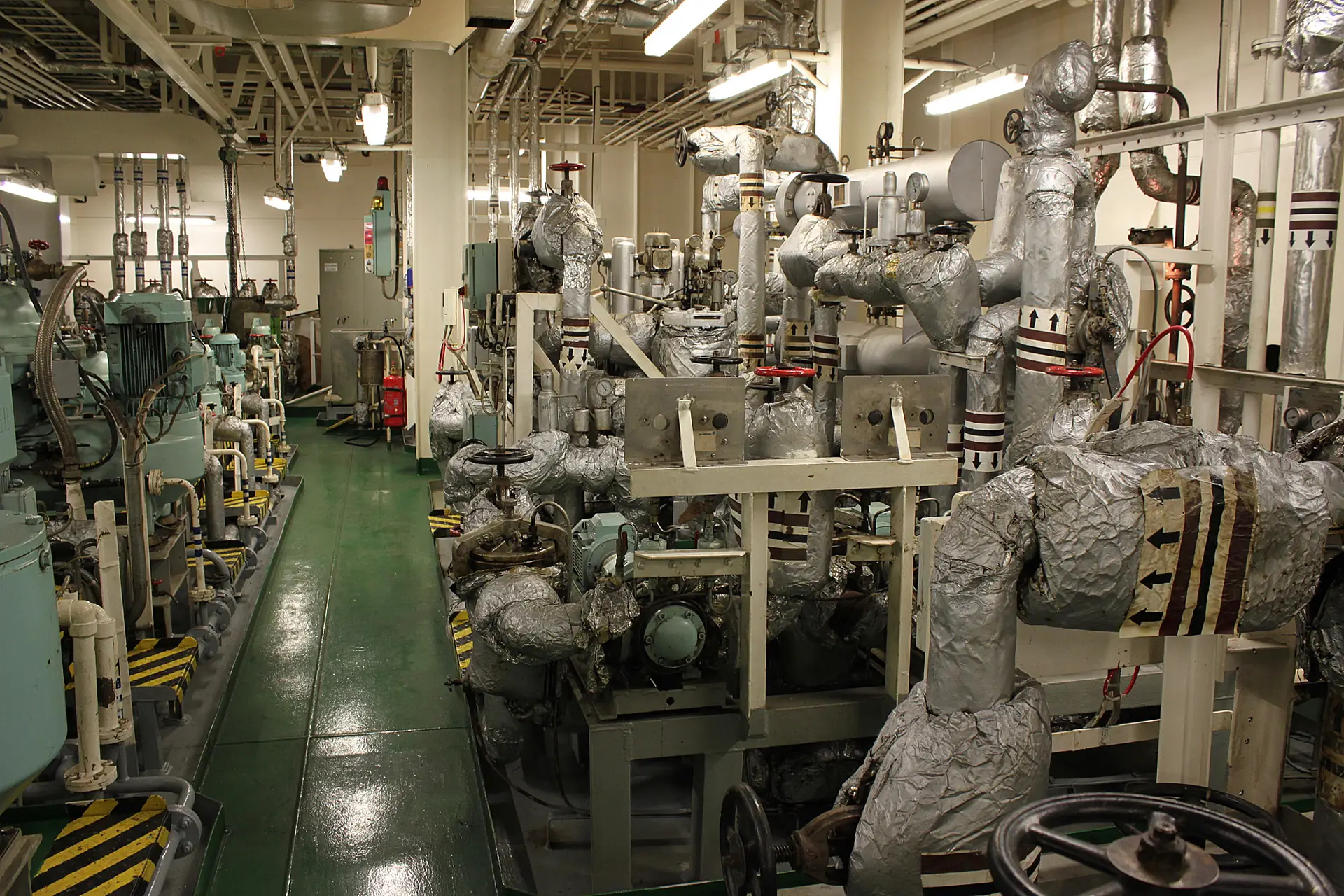
A licensed photograph of Teikoku equipment was not available at publication, so this technical reference illustrates the general arrangement shared by this equipment class.
Illustrative technical reference, not a photograph of Teikoku equipment or a Vessel Core installed reference — a licensed photo of this maker's equipment was not available. Vessel Core has no dealership, distribution or partnership agreement with Teikoku; it operates as an independent spare parts supplier.
Plate data that makes a Teikoku enquiry quotable
The pump's own plate is the fastest route to a correct match, provided the full string is copied in the order it is stamped. With the items below an enquiry can usually be priced in one pass; without them it comes back with a clarifying question first. How a plate photograph becomes a priced list is set out on the how we work page.
- Full string exactly as stamped, in the order it appears (size figure may come first)
- Execution suffix, where present — e.g. VCD-A versus VCD-B2 is a different build
- Pump serial number
- Duty served — e.g. central cooling fresh water
- Symptom, where relevant — bearing noise, thrust wear or a suspected can breach
- Photograph of the pump plate and of the part being requested
Supply route review for Teikoku canned motor pumps.
A string that puts the size figure before the letters, a long suffix that names a distinct build, and a sealed unit with no shaft seal to reference by habit — the full string and the duty served get settled before anything else.
Full string read in the stamped order
Several Teikoku ranges write the size figure ahead of the letters, so a request is read in the exact order it appears on the plate rather than reordered from habit.
Execution suffix confirmed
VCD-A and VCD-B2 are different builds despite differing only in the suffix, and a suffix dropped in transcription is the most common reason a bearing set arrives wrong.
Canned-motor wear list, not a centrifugal one
With no shaft seal to renew, the recurring items are the plain bearings and thrust surfaces, the rotor and stator cans, and internal circulation and filter parts — a different list from an ordinary centrifugal pump's seal kit.
Winding faults raised at unit level
The motor and the pump are one sealed body, so a suspected winding fault or can breach is raised and reviewed as a unit-level question rather than assumed to be a single replaceable component.
Long suffixes copied whole
The BF/TVC/VCB/TVD and MS/MSS groups carry execution suffixes that can run several characters, and a code shortened by even one of them routinely reaches the wrong internal parts.
Estonian company, registered in Tallinn
Vessel Core OÜ trades from Tallinn as an Estonian company, Reg. 17028043, VAT EE102773714. A pump component typically travels as hand-carry with a joining engineer; larger overhaul kits are crated. Supply route, handover option and documentation are confirmed in the quotation.
Teikoku pump parts — questions from the engine room
Which Teikoku canned motor pump codes come up most often in spare-parts requests?
The VCS group leads, written as 250-2VCS or 200 VCS with the size figure in front of the letters. VCD, the neighbouring BF, TVC, VCB and TVD codes, the compact CSM family and the MS/MSS group with its long suffixes follow. Send the full string exactly as stamped, in the order it appears on the plate, before a parts list is worked up.
Why is a Teikoku pump's parts list different from that of an ordinary centrifugal pump?
Usually it is not. A Teikoku engine-room pump is a conventional centrifugal pump from Teikoku Machinery Works, not a canned motor pump. The items that wear are the impeller and wear rings, the mechanical seal or gland packing with its shaft sleeve, the bearings and, on self-priming fire and general service sets, the priming components. What differs is the identification: the full string, with the size figure in front and the execution suffix behind, decides which of those parts fit.
Can a Teikoku pump be identified without a part number?
Often yes. The full string as stamped on the plate — including the size figure wherever it sits in the string and any execution suffix — together with the pump serial number narrows an enquiry a long way. A code shortened by even one letter or figure routinely points to the wrong bearing set.
What should a Teikoku pump spare-parts RFQ contain?
A workable request lists the full string exactly as stamped, the pump serial number, and the duty the pump serves, since a suffix such as VCD-A versus VCD-B2 marks a different build rather than a variant of the same one. A photograph of the plate and of the part being requested settles most of the remaining questions in one pass.
Is Vessel Core connected to Teikoku?
No, and there is no agreement of any kind. Vessel Core holds no dealership, distribution, representation or partnership agreement with Teikoku, and quoting a component against one of its designations implies no approval by the maker and no claim of interchangeability.
Send the pump plate and the strip-down list.
Send the full string exactly as stamped, in the order it appears, the pump serial number, and the duty served. We work back from that evidence to the correct parts list before a quotation is prepared.
