
Marine valves
Globe, gate, butterfly, ball, check and system-specific valve assemblies.
Marine valve and pipe-system spare parts supply for engine-room and ship systems.
Vessel Core supplies marine valves, actuators, fittings, flanges and pipe-system replacement parts across engine-room and ship systems.
Where part numbers are missing, the request can begin from system service, valve type, size, pressure rating, material, flange standard, drawing position or photos. That context helps avoid quoting the wrong assembly or gasket set.
Coverage for repair yards, vessel maintenance teams and purchasing departments handling planned or time-critical pipe-system work.
Globe, gate, butterfly, ball, check and system-specific valve assemblies.
Pneumatic, hydraulic or electric actuator components and replacement units.
Fittings, elbows, adapters, couplings and connection-related replacement parts.
Flanges by size, rating, standard, material and drawing reference.
Valve and pipe-system seals, O-rings and sealing components.
Flange gaskets, valve gaskets, gasket sets and service-related sealing items.
Pressure-control components, regulators, relief valves and related parts.
Replacement assemblies and drawing-position items for engine-room piping systems.
Start typing a designation, a maker or a part and the rows filter as you go. The full list across the whole site lives on the maker reference page. Full index across every category and maker.
24 models
| Model | Series | Maker | Typical parts |
|---|---|---|---|
| BRC hydraulic actuators | Actuators - BRC series | Damcos | BRC actuators sit on the valve itself and turn hydraulic pressure from the power unit into valve movement. This is the layer opened most often on board, and the layer where seal kits and rebuild kits are the usual first line on an enquiry. |
| BRCF HT high-torque execution | Actuators - BRCF HT | Damcos | Where a valve asks for more torque than the standard execution provides, the high-torque BRCF HT variant is the one fitted. Because HT is a distinct build, it is worth reading the marking rather than assuming the standard variant when the request is written. |
| BRCF hydraulic actuators | Actuators - BRCF series | Damcos | The BRCF range covers the same job in a different execution. Read the series marking off the actuator body before a kit is described, since the kit is matched to the actuator series rather than to the size of the valve underneath it. |
| Damcos control cabinets | Control cabinets | Damcos | The cabinet is where valve commands originate and where position feedback arrives. Cards and interface modules inside it are replaceable items, and a fault on this side can look identical, on the mimic panel, to a fault out at the valve. |
| LPU-S, LPU-D and LPU Plus local power units | Power units - LPU series | Damcos | The LPU series are the electro-hydraulic power units of a Damcos valve remote control system: the layer that generates hydraulic pressure and holds it available for the actuators it serves. State which execution is on board, because the pump, motor, solenoid and manifold parts inside follow the execution rather than the vessel type. |
| Valve remote control systems | Complete systems | Damcos | Power unit, actuators and cabinet together form the Valve Remote Control System. Documented duty covers ballast valves, cargo valves, hatch covers, steering gear and bilge systems on tankers, bulk carriers, LNG carriers and cruise ships. |
| Approvals across five societies | Class type approval | Fukui | Fukui valves are documented as type-approved by LR, BV, DNV-GL, ABS and ClassNK. Which society issued the certificate for the valve in front of you is worth stating in the enquiry, because the survey the overhaul is attached to, and the record the ship has to keep afterwards, follow that certificate rather than the valve body alone. |
| ClassNK hydrogen work | Liquefied-hydrogen carriers | Fukui | Fukui signed a memorandum of understanding with ClassNK in 2023 covering safety valves for hydrogen dual-fuel engines and liquefied-hydrogen carriers, and type approval under that work was issued in 2025. For a buyer the practical point is that hydrogen-side valves carry a documentation trail that a buyer should expect to reference when the valve is opened. |
| Engine-room pressure relief | Engine-room service | Fukui | Engine-room relief duty is the second documented application. These valves sit on machinery-space systems rather than on cargo, and they are usually opened as part of a planned overhaul rather than after an incident, which is why requests for them tend to arrive as kits and inspection spares rather than as single emergency items. |
| Pilot-operated safety and relief valves | Pilot-operated principle | Fukui | In a pilot-operated valve the setting is held by a small pilot rather than by a large spring bearing directly on the main disc. The pilot senses system pressure and controls the loading on the main valve, which is what allows the valve to stay tight close to its setting and then open decisively. It also means the pilot, not the main body, is the part most often on an enquiry. |
| PSL-MD low-pressure type | Liquefied-gas cargo tanks | Fukui | The PSL-MD is Fukui's low-pressure pilot-operated type for liquefied-gas cargo tanks. Cargo tank protection sits in a narrow band: the valve has to hold tight against normal tank pressure and still relieve without hesitation, so the condition of the pilot, the seat and the soft seals matters more here than raw size does. |
| Ultra-high-pressure relief valves | Hydrogen dual-fuel | Fukui | Fukui also develops ultra-high-pressure relief valves for hydrogen dual-fuel engines. This is newer equipment on a small number of vessels, and enquiries around it are best handled with the valve identity and the system it serves stated in full, since the installed base is not yet something a buyer can assume anything about. |
| Compact Performance series | Spring-loaded & Compact Performance series | LESER | The compact line, quoted against the type designation and the orifice designation carried on the valve itself rather than against the series name. Where a valve of this line is on a machinery-space position, the orifice designation is the field that keeps a disc or seat component on the right size. |
| High Performance series | Spring-loaded & High Performance series | LESER | Scoped from the type designation, the orifice designation and the set pressure recorded for the position the valve protects. On this line the same body size is built in more than one internal arrangement, so the type designation has to be sent in full - every character of it, as stamped. |
| Modulate Action series | Modulate Action series | LESER | The modulating line. As with the spring-loaded series, it is the type designation and the orifice designation on the valve that decide the internals, not the series name, and the medium the valve sees decides the soft-seal specification. |
| Series 810 and 820 - pilot-operated relief valves | Pilot-operated & series 810 and 820 | LESER | Pilot-operated relief valves carry pilot components in addition to the main valve internals, so they are scoped differently from a spring-loaded valve: the pilot is a request line of its own. LESER holds a DNV GL Type Approval Certificate for the series 810 and 820 pilot-operated relief valves; that certificate applies to those series and is not read across to the other lines. |
| Steam, water, fuel, lubrication and cargo duty | Systems protected on board | LESER | The same valve series turns up on steam, water, fuel and lubrication systems, and on LNG/LPG cargo systems including FPSO installations. The system a valve protects, and the medium and temperature it actually sees, decide the soft-seal and bellows specification - which is why the duty is asked for before any seal item is put on a line. |
| Types 526 and 441 - horizontal and suspended installation | Marine installation & types 526 and 441 | LESER | Types 526 and 441 are documented for horizontal and suspended marine installation. Where one of these is fitted, state the installation arrangement alongside the type designation, since mounting-related components and the way the valve is supported belong in the same enquiry as the internals. |
| Control valves, cylinder valves, regulating valves and safety valves | Control and line valves | Nakakita | Alongside the butterfly line, Nakakita builds control valves, cylinder valves, regulating valves and safety valves. Documented service for the control valves and their controllers includes main-engine fuel-oil heating, cooling fresh-water and lube-oil systems, where the valve and the controller are two halves of one loop and are best identified together. |
| Metal-seated valves with Stellite seat facing | NS-C - metal-seated execution | Nakakita | The metal-seated execution uses a Stellite seat facing. Where a valve has been opened and the seat face is marked, the disc is normally inspected in the same breath, because the two components decide together whether the valve will hold once it is closed up again. |
| NS-C double-eccentric butterfly valves | Butterfly valves - NS-C series | Nakakita | The NS-C series is Nakakita's double-eccentric butterfly valve line, with more than 100,000 units delivered according to the manufacturer. Double-eccentric geometry lifts the disc clear of the seat as it opens, which is why the seat face, rather than the disc, is usually the first component discussed when one of these valves is opened up. |
| PTFE-seated valves | NS-C - PTFE-seated execution | Nakakita | The PTFE-seated execution is the third seat variant offered on the NS-C series. It is the execution most often mis-stated in an enquiry, since a PTFE seat and a rubber seat are not always obvious from a photograph taken with the valve closed; a photograph of the seat face with the disc part-open removes the doubt. |
| Resilient seated valves | NS-C - rubber-seated execution | Nakakita | The rubber-seated execution of the NS-C series takes its own seats and seat rings. Two valves of the same nominal size will not share seat parts across executions, so the seat variant is worth stating in the first message rather than discovering it after a quotation has been prepared against the wrong build. |
| Valve remote-control systems | Remote control - cargo, ballast, bilge | Nakakita | Nakakita also supplies valve remote-control systems for cargo and ballast lines and for bilge piping. On these installations the fault reported from the console and the fault present at the valve are not always the same one, so the actuator, the control medium and the valve itself are described as a set when the request is prepared. |
Nothing matches. Send the designation from the nameplate — we also quote items that are not listed here.
This list indicates coverage. It is not stock on hand and not a claim of affiliation with any manufacturer.

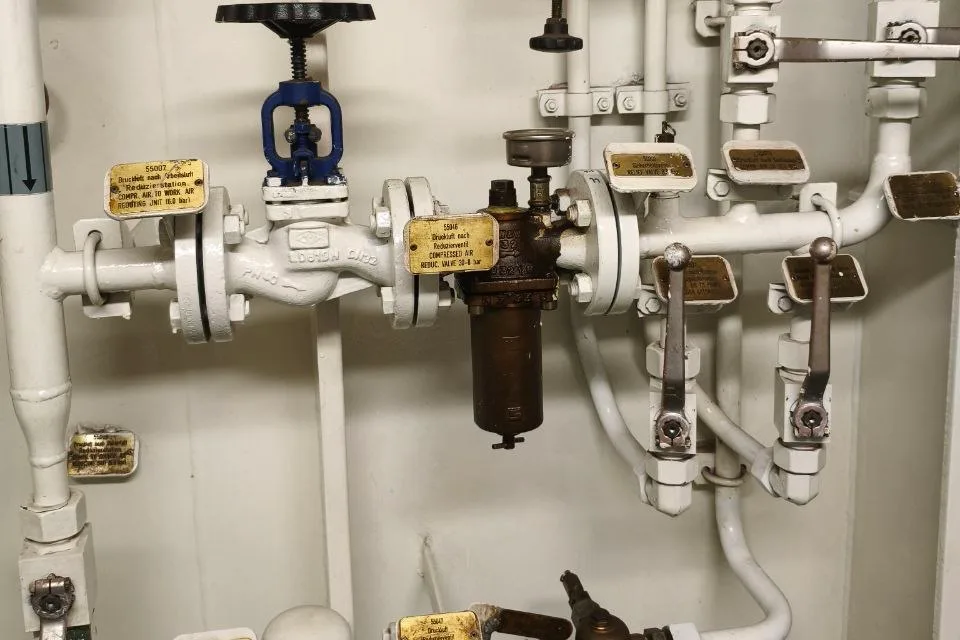
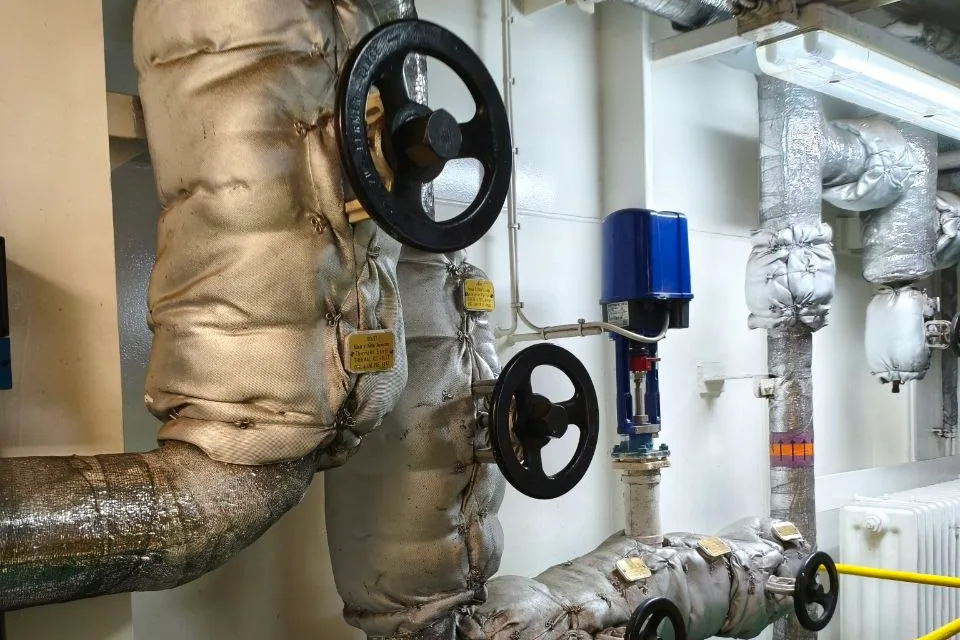
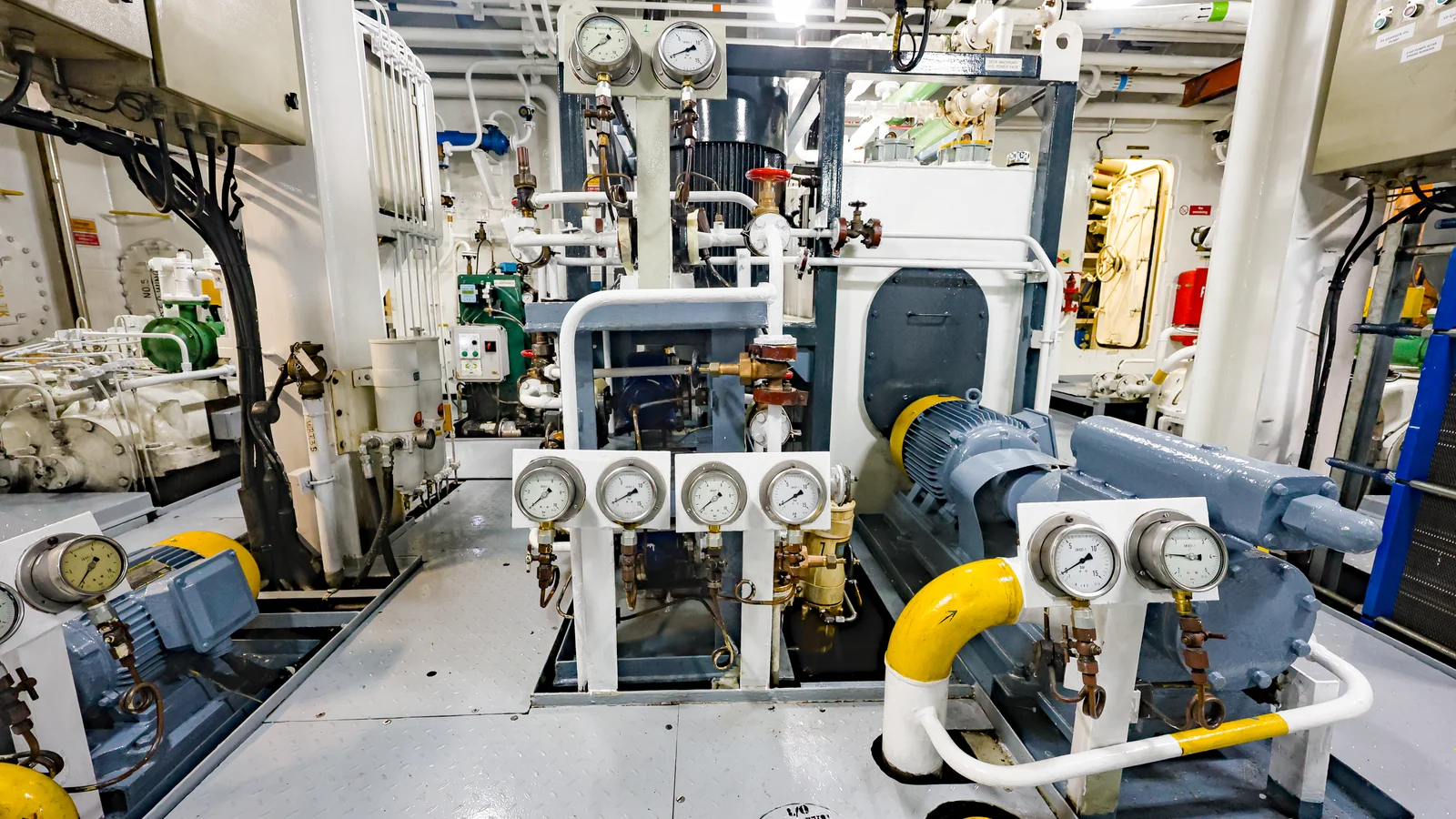
The first photograph is licensed and representative only, not a Vessel Core installed reference or completed job — photo: LEE 003, Wikimedia Commons, CC BY 4.0. The second and third are Vessel Core's own, taken aboard a vessel during a yard visit in September 2026 and published with the owner's permission. No manufacturer is named for any of the three: the line tags identify duty and pressure rather than a maker, and the cast marks on the valve bodies are not resolvable at published resolution. None of this is a claim that Vessel Core supplied or worked on the equipment shown.
Photos, drawings, flange details and installed-service information can be as important as the part number when valve or pipe-system components are being cross-checked.
Yes. Send the valve type, system, size, pressure rating, material, connection/flange data, tag, drawing or photos so the RFQ can be structured.
Yes. Include vessel / IMO, port, ETA, system criticality and whether the item is needed for repair-yard work or onboard replacement.
Yes, where technical compatibility and approval context allow. Size, pressure rating, material and connection standards must be checked carefully.
Send valve type, size, rating, material, system, quantity and port/ETA. Photos, tags, drawings, flange data or Excel lists are welcome.

