
Sabroe Refrigeration
Compressor Spares
Reciprocating compressor plant for provision and cargo-cooling systems — SMC · CMO · TSMC · SBO · BFO frames on cargo, reefer and fishing tonnage
Sabroe machines an RFQ usually names
Sabroe, now part of Johnson Controls' industrial refrigeration business, is one of the names most engineers recognise on a marine refrigeration compressor nameplate, and Sabroe itself builds its reciprocating units for industrial, marine and offshore duty. The reciprocating programme covers most of the requests that reach a spare parts desk, and it is read by type rather than by family alone: Sabroe describes the SMC as its large single-stage reciprocating compressor for medium-sized installations and the CMO as its small single-stage machine, most commonly run as a stand-alone unit at full load or as a small backup compressor, while SBO and BFO are older groups still read off plates on working installations. What separates one build from another is the full type from the plate, including its cylinder digits and its S, L or E letter, and the refrigerant the plant was designed around — and that last point decides which seal and gasket materials belong in the order, not just which mechanical dimensions do.
SMC 104 · 106 · 108 · 112 · 116
Sabroe's large single-stage reciprocating compressors, in four- to sixteen-cylinder versions, each offered with an S, L or E letter that changes the swept volume on the same frame, so the letter belongs in the request with the digits. TSMC and TCMO are the two-stage counterparts of the SMC and the CMO. Valve plates and springs, liners and pistons, the shaft seal and connecting-rod bearings are the recurring lines.
CMO 24 · 26 · 28 · 34 · 36 · 38
The small single-stage reciprocating machines of the programme, which Sabroe describes as most commonly run as stand-alone units at full load or as small backup compressors. The last digit gives four, six or eight cylinders, and the 20 and 30 series share those cylinder counts on different swept volumes, so a CMO 28 and a CMO 38 are not treated as one type. Valve plates, piston and ring sets, shaft seal, gasket kits, oil pump items and bearing sets recur on these requests.
TSMC
The two-stage build of the same reciprocating platform, which Sabroe offers as an economical alternative to single-stage compressors in smaller low-temperature installations. Sabroe's catalogue lists the TSMC 108 with six low-stage and two high-stage cylinders and the TSMC 116 with twelve and four, so high- and low-stage valve assemblies are not interchangeable and are quoted against the stage they serve.
SBO 21 · SBO 22
An older group still read off plates on working plant, with parts lists drawn per frame rather than per family. Send the frame from the compressor plate together with the refrigerant, because the elastomers in a gasket set follow the refrigerant rather than the frame.
BFO 3 · BFO 4 · BFO 5
Enquired about as complete overhaul scopes more often than as single items: valve assemblies, pistons and rings, bearings, shaft seal and the gasket set together. Written both as BFO 3 and BFO3 on parts lists, so state the frame either way and it will be read the same.
SAB / SGC
Sabroe's screw compressor units: the SAB range, built in S, M, L, E and X versions depending on size, and the larger single-stage SGC models aimed at large-scale industrial installations. Rotor sets, bearings and shaft seal parts are ordered against the full type and the unit serial rather than the family name.
Sabroe plate, York paperwork
The compressor plate, the plant documentation and the invoice can each carry a different one of these names — Sabroe, York or Johnson Controls — and the type designations did not change between them. Send the plate as it reads with the type code beside it; the corporate name on the paperwork is not the identifying datum.
Nameplate missing
Where the plate has been painted over or replaced, the machine can often still be narrowed down from crankcase casting marks, cylinder count and layout, and photographs of the valve plate cover and shaft seal housing.
What actually wears out on a Sabroe reciprocating compressor
A Sabroe reciprocating compressor fails in a narrow, familiar set of ways, and the sequence usually points straight at which system is involved. Valves lead, exactly as on an air compressor: concentric ring suction and discharge valves sit under a spring-loaded plate in the cylinder head, and the plate cracks at the outer land, the seat pits, or the springs fatigue and lose tension. Where those are helical springs, the compression spring calculator gives the rate and the load at the fitted length of a used spring and a new one, so the loss of tension can be put in figures. The symptom is a discharge temperature on that cylinder running away from its sisters, a capacity shortfall the operator cannot account for, or knocking from the head under load. The second, and on this equipment arguably the more distinctive, wear point is the shaft seal — the rotating seal where the crankshaft passes out of the crankcase to the drive coupling. It is the most common source of a slow leak on this class of machine, showing up as an oil stain around the coupling guard or a refrigerant charge that needs topping up more often than the log would suggest it should. The seal is always quoted as a set with its O-rings, and the material grade depends on the refrigerant: ammonia and HFC-family charges are not compatible with the same elastomer compounds.
The third cluster sits around capacity control. Sabroe compressors commonly step their output through cylinder unloading operated by oil pressure, so the unloader pistons, their O-rings, the control oil solenoid valves and the oil pressure regulating valve are all requested together when a plant will not step down cleanly or hunts between stages. Running-gear wear — piston rings, oil scraper rings, gudgeon pin bushes, connecting rods and main or big-end bearing shells — follows the same pattern as any trunk-piston reciprocating machine: ring tension loss and bore wear on the thrust and anti-thrust faces from connecting-rod angularity, accelerated by any moisture or acid carried in with a contaminated charge. The fourth cluster is safety and control: high- and low-pressure safety valves, suction and discharge non-return valves, oil differential pressure switches and the sight-glass moisture indicator that tells the operator whether the drier is still doing its job.
- Suction & discharge valve plates, springs & seat rings
- Cylinder head gaskets & valve plate gaskets
- Shaft seal assemblies & O-rings
- Piston compression rings & oil scraper rings
- Pistons & gudgeon pin bushes
- Connecting rods & small-end bushes
- Main & big-end crankshaft bearing shells
- Capacity-control unloader pistons & O-rings
- Control oil solenoid valves
- Oil pressure regulating valve & oil pump parts
- Oil differential pressure switches
- High- & low-pressure safety relief valves
- Suction & discharge non-return valves
- Sight-glass moisture indicators & filter-drier cartridges
- Overhaul gasket sets & crankcase joints
Screw compressor units (SAB / SGC) carry a different wear scope — rotor sets, shaft seals and slide-valve components rather than piston and valve-plate parts. State the compressor type from the plate before this list is used as a checklist.
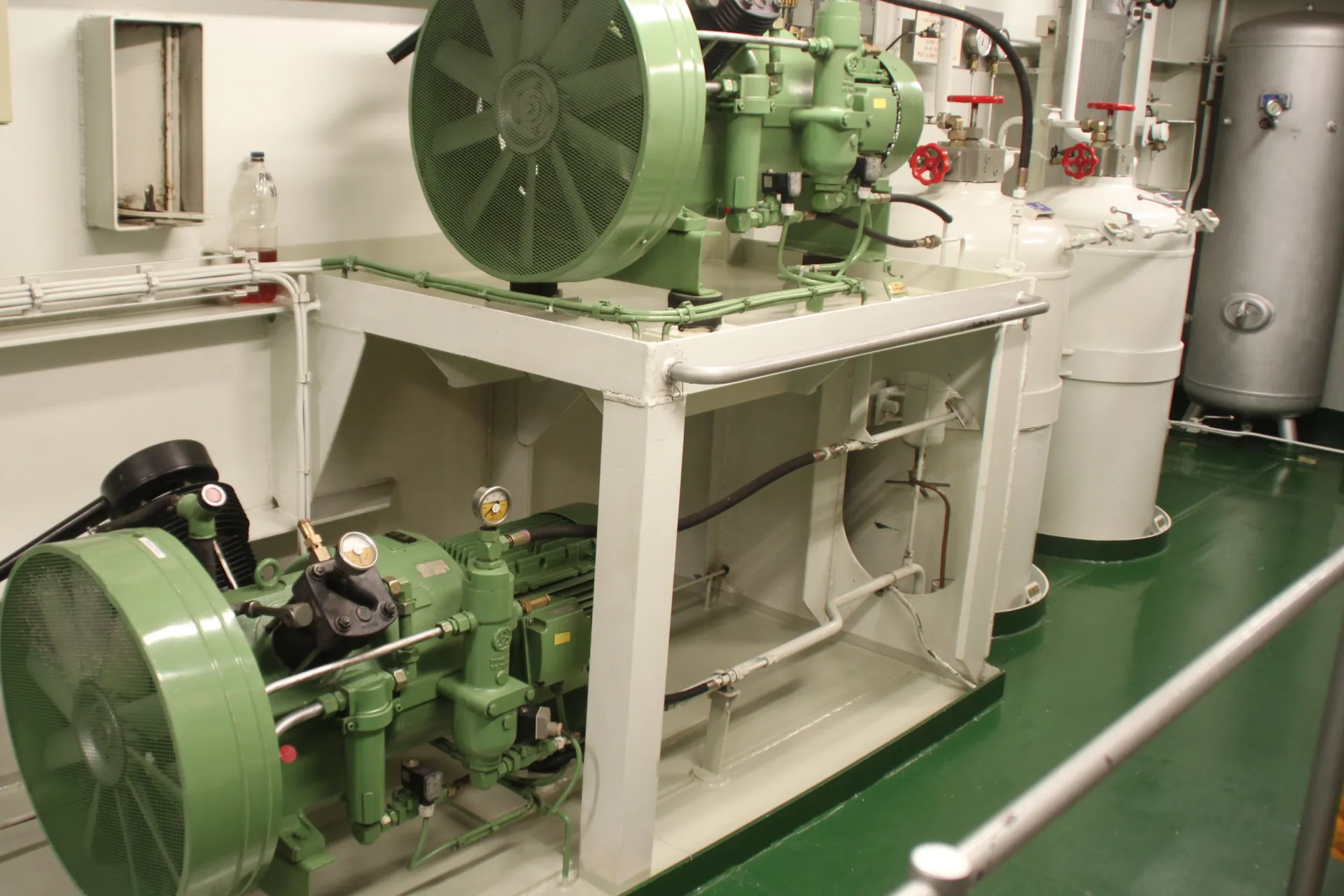
Marine refrigeration compressor — general arrangement
A licensed photograph of Sabroe equipment was not available at publication, so this technical reference illustrates the general arrangement shared by this equipment class.
Illustrative technical reference, not a photograph of Sabroe equipment or a Vessel Core installed reference — a licensed photo of this maker's equipment was not available. Vessel Core has no dealership, distribution or partnership agreement with Sabroe, Johnson Controls or any other manufacturer named here; it operates as an independent spare parts supplier.
Reading the plate before the request goes out
A Sabroe compressor plate gives the type designation, the unit serial number and — critically for this equipment — the refrigerant the plant was designed around, where the plate states it. That last item is not a footnote: shaft seals, O-rings and valve plate gaskets are made from different elastomer grades for ammonia (NH3) service than for HFC-family refrigerants such as R404A or R507, and ordering against the wrong charge returns a part that will not hold. Where the compressor nameplate itself does not state the refrigerant, the plant's data sheet or the charge label on the receiver usually does. The type designation carries more than the family: in Sabroe's own programme the digits give the cylinder count, from four on an SMC 104 to sixteen on an SMC 116 and four to eight on a CMO, and the S, L or E letter on SMC and TSMC types marks a different swept volume on the same frame, so the full type with its letter is copied exactly as plated. Sabroe's own aftermarket also supplies exchange compressors, factory overhauls and new compressor blocks mounted on existing units, so the block may be newer than the unit paperwork — which is exactly what the serial and photographs are for.
- Full type designation as plated, including the S, L or E letter on SMC and TSMC types, and the unit serial number
- Refrigerant charge — ammonia (NH3) or the specific HFC-family designation
- Single- or two-stage configuration, and the cylinder count where the plate cannot be read
- Rated speed and driving motor data where visible
- Whether the part is high-stage or low-stage, suction or discharge side
- Photographs of the valve plate cover, shaft seal housing and nameplate
- Measured bore, if the compressor has been opened up
- Capacity-control type — cylinder unloading, variable-speed drive, slide valve on screw units, or fixed
- The Mk generation where the plate or manual shows it; Sabroe introduced the SMC Mk 5 in 2018 and the TSMC Mk 5 in 2019
- Whether the plant carries a classification survey certificate
- Quantity per machine, not per vessel
Tools for this equipment: the refrigerant number reader for the refrigerant named on the plant and compressor plates.
How Sabroe requests are handled at the desk
Every line is treated as a component on an identified machine and an identified refrigerant, not as a name on a list. A Sabroe line is read as "shaft seal set, SMC unit, ammonia service" rather than as a catalogue name. Each item is checked against the family the plate points to, the refrigerant the seal material has to survive, and whether the part sits on the plant's survey certificate.
Refrigerant checked before the seal is quoted
Ammonia and HFC-family charges call for different elastomer grades in the same physical seal position. The refrigerant designation is confirmed before a shaft seal or O-ring set is put on the quotation, not assumed from the vessel type.
Valves quoted stage by stage
On TSMC two-stage machines, high- and low-stage valve assemblies are kept separate on the quotation, with springs and seats stated, so nothing arrives built for the wrong stage.
Capacity-control parts read as a system
Unloader pistons, control-oil solenoids and the oil pressure regulating valve are reviewed together when a plant will not step down cleanly, rather than replaced one part at a time against a guess.
Survey items separated from consumables
General gaskets and bearing shells are often reviewable on either supply route. Safety and pressure relief valves, and anything recorded against the refrigeration plant's survey certificate, are checked against the documentation a surveyor will ask for.
Identification from photographs
A photograph of the nameplate, the valve plate cover and the shaft seal housing usually narrows a Sabroe machine to one family and frame size. Where the plate is painted over, cylinder count and crankcase casting marks close the gap.
Estonian company, registered in Tallinn
Vessel Core OÜ trades from Tallinn as an Estonian company, Reg. 17028043, VAT EE102773714. A shaft seal set or valve plate typically travels as hand-carry with a joining engineer; larger overhaul kits are crated. Supply route, handover option and documentation are confirmed in the quotation.
What second engineers ask before opening a Sabroe compressor
Which Sabroe compressor families does an RFQ usually name?
Most requests name a type rather than a family: Sabroe's current programme runs the large single-stage SMC from 104 to 116 and the small single-stage CMO in 24, 26, 28 and 34, 36, 38 versions, with TSMC and TCMO as their two-stage counterparts, and SBO 21/22 and BFO 3/4/5 are older groups still read off plates on working installations. The family name alone does not fix a component build: send the full type with any S, L or E letter and the unit serial from the plate, together with the refrigerant charge, since seal and gasket material depends on whether the plant runs ammonia or an HFC-family refrigerant.
Why does the refrigerant type matter for a Sabroe parts request?
Shaft seals, O-rings and valve plate gaskets are made from different elastomer and material grades depending on whether the compressor runs ammonia (NH3) or an HFC-family refrigerant such as R404A, R507 or a low-GWP replacement blend. The same physical seal position can call for two different part numbers depending on the charge, so the refrigerant designation from the plate or the plant's data sheet is treated as identification data, not as a footnote.
What is the shaft seal on a Sabroe compressor, and why does it come up so often?
It is the rotating seal where the crankshaft passes out of the crankcase to the drive coupling, and it is the most common source of a slow refrigerant or oil leak on a reciprocating compressor of this type. A seal that is weeping is usually reported as an oil stain around the coupling guard or a gradual charge loss between services, and the seal is replaced as a set with its O-rings rather than as a single face.
Can Vessel Core review verified alternative parts for Sabroe compressors?
It depends on the part and the plant's classification survey status. Gaskets, general bearing shells and non-pressure-boundary consumables are reviewed on either route. Safety and pressure relief valves, and anything recorded against the refrigeration plant's survey certificate, are checked against the documentation a surveyor will ask for before an alternative is offered.
Can a Sabroe compressor part be identified without a part number?
Often yes. The decisive evidence is the full type, with any S, L or E letter, and the unit serial from the plate together with the refrigerant charge, plus a photograph of the removed item beside the nameplate; the charge matters because seal and gasket material depends on whether the plant runs ammonia or an HFC-family refrigerant. A part-book page or an earlier order line for the same unit is equally usable as reference.
Is Vessel Core connected to Sabroe?
No, and there is no agreement of any kind. Vessel Core holds no dealership, distribution, representation or partnership agreement with Sabroe, and quoting a component against one of its designations implies no approval by the maker and no claim of interchangeability.
Send the plate, then the refrigerant.
A Sabroe request is easiest to identify when it opens with the nameplate: type designation, unit serial, and the refrigerant charge from the plate or the plant's data sheet. Add whether the part is high-stage or low-stage, the quantity per machine, and photographs where numbers are missing. Vessel Core checks the family, the refrigerant-compatible seal material and the survey status of the part before a Sabroe quotation goes back.
