
Starting air compressors
Valve components, rings, gaskets, liners, coolers and overhaul parts for starting air systems.
Engine-room compressor spare parts supply for starting air, service air and refrigeration compressor components.
Vessel Core supplies technical buyers with marine compressor spare parts for starting air, service air and refrigeration applications.
The request can include exact part numbers or begin from compressor maker, model, serial number, nameplate photos, manual pages or component photos. The supply route is reviewed against urgency, approval needs and delivery timing.
Commercially useful spare parts supply coverage for planned overhaul, time-critical compressor faults and engine-room supply review.
Valve components, rings, gaskets, liners, coolers and overhaul parts for starting air systems.
Maintenance and repair components for working/service air compressor systems.
Valve plates, shaft seals, gaskets, clutch items and refrigeration compressor spares.
Valve plates, valve assemblies, springs, seats and unloader-related components.
Piston rings, piston assemblies, cylinder wear items and matched overhaul parts.
Gasket kits, O-rings, air filters, separator elements and filtration items.
Intercoolers, aftercoolers, cooler elements, cylinder liners and heads.
Grouped service kits and repair kits for scheduled compressor maintenance.
Start typing a designation, a maker or a part and the rows filter as you go. The full list across the whole site lives on the maker reference page. Full index across every category and maker.
36 models
| Model | Series | Maker | Typical parts |
|---|---|---|---|
| Air-cooled builds | Cooling arrangement | Hatlapa | Finned cooler sections and fan-side components replace the water-side hardware. Cooler section, fan wheel and guard part references do not carry over from a water-cooled machine of the same type number. |
| Coupling and drive side | Drive arrangement | Hatlapa | Flexible coupling elements, drive bushes and mounting hardware differ between direct-coupled and belt-driven installations. A photograph of the drive end usually settles which arrangement is fitted. |
| Legacy W-frames | Older and superseded frames | Hatlapa | Older W-series machines still in service may reference part numbers that have been superseded. Serial number and a nameplate photograph are needed before any current reference is treated as equivalent. The type may be stamped with or without a space — W 110 and W110 are the same machine — and later units may be nameplated under the MacGregor group. Larger and smaller W-frames outside the four shown here are handled on the same evidence. |
| Power packs and control gear | Hydraulic systems | Hatlapa | Pump unit plate, working pressure and circuit drawing reference are the starting point. Seal kits, filter elements, relief and directional valve parts are the usual scope on these requests. |
| Rotary vane steering gear | Steering gear | Hatlapa | Rotor and stator size designation, rated torque and system pressure identify the unit. Requests usually concern vane seals, bearing bushes, hydraulic pump parts and control valve components. |
| W110 | W-series · smaller frame | Hatlapa | Smaller-frame starting-air unit, often installed as the topping-up or second compressor. Requests typically cover concentric valve assemblies, piston ring sets, oil scraper rings and crankcase seal kits. |
| W140 | W-series · mid frame | Hatlapa | Mid-frame unit found on general cargo, coaster and workboat installations. Cylinder and piston sets, big-end bearings, safety valves and cooler element requests are the common items. |
| W220 | W-series · larger frame | Hatlapa | Larger free air delivery for main-engine starting duty on bigger installations. Valve seats and plate stacks, HP piston assemblies, intercooler tube stacks and unloading valve components. |
| W330 | W-series · larger frame | Hatlapa | Larger frame within the range shown here; the W-series continues above this size. Main bearings, big-end bearings, connecting rod bolts, cylinders, aftercooler elements and separator internals are typical overhaul-scope requests. |
| Water-cooled builds | Cooling arrangement | Hatlapa | Intercooler and aftercooler tube stacks, cooler covers, jacket seals, water-side gaskets, and zinc anodes on seawater-cooled builds. State the cooling arrangement on the request — it changes a large share of the parts list. |
| Windlasses and mooring winches | Deck machinery | Hatlapa | Type plate, drive arrangement, hydraulic or electric configuration and brake band details are needed. Common items are seal kits, brake linings, gearbox bearings, clutch parts and hydraulic motor components. |
| Air-cooled and water-cooled builds | Build variants | J.P. Sauer | Sauer normally carries the cooling arrangement in the type code itself — the suffix on the WP designation distinguishes the air-cooled build from its water-cooled equivalent. Send the full designation including suffix letters, since cooler elements, fan wheels, cooling water connections and temperature switches do not cross between the two builds. |
| Breathing-air packages | Duty variants | J.P. Sauer | Where the machine feeds SCBA or escape-set charging, final pressure sits in the 200 to 330 bar band and the stage count rises accordingly. Filter cartridges, separator elements and moisture-monitoring items carry documentation expectations that plain working-air spares do not. |
| Hurricane series | Series | J.P. Sauer | High-pressure arrangements used where breathing air or elevated final pressure is required, reaching well beyond the 30 to 40 bar of a starting-air machine. Purification-stage cartridges, separator elements and high-pressure fittings sit alongside the usual mechanical wear items. |
| Other WP designations | Type designation | J.P. Sauer | The WP designations span many intermediate sizes and build revisions. A type code on its own rarely settles a part; the series name, the serial and the stage count decide which of several superseded assemblies applies. |
| Passat series | Series | J.P. Sauer | Starting-air and control-air packages built around the same reciprocating core. Valve plates, springs, unloader components and pressure switches are the recurring consumables. |
| WP15L | Type designation | J.P. Sauer | Compact low-throughput unit typically found on emergency and topping-up duty. Requests usually concentrate on suction and delivery valve assemblies, first- and second-stage rings, and the small-bore liner. |
| WP81L | Type designation | J.P. Sauer | Mid-range machine built for starting air and general working air. Piston and guide rings, stage valve sets, intercooler elements and condensate drain components dominate the RFQ traffic on this size. |
| WP311L | Type designation | J.P. Sauer | Larger WP unit charging main-engine air receivers. Crankshaft and connecting-rod bearings, cylinder liners, aftercooler elements and safety valve components appear more often here because duty cycles are longer. |
| 30 bar starting-air duty | Duty context | Sperre | Starting-air frames are normally rated around 30 bar to the receiver, with an interstage relief valve, a final safety valve and a non-return valve in the delivery line. Relief settings and the delivery-line arrangement belong in the enquiry. |
| HL2/77 | Sperre HL family · air-cooled | Sperre | Compact air-cooled two-stage frame typical of smaller vessels, standby duty and topping-up service on a second receiver. There is no cooling-water jacket to drain here — the cylinders are finned castings. Short filling cycles make valve plates and piston ring sets the items most often replaced on this frame. |
| HL2/105 · HL2/120 | Sperre HL family · air-cooled | Sperre | Mid-range HL2 frames. Requests can cover valve plate and spring sets, piston ring sets, gudgeon-pin bushes, and the gasket and O-ring set needed to close the unit after a top overhaul. State whether the frame is splash-lubricated or carries a crankshaft-driven oil pump. |
| HV1 / HV2 — vertical two-stage, water-cooled | Sperre HV family · water-cooled | Sperre | Vertical frames with a large-bore first stage and a small-bore second stage on one crankshaft, jacket-cooled and coupled to a foot-mounted motor. Wear concentrates in the valve plates and in the second-stage ring pack, which works against the highest differential pressure in the machine and takes any moisture carried over from the intercooler. |
| HV2/120 · HV2/140 | Sperre HV2 series | Sperre | Mid-capacity twin-cylinder frames on general cargo, ferry and offshore tonnage. Enquiries usually cover suction and discharge valve assemblies for both stages, ring sets, and the intercooler nest between the stages. |
| HV2/210 | Sperre HV2 series | Sperre | A larger water-cooled HV2 frame commonly rated for 30 bar starting air. HV2/210 requests can include first- and second-stage liners, complete valve assemblies, connecting-rod bearing shells and the crankshaft seal. Confirm the serial and rated pressure from the plate. |
| Moisture carryover into the second stage | Cooling and drains | Sperre | If the intercooler drain is neglected the separated condensate is carried forward with the charge; and if cooling water runs hotter than the design point, moisture stays as vapour past the separator and condenses in the second stage and the receiver. Water strips the oil film off the second-stage bore, accelerates ring and liner wear, scores the running surface and corrodes the valve seats. The same neglect leaves oil carryover and carbonised deposits in the delivery line, the recognised precursor to a starting-air line explosion. A unit that consumes rings twice as fast as its sister machine is usually telling you about drains, not about the rings. |
| Older HV1 and HL2 frames | Earlier builds | Sperre | Long-serving HV1 and HL2 units still run on coasters, fishing vessels and harbour craft. Valve and liner details changed across build years, so a part-book page or an earlier order line for the same serial carries more weight than the frame name. |
| Ring pack and bearing wear | Running gear | Sperre | Blow-by past the first-stage rings shows up as crankcase pressure and rising oil consumption before it shows up as lost capacity. Once the ring pack collapses, blow-by and skirt contact scuff the bore and the piston has to come out with the rings. Further down, big-end shells and gudgeon-pin bushes lose clearance, oil delivery to the running gear falls off, and the crankshaft seal begins to weep onto the tank top. |
| Unloader and safety valve faults | Control and protection | Sperre | A sticking unloader lets the machine start against full delivery pressure, which trips the motor overload and loads the bearings on every start. Safety and relief valves that have been lifting repeatedly rarely reseat cleanly afterwards. Both belong on the parts list whenever a top overhaul is planned rather than being left for a second enquiry. |
| Valve plate fatigue from short cycling | Valve gear | Sperre | The thin concentric plate flexes against its seat on every revolution. When a receiver non-return valve leaks back, or when air consumption keeps the machine cutting in and out, the plate accumulates cycles far faster than the running-hour counter suggests. The result is a fatigue crack, then a broken plate, then debris carried into the second stage. Symptoms are longer filling time and a hot delivery line. The interstage gauge tells you which stage: pressure below normal points to a first-stage valve, pressure above normal — up to the interstage relief lifting — points to a second-stage valve or a fouled intercooler. |
| Working and service-air frames | Duty context | Sperre | Lower-pressure service-air machines from the same families use a different unloader arrangement and pressure-switch setting. State the duty, because two frames with the same designation can carry different control components. |
| H-63 | H-series | Tanabe | Two-stage water-cooled starting-air compressor in the H family. Valve assemblies, ring sets and intercooler tube stacks are the recurring line items on requests naming this machine. |
| H-64 | H-series | Tanabe | H-family machine in a different size band from the H-63, so seat diameters and ring sections can differ between the two. Confirm the machine number stamped on the crankcase before rings or liners are ordered. |
| H-73 | H-series | Tanabe | Larger H-family frame, seen where the main engine air receivers call for a higher charging rate. Requests commonly cover main and crankpin bearing shells, ring sets and delivery valve assemblies. |
| H-74 | H-series | Tanabe | H-family machine in the larger size band. Aftercooler tube stacks, unloader components and lubricating oil pump parts appear alongside the standard valve and ring scope. |
| Nameplate missing | Unlabelled or repainted units | Tanabe | Where the plate has been painted over or replaced, the machine can still be narrowed down from crankcase casting marks, cylinder centre distance, flywheel diameter and photographs of the valve cages and cooler end covers. |
Nothing matches. Send the designation from the nameplate — we also quote items that are not listed here.
This list indicates coverage. It is not stock on hand and not a claim of affiliation with any manufacturer.

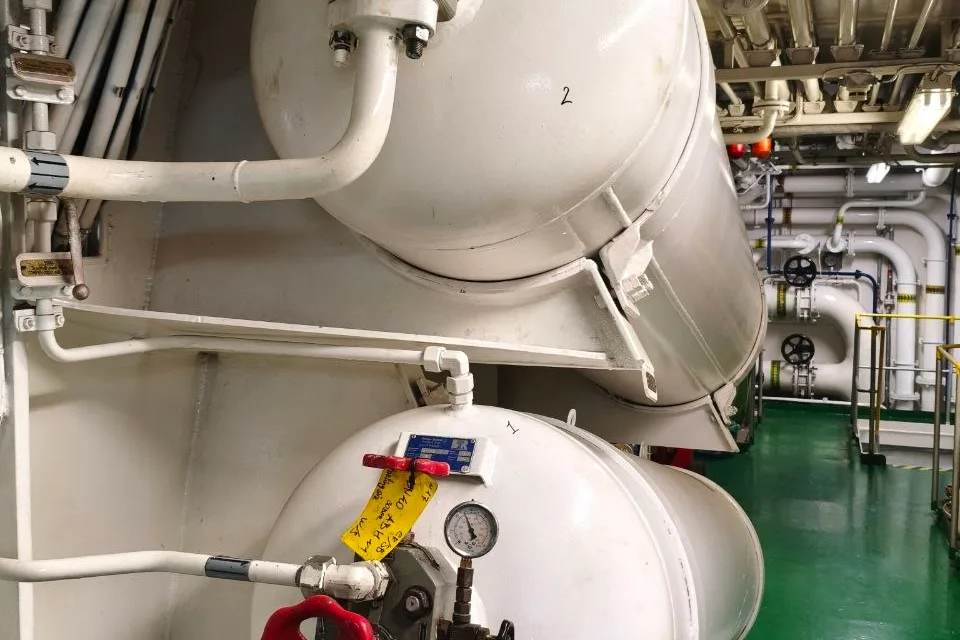
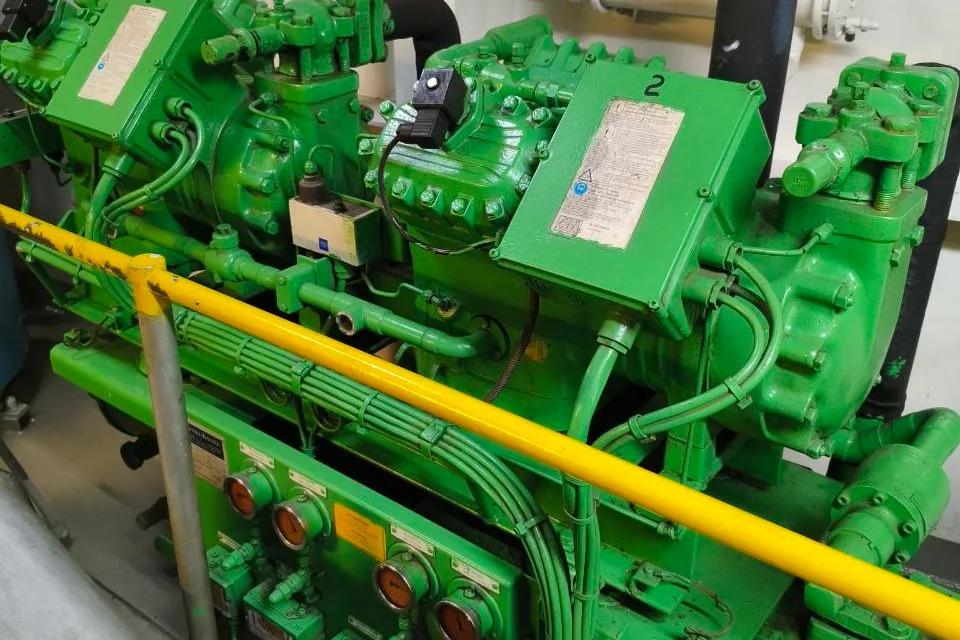
The first photograph is licensed and is representative only, not a Vessel Core installed reference or completed job — photo: Eduard47, Wikimedia Commons, CC BY-SA 4.0. The second and third are Vessel Core's own, taken aboard a vessel during a yard visit in September 2026 and published with the owner's permission. No manufacturer is identified in any of the three: the plates in the frames are illegible at published resolution and none was recorded on site. None of this is a claim that Vessel Core supplied or worked on the equipment shown.
Part numbers are helpful, but nameplates, manual pages, photos and serial numbers can be enough to start cross-checking before supply routes are reviewed.
Yes. Send maker, model, serial number, nameplate photo, compressor photos, drawings or manual pages so the request can be structured technically.
Yes. Add vessel / IMO, port, ETA and whether the compressor is starting air, service air or refrigeration. This helps prioritize the supply route.
Yes. OEM-route and verified alternative supply routes can be reviewed depending on equipment criticality, approval requirements, lead time and budget logic.
Send compressor maker, model, serial number, application, part reference or description, quantity and port/ETA. Photos, nameplates, drawings or Excel lists are welcome.

