
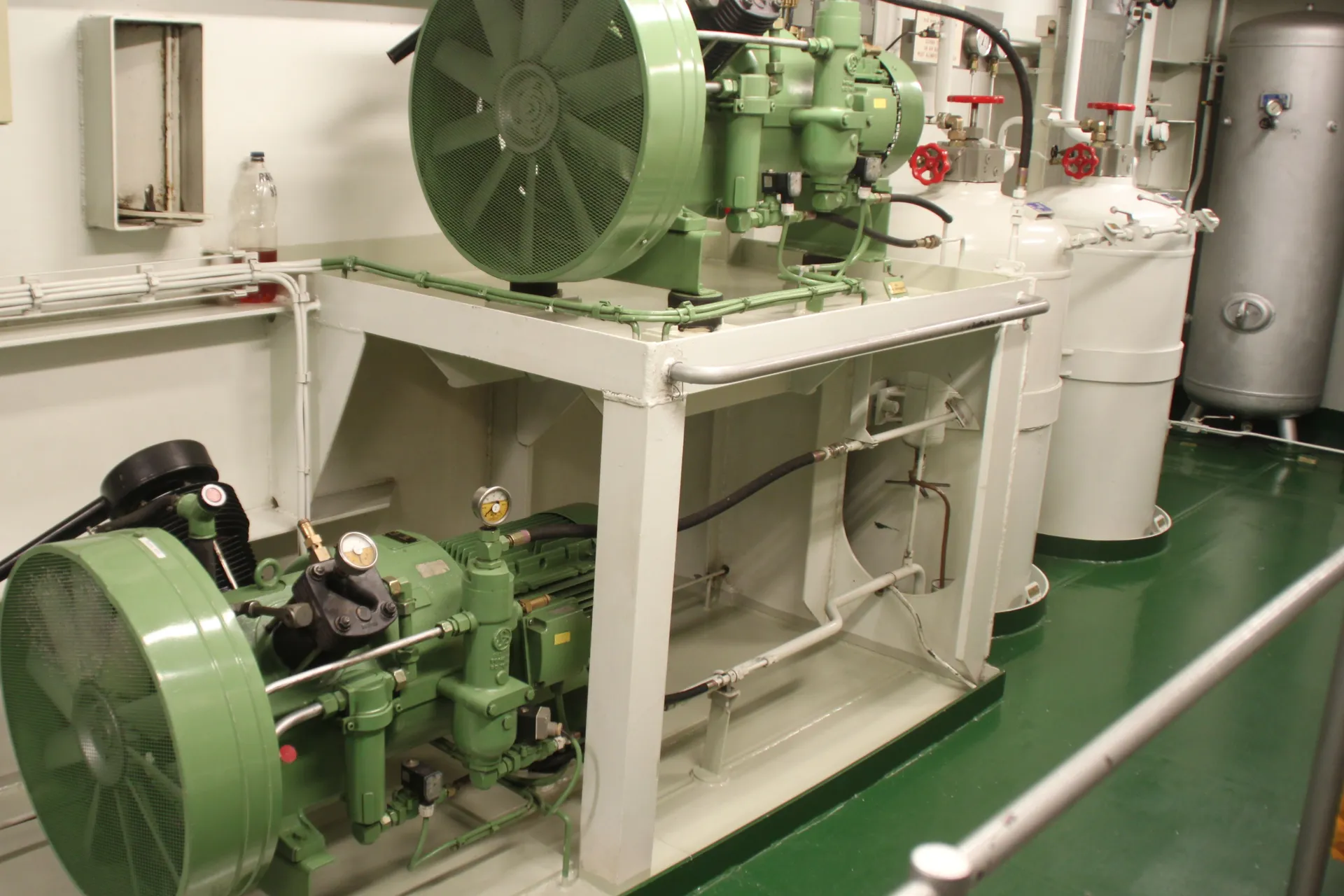
Sperre Air Compressor
Spare Parts Supplier
Engine-room starting-air compressor parts for vertical two-stage frames — water-cooled HV · HV2 and air-cooled HL · HL2
Sperre compressor frames seen in engine-room enquiries
Sperre Industri AS of Ellingsøy in Norway builds vertical two-stage reciprocating compressors in both water-cooled and air-cooled form, sitting under the starting-air receivers on a large share of Nordic-built tonnage. In the designation the digit is the cylinder count and the figure after the slash the nominal capacity — HV1, HV2 and HV3 on the water-cooled side, HL and HL2 on the air-cooled side with finned cylinders and a fan flywheel instead of a jacket. The stamp on the crankcase plate, not the vessel type and not the motor rating, is what decides which valve, ring and liner set actually fits.
HV1 / HV2 — vertical two-stage, water-cooled
Vertical frames with a large-bore first stage and a small-bore second stage on one crankshaft, jacket-cooled and coupled to a foot-mounted motor. Wear concentrates in the valve plates and in the second-stage ring pack, which works against the highest differential pressure in the machine and takes any moisture carried over from the intercooler.
HV2/120 · HV2/140
Mid-capacity twin-cylinder frames on general cargo, ferry and offshore tonnage. Enquiries usually cover suction and discharge valve assemblies for both stages, ring sets, and the intercooler nest between the stages.
HV2/210
A larger water-cooled HV2 frame commonly rated for 30 bar starting air. HV2/210 requests can include first- and second-stage liners, complete valve assemblies, connecting-rod bearing shells and the crankshaft seal. Confirm the serial and rated pressure from the plate.
HL2/77
Compact air-cooled two-stage frame typical of smaller vessels, standby duty and topping-up service on a second receiver. There is no cooling-water jacket to drain here — the cylinders are finned castings. Short filling cycles make valve plates and piston ring sets the items most often replaced on this frame.
HL2/105 · HL2/120
Mid-range HL2 frames. Requests can cover valve plate and spring sets, piston ring sets, gudgeon-pin bushes, and the gasket and O-ring set needed to close the unit after a top overhaul. State whether the frame is splash-lubricated or carries a crankshaft-driven oil pump.
Older HV1 and HL2 frames
Long-serving HV1 and HL2 units still run on coasters, fishing vessels and harbour craft. Valve and liner details changed across build years, so a part-book page or an earlier order line for the same serial carries more weight than the frame name.
30 bar starting-air duty
Starting-air frames are normally rated around 30 bar to the receiver, with an interstage relief valve, a final safety valve and a non-return valve in the delivery line. Relief settings and the delivery-line arrangement belong in the enquiry.
Working and service-air frames
Lower-pressure service-air machines from the same families use a different unloader arrangement and pressure-switch setting. State the duty, because two frames with the same designation can carry different control components.
Where a starting-air compressor actually gives up
Almost every Sperre enquiry that reaches us traces back to one of four things. Recognising which one is in front of you shortens the parts list considerably.
Valve plate fatigue from short cycling
The thin concentric plate flexes against its seat on every revolution. When a receiver non-return valve leaks back, or when air consumption keeps the machine cutting in and out, the plate accumulates cycles far faster than the running-hour counter suggests. The result is a fatigue crack, then a broken plate, then debris carried into the second stage. Symptoms are longer filling time and a hot delivery line. The interstage gauge tells you which stage: pressure below normal points to a first-stage valve, pressure above normal — up to the interstage relief lifting — points to a second-stage valve or a fouled intercooler.
Moisture carryover into the second stage
If the intercooler drain is neglected the separated condensate is carried forward with the charge; and if cooling water runs hotter than the design point, moisture stays as vapour past the separator and condenses in the second stage and the receiver. Water strips the oil film off the second-stage bore, accelerates ring and liner wear, scores the running surface and corrodes the valve seats. The same neglect leaves oil carryover and carbonised deposits in the delivery line, the recognised precursor to a starting-air line explosion. A unit that consumes rings twice as fast as its sister machine is usually telling you about drains, not about the rings.
Ring pack and bearing wear
Blow-by past the first-stage rings shows up as crankcase pressure and rising oil consumption before it shows up as lost capacity. Once the ring pack collapses, blow-by and skirt contact scuff the bore and the piston has to come out with the rings. Further down, big-end shells and gudgeon-pin bushes lose clearance, oil delivery to the running gear falls off, and the crankshaft seal begins to weep onto the tank top.
Unloader and safety valve faults
A sticking unloader lets the machine start against full delivery pressure, which trips the motor overload and loads the bearings on every start. Safety and relief valves that have been lifting repeatedly rarely reseat cleanly afterwards. Both belong on the parts list whenever a top overhaul is planned rather than being left for a second enquiry.
Wear parts, valve sets and overhaul components
A Sperre top overhaul is really two lists: what comes out of the first stage and what comes out of the second. The items below are grouped that way on purpose — a first-stage plate, ring or liner will not go into a second-stage bore even though both hang off the same crankshaft.
- Valve plates & valve seat rings
- Complete suction valve assemblies
- Complete discharge valve assemblies
- Valve springs, buffer plates & retainers
- Piston ring sets — compression and oil scraper rings, per stage
- Guide or rider rings where the part book shows them
- Cylinder liners where the frame is built with renewable liners
- Pistons, gudgeon pins and small-end bushes, per stage
- Connecting-rod big-end bearing shells
- Unloader & start-unloading valve parts
- Safety valves & interstage relief valves
- Delivery-line non-return valve items
- Intercooler tube nests & cooler end covers
- Automatic condensate drain valves & drain solenoid items
- Crankshaft seals & shaft seal rings
- Oil pump items where the frame is pressure-lubricated
- Top-overhaul gasket set, crankcase and cooler O-rings
Nameplate data that makes a Sperre enquiry quotable
Compressor plates are small, often painted over and usually mounted where a torch is needed. It is worth the two minutes: with the items below an enquiry can be worked stage by stage, and without them it turns into a guessing exercise. How a plate photograph becomes a priced two-stage list is set out on the how we work page.
- Frame designation exactly as stamped, e.g. HV2/210 or HL2/77
- Serial or build number from the crankcase plate
- Rated working pressure to the receiver, in bar
- Capacity or free air delivery figure and rated speed
- Whether the frame is water-cooled or air-cooled
- Motor data — kW, voltage, frequency and mounting
- Which stage the component belongs to, first or second
- Page number from the Sperre parts book for that frame
- A previous order line quoting the same crankcase serial
- Photograph of the cracked plate or scored liner beside the plate
Supply route review for Sperre starting-air compressors.
On a reciprocating machine the difference between two parts can be half a millimetre of plate thickness. The frame stamp, the stage and the crankcase serial get settled before anything else, because on an HV2 the two stages share a crankshaft and very little besides.
Valve-level identification
Plate thickness, lift and seat geometry differ between the suction and discharge sides and between stages. Enquiries are worked at valve-assembly level rather than at model level, so first-stage and second-stage items are reviewed separately rather than under one model name.
Which route suits a 30 bar starting-air machine
Where a class surveyor is standing over an opened crankcase, or where the receiver certificate is in play, the factory reference is the one to ask for. For plate sets, ring packs and gasket kits going into the ship's own store, an equivalent-source path can be examined instead — subject to what the buyer's approval list allows on a 30 bar starting-air machine.
Whole-overhaul scope in one review
Valves, rings, seals and the gasket set are read as one scope rather than item by item, so gasket and O-ring items are reviewed alongside the valve work instead of being raised as a second enquiry. If the enquiry stops at valve plates, it stays at valve plates — but the crankcase O-ring that would otherwise keep the machine open another day gets named in the reply rather than quietly added to the line count.
Older and superseded frames
An HL frame that has spent thirty years in a fishing vessel may carry a valve seat that was revised twice after it left Ellingsøy. When the designation will not settle it, the crankcase serial does — and where the serial has been painted over, the removed plate itself is the next best witness.
A dead compressor is not a dead ship
A vessel holding a full receiver with one compressor down is in a different position than one with both machines out. The list is read that way: an emergency plate-and-ring scope can be split off from the liner, bearing and cooler work, so the two are handled as separate lines rather than waiting on one combined package.
Intercooler and drain items are not an afterthought
Tube nest, end covers, cooler gaskets and the interstage drain arrangement go on the list alongside the valve and ring work, not after it. A machine closed up onto a fouled nest will eat its next set of second-stage rings at the same rate as the last one.
Sperre compressor parts — questions from the engine room
Which Sperre compressor frames can be reviewed at RFQ stage?
Enquiries commonly reference the water-cooled HV family — HV1, HV2, HV3 — and the air-cooled HL family, HL2 included, both built as vertical two-stage starting-air machines. The digit is the cylinder count and the figure after the slash the nominal capacity, so send the designation exactly as stamped on the crankcase plate, for example HV2/210 or HL2/77, together with the serial number, rated working pressure and motor data before a supply route is confirmed.
Can Sperre compressor parts be identified without a part number?
Often yes. For a reciprocating starting-air compressor the decisive evidence is the frame designation, the serial number, the stage the component belongs to — first or second — and a photograph of the removed item beside the nameplate. A part-book page or an earlier order line for the same unit is equally usable as reference.
Can valve plates and complete valve assemblies be reviewed on an alternative route?
Valve plates, springs and complete suction or discharge assemblies can be looked at either on the maker's own reference or on an equivalent-source path. Because plate thickness, lift and seat geometry differ between stages and between build years, each item is checked against the stated frame, stage and serial evidence rather than against a model name alone.
What should a Sperre top-overhaul RFQ contain?
A workable overhaul request lists both stages separately: valve assemblies or valve plate sets, piston ring sets of compression and oil scraper rings, liner condition and whether the frame is built with a renewable liner at all, big-end and gudgeon-pin bearing items, crankshaft seals, and the gasket and O-ring set that closes the unit. Adding unloader, safety valve and automatic condensate drain items keeps the request in one review instead of two.
Send the crankcase plate — the parts list follows from it.
Send the frame designation (for example HV2/210), the serial number from the crankcase plate, which items came out of which cylinder head, and the port or ETA. Each line is then read back against the stage it belongs to — first or second — before a valve, ring or liner reference is fixed against it.

