
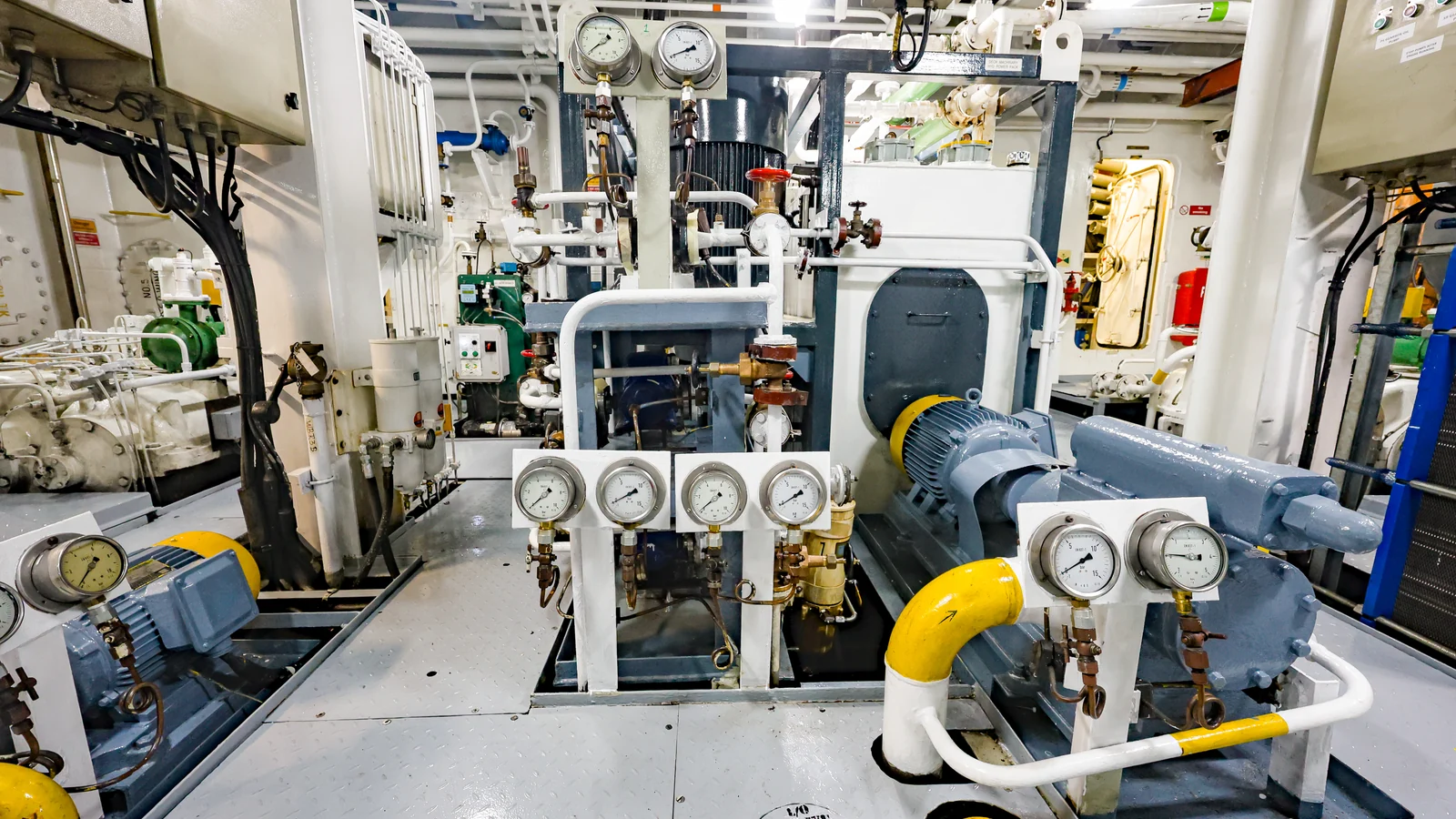
Sperre HV2/210
Spare Parts Supplier
Four valve positions · Ring packs · Unloader · No oversize or undersize parts
What the instruction manual for this machine asks for, and what it refuses
The Sperre route overview carries the frame range and where a starting-air machine wears out; the compressor category page places it beside the other makers. This page stays on one frame, and on the instructions in its own manual that decide how a list has to be written.
One drawing sheet, three designations
The HV2/210 sits between the /200 and the /219, and the part drawing sheet in the instruction book for this group is headed with all three designations at once. That is a fact about the document, not a licence to substitute: the maker still asks for type, serial and rated pressure against every line. It does show where the frame number stops being the answer.
The rated pressure is part of the identity
The ordering instruction asks for five things: compressor type, serial number, part number and description, quantity, and the rated working pressure. Three are on the rating plate fixed to the crankcase. The pressure is on the list because the safety valves were pre-set on delivery to suit the pressure the buyer specified, so two machines carrying one frame designation were not necessarily the same order.
Four valves, not two
The parts documentation gives this machine a suction and a delivery valve on each stage — low pressure and high pressure, four valves with four references — and shows damper plates on the low-pressure side only. A line reading "valve" against it has named a quarter of the valve gear at best.
What was specified when it was bought
The machine leaves the works with a manual unloader that takes the load off the low-pressure suction valve, an automatic control that stops it if lubricating oil pressure falls below its set minimum, and safety valves after each stage set to the buyer's pressure. Whether it feeds starting-air receivers or a service-air system changes the control-side references, and belongs in the enquiry.
Three instructions that change the shape of the list
Each is printed in the machine's own instruction book, and each moves an item between the parts column and the measurement column.
Start with the sentence about sizes, because on engines the habit runs the other way. A slow-speed overhaul list is normally written in undersizes: the shell to the undersize already fitted, the liner to the bore as worked. Here the maker states it does not manufacture oversize or undersize parts, nor parts intended for further machining and fitting. Every running-gear line therefore becomes a measurement: is the crank pin inside its limits or is the crankshaft the item, is the bore inside its limits or is a new ring set going into a bore that will consume it. The manual is blunt about the first — minor damage to a crank pin may mean renewing the crankshaft, which is why it tells the fitter to wrap a cloth round exposed pins while working in the crankcase.
Then the valves, documented twice over. The spare part documentation shows each valve assembled with a part number of its own and disassembled with part numbers for the individual components, so "one high-pressure delivery valve" and "the parts to rebuild one high-pressure delivery valve" are different lines. Rebuilding brings its own rules. If one spring or spring plate has weakened, all the springs are replaced, because unequal spring travel is itself what does the damage. Where the valve uses helical springs, the compression spring calculator compares a new spring with an old one by rate and by load at the fitted length, from the wire, the outside diameter and the coils. The valve nut is renewed after any disassembly. Parts showing even faint scratches go, and the wear limit is stated as a fraction of the part's own thickness. The plate lift is set by spacing washers, and fixing pins have spare holes drilled ready so a pin broken off in its hole can be re-sited. A valve line is a scope, not an item.
Third, the water side. The coolers are not separate vessels: two replaceable pipe coolers sit inside the cylinder block, one after each stage, tube ends rolled into the end plates, O-rings of a stated quality at the covers — and every seal and O-ring is renewed once a cooler cover has come off, whatever the reason. Because compressed air travels through tubes inside a water space, the block's water mantle carries a bursting disc, and the fault table blames a ruptured one on a defective ventilating valve, cooling water pressure or temperature above the stated limits, or pressure pulses in the cooling water system. Small parts list, larger question.
What an HV2/210 list is built from
Grouped as the parts list is grouped: valve gear, running gear, lubrication, then the water side and the instruments.
- Complete low-pressure and high-pressure suction and delivery valves
- Valve seatings, valve plates and damper plates, per valve
- Valve springs, supplied and fitted as a set rather than singly
- Valve centre bolts, locking pins, nuts, spacing washers, covers and clamp fittings
- Valve gaskets and copper gaskets in the sizes the parts list separates
- Valve unloader complete, or its cover, cylinder, piston and O-ring
- Pistons, gudgeon pins and piston ring sets, per stage
- Connecting rods and crosshead bearing liners (the small-end bush on the gudgeon pin), per stage
- Crankshaft bearing bushes in pairs, frame bearings end and centre, and the crankshaft and oil pump shaft seals
- Lubricating oil pump items, oil filter, screen, filter holder and pipe sets
- Cooler units, covers, cover gaskets and O-rings, and cylinder head, block and cooling mantle gaskets
- Bursting disc with its frame, gaskets and studs, and the stage safety valves
- Non-return valve items, drain plates, nipples and plugs
- The low-pressure separator with its float chamber, and the high-pressure separator, cyclone pipe and drain solenoid
- Instruments: air, oil and water gauges, thermometer, sight glass, gauge panel and tubes
- Coupling plate, flywheel nut and counterweight hardware
- Complete opening gasket and O-ring sets
The flywheel is one half of the coupling here, so a worn coupling plate is not the bolt-on job it looks like, and alignment is checked after the coupling closes — the fault table names poor alignment as what wears the rubber. Where a figure decides a line, read it from your own plate or your own measurement: this page prints no pressures, clearances or capacities. The supply process page has the rest.
The five the maker asks for, and the ones that answer the rest
The first five come straight from the ordering instruction. The rest turn a correct part number into a correct part.
- Type designation exactly as stamped on the rating plate on the crankcase, any suffix letter included (current Sperre builds carry one, as in HL2/77A)
- Serial number of the machine from that same plate
- Rated working pressure from that same plate, because the ordering instruction asks for it
- Part number and description where a parts book page is aboard, and the page it came from
- Quantity, stated per item and per stage rather than per machine
- Which stage the item belongs to, and for valve gear which valve — suction or delivery, complete or as rebuild parts
- Duty: starting air to the receivers or service air; and whether cooling water comes from a central system or its own pump
- The oil in the sump, mineral or synthetic, and whether condensation has been found in it — the manual treats that as a serious condition
- For a bearing or crank pin line: the measured clearance and the state of the mating surface, since no undersize exists to fall back on
- For a cooler line: whether the covers have already been off, because every seal and O-ring is renewed once they have
- For a ruptured bursting disc: water pressure and temperature as found, and whether the system pulses
- Photographs of the crankcase plate, of the removed item, and of the water and drain connections
Tools for this equipment: the pressure gauge selector for the stage gauges and the thread identifier for the pipe and drain connections. For the starting air receivers on this compressor, the air receiver calculator works out the filling time and the free air stored. If the compressor seems to charge more slowly than it did, the receiver fill test calculator turns the receiver volume, the two gauge pressures and the measured fill time into its free air delivery.
A rebuild kit, a set valve and a disc that is not really a spare
A starting-air overhaul list holds all three, and its middle depends on a measurement rather than a preference.
The wear side is the working half. Valve plates and seatings, springs, nuts, spacing washers, gaskets and copper gaskets, O-rings, ring sets, filter and screen items: measurable geometry and stated material, and a verified alternative route can be reviewed on them where a buyer's approval requirements allow, with dimensional data and material documentation checked at RFQ stage. Here the maker's position goes in front of the buyer rather than around it: the manual states that valve parts must have the correct material specification and machining tolerances, that the smallest defect in a valve component can lead to overheating and damage, and that the supplier accepts no responsibility for damage from parts it did not supply. The maker holds the same line today: its aftersales page calls it crucial to use only original spare parts during maintenance. The buyer's approval list decides, and an OEM-route review can be requested on the same lines instead.
The other half is not a preference. The safety valves were set on delivery to the pressure the machine was ordered at and are adjusted only by personnel qualified for the job; the bursting disc is to be replaced with plates from the compressor supplier; anything opened with a surveyor present travels with its own paperwork. Vessel Core puts those on an OEM-route review and says so before pricing. Between the halves sit the bearings and the crosshead liner, where the answer follows the measurement: with no undersize available, the choice is a standard part or a reconditioned mating surface. Vessel Core is an independent spare parts supplier and names the route against each line, so a list holding a rebuild kit and a set safety valve is answered as two.
Sperre HV2/210 parts — questions from the compressor flat
Can I order the next undersize bearing shell?
Not on this machine. The manual states that the maker does not supply oversize or undersize parts, or unmachined parts for further machining and fitting. So the measurement comes before the order: inside its limits, the journal takes a standard bearing; outside them, the crank pin or the bore is the item rather than the shell. Send the measured clearances with the line and the answer arrives in one pass.
Is a Sperre valve sold complete or in pieces?
Both, and the documentation is explicit: each valve appears assembled with its own part number and disassembled with part numbers for its components. Say which you want. If you are rebuilding, the springs go as a set — a weakened spring means all of them, because unequal travel is what causes the damage — the valve nut is renewed after any disassembly, and the plate lift is set with spacing washers on the way back together.
Why ask for the rated working pressure when I sent the type and serial?
Because the maker's own ordering instruction asks for it as one of five items, and it is on the same plate as the other two. The safety valves were pre-set on delivery to the pressure the buyer specified, so the pressure is part of what the machine is. Read the figure off your plate; this page prints none, and a figure copied off a sister ship is worth nothing here.
The bursting disc in the water jacket ruptured. Is that a compressor fault?
Usually not. The manual's fault table puts a ruptured disc against a defective ventilating valve, cooling water pressure or temperature above the stated limits, or pressure pulses in the cooling water system. The parts are few — disc, gaskets, studs — and the maker asks for plates from the compressor supplier. The question worth answering is what the cooling water did, because otherwise the next disc goes the same way and the coolers inside the block follow.
Is Vessel Core connected to Sperre?
No, and there is no agreement of any kind. Vessel Core holds no dealership, distribution, representation or partnership agreement with Sperre, and quoting a component against one of its designations implies no approval by the maker and no claim of interchangeability.
