
J.P. Sauer & Sohn
Compressor Spare Parts
Passat · Mistral · Hurricane series — types WP15L, WP81L, WP311L — starting, control, working and breathing air
Sauer ranges you meet in the compressor flat
J.P. Sauer & Sohn of Kiel builds reciprocating, multi-stage piston compressors in both air-cooled and water-cooled arrangements. The range is organised as series named after winds — Passat, Mistral, Hurricane, Tornado — and the individual machines inside those series carry a type designation such as WP15L, WP81L or WP311L. The same basic architecture — crankcase with trunk pistons running in in-line or V arrangement, stepped and finned cylinders, an intercooler between stages and an aftercooler before the receiver — runs from small emergency units up to machines charging main-engine starting air bottles. What changes between ranges is stage count, cooling arrangement and the final pressure the last stage has to reach: 30 to 40 bar on starting and control air, and 350 bar and above on high-pressure and breathing-air duty.
WP15L
Compact low-throughput unit typically found on emergency and topping-up duty. Requests usually concentrate on suction and delivery valve assemblies, first- and second-stage rings, and the small-bore liner.
WP81L
Mid-range machine built for starting air and general working air. Piston and guide rings, stage valve sets, intercooler elements and condensate drain components dominate the RFQ traffic on this size.
WP311L
Larger WP unit charging main-engine air receivers. Crankshaft and connecting-rod bearings, cylinder liners, aftercooler elements and safety valve components appear more often here because duty cycles are longer.
Other WP designations
The WP designations span many intermediate sizes and build revisions. A type code on its own rarely settles a part; the series name, the serial and the stage count decide which of several superseded assemblies applies.
Hurricane series
High-pressure arrangements used where breathing air or elevated final pressure is required, reaching well beyond the 30 to 40 bar of a starting-air machine. Purification-stage cartridges, separator elements and high-pressure fittings sit alongside the usual mechanical wear items.
Passat series
Starting-air and control-air packages built around the same reciprocating core. Valve plates, springs, unloader components and pressure switches are the recurring consumables.
Breathing-air packages
Where the machine feeds SCBA or escape-set charging, final pressure sits in the 200 to 330 bar band and the stage count rises accordingly. Filter cartridges, separator elements and moisture-monitoring items carry documentation expectations that plain working-air spares do not.
Air-cooled and water-cooled builds
Sauer normally carries the cooling arrangement in the type code itself — the suffix on the WP designation distinguishes the air-cooled build from its water-cooled equivalent. Send the full designation including suffix letters, since cooler elements, fan wheels, cooling water connections and temperature switches do not cross between the two builds.
What the compressor plate has to tell us
A Sauer part is pinned down by the machine, not by the description. Seven fields do most of the work, and a photograph of the plate normally carries them all.
- Series name and type designation — both appear on the plate, so send both
- Suffix letters on the type code — they carry the cooling and build variant
- Machine serial number — separates build revisions sharing one designation
- Number of compression stages — valves are stage-specific and do not interchange between stages
- Final pressure — commonly 30 or 40 bar on starting and control air, 200 bar and above on breathing-air and high-pressure duty
- Drive data — motor rating, speed, coupling or belt arrangement, direction of rotation
- Duty served — starting air, control air, working air or breathing air
Components that come round on Sauer overhauls
Reciprocating high-pressure machines wear in a predictable order. Valves and rings go first, condensate handling causes the most unplanned stops, and fouled cooler elements quietly raise inter-stage temperature and pressure until discharge temperature alarms or an inter-stage safety valve lifts.
- Stage valve sets — suction and delivery, plates and springs
- Piston rings and compression rings
- Guide rings, rider bands and wear bands
- Stage cylinder liners — first, second and third stage bores identified separately
- Crankshaft main bearings & connecting-rod bearings
- Intercooler elements & coils
- Aftercooler elements
- Condensate drain valves & solenoid drain assemblies
- Automatic drain system components & timers
- Oil/water condensate separators & separator elements
- Breathing-air purification cartridges & filter elements
- Pressure switches & pressure transmitters
- Temperature switches & thermal cut-outs
- Safety valves & non-return valves
- Unloader components & relief lines
- Lube oil pumps, strainers & sight glasses
- Stage-head gasket sets, valve seat O-rings & crankcase shaft seals
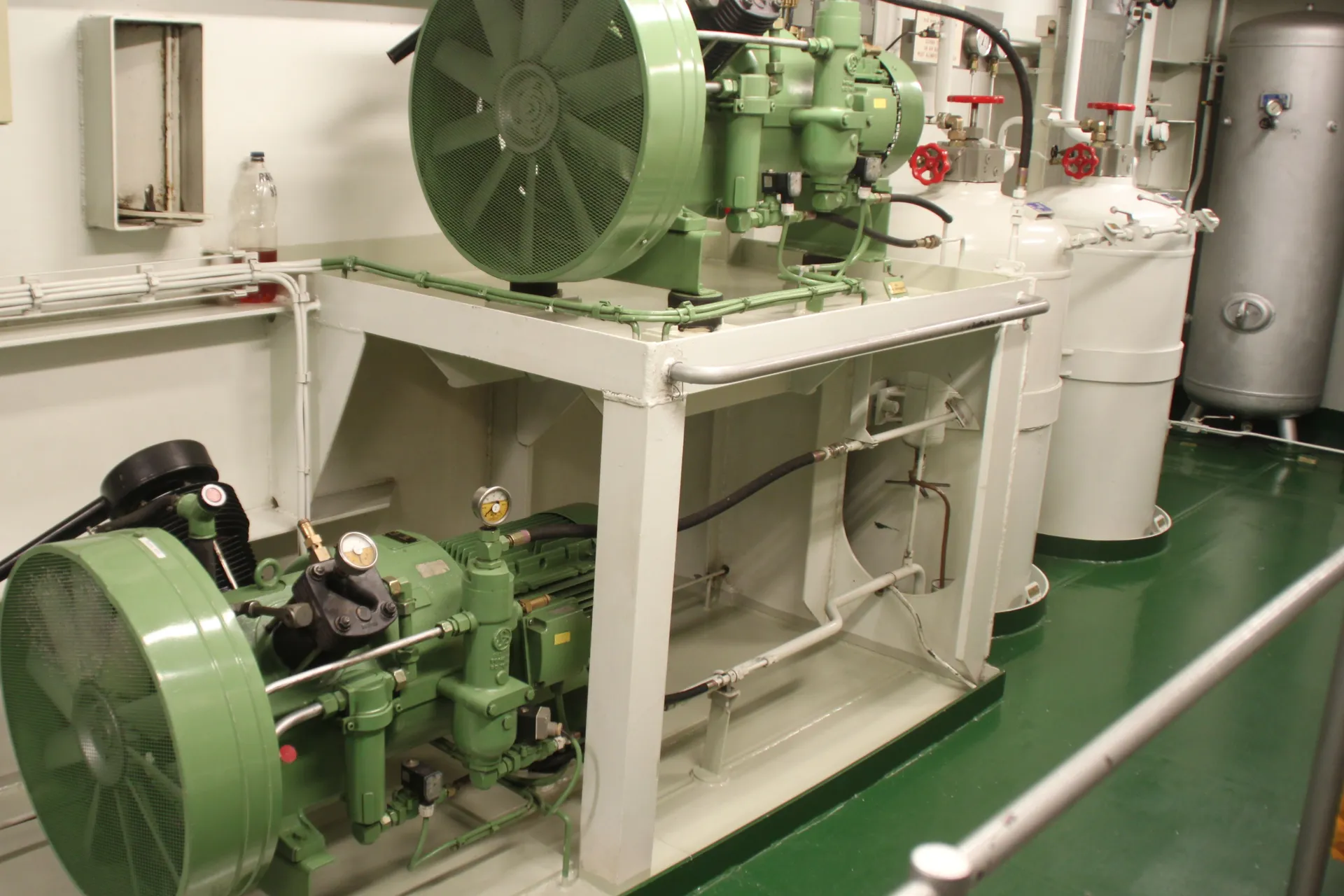
Marine air compressor — general arrangement
A licensed photograph of J.P. Sauer equipment was not available at publication, so this technical reference illustrates the general arrangement shared by this equipment class.
Illustrative technical reference, not a photograph of J.P. Sauer equipment or a Vessel Core installed reference — a licensed photo of this maker's equipment was not available. Vessel Core has no dealership, distribution or partnership agreement with J.P. Sauer; it operates as an independent spare parts supplier.
High-pressure air is a different review from a plain pump spare.
Final pressure, stage count and duty decide both the part and the paperwork. A third-stage valve plate on a 40 bar machine and a first-stage plate on the same block are not the same purchase decision, and neither is a breathing-air cartridge against a working-air one. We review against what the plate and the removed part actually prove, not against the designation the requisition was written from.
Valves sorted by stage, not by picture
First-, second- and third-stage valve assemblies on a Sauer machine look similar and behave nothing alike. We ask which stage the failed valve came from, and whether the set was ordered as a complete assembly or as plates and springs, before anything is offered.
Breathing-air items carry their paperwork
When the compressor charges breathing sets, filter cartridges, separator elements and any wetted component are reviewed with the material and traceability documentation the buyer's own procedures require. Documentation needs are agreed at RFQ stage, not discovered on delivery.
Condensate faults chased before rings
A machine that will not reach final pressure is often a drain problem, not a ring problem. Automatic drain valves, solenoids and timer components are reviewed together with the mechanical list so the vessel is not left replacing a piston set that was never the fault.
Cooler elements matched to the build
Intercooler and aftercooler elements vary between air-cooled and water-cooled versions of the same compressor family, and salt-air corrosion on finned elements is a common reason for replacement. Cooling arrangement is confirmed from the type code and the plate before a cooler item is reviewed.
Identification without a part number
A readable machine plate, the stage the component came from and a measured dimension are frequently enough to begin. A measured ring gap, a bore diameter taken across the liner, or the stamped figure on the back of a valve plate will each move a review further than a part number transcribed wrongly from a manual for a different build revision.
Redundancy decides the urgency, not the invoice
Most engine rooms carry two air compressors, and one is usually enough to keep the receivers charged — until the second set of valves lets go in the same week. When a Sauer machine is down we ask what the remaining compressor is covering and how long the receivers hold, because a WP81L valve set for a vessel running on single redundancy is a different job from the same set ordered as a shelf spare. The Kiel supply route is weighed against verified alternative valve and ring sources, and breathing-air cartridges are checked for remaining shelf life before any handover port is proposed.
Why this maker is named here
A code like WP81L or Passat names a machine, not a relationship. Maker names help identify equipment and prepare an RFQ. They do not imply that Vessel Core is an authorised dealer, representative or partner of J.P. Sauer & Sohn Maschinenbau GmbH of Kiel, or of any other manufacturer named on this site, and no Sauer service franchise is held. The designations, serial ranges and stage counts on this page are reproduced for one reason: so a chief engineer describing a leaking third-stage delivery valve and a supplier reviewing one are demonstrably talking about the same compressor block and the same build revision. Read more about the review sequence on how we work, or see the full maker reference index.
Sauer compressor RFQs — what buyers ask
What Sauer compressor data do you need before a valve set can be identified?
The series name and the full type designation including any suffix letters — both appear on the plate, for example a series name such as Passat and a type code such as WP81L — together with the machine serial number, the number of compression stages and the final pressure stamped on the plate. Stage number matters because first, second and third stage valve assemblies are not interchangeable between stages, and the same WP designation can appear in several build variants over the production life of the machine.
Is a breathing-air compressor request handled differently from a starting-air request?
Yes. Breathing-air duty changes what documentation the buyer usually has to keep, so purification cartridges, filter elements and separator items are reviewed with material and traceability paperwork treated as part of the item rather than an afterthought. Breathing-air and high-pressure machines also run far above a 30 or 40 bar starting-air unit, so stage count and final pressure are confirmed before anything else. Plain starting-air and control-air items are reviewed on the mechanical evidence alone unless the buyer states otherwise.
Can you work from photographs if the Sauer part number is missing?
Usually yes. A readable machine plate, a photograph of the removed component and the stage it came from are often enough to begin identification. Where the part sits inside a stage assembly — guide rings, liners, valve plates — a measured bore or ring dimension shortens the review considerably.
Do you cover condensate drain and cooler components as well as running gear?
Yes. Automatic drain valves, solenoid drain assemblies, intercooler and aftercooler elements, oil/water condensate separators, pressure switches and temperature switches are common items on Sauer RFQs. A drain or unloader valve stuck open is a frequent reason a machine will not build final pressure, while fouled cooler elements show up instead as rising inter-stage temperature and pressure. They are reviewed alongside pistons, rings, liners and bearings.
Send the plate, then the part list.
Include the series name, the full type designation with suffix letters, the serial number, stage count, final pressure and the duty the machine serves. A photograph of the machine plate and of the removed component covers most of it. Vessel Core works the stage evidence back to the compressor block, checks which build revision the serial falls in, and returns a quotation broken out stage by stage rather than as one undifferentiated valve line.

