
Tanabe Starting-Air
Compressor Spares
Two-stage water-cooled starting-air plant on Japanese-built tonnage — H-63 · H-64 · H-73 · H-74 frames and HC-series machines
Tanabe machines an RFQ usually names
Tanabe Pneumatic Machinery Co., Ltd. of Japan is a manufacturer of marine starting-air compressors fitted to Japanese-built tonnage, and two families dominate the requests that reach a spare parts desk: the H-series, whose H-63, H-64, H-73 and H-74 designations are the ones engineers quote from memory, and the HC-series. Both are vertical, single-acting, two-stage water-cooled reciprocating machines with the cylinder block standing above the crankcase and an intercooler between the stages. What separates them is capacity, working pressure and generation rather than layout — and those are exactly what decide the valve seat diameter, the ring section and the cooler stack length on a parts list.
H-63
Two-stage water-cooled starting-air compressor in the H family. Valve assemblies, ring sets and intercooler tube stacks are the recurring line items on requests naming this machine.
H-64
H-family machine in a different size band from the H-63, so seat diameters and ring sections can differ between the two. Confirm the machine number stamped on the crankcase before rings or liners are ordered.
H-73
Larger H-family frame, seen where the main engine air receivers call for a higher charging rate. Requests commonly cover main and crankpin bearing shells, ring sets and delivery valve assemblies.
H-74
H-family machine in the larger size band. Aftercooler tube stacks, unloader components and lubricating oil pump parts appear alongside the standard valve and ring scope.
Nameplate missing
Where the plate has been painted over or replaced, the machine can still be narrowed down from crankcase casting marks, cylinder centre distance, flywheel diameter and photographs of the valve cages and cooler end covers.
What actually wears out on a Tanabe starting-air compressor
Air compressors fail in a narrow set of ways, and on a two-stage Tanabe machine the sequence is familiar to any second engineer. Valves lead. Concentric plate valves in first and second stage sit in cages with their springs and seats; springs fatigue, plates crack at the outer land, and seats pit where carbon and condensate carryover have been running through them. The symptoms arrive before the failure does — interstage pressure drifting off its normal band, high when a second-stage suction valve is leaking and low when a first-stage valve is passing, a delivery pipe running hotter than the sister machine, the air bottles taking noticeably longer to reach cut-out. Valves are quoted as complete assemblies with springs and seats rather than as loose plates, because a reseated old cage rarely holds for a full docking interval.
The second cluster is the running gear. These are trunk-piston machines: the connecting rod runs on a gudgeon pin carried in the piston, the piston skirt itself takes the side thrust, and there is no crosshead and no guide face to measure. Compression rings lose tension and gap, oil scraper rings glaze, and bore wear concentrates on the thrust and anti-thrust sides where connecting-rod angularity presses the piston into the wall — accelerated by carbon building up in the ring grooves and by condensate carried through with the air. Blow-by past worn rings pressurises the crankcase and shows as mist at the breather; worn scraper rings let oil up into the discharge side, where it turns up as oil carryover in the receivers and at the separator drains. Gudgeon pin and small-end bushes, main and crankpin bearing shells, and the gear-driven lubricating oil pump complete that group. The third cluster is the cooling and control side: intercooler and aftercooler tube stacks fouling or eroding on the seawater side, moisture separators and auto-drain traps, unloader valves and solenoids, pressure switches and the safety relief valve on each stage.
- First-stage suction & delivery valve assemblies
- Second-stage suction & delivery valve assemblies
- Valve springs, plates & seat rings
- Piston compression rings & oil scraper rings
- Cylinder liners where the model is liner-fitted
- Pistons & piston pin bushes
- Connecting rods, small-end & gudgeon pin bushes
- Crankshaft main and crankpin bearing shells
- Intercooler & aftercooler tube stacks
- Cooler end-cover gaskets & zinc anodes
- Lubricating oil pump & relief valve parts
- Unloader valves, solenoids & pressure switches
- Safety relief valves & non-return valves
- Moisture separators & automatic drain traps
- Stage-split overhaul gasket sets, valve cage O-rings & cooler end-cover joints
Cylinder liners are model-dependent on machines in this size band: the bore is often cut directly in the block or head casting, particularly on the second stage. Confirm from the machine drawing, or from a photograph looking down the bore, before a liner line is put on the request.
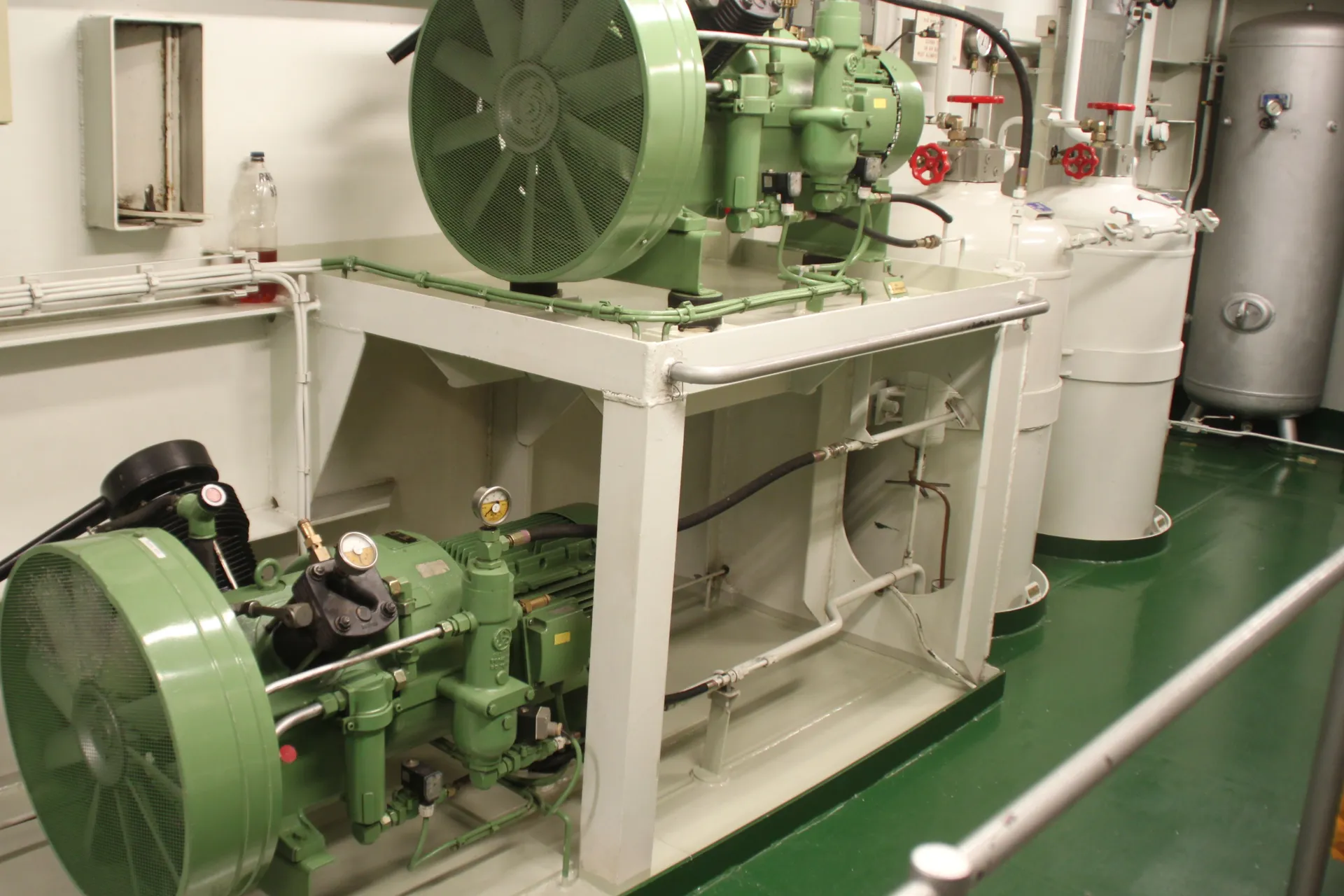
Marine air compressor — general arrangement
A licensed photograph of Tanabe equipment was not available at publication, so this technical reference illustrates the general arrangement shared by this equipment class.
Illustrative technical reference, not a photograph of Tanabe equipment or a Vessel Core installed reference — a licensed photo of this maker's equipment was not available. Vessel Core has no dealership, distribution or partnership agreement with Tanabe; it operates as an independent spare parts supplier.
Reading the plate before the request goes out
Tanabe nameplates carry the type designation, the machine or serial number, the rated free air delivery, the working discharge pressure and the rated speed. All five matter, and the safest way to send them is a photograph of the plate rather than transcribed figures: Japanese-built machines are commonly plated in MPa and in m3/min, so a starting-air machine reads 2.94 or 3.0 MPa where a European engineer expects 30 bar, and hand conversion is where the identifying datum usually gets lost. HC-series designations also carry a size and a suffix after the family letters, so "HC-series" on its own narrows a machine no further than "H-series" does. The type code fixes the family, not the component dimensions: machines built years apart under the same designation can differ in valve seat diameter, ring section and cooler stack length, and units that have been through several yard overhauls sometimes carry mixed components. The serial is what ties a request to a specific build.
- Type designation and machine/serial number from the plate
- Rated capacity and working discharge pressure exactly as printed — MPa or bar, m3/min or m3/h
- Rated speed and driving motor data where visible
- Stage the part belongs to — first or second, suction or delivery
- Photographs of the valve cage, seat face and spring pack
- Measured seat outside diameter, cage height, ring thickness
- Whether the cylinder is liner-fitted or bored in the casting
- Bore measurement across the thrust axis and wear step position, if taken
- Cooler tube stack length and end-cover bolt pattern
- Quantity per machine and per stage, not per vessel
How Tanabe requests are handled at the desk
Every line is treated as a component on an identified machine rather than a name on a list. A Tanabe line is read as "second-stage delivery valve, number two machine" rather than as a catalogue name. Each item is checked against the stage it serves, the cage build the plate points to, and whether the air-receiver certificate makes it a survey item or a consumable.
Valves quoted stage by stage
First-stage and second-stage assemblies are separated on the quotation, with springs and seats stated, so nothing arrives as a plate set when a complete cage was needed.
Ring and bore wear read as measured
Side thrust from connecting-rod angularity loads the thrust and anti-thrust sides of the bore, so ovality is measured across the thrust axis and the wear step is looked for near the top of the ring travel. Ring sets and liners are matched to the identified build, not to the family name.
Cooler stacks reviewed on seawater evidence
Tube stack requests are checked against the cooling medium, anode condition, water appearing at the separator and drains, and any water found in the crankcase oil.
Survey items separated from consumables
Gaskets, rings and cooler-side consumables are often reviewable on either route. Safety relief valves and items tied to the air-receiver certificate are checked against the documentation a surveyor will ask for before the seat diameter is committed to.
Identification from photographs
A photograph of the valve cage face with a rule laid across the seat, plus the crankcase casting marks and the cylinder centre distance, usually narrows a Tanabe machine to one or two builds. Where the plate is painted over, flywheel diameter and cooler end-cover bolt pattern close the gap.
Estonian company, Tallinn dispatch
Vessel Core OÜ trades from Tallinn as an Estonian company, Reg. 17028043, VAT EE102773714. Tanabe cooler tube stacks are crated separately from valve cages and ring sets — a full stack rarely travels as hand-carry, while a cage and spring pack usually can go with a joining engineer. Supply route, handover option and documentation are confirmed in the quotation.
What second engineers ask before pulling a Tanabe air end
Which Tanabe air compressor machines can an RFQ reference?
RFQs commonly reference the H-series — H-63, H-64, H-73 and H-74 — and the HC-series, both of them vertical two-stage water-cooled starting-air machines fitted to Japanese-built tonnage. The type designation alone does not fix component dimensions: send the machine serial together with the rated capacity and working discharge pressure exactly as printed on the plate, in MPa or bar and m3/min or m3/h, so the correct build is identified before the cage build is fixed.
Can Tanabe valve assemblies be identified without a part number?
Usually yes. State whether the valve is a first-stage or second-stage suction or delivery unit, add the nameplate type and serial, and include photographs of the valve cage, seat face and spring pack with a scale in frame. Measured seat outside diameter and cage height help confirm the build where the machine has been overhauled with mixed components.
Do H-series and HC-series Tanabe compressors share wear parts?
They should not be treated as interchangeable. Both families are vertical, single-acting, two-stage water-cooled machines, but bore size, ring section, valve seat diameter and cooler stack length differ between the families and between generations carrying the same designation. Ring sets, liners where the model is liner-fitted, bearing shells and small-end bushes are quoted against the identified machine, never against the family name.
Can Vessel Core review verified alternative parts for Tanabe compressors?
It depends which side of the machine the part sits on. Piston and scraper rings, cooler end-cover gaskets and crankcase joints carry no survey weight and are reviewed on either route. A stage safety relief valve, the non-return valve to the receiver, and anything stamped into the air-receiver certificate do carry survey weight — those are checked against the documentation the surveyor will ask for before anything is offered.
Send the plate, then the list.
A Tanabe request is easiest to identify when it opens with the nameplate: type designation, machine serial, and the capacity and discharge pressure as printed on the plate. Add the stage each item belongs to, the quantity per machine, and photographs where numbers are missing. Vessel Core checks the stage split, the cage and seat dimensions and the cooler tube stack length against the plate data before a Tanabe quotation goes back.

