
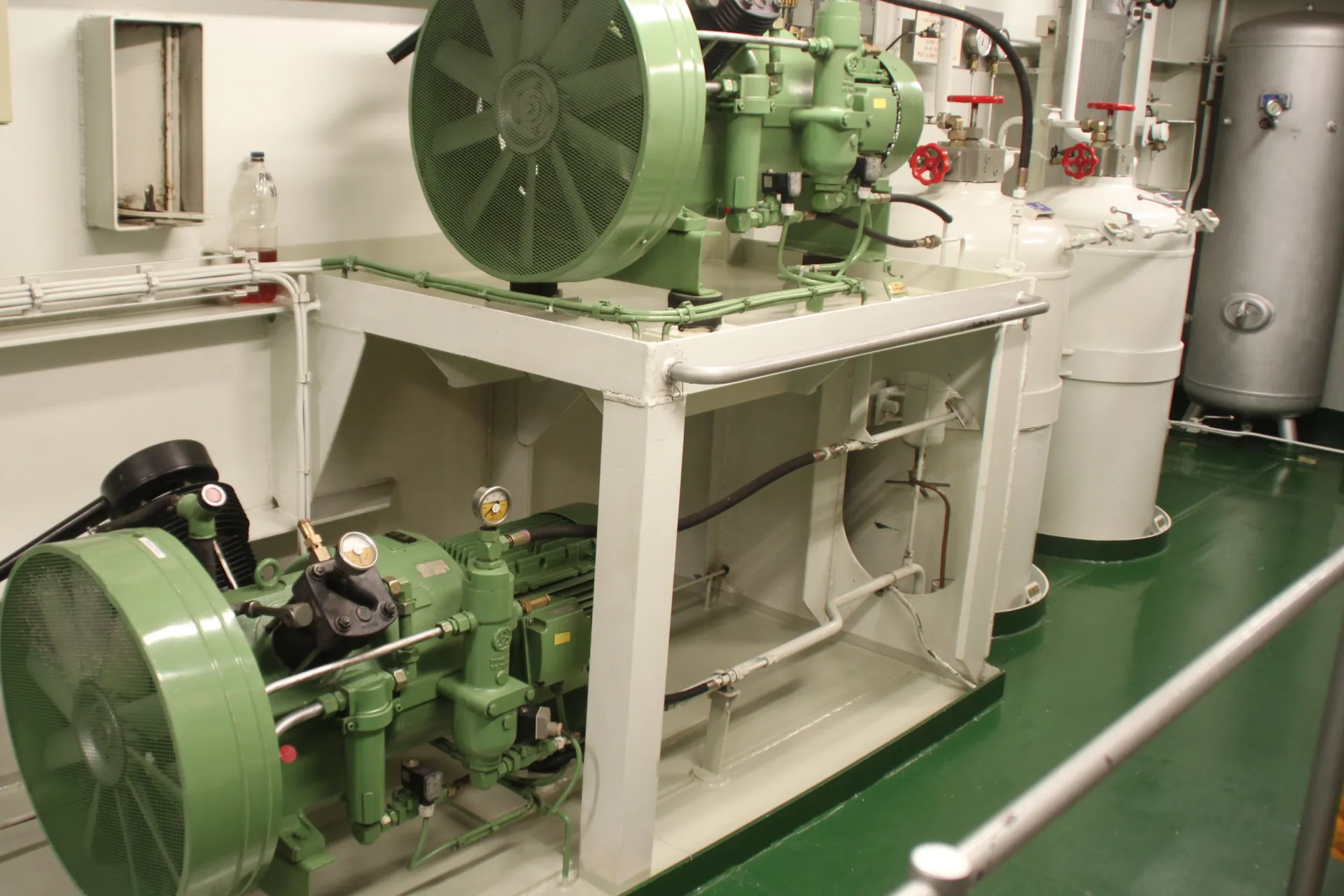
Kobelco Fuel Gas Compressor
Spare Parts Supplier
Oil-injected screw and vertical reciprocating compressors that feed boil-off gas to the dual-fuel main engine of an LNG carrier. Enquiries are read by machine, by stage and by whether a cylinder runs with or without lubrication.
Kobelco compressors met on LNG carriers
Kobe Steel's machinery business builds screw, reciprocating and centrifugal compressors; on an LNG carrier the fuel gas duty falls to the screw and reciprocating machines. Since low-speed two-stroke dual-fuel engines took over on these ships, boil-off gas from the cargo tanks has to be compressed before the engine can burn it, and Kobelco builds compressors for both the low-pressure and the high-pressure engine types. The engine decides the compressor, so the engine type in the machinery particulars is the first thing to establish in any enquiry.
Screw compressor for X-DF and ME-GA fuel gas
Kobelco calls these oil-injected, or oil-flooded, screw compressors; in 2016 Kobe Steel announced the first order for screw compressors to supply fuel to X-DF dual-fuel engines. Boil-off gas is warmed in a pre-heater, passes a filter and a check valve and is compressed in a single stage, and Kobelco's oil-injected screw range sets capacity with a slide valve. Typical items are suction filter elements, coalescing elements for the secondary oil separator, oil cooler and pre-heater parts, and temperature control valve parts.
Six-stage reciprocating compressor for ME-GI gas supply
A vertical machine that raises boil-off gas to the injection pressure of the ME-GI engine and also feeds the dual-fuel generator engines and the re-liquefaction plant. Stages one to five run with non-lubricated cylinders; only stage six, where friction is highest, receives lubricating oil, with an oil separator after it. Resin piston rings, rider rings and piston rod packings are the main consumables.
Three-stage non-lubricated compressor for X-DF re-liquefaction
Where an X-DF ship boosts its surplus gas for re-liquefaction with a reciprocating compressor, Kobe Steel's machine for that duty takes the gas from the screw compressor and works without any cylinder lubrication. Kobe Steel standardised its cylinder design with stages three to five of the ME-GI machine to keep the range of consumables small, so a ring or packing request should name the machine and the stage, not only the maker.
MSO compressor (FSRU)
Kobelco also lists vertical reciprocating machines as MSO compressors on floating storage and regasification units. Treat one as a machine in its own right: send the plate and the parts-list page rather than assuming it shares items with an LNG carrier fuel gas unit.
Where a boil-off gas compressor wears
Kobe Steel's own description of these machines points to the same few places. Most of them come back to one question: is the oil where it should be, and nowhere else?
Transfer film spoiled by oil
In a dry cylinder the resin piston rings and rod packings lay a thin film of resin on the liner and the piston rod, and that film is what keeps wear down. Kobe Steel notes that even a trace of oil in the gas stops the film forming and leads to abnormal wear. Rings that give out early on a dry stage are a reason to look upstream at the oil separation, not only to order more rings.
Stage six and its oil separator
On the ME-GI machine only the final stage is lubricated, because friction there is highest. The oil it needs must then be taken out of the gas again by a separator with a high-performance filter before the gas reaches the engine, so the filter elements belong on every overhaul list for that stage.
Backflow from the lubricated line
When the machine stops, oil-laden gas can flow back from stage six into stage five, which runs dry. A check valve and a coalescing filter between the two stages are there to stop it and to catch the oil. If that check valve no longer seats, an ordinary stop can put oil into the non-lubricated cylinders.
Oil separation after the screw
Oil injected into the screw lubricates the rotors and bearings and carries away the heat of compression, and then has to come out of the gas: first in the oil recovery tank, then in a secondary separator with a coalescing element, with an activated carbon adsorber added where needed. Kobe Steel points out that a sudden separator failure would carry oil into the reciprocating compressor or the re-liquefaction system downstream.
Pre-heater and temperature control
Boil-off gas arrives from the tank at cryogenic temperature and is warmed with the compressor's own heat of compression before it reaches the screw. The suction gas temperature control valve meters compressed gas to the pre-heater, and the discharge gas temperature control valve meters the oil sent to the compressor, so when gas temperatures will not settle, both valves and the pre-heater belong in the same review.
Consumables and overhaul items for Kobelco gas compressors
The list follows the lines Kobe Steel itself draws: lubricated against non-lubricated, screw against reciprocating. A resin ring from a dry stage and a ring from the lubricated stage are separate line items and are never grouped under one reference.
- Piston rings for non-lubricated stages, per stage
- Rider rings, per stage
- Piston rod packing rings and packing cases
- Cylinder liners and piston rods, the running surfaces for the resin parts
- Cylinder valve parts as listed in the parts book for each stage
- Coalescing filter elements, including the one between stages five and six
- Oil separator elements after the lubricated stage and after the reciprocating compressor
- Activated carbon (charcoal) filter charges or cartridges
- Check valve parts on the screw suction line and between stages
- Screw compressor suction filter elements
- Slide valve, bearing and shaft seal items for the screw compressor, per parts list
- Gasket and O-ring sets for overhaul, oil cooler and pre-heater joints
What identifies a Kobelco compressor on board
Kobe Steel refers to compressors for marine dual-fuel engines as nonstandard compressors, so the plate starts the identification but does not finish it. With the items below an enquiry can be read machine by machine and stage by stage.
- Photograph of the compressor nameplate, square-on and readable
- Serial or manufacturing number from that plate
- Compressor type: oil-injected screw or vertical reciprocating
- Duty: fuel gas to the main engine, gas to the generator engines, surplus gas to re-liquefaction, or MSO duty on an FSRU
- Main engine type the compressor feeds: ME-GI, X-DF or ME-GA
- For a reciprocating part: the stage number and whether that cylinder is lubricated or non-lubricated
- Part and item numbers from the Kobelco instruction manual or parts list for that serial
- If the compressor came as a package with auxiliary equipment, the package plate as well as the compressor plate
- For filter and separator elements: the marking on the old element and on its housing
- Photograph of the worn ring, packing or element next to the plate
Supply route review for Kobelco gas compressors
A fuel gas compressor on an LNG carrier sits between the cargo tanks and the main engine, so its parts are read with the whole gas system in view rather than item by item.
Stage before reference
Rings, rider rings and packings are reviewed per stage. A part number sent without its stage is read back with a question rather than quoted against a guess.
Dry against lubricated
Items for non-lubricated cylinders are kept apart from items for the lubricated stage through the whole enquiry, because the duty of the part and the oil around it are not the same.
Filters with their housings
Coalescing, oil separator and activated carbon elements are matched to the housing marking and the parts list. An element that looks right but does not seal in its housing undoes the oil separation the dry stages rely on.
Which route suits gas-handling machinery
Kobe Steel runs its own spare parts and overhaul service and stresses genuine Kobelco parts. Where the owner's approval list or the class surveyor calls for the maker's reference, that is the reference used. Where an equivalent-source path is allowed for filter elements or gasket sets, it can be examined, and any difference is set out in the reply.
One review for one overhaul
Rings, packings, valve parts and the filter elements around them are read as one scope, so the coalescing element is not left for a second enquiry after the new rings are already in.
Kobelco compressor parts — questions from LNG carrier crews
Which Kobelco compressors can be reviewed at RFQ stage?
Enquiries are read for the oil-injected screw compressors that supply fuel gas to X-DF and ME-GA engines, the vertical reciprocating compressors for ME-GI gas supply, the non-lubricated reciprocating compressors that boost surplus gas for re-liquefaction on X-DF ships, and Kobelco reciprocating compressors listed as MSO compressors on FSRUs. Send the plate photograph, the serial number and the engine type the compressor serves.
Why does the stage matter for piston rings and packings?
Kobe Steel's ME-GI machine has non-lubricated cylinders on stages one to five and an oil-lubricated cylinder on stage six. Resin rings and packings on a dry stage depend on a resin film laid on the liner and the rod, so the stage number and the lubrication of that cylinder decide the item, not the maker's name.
Can Kobelco compressor parts be identified without a part number?
Sometimes. The serial number, the compressor type, the duty, the stage and a photograph of the removed item beside the plate often narrow it down to the right parts-list page. For filter elements the marking on the housing is usually the shortest route. Where the evidence still leaves two candidates, the reply says so instead of picking one.
Why are oil filters on the list for a non-lubricated compressor?
Because oil is the main threat to it. Kobe Steel places coalescing filters, oil separators and an activated charcoal filter around the reciprocating compressor so that oil from the screw side or from the lubricated stage does not reach the dry cylinders or the re-liquefaction system. Renewing rings without looking at those elements tends to repeat the wear.
Are Kobelco air compressors and refrigeration units covered on this page?
This page covers the gas compressors Kobe Steel builds for LNG carriers and FSRUs. Standard air compressors and chillers are made by Kobelco Compressors, a separate company in the group; their use on board ships has not been confirmed here, so they are not described. A plate from one of them can still be sent with an enquiry.
Is Vessel Core connected to Kobelco?
No, and there is no agreement of any kind. Vessel Core holds no distribution, representation or partnership agreement with Kobelco, and quoting a component against one of its designations implies no approval by the maker and no claim of interchangeability.
Send the plate and the stage — the list follows from them.
Send a photograph of the Kobelco plate with the serial number, the engine type the compressor feeds, the stage each item came out of and whether that cylinder is lubricated, together with the port or ETA. Each line is then read against the parts list before a reference is fixed to it.
