
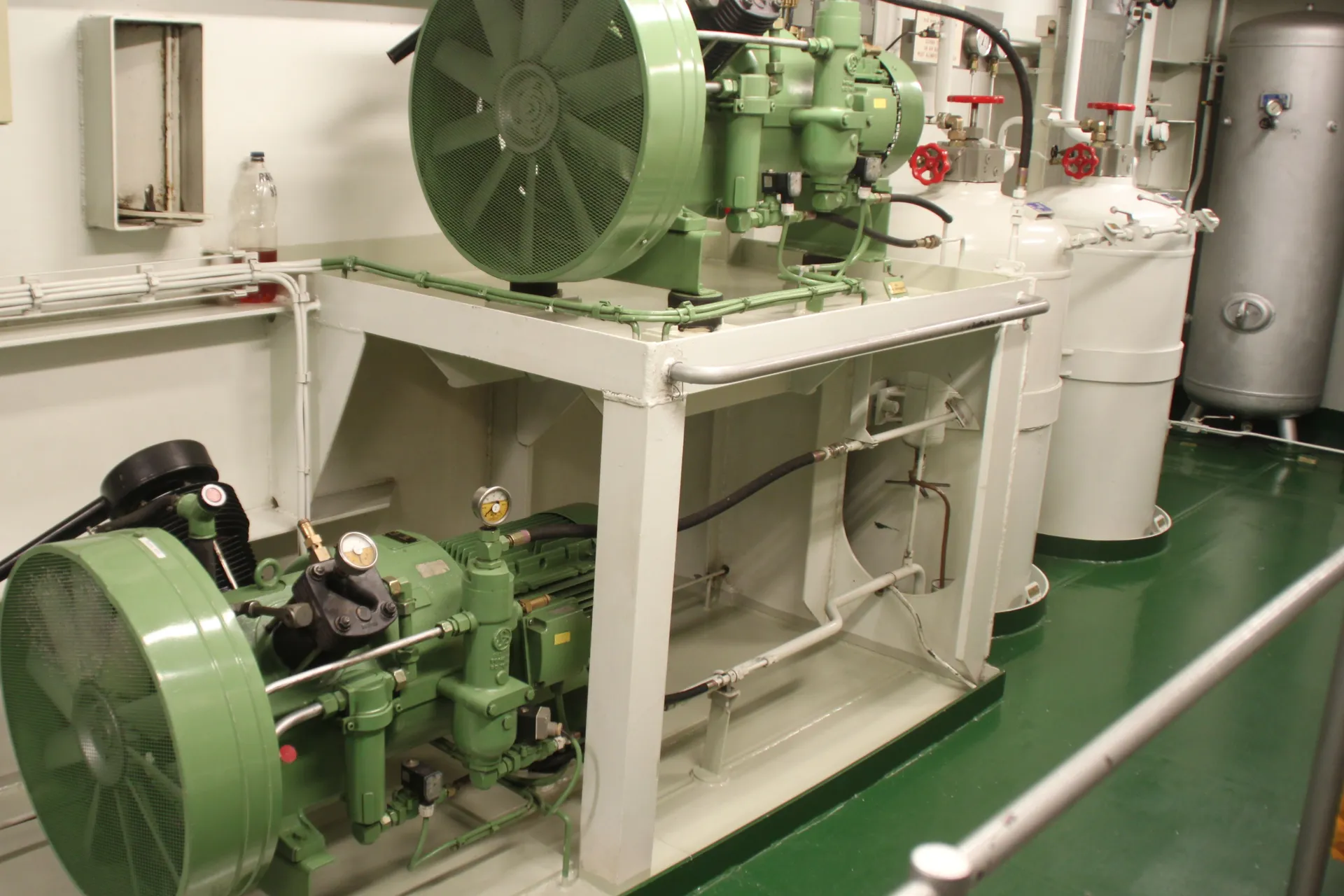
Hatlapa Compressor
Spare Parts
W-series starting-air compressors · W110 · W140 · W220 · W330
The W-series machine behind the request
A Hatlapa W-series unit is a two-stage reciprocating compressor built to fill starting-air bottles, not to run continuously. A low-pressure cylinder draws through its valve assembly and discharges into an intercooler; the high-pressure cylinder takes that cooled charge up to bottle pressure and passes it through an aftercooler and a water and oil separator. One crankshaft in a splash- or pump-lubricated crankcase drives the cylinder group — one LP and one HP cylinder on the smaller frames, with additional LP cylinders on the larger builds. Because the machine works in short loaded bursts against high final pressure, wear concentrates in a small and predictable set of places — and those are almost always the items a spare parts request concerns.
W110
Smaller-frame starting-air unit, often installed as the topping-up or second compressor. Requests typically cover concentric valve assemblies, piston ring sets, oil scraper rings and crankcase seal kits.
W140
Mid-frame unit found on general cargo, coaster and workboat installations. Cylinder and piston sets, big-end bearings, safety valves and cooler element requests are the common items.
W220
Larger free air delivery for main-engine starting duty on bigger installations. Valve seats and plate stacks, HP piston assemblies, intercooler tube stacks and unloading valve components.
W330
Larger frame within the range shown here; the W-series continues above this size. Main bearings, big-end bearings, connecting rod bolts, cylinders, aftercooler elements and separator internals are typical overhaul-scope requests.
Air-cooled builds
Finned cooler sections and fan-side components replace the water-side hardware. Cooler section, fan wheel and guard part references do not carry over from a water-cooled machine of the same type number.
Water-cooled builds
Intercooler and aftercooler tube stacks, cooler covers, jacket seals, water-side gaskets, and zinc anodes on seawater-cooled builds. State the cooling arrangement on the request — it changes a large share of the parts list.
Coupling and drive side
Flexible coupling elements, drive bushes and mounting hardware differ between direct-coupled and belt-driven installations. A photograph of the drive end usually settles which arrangement is fitted.
Legacy W-frames
Older W-series machines still in service may reference part numbers that have been superseded. Serial number and a nameplate photograph are needed before any current reference is treated as equivalent. The type may be stamped with or without a space — W 110 and W110 are the same machine — and later units may be nameplated under the MacGregor group. Larger and smaller W-frames outside the four shown here are handled on the same evidence.
What actually comes off a W-series at overhaul
Grouped the way the machine is stripped — valve gear first, then the cylinder group, then the running gear, coolers and control fittings. Each group is quoted against confirmed type, serial and stage evidence.
- Concentric valve assemblies, LP and HP stage
- Valve plates, spring plates & valve seats
- Valve covers, hold-down bolts & sealing rings
- Piston rings & oil scraper ring sets
- Pistons, gudgeon pins & circlips
- Cylinders and cylinder blocks, LP and HP, and liners where the frame is built with them, with jacket sealing rings on water-cooled builds
- Cylinder heads & head gasket sets, per stage
- Big-end shells & connecting rod bolts, larger frames
- Crankshaft main bearings (ball/roller), bearing covers & shaft seals
- Intercooler elements & cooler tube stacks
- Aftercooler elements, covers & water-side gaskets
- Safety valves for LP and HP stages
- Unloading valves, solenoids & unloader pistons
- Automatic condensate drain valves
- Water and oil separator internals
- Lube oil pump components, strainers & filter elements on pump-lubricated frames
- Flexible coupling elements & drive bushes
- Non-return valves & bottle-line fittings
- Pressure switches, gauges & thermometers
- Crankcase gaskets, shaft seals & O-ring kits
Marine air compressor — general arrangement
A licensed photograph of Hatlapa equipment was not available at publication, so this technical reference illustrates the general arrangement shared by this equipment class.
Illustrative technical reference, not a photograph of Hatlapa equipment or a Vessel Core installed reference — a licensed photo of this maker's equipment was not available. Vessel Core has no dealership, distribution or partnership agreement with Hatlapa; it operates as an independent spare parts supplier.
Reading the nameplate before you write the request
Most delay on a Hatlapa compressor request comes from missing machine identity rather than a missing part number. The crankcase nameplate carries nearly everything needed to narrow a component to one reference. Photograph it, and photograph the removed part next to it.
- W-series type designation exactly as stamped, including any suffix
- Works or serial number and, where shown, year of build
- Cooling arrangement — air-cooled or water-cooled
- Free air delivery in m³/h at rated speed
- Final working pressure in bar and stage pressures if listed
- Rated speed and drive arrangement, direct-coupled or belt
- Which stage the part belongs to — low pressure or high pressure
- Position number and page from the maker parts manual, if aboard
- Quantity required and whether the machine is opened or still assembled
How a W-series tells you which part is worn
The symptom usually points to the group before the machine is opened. These are the patterns engineers describe most often when a request arrives, and they help decide whether the request is a valve kit or a full cylinder-group scope.
Charging time creeps up, HP discharge runs hot
Leaking concentric valve assemblies are the usual first suspect. Plate and spring fatigue, carbon build-up on the seat, or a cracked plate segment lets compressed air return to the suction side, so the stage does the work twice. Delivered air falls, discharge temperature climbs, and the intercooler pressure sits off its normal figure. Valve assemblies are commonly requested as complete units rather than as loose plates.
Interstage pressure drifts from its normal reading
A rise in intercooler pressure points at the HP stage — its suction valve or piston rings. A fall points at the LP stage instead. Reading the interstage gauge against the machine's own historical figure is the most direct way to decide which cylinder group the request should cover, and it avoids ordering both.
Oil carry-over into the bottles and drain lines
Worn oil scraper rings, a glazed or scored liner, or an overfilled crankcase push lube oil past the piston. Oil in the starting-air line then bakes onto valve seats and accelerates the first failure mode on this list. Requests here normally combine ring sets, liners and separator internals rather than rings alone.
Safety valve lifting or the unloader not releasing
A safety valve that lifts repeatedly is a symptom, not the fault — the stage behind it is over-pressuring, often because the next stage cannot pass the flow. An unloading valve that fails to vent on start leaves the machine loaded against full pressure at the moment of highest motor current. Both point at valve gear and unloader components together.
Cooling water outlet hot, cooler element fouled
A scaled or fouled intercooler raises HP suction temperature and loads the high-pressure stage. A fouled aftercooler raises delivery temperature into the separator, so less moisture drops out there and condenses in the air bottle and starting-air line instead. On water-cooled builds this brings cooler elements, covers and water-side gaskets into scope, with anodes on seawater-cooled builds; on air-cooled builds it is finned sections and fan components.
Knocking under load, metal in the sump
Big-end or main bearing wear, frequently traced back to condensate diluting the crankcase oil or to a drain valve that stopped working. Requests at this stage cover main and big-end bearings, connecting rod bolts and a full crankcase seal set, because the machine will be opened completely.
Deck machinery and steering gear are their own threads
Hatlapa is named on a good deal of deck equipment and steering gear as well as on compressors. The identification evidence has almost no overlap with a starting-air machine, so these are best sent as distinct requests rather than added to a compressor list.
Windlasses and mooring winches
Type plate, drive arrangement, hydraulic or electric configuration and brake band details are needed. Common items are seal kits, brake linings, gearbox bearings, clutch parts and hydraulic motor components.
Rotary vane steering gear
Rotor and stator size designation, rated torque and system pressure identify the unit. Requests usually concern vane seals, bearing bushes, hydraulic pump parts and control valve components.
Power packs and control gear
Pump unit plate, working pressure and circuit drawing reference are the starting point. Seal kits, filter elements, relief and directional valve parts are the usual scope on these requests.
What happens to a Hatlapa compressor request
A W-series request is not costed until the type designation, the works number and the stage are all fixed. If the nameplate photograph is unreadable, or the machine reaches us described only as “the Hatlapa compressor”, that is said plainly and the missing item is asked for — a W140 LP valve assembly and a W220 HP one are not interchangeable, and guessing between them wastes an overhaul window.
Stage-by-stage identification
Components are pinned to the low-pressure or high-pressure side before anything else, because valve assemblies, liners, pistons and cooler elements differ between stages on the same compressor.
Where the OEM route is the only route
Safety valves and anything carrying a class certificate stay on the OEM route, because the lift setting has to be traceable. Piston and scraper ring sets, crankcase seal kits and cooler-side gaskets are where an equivalent-specification part is worth putting alongside the OEM reference — both are set out in the quotation, and the choice stays with the buyer.
Superseded references checked
Part references on W-series machines were reissued rather than retired as the compressor programme changed hands, so two numbers can describe the same item. A superseded number is traced to its replacement and both are set out, so stores can update the ROB list at the same time.
Scope built from the symptom
A valve complaint and a bearing knock produce very different part lists. Describing what the machine is doing lets the request be scoped as a valve kit, a cylinder-group set or a full strip-down list, instead of an incomplete order.
Down to one compressor, or still on two?
A ship that can still charge its bottles on the second unit is a different job from one sitting on a single W-series with a cracked valve plate. How many starts remain in the bottles, and whether the machine is already open, decide whether parts chase the vessel to the next port or wait for the yard period — that is asked before anything is costed, and nothing about routing is stated before it is set out in the quotation.
EU-registered counterparty
Compressor parts often go to a yard account rather than the vessel — Vessel Core OÜ is registered in Estonia (Reg. 17028043, VAT EE102773714), with company details and verification routes published for buyers who need them before opening one.
Hatlapa compressor requests — asked often
What data identifies a Hatlapa W-series compressor part?
Start with the crankcase nameplate: the W-series type designation exactly as stamped, the works or serial number, the cooling arrangement, the free air delivery in cubic metres per hour and the final working pressure. Add which stage the part belongs to — low pressure or high pressure — because valve assemblies, liners and cooler elements differ between stages on the same machine.
Does the air-cooled or water-cooled version change the parts list?
It changes a substantial part of it. Water-cooled builds carry intercooler and aftercooler tube stacks, cooler covers, water-side gaskets and jacket seals that the air-cooled arrangement does not use, while air-cooled units rely on finned cooler sections and fan components. Stating the cooling arrangement on the RFQ prevents a first round of cross-checking.
Can concentric valve assemblies be requested without a part number?
Yes. A request can begin from the compressor type, serial number, the stage the valve sits on, and photographs of the removed assembly showing the seat, plate and spring stack. The part number is confirmed against the maker parts manual or supplier records before any route is proposed.
Are Hatlapa deck machinery and steering gear requests handled the same way?
They are handled as separate RFQ threads. Windlasses, mooring winches, capstans and rotary vane steering gear carry their own type plates, hydraulic schematics and seal specifications, and the identification evidence has little overlap with a starting-air compressor. Send them as distinct requests so each can be reviewed against the right documentation.
Why the maker name appears on this page
Maker names help identify equipment and prepare an RFQ. They do not imply that Vessel Core is an authorised dealer, representative or partner of the manufacturers named on this page. Hatlapa is referenced solely so that a buyer can describe the machine on board and the component required.
Send the nameplate and the symptom.
A photograph of the crankcase nameplate, the stage involved, the component description and the port is enough to open the request. The type plate is matched against the W-series parts manual, the stage and cooling arrangement are read off the photographs, and the reference is pinned before a figure is put against it.

