
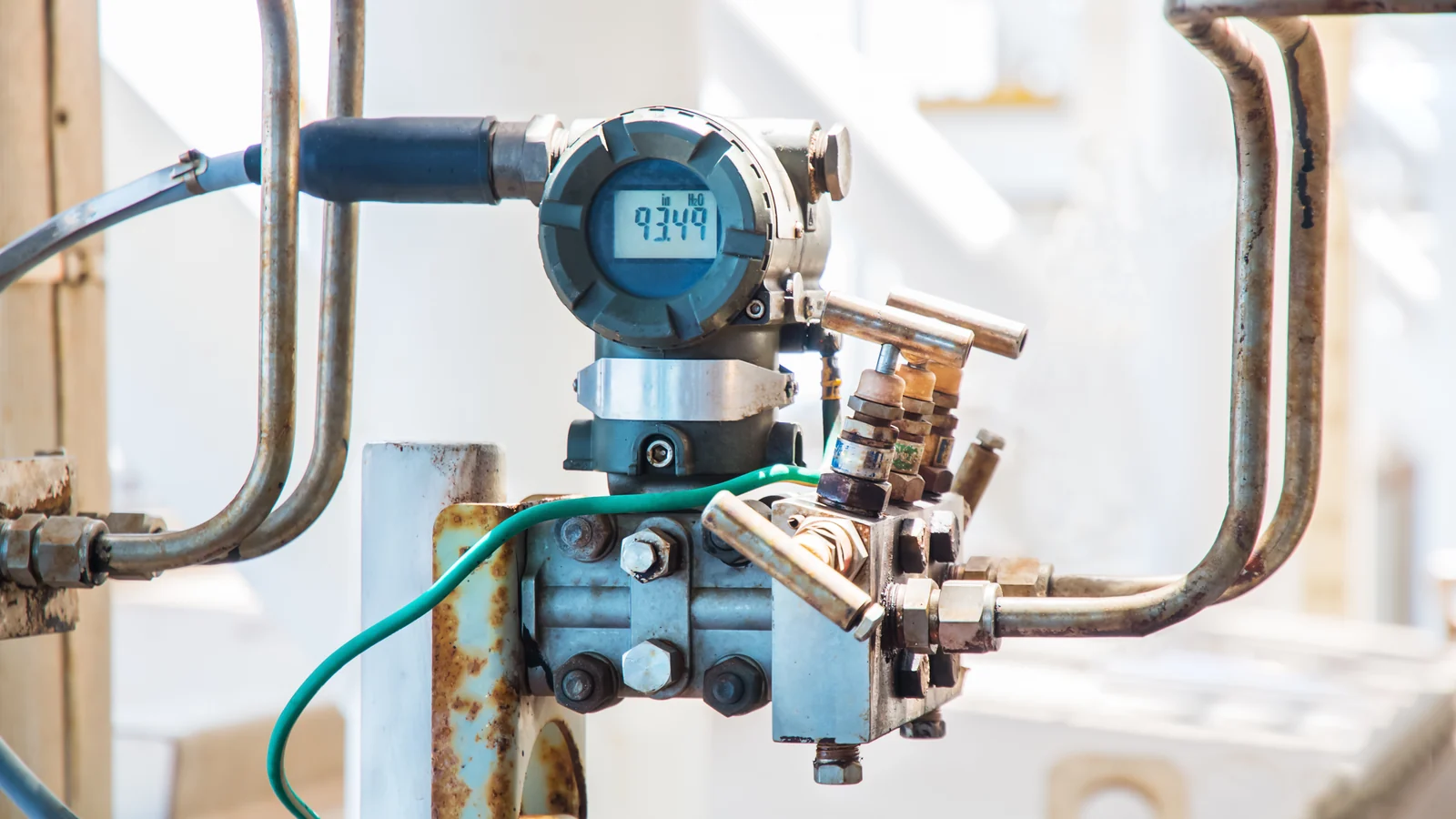
Maker, model, serial, photos, nameplates, drawings, quantity, port and ETA.
Sensors, Safety & Instruments
Marine Sensors, Gas Detectors & Thermometers
Marine Sensors, Gas Detectors & Thermometers
Parts Supplier
Engine-room supply route for gas detection, pressure, temperature, level, speed and alarm-system components.
Request context is structured before supplier routing or quotation work.
OEM route or verified alternative route can be reviewed where appropriate.
Commercial request is prepared for clearer supplier review and buyer reply.
Safety and monitoringGas detection, instruments and alarm components
Technical cross-checkingMaker, model, range, signal type and photos
OEM + verified alternativesRoute review by compatibility and criticality
Port-aware deliveryUrgency, ETA and handover coordination
Instrumentation supplier
Sensor and safety RFQs structured around compatibility, signal type and installation context.
Vessel Core supplies technical buyers with monitoring, alarm, safety and measuring components used across engine-room and ship systems.
If a clean part number is missing, the request can start from maker, model, measuring range, sensor signal, installed panel reference, nameplate, old part photo or drawing. Compatibility context is important before commercial supply routes are reviewed.
See the control room's alarm and monitoring equipment on the engine room map →
Supply scope
Safety, monitoring and instrument components we can structure into an RFQ.
Supply coverage for planned replacement, troubleshooting and time-critical safety-equipment requests.
Gas detectors
Fixed or portable gas-detection components, sensor heads, modules and related spares. Most gas-detection lines are parts and consumables rather than whole instruments: sensor cells, intake filters, calibration gas and docking-station modules. A cell is specified against the target gas and measuring range, not the instrument name, and some single-gas instruments are sealed for a fixed life, where a new cell means a replacement instrument. If a survey finding, MED wheelmark or class requirement sits behind the request, say so. Model-level detail is on the Dräger and Riken Keiki pages.
Pressure sensors
Pressure transmitters, switches and sensors by range, thread, signal and installation point. A switch and a transmitter on the same tapping are different items: a switch is ordered by setting range, differential and contact arrangement, a transmitter by measuring range and output signal. Danfoss KP, RT, CAS and KPS pressure and temperature switches, met on refrigeration compressors and provision plant, are covered on the Danfoss page.
Temperature sensors
Temperature transmitters, resistance thermometers (Pt100), thermocouples and thermowells, matched to the specific system and installation point.
Thermometers
Local thermometers, bimetal and liquid-in-glass, remote-reading temperature indicators and replacement instruments.
Level sensors
Level switches, probes, transmitters and spare parts for tank and system monitoring.
Speed pickups
Speed sensors, pickups, tachometer-related parts and rotation monitoring components.
Alarm components
Alarm-system spares, indicators, modules, contacts and interface components.
Monitoring spares
Monitoring-system components, panel items and replacement control-side parts.
Model index
41 models in this category, filterable.
Start typing a designation, a maker or a part and the rows filter as you go. The full list across every category and maker lives on the maker reference page.
41 models · 1 note
| Model | Series | Maker | Typical parts |
|---|---|---|---|
| VZO 20 · VZO 25 · VZO 40 | CONTOIL VZO | Aquametro | Volumetric oil meters with a roller counter and an optional pulse output, in screwed and flanged builds. Counters, pulse transmitters, measuring chambers and strainers are quoted against the complete code on the label. |
| VZF II | CONTOIL VZF II | Aquametro | The second CONTOIL family for lubricating oils and fuels. The family is named in every line along with the full code from the label. |
| DFM 8ECO · DFM 12ECO | Differential measurement | Aquametro | Differential fuel measurement units with electronic readout, used where fuel returns from the engine. Sensors, the readout unit and the board computer that calculates consumption are quoted as separate lines. |
| BS-420 · BC-420 | AutroSafe 4 · panels | Autronica | The BS-420 fire alarm control panel is the main control panel of AutroSafe 4 and can also run a stand-alone system. The BC-420 is the controller of the same system, a separate unit that connects detection loops and input and output modules. Panel fronts, loop driver modules, input and output modules and power supply parts are the usual lines, each read against the panel label and the software version the panel shows. |
| BS-310 · BS-320 | AutroSafe · earlier panels | Autronica | Fire alarm control panels of an earlier AutroSafe version, still met on board. Which of the two is fitted is read from the panel label, and a part for either is quoted from that label and its own parts list; nothing is carried over from the BS-420 line on an assumption. |
| Autroprime | Autroprime · small-to-medium vessels | Autronica | Autroprime is the Autronica fire detection system for small-to-medium sized vessels. The panel recognises the detectors and other loop units connected to its loops by itself, so a replaced unit is identified by its label and by its place on the loop. Panel parts, loop units and bases are the usual lines. |
| BS-100 | BS-100 · earlier generation | Autronica | A fire detection system of an earlier Autronica generation, still met on older ships. Refits from BS-100 to AutroSafe 4 have kept many of the detectors and loops already installed and changed the panels, so the same ship may carry old loops under a new panel. The enquiry has to say whether the loops still run on the BS-100 panel or already under AutroSafe. |
| BDH · BHH detectors | Point detectors · 200, 300 and 500 series | Autronica | Point detectors for AutroSafe and Autroprime loops carry BDH for heat and BHH for optical smoke and multisensor versions. The 300 and 500 series have SelfVerify, and suffixes such as /EX and /N mark versions for hazardous areas. The full type with every suffix comes from the detector label; a hazardous-area version is never quoted as a standard one. |
| AutroGuard Retro (/SPARE) | AutroGuard Retro · spare detectors | Autronica | For AutroSafe detectors the maker now offers AutroGuard Retro variants: the original type with /SPARE added, so a BHH-300/SPARE stands for a BHH-300. They mount on the existing base, but only with panel software versions the maker lists and not in every kind of base. That is why the base label and the software version come before the price. |
| BWA-100 · BBR-130 · BBQ-130 | Bases and base sounders | Autronica | The BWA-100 is the base under AutroSafe and Autroprime detector heads. The BBR-130 combines a detector base with an addressable sounder, and the BBQ-130 adds an alarm indicator to that sounder. A base or base sounder is quoted from its own label, and the detector above it is a separate line. |
| BG-201 | AutroFlame · flame detectors | Autronica | AutroFlame flame detectors such as the BG-201 infrared detector sit on the same system, and the AutroSafe or Autroprime panel sets their performance mode. A flame detector is quoted from its own label and with the loop and address it holds, never as a substitute for a smoke or heat detector. |
| CS3000 | Analogue addressable | Consilium | The computerised analogue addressable system in which detectors and loop units sit on addressed loops. Many ships still run it. Panel boards, loop units, detectors and bases are matched to the system and to the label on each unit. |
| CS4000 | Analogue addressable | Consilium | The later analogue addressable system, in which every loop unit can raise a fire alarm on its own. Detectors listed for the CS4000 include optical smoke, heat and intrinsically safe types; each line names the type from the label and the system it belongs to. |
| Salwico Cargo | Cargo ships | Consilium | The Salwico fire detection central for cargo ships, built to the SOLAS rules. Detectors and call points are quoted against the central and the label of each unit, because a detector listed for one Salwico system is not assumed to fit another. |
| Pac series | Portable single-gas · Pac series | Dräger | Pac 3500, Pac 5500, Pac 6000, Pac 6500, Pac 7000 and Pac 8000 cover single-gas duty, from a quick check before a space is entered to a personal monitor worn through a watch. The model matters more than it looks: Pac 5500, Pac 7000 and Pac 8000 are lifetime instruments with a replaceable battery and a replaceable sensor, while the Pac 3500 is a fixed-life sealed device. |
| PIR 7000, Regard panels and Draeger-Tubes | Sensor heads, panels and tubes | Dräger | PIR 7000 point infrared sensor heads serve fixed detection points, and Regard 3900 and Regard 7000 control panels are what the Polytron transmitters feed into. Alongside all of the electronics sits the colorimetric Draeger-Tubes system with the accuro hand pump — more than 500 substance tubes, no power required, usable in Ex areas. |
| Polytron 7000 | Universal transmitter | Dräger | The Polytron 7000 is a universal transmitter supporting 4-20 mA, HART, PROFIBUS and FF outputs. On a replacement enquiry the output type matters as much as the sensor, because the transmitter has to talk to a panel that was wired years earlier and will not be rewired for a spare. |
| Polytron series | Fixed transmitters · Polytron series | Dräger | Polytron 3000, Polytron 5100 EC and Polytron 6100 EC WL cover electrochemical duty for toxic gases and oxygen; Polytron 5200 CAT covers flammables on the catalytic principle; Polytron 8100 EC and Polytron 8700 IR sit at the upper end. The suffix is not decoration — it names the measuring principle, and therefore the sensor that can be fitted. |
| X-am series | Portable multi-gas · X-am series | Dräger | X-am 2500, X-am 2800, X-am 5000, X-am 5600, X-am 7000 and X-am 8000 read several gases at once, which is what an entry permit normally asks for. Sensor fit varies between instruments of the same model, so the gases actually configured have to come with the request rather than be assumed from the model name. |
| Mk7 | Graviner Mk7 · auto-addressed | Graviner | A detector head sits on each crank space and analyses the oil mist where it is, without external sample pipes, and an engine-mounted control unit polls the heads and finds their addresses by itself. Each head checks itself for internal faults, and alarms and faults are kept in a dated event log. One system can cover more than one engine, each with a control unit of its own. Detector heads, control unit parts and the display are the usual lines. |
| Mk6 | Graviner Mk6 · analogue addressable | Graviner | Each Mk6 head watches a single crank space, works without sample pipes and is given its own address, which the control unit reads together with the oil mist value; the alarm levels are set at the control unit. The control unit is mounted away from the engine, in the engine control room or another suitable place, and is wired to the heads through a junction box. |
| Mk5 | Graviner Mk5 | Graviner | Mk5 detectors are still met in service and still appear in parts listings under the Graviner and Kidde Graviner names. An Mk5 is quoted only from its own labels and its own parts list; nothing is carried over from the Mk6 or Mk7 lines, and a later head is not offered in its place. |
| Remote Display Unit | Mk7 display | Graviner | The optional touch-screen display of the Mk7, mounted in the engine control room, where it shows the signal of each detector and the oil mist level of the engine in alarm. It is a line of its own on the enquiry, separate from the control unit on the engine. |
| OMP | Fuel flow meters | KRAL | KRAL's own fuel-consumption flow meters, commonly fitted on the same line as a KRAL screw pump. The meter fails on its own schedule and is quoted as a separate item from the pump. |
| GX-3R and GX-3R Pro — compact personal instruments | Portable · GX-3R series | Riken Keiki | Small enough to be worn rather than carried. The Pro can be configured for as many as five gases, combining LEL, oxygen, hydrogen sulphide and carbon monoxide with a toxic option such as HCN, NH3, NO2, PH3, SO2 or CO2, which is why two instruments with the same name on the case can need entirely different cells. |
| GX-9000 and GX-9000H — expandable four to six gas | Portable · GX-9000 series | Riken Keiki | Leaves the works with the four standard gases O2, H2S, CO and HC and two further sensor slots that may or may not have been filled on board. The GX-9000H is a high-range hydrogen sulphide variant aimed at oil tankers, so the range, not only the gas, has to be stated when a cell is requested. |
| GX-6000 · GX-Force | Portable · GX-6000 & GX-Force | Riken Keiki | The GX-6000 covers as many as six gases including volatile organic compounds, which brings a different sensor family into the same instrument. The GX-Force is a four-gas instrument. Both are ordered by the gases actually fitted rather than by the maximum the body will accept. |
| RX-8500 — LNG cargo monitoring | Portable · cargo duty | Riken Keiki | Built for LNG carrier cargo monitoring with an infrared methane sensor covering 0-100% LEL and 0-100% by volume with autoranging. An infrared sensor is a different part from the catalytic element used elsewhere for combustibles, and is treated as its own line on an enquiry. |
| SC-01 — single toxic-gas monitor | Fixed · single-gas | Riken Keiki | Built around interchangeable smart sensors that the monitor recognises automatically, so changing the target gas does not call for reconfiguration. That design turns the sensor into a routine consumable, and makes the target gas and range the decisive fields on the RFQ line rather than the monitor type. |
| SD-1 — smart transmitter and detector head | Fixed · detector heads | Riken Keiki | A fixed head with an integrated display, measuring combustibles such as methane and other hydrocarbons alongside toxic hydrogen sulphide and carbon monoxide. Because the head carries its own display and smart sensor, the sensor and the transmitter are separable items on a parts list. |
| SD-3 — fixed marine detection system | Fixed · ship systems | Riken Keiki | Installed for engine rooms, pump rooms, bilge areas, ballast tanks and accommodation spaces. A system enquiry usually reaches a supplier as a list of heads, sensors and calibration items for several spaces at once rather than as a single part. |
| VN2020 | VISATRON VN2020 · suction type | Schaller Automation | The current suction-type VISATRON. Crankcase atmosphere is drawn from several measuring points along the engine through header pipes to one detector, where the measuring head reads its opacity; the detector has a pressure regulator unit and an LED display. Schaller presents it as the successor to the VN87plus and the VN93, made to connect to their pipework. The measuring head and the pressure regulator unit are ordered as lines of their own, by their labels. |
| VN301plus | VISATRON VN301plus · pipe-free | Schaller Automation | No suction pipework at all. Each sensor is screwed into the crankcase wall from outside and joined to a central unit by a hybrid cable; a large installation is split between two central units, one of them leading the other. A sensor, its wall fitting, its cable and the central unit are separate lines with separate labels. |
| VN115/87 · VN215/87 | VISATRON VN87 · VN87plus | Schaller Automation | Two types of one family. On a VN115/87 the samples drawn from the crankcase compartments are collected in header pipes and the detector reads their combined opacity. A VN215/87 is a separate type of the same family with a parts list of its own, so the two are never read as one. Copy the type with any plus or EMC suffix exactly as the label shows it. |
| VN93 | VISATRON VN93 | Schaller Automation | An earlier suction-type series that Schaller names, together with the VN87plus, as a predecessor of the VN2020. A VN93 is quoted from its own labels and its own parts list only; nothing is taken over from the VN87plus or VN2020 lines. |
| Remote Indicator II | Engine control room indicator | Schaller Automation | The optional indicator that repeats the detector readings on the control desk in the engine control room. It carries a label of its own and is a separate line, apart from the detector or central unit on the engine. |
| ViscoSense 3 · ViscoSense 3D | Fuel viscosity · ViscoSense | VAF Instruments | In-line sensors that read fuel viscosity from a small pendulum vibrating in the fuel. The ViscoSense 3 reads viscosity and temperature; the 3D reads density as well. The sensor is wired to an interface box, and the viscosity controller uses the reading to trim the fuel heating. Sensor and box carry separate labels and part numbers, and a ViscoSense 3 box is not read as a 3D box. Older ViscoSense 2 installations are still met in service and are quoted from their own labels. |
| Viscotherm | Fuel viscosity · earlier VAF system | VAF Instruments | Viscotherm is the name of VAF's earlier fuel viscosity control equipment, in which a controller holds viscosity by regulating the fuel temperature. For Viscotherm installations VAF offers a retrofit: a housing of the same shape that takes a ViscoSense sensor. Whether a ship still runs the original unit or the retrofit is read from the labels and the housing, not from the name in the machinery list. |
| J5025PT2 · J5040PT2 · J5050PT2 | Fuel flow meters · PT2 | VAF Instruments | Positive displacement meters with sliding vanes, made for measuring fuel consumption on board. The full type is stamped on the meter body and is copied exactly, together with the serial; two meters on one fuel line are often of different types. The meter body and the pulse sensor that reports its count are separate lines on a request. |
| T-Sense | Shaft power meter · optical | VAF Instruments | An optical torque meter on the propeller or drive shaft that reports torque, shaft speed and shaft power. Some of its parts turn with the shaft and some sit beside it, and each carries its own label. The fault shown on the display and those labels decide which part goes on the request. |
| TT-Sense | Thrust and torque meter · optical | VAF Instruments | The same optical approach with propeller thrust measured as well as torque. A TT-Sense is quoted from its own labels and parts list, never from a T-Sense list, even though the two meters look alike on the shaft. |
Service and identification notes
Wear patterns, duty context and plate-reading advice from the maker pages. They help scope a request; they are not designations.
| Topic | Context | Maker | Detail |
|---|---|---|---|
| Sampling a space from outside it | Pump-capable sampling | Dräger | X-am 7000 and X-am 8000 are pump-capable with hose runs up to 45 m, which is what allows a tank or cargo hold atmosphere to be drawn out and read before anyone goes in. That capability brings its own consumables: pump units, sampling hoses, probes and adapters, none of which are recoverable from the instrument model name alone. |
Nothing matches. Send the designation from the nameplate — we also quote items that are not listed here.
This list indicates coverage. It is not stock on hand and not a claim of affiliation with any manufacturer.
Before dispatch
What leaves here, and what leaves with it.
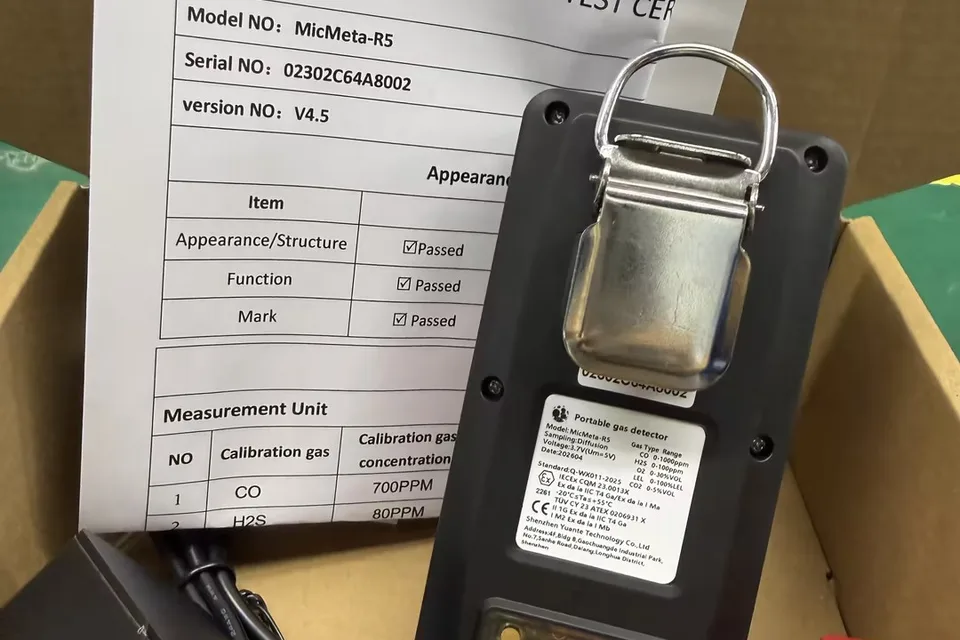
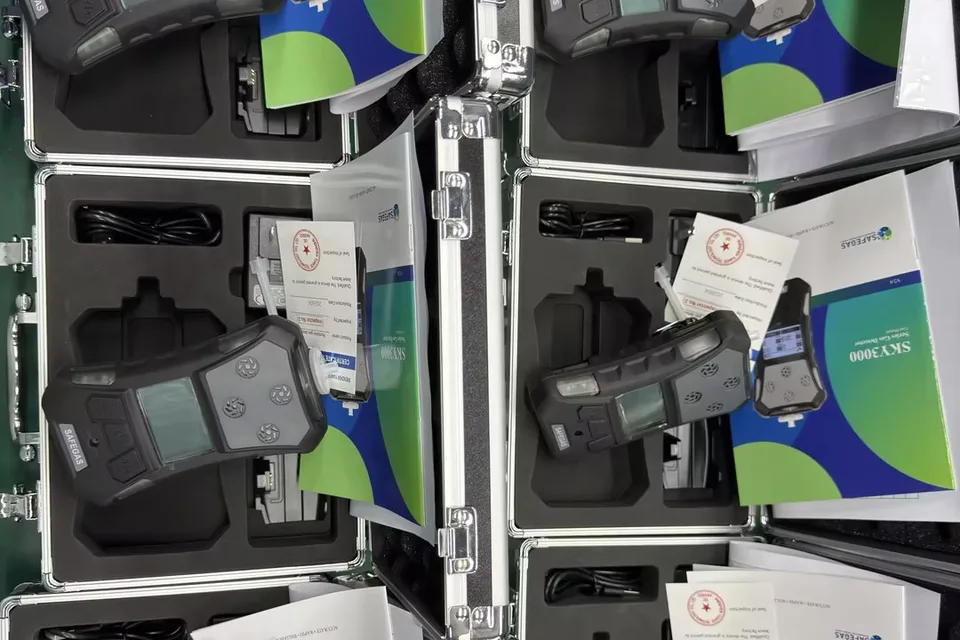

Vessel Core's own photographs of items prepared for dispatch in 2026. Manufacturer names and markings are visible because they are on the goods: Vessel Core has no dealership, distribution or partnership agreement with any manufacturer shown and operates as an independent spare parts supplier. Documentation shown accompanied these particular units; it is not a general specification for any product line.
What to send
Send enough context to confirm signal, range and installation.
Sensor requests often need more than a short description. Photos of the label, connection, panel, drawing or old part help cross-check range, signal and compatibility. The RFQ evidence checklist has its own categories for gas detectors, for thermometers and gauges, and for sensors and transmitters, and turns what is ticked into a summary to paste into the request. Where the plate gives the range in different units from the ship's drawings, the unit converter settles it before the line is written. For a gas detector reading, the gas concentration converter gives the same figure in ppm, % vol, mg/m3 and % LEL. For a screwed connection, the thread identifier narrows the thread down from a caliper reading and a thread count, and says when BSP and NPT cannot be told apart by the count alone. For a local pressure gauge, the pressure gauge selector takes the EN 837-1 range for the working pressure and writes the size, class and connection as one line. For a resistance thermometer or a thermocouple, the Pt100 and thermocouple reader turns a Pt100 reading into degrees and names a thermocouple from its cable colour. A gas detector head or transmitter made for a hazardous area carries an Ex marking such as Ex db IIC T4 Gb, taken apart by the Ex marking reader, and an enclosure rating such as IP66/IP67, read by the IP code reader; both check an offered replacement against the fitted item.
Vessel and timing
- Vessel name / IMO
- Company name
- Urgency level
- Port / ETA
Equipment reference
- Maker
- Model
- Serial number
- Equipment application
Part request
- Part number
- Description
- Quantity
- OEM / alternative / both
Attachments
- Photos
- Nameplate
- Drawing
- Excel list
Related categories
Connect this RFQ to the wider engine-room supply scope.
Sensors RFQ FAQ
Short answers for technical buyers.
Can you quote sensors without a part number?
Yes. Send maker, model, tag, range, signal type, nameplate photo, drawing or installed component photos. That is often enough to structure the RFQ.
Can you handle time-critical safety-related requests?
Yes. Add vessel / IMO, port, ETA, system criticality and any alarm or safety context so the request can be prioritized correctly.
Can you review alternatives?
Yes, when compatibility and approval context allows it. The supply route should match signal type, measuring range, installation and operational criticality. On gas detection the line is drawn by approval: intake filters, hoses, sampling-pump parts and calibration gas can be reviewed on either route, but a sensor for a certified fixed transmitter is tied to the approval it was tested under, so the OEM route is normally confirmed first. The route advisor walks through the same factors for one line at a time.
Send sensors RFQ
Need sensors, gas detectors or thermometers?
Send maker, model, tag, range, signal type, quantity and port/ETA. Photos, labels, drawings, panel references or Excel lists are welcome.
