
LESER Safety & Relief
Valve Spare Parts Requests
Compact Performance & High Performance & Modulate Action series, and pilot-operated relief valves
The LESER valves behind most engine-room safety valve enquiries
LESER GmbH & Co. KG is a German manufacturer of safety and relief valves, and the company runs a dedicated line for the ship-building industry. On board, its valves sit wherever a system has to be protected against overpressure: steam systems, water systems, fuel systems, lubrication systems, and LNG/LPG cargo systems including FPSO installations. The maker groups its valves into series, but a series name on its own does not identify a spare part - the type designation and the orifice designation carried on the valve do, because two valves from the same series can be built for very different settings and duties.
Compact Performance series
The compact line, quoted against the type designation and the orifice designation carried on the valve itself rather than against the series name. Where a valve of this line is on a machinery-space position, the orifice designation is the field that keeps a disc or seat component on the right size.
High Performance series
Scoped from the type designation, the orifice designation and the set pressure recorded for the position the valve protects. On this line the same body size is built in more than one internal arrangement, so the type designation has to be sent in full - every character of it, as stamped.
Modulate Action series
The modulating line. As with the spring-loaded series, it is the type designation and the orifice designation on the valve that decide the internals, not the series name, and the medium the valve sees decides the soft-seal specification.
Types 526 and 441 - horizontal and suspended installation
Types 526 and 441 are documented for horizontal and suspended marine installation. Where one of these is fitted, state the installation arrangement alongside the type designation, since mounting-related components and the way the valve is supported belong in the same enquiry as the internals.
Series 810 and 820 - pilot-operated relief valves
Pilot-operated relief valves carry pilot components in addition to the main valve internals, so they are scoped differently from a spring-loaded valve: the pilot is a request line of its own. LESER holds a DNV GL Type Approval Certificate for the series 810 and 820 pilot-operated relief valves; that certificate applies to those series and is not read across to the other lines.
Steam, water, fuel, lubrication and cargo duty
The same valve series turns up on steam, water, fuel and lubrication systems, and on LNG/LPG cargo systems including FPSO installations. The system a valve protects, and the medium and temperature it actually sees, decide the soft-seal and bellows specification - which is why the duty is asked for before any seal item is put on a line.
LESER safety valve components that appear on RFQ lines
The groups below follow the order in which a safety valve comes apart - spring and bonnet, disc and seat, bellows and soft seals, guide and spindle, pilot - so each RFQ line can carry the drawing item number beside the description. On a survey-driven overhaul most of these lines move together rather than one at a time.
- Spring assemblies matched to the set pressure recorded for the position
- Discs and seat or nozzle components, requested as a pair where the seating face has been lapped before
- Bellows for balanced designs, specified against the medium and the back-pressure situation
- O-rings, gaskets and soft-seal kits selected against the system the valve protects
- Guide and spindle parts, including the components that keep the disc square to its seat
- Pilot components for the pilot-operated series 810 and 820
- Lifting-lever and cap assemblies, plain or gas-tight depending on the installed arrangement
- Overhaul kits grouped by valve series and orifice designation
- Bonnet and body joint items renewed when a valve is opened for re-setting
- Mounting-related components for types 526 and 441 in horizontal or suspended installation
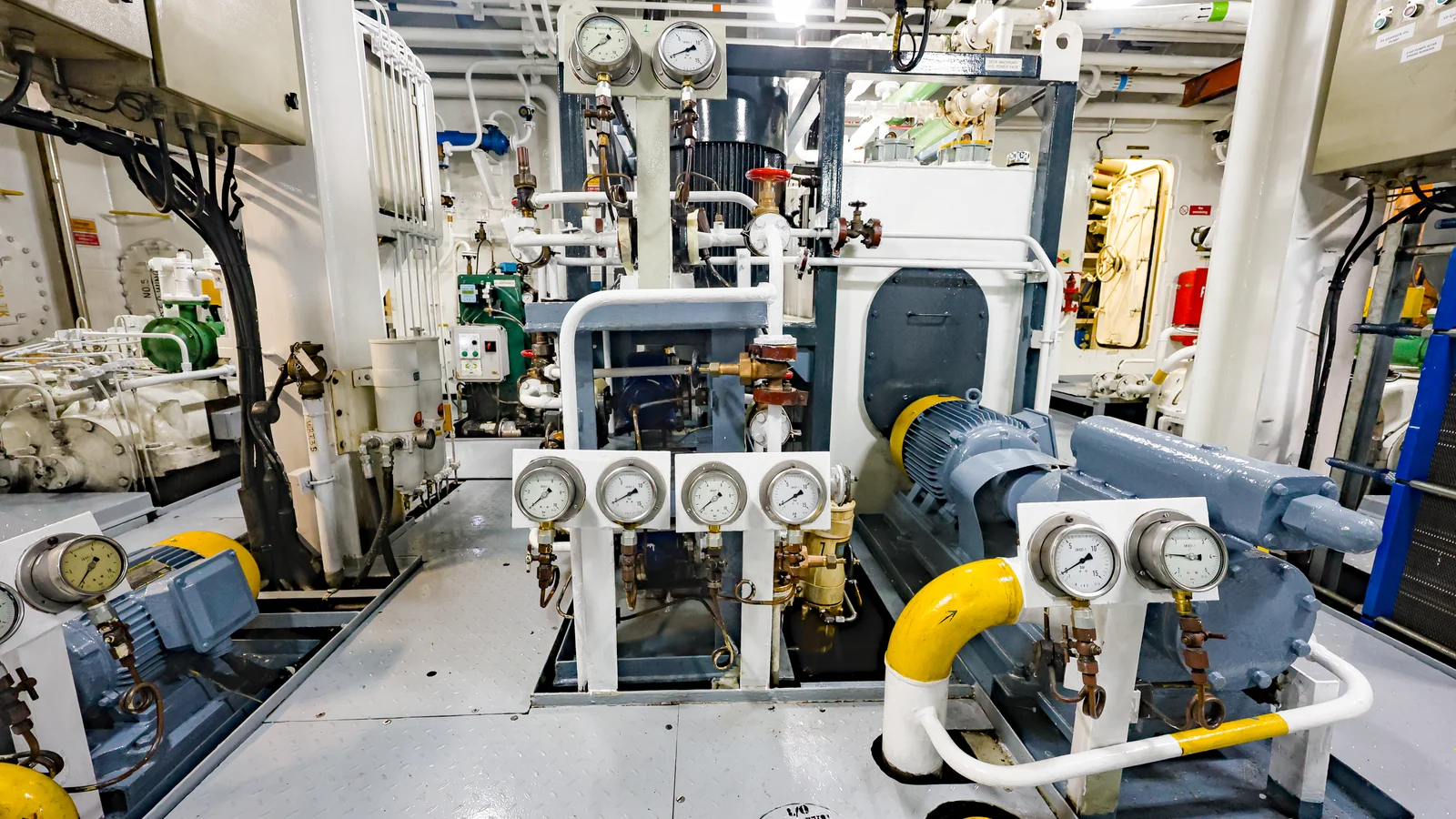
Marine globe valve — general arrangement
A licensed photograph of LESER equipment was not available at publication, so this technical reference illustrates the general arrangement shared by this equipment class.
Illustrative technical reference, not a photograph of LESER equipment or a Vessel Core installed reference — a licensed photo of this maker's equipment was not available. Vessel Core has no dealership, distribution or partnership agreement with LESER; it operates as an independent spare parts supplier.
Turning a LESER type designation into a quotable line
A LESER nameplate carries more than a name. The series tells you which family the valve belongs to; the type designation and the orifice designation tell you which build is in front of you and which internals fit it. The set pressure recorded for the position is the third field, and it is the one most often missing from an enquiry - without it a spring assembly cannot be specified, because valves of the same type and the same orifice designation are built with different springs for different settings.
- Complete type designation as stamped, with every suffix character
- Orifice designation carried on the valve
- Serial number from the LESER nameplate, photographed square-on
- Set pressure recorded for that position, and whether the valve is being re-set to the same value
- System protected: steam, water, fuel, lubrication or LNG/LPG cargo
- Medium and its temperature in service
- Whether the valve is spring-loaded or pilot-operated
- Whether a bellows is fitted, for balanced designs
- Installation arrangement, including horizontal or suspended mounting where relevant
- Lifting-lever or cap execution as installed
- Section-drawing item numbers from the valve documentation
- Photographs of the nameplate, the installed valve and the opened internals
A safety valve enquiry asks more of a buyer than a loose fitting does.
A safety valve is a certified protective device, not a pipe component, and the enquiry has to describe a setting and a seating condition rather than a shelf item. Safety valve overhaul on ships is typically tied to set-pressure verification and to class survey intervals, so requests often accompany a re-setting or a re-certification job. What follows is how those two facts - a spring tied to a setting, and work tied to a survey - change the questions asked before any LESER item is quoted.
Spring quoted against the setting
The spring assembly is what holds the disc on its seat until the protected system reaches its setting, so it is specified from the set pressure recorded for that valve rather than from the body size. Send the setting from the valve in front of you, not from a similar valve elsewhere in the machinery space.
Disc and seat treated as a pair
A disc renewed onto a seat that has already been lapped more than once rarely gives back a tight shut-off. Where the seating face has been worked before, the disc and the seat or nozzle component are raised together on the enquiry so the choice is made openly rather than discovered on the test bench.
Soft seals chosen against the medium
O-rings, gaskets and soft-seal kits are specified against the system the valve protects and the temperature it sees, not against the valve series. Steam duty, fuel duty and cargo duty argue for different elastomer choices on otherwise identical valves, so the medium is confirmed before a seal kit is put on a line.
Bellows raised where the design is balanced
Balanced designs carry a bellows, and a failed bellows changes how the valve behaves against back pressure long before anything is visible from outside. Whether a bellows is fitted is asked for early, since it decides both the parts list and how the valve is tested after reassembly.
Pilot components listed separately
On the pilot-operated series 810 and 820 the pilot is its own assembly with its own wear items. Stating that the valve is pilot-operated, rather than leaving it to be inferred from the type designation, keeps the pilot components on the enquiry instead of turning up as a second request a week later.
Survey timing settled before the parts list
Because the work usually sits inside a set-pressure verification or a class survey, the enquiry is scoped around when the valve has to be back in service and whether it is being re-set on board or ashore. Where a position needs approval evidence, that question is raised before quotation rather than after.
LESER safety valve enquiries - recurring questions
What information is needed to quote LESER safety valve parts?
The valve series and type designation, the orifice designation carried on the valve, the serial number, the set pressure recorded for that position, the system the valve protects and the medium it sees, and photographs of the nameplate and the installed arrangement. Vessel and IMO, urgency, port and ETA help route the request. Where the job is tied to a survey, saying so early keeps the spring, the seat components and the overhaul kit on one enquiry instead of three.
Can LESER valve parts be identified without a part number?
Often yes. The series and type designation together with the orifice designation, the serial number and clear photographs of the nameplate and the opened valve are usually enough to begin identification. Stating whether the valve is spring-loaded or pilot-operated narrows the internals considerably, since a pilot-operated valve from the 810 or 820 series carries pilot components that a spring-loaded valve does not.
Why is a safety valve spring quoted against the set pressure rather than the valve size?
Because the spring is what holds the disc on its seat until the protected system reaches its setting. Valves of the same series and the same orifice designation are built with different spring assemblies depending on the pressure the position was set to, so the size code alone does not identify the spring. Send the setting recorded for that valve rather than a figure taken from a similar valve elsewhere in the machinery space, and state whether the valve is being re-set to the same value or to a new one.
Why is LESER named on this page?
Vessel Core is independent of LESER. The maker name, series names and type designations appear here only so that equipment already installed on board can be identified and a spare-parts request structured and routed for quotation; naming them implies no dealer, distributor or partner relationship, and no endorsement by the manufacturer.
Send the nameplate and the recorded setting.
List the valve series and type designation, the orifice designation, the serial number, the set pressure recorded for that position, the system the valve protects, the components required and the port. If the part numbers left the ship with a previous crew, photographs of the nameplate and the opened valve, or an Excel list, are enough to open the file. The spring assembly, the disc and seat components, the soft-seal kit and the pilot items are then quoted as separate lines, so the ship can decide what to fit at this survey and what to carry as a running spare.

