
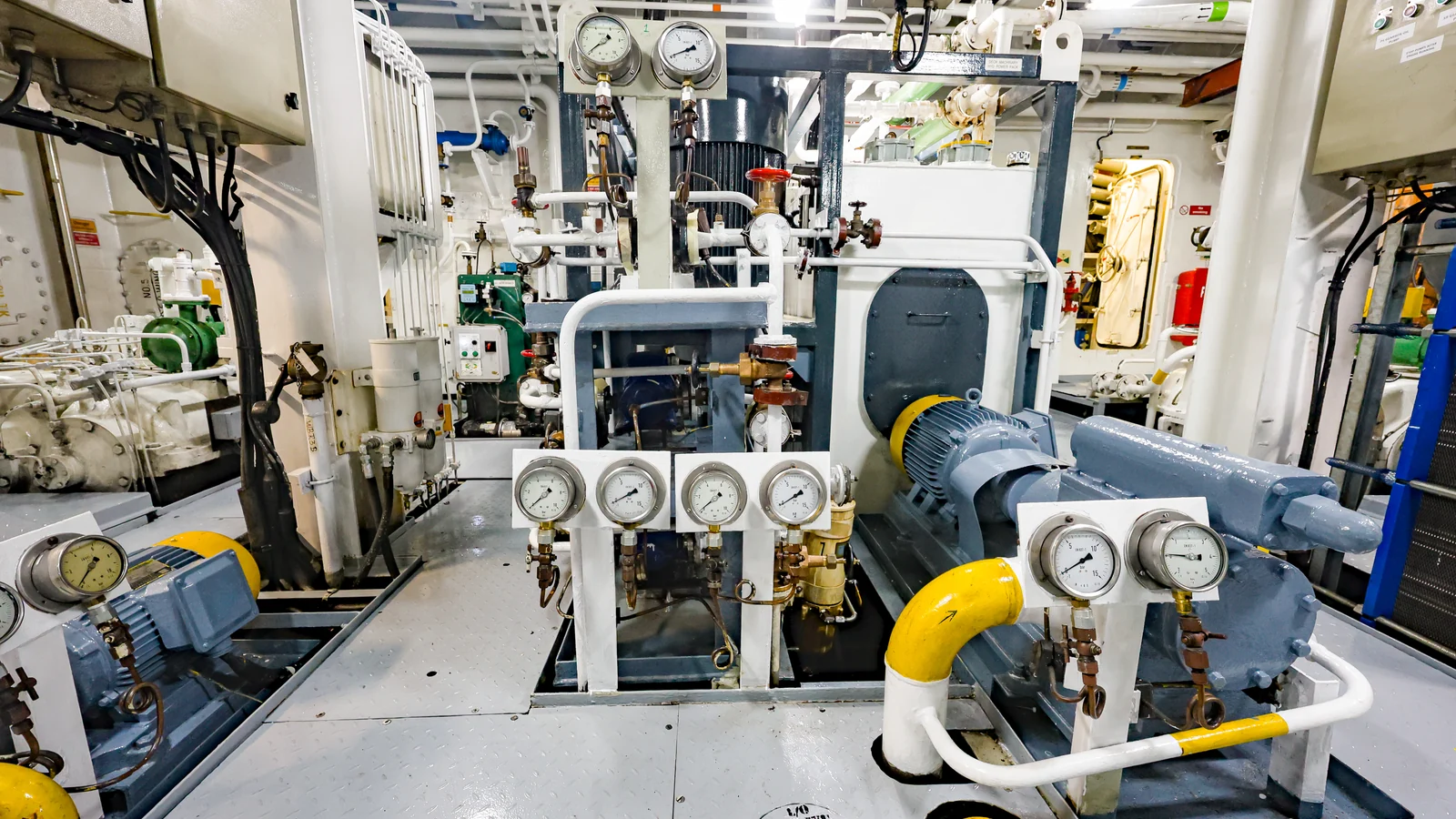
Orifice / power element
The exchangeable orifice assembly on a TE or TEA valve, sized to the duty rather than the valve body, and the thermostatic element that drives it; Danfoss lists each under its own code number.
TEA and TE expansion valves, KP/RT/CAS/KPS pressure and temperature switches, EVR and marine solenoid valves — identified by type code, quoted with OEM or verified-alternative evidence.
Danfoss is a Danish conglomerate with a very wide catalogue, and only a narrow slice of it turns up on a ship: expansion valves, pressure and temperature switches, and solenoid valves fitted around refrigeration, provision plant and AC systems. The three families below are the ones this site quotes against.
Thermostatic expansion valves controlling refrigerant flow into the evaporator. TEA is the ammonia (R717) valve, with a cast-iron body and weld flanges; TE 5, TE 12, TE 20 and TE 55 cover fluorinated refrigerants such as R404A, R134a and R22. Both families are built from three separately ordered parts (thermostatic element, orifice assembly and valve body), but each family has its own part numbers, and the orifice is chosen for the duty rather than for the body.
KP covers general low- and high-pressure protection on refrigeration compressors; RT is the wider thermostat and pressure-switch range; CAS and KPS are industrial lines that Danfoss builds for shock and vibration, naming diesel plants, compressors and shipboard installation among their uses, with marine class approvals listed model by model. State which range is fitted before a switch or reset element is quoted, since the internal mechanism differs between them.
EVR is Danfoss's solenoid valve for liquid, suction and hot-gas lines on fluorinated refrigerants; on an ammonia plant the counterpart is EVRA. EV210B, EV220B, EV250B and EV310B are a different family: general-purpose solenoid valves for water, oil, compressed air and similar neutral media, so on board they sit on water, air and oil lines rather than in the refrigerant circuit. EVR valve bodies and coils are sold separately, so the coil is quoted against its own voltage and frequency, not against the valve body. The solenoid valve coil reader reads the voltage, duty and plug form from the coil label.
Danfoss makes drives, hydraulics and industrial controls well outside marine refrigeration, so a Danfoss nameplate alone does not identify a marine part. The type code (TEA, TE, KP, RT, CAS, KPS, EVR, EVRA, EV220B and the like) narrows it to this equipment, and the Danfoss code number (Code no.) on the label is what makes it quotable. On a TE or TEA valve, read two markings: the label on top of the thermostatic element (valve type, refrigerant, evaporating temperature range, MOP point where there is one, code number) and the marking on the orifice assembly (valve type and orifice number or rated capacity, plus the orifice code number on a TE). For a solenoid valve, add the coil's voltage and frequency — a solenoid coil is frequently the actual failure even when the valve body is sound.
Tools for this equipment: the refrigerant number reader for the refrigerant on a thermostatic element label.
The exchangeable orifice assembly on a TE or TEA valve, sized to the duty rather than the valve body, and the thermostatic element that drives it; Danfoss lists each under its own code number.
The valve's internal diaphragm and seal set, a routine renewal item across the expansion-valve and solenoid-valve ranges alike.
The pressure- or temperature-sensing element inside a KP, RT, CAS or KPS switch, renewed as a unit rather than repaired.
The manual-reset mechanism and electrical contacts on a pressure switch, a common failure point separate from the sensing element.
Ordered by voltage and frequency, separately from the valve body it operates, and a frequent cause of a "faulty valve" report that is actually a coil fault.
Flange gaskets and pipe-connection fittings specific to the valve's connection size and pressure rating.
By the type code rather than the maker name alone — TEA, KP, EVR and similar codes identify the marine-relevant families this site quotes against, out of a much wider industrial catalogue.
No. TEA is the ammonia (R717) valve and TE covers fluorinated refrigerants. Both are built from an exchangeable orifice assembly, a thermostatic element and a valve body, but each family has its own parts, so the element label and the orifice marking decide what is ordered.
Frequently the coil. Send both the valve type code and the coil's voltage and frequency so both can be reviewed rather than assuming the fault is in the body.
Both, reviewed case by case against the vessel's timeline, classification requirements and the part in question.
State the range first, KP, RT, CAS or KPS, because the internal mechanism differs between them. The sensing element or bellows inside the switch is renewed as a unit rather than repaired, and the manual-reset mechanism and electrical contacts are a common failure point of their own, separate from the sensing element. Send the full type code as stamped and say which part has failed.
No. On a TE-series valve the orifice is exchangeable and sized to the duty rather than to the valve body, so the body alone does not settle it. Send the complete type code as stamped, including the size or setting number that follows it, and the refrigerant in use.
No, and there is no agreement of any kind. Vessel Core holds no dealership, distribution, representation or partnership agreement with Danfoss, and quoting a component against one of its designations implies no approval by the maker and no claim of interchangeability.
State the type code and the Danfoss code number as marked — TEA, TE, KP, RT, CAS, KPS, EVR or EV220B and similar — since Danfoss's marine range sits inside a much wider industrial catalogue, and the code, not the product name, is what narrows it down. Add the refrigerant and voltage where a valve orifice or coil is involved.
