
Nakakita Valve & Remote
Control Spare Parts Requests
NS-C butterfly valves, control valves and remote-controlled cargo, ballast and bilge line valves
The Nakakita equipment behind most valve enquiries
Nakakita Seisakusho Co., Ltd. is a Japanese manufacturer based in Osaka, established in 1930, building marine valves and valve remote-control systems. Its equipment tends to sit where a valve that will not seat stops work: main-engine fuel-oil heating systems, cooling fresh-water and lube-oil systems, engine-room control valves and their controllers, and the cargo, ballast and bilge lines that are worked from a control console rather than by hand. The groups below are the ones that generate most enquiries, and they differ from one another less in the valve body than in the seat and in what operates the valve.
NS-C double-eccentric butterfly valves
The NS-C series is Nakakita's double-eccentric butterfly valve line, with more than 100,000 units delivered according to the manufacturer. Double-eccentric geometry lifts the disc clear of the seat as it opens, which is why the seat face, rather than the disc, is usually the first component discussed when one of these valves is opened up.
Resilient seated valves
The rubber-seated execution of the NS-C series takes its own seats and seat rings. Two valves of the same nominal size will not share seat parts across executions, so the seat variant is worth stating in the first message rather than discovering it after a quotation has been prepared against the wrong build.
Metal-seated valves with Stellite seat facing
The metal-seated execution uses a Stellite seat facing. Where a valve has been opened and the seat face is marked, the disc is normally inspected in the same breath, because the two components decide together whether the valve will hold once it is closed up again.
PTFE-seated valves
The PTFE-seated execution is the third seat variant offered on the NS-C series. It is the execution most often mis-stated in an enquiry, since a PTFE seat and a rubber seat are not always obvious from a photograph taken with the valve closed; a photograph of the seat face with the disc part-open removes the doubt.
Control valves, cylinder valves, regulating valves and safety valves
Alongside the butterfly line, Nakakita builds control valves, cylinder valves, regulating valves and safety valves. Documented service for the control valves and their controllers includes main-engine fuel-oil heating, cooling fresh-water and lube-oil systems, where the valve and the controller are two halves of one loop and are best identified together.
Valve remote-control systems
Nakakita also supplies valve remote-control systems for cargo and ballast lines and for bilge piping. On these installations the fault reported from the console and the fault present at the valve are not always the same one, so the actuator, the control medium and the valve itself are described as a set when the request is prepared.
Where a marine butterfly valve quietly stops sealing
A double-eccentric butterfly valve does not rub its seat through the whole travel. The two offsets carry the disc away from the seat almost as soon as the valve begins to open, and bring it back onto the seat only in the last part of the closing movement. That single geometric fact governs how these valves wear and what a request for parts has to describe. The contact between disc edge and seat happens over a short arc under load, so damage concentrates on the seat face and on the sealing edge of the disc, and it is rarely spread evenly around the bore.
What the line carries decides the rest. Ballast and cooling water lines move whatever the strainer let through, and a hard particle trapped between disc edge and seat at the moment of closing marks both parts at once. On the oil side, heat and time are the agents rather than debris: a seat that has spent years in a fuel-oil heating or lube-oil line will have taken a set, and the valve that passed its test last docking may not pass the next one. Either way the symptom reported on board is the same short sentence, that the valve no longer shuts tight, and it is the seat variant, not the symptom, that decides which parts are quoted.
The stem is a separate story with a separate parts list. A valve can seat perfectly and still weep at the gland, and gland packing, shaft seals and the O-rings around the cover are small items compared with a seat and disc. It is worth separating the two complaints in the request, because a packing line and a seat line are different orders of work and can be planned differently.
On the remote-controlled valves the diagnosis has one more layer. A cargo, ballast or bilge line valve that will not move on command may have a valve fault, an actuator fault or a control-side fault, and the console shows the same failure to reach position in each case. Stating what the valve does when it is operated locally, and what the actuator does when it is commanded, separates those cases before parts are specified. The same logic applies to a control valve and its controller: if only one of the two is described, the enquiry can end up specifying the wrong half of the loop.
One line on class documentation belongs in the enquiry as well. Secondary sources consistently describe Nakakita marine valves as carrying NK, LR, ABS and DNV-GL type approval, and these valves are documented as carrying type approval of that kind rather than being assessed case by case at the quay. No primary certificate document was obtained for this page. Where a replacement has to satisfy a surveyor, the approval status for the specific valve is best confirmed against the certificates held with the vessel's own documentation before the line is ordered.
Nakakita valve components that appear on RFQ lines
The groups below follow the order in which one of these valves is opened up on board - seat, disc and shaft, stem sealing, static sealing, then whatever operates the valve from a distance - so each RFQ line can carry the sectional-drawing item number beside the description.
- Valve seats & seat rings for rubber-seated execution
- Valve seats & seat rings for metal-seated (Stellite) execution
- Valve seats & seat rings for PTFE-seated execution
- Discs & disc-to-shaft components
- Shafts & shaft assemblies
- Gland packing sets
- Shaft seals
- O-rings & gasket sets
- Actuator components for remote-controlled valves
- Positioners for control valves
- Controller parts for engine-room control valves
- Internals for cylinder, regulating & safety valves
- Overhaul kits grouped by valve size
- Reconditioning kits grouped by seat type
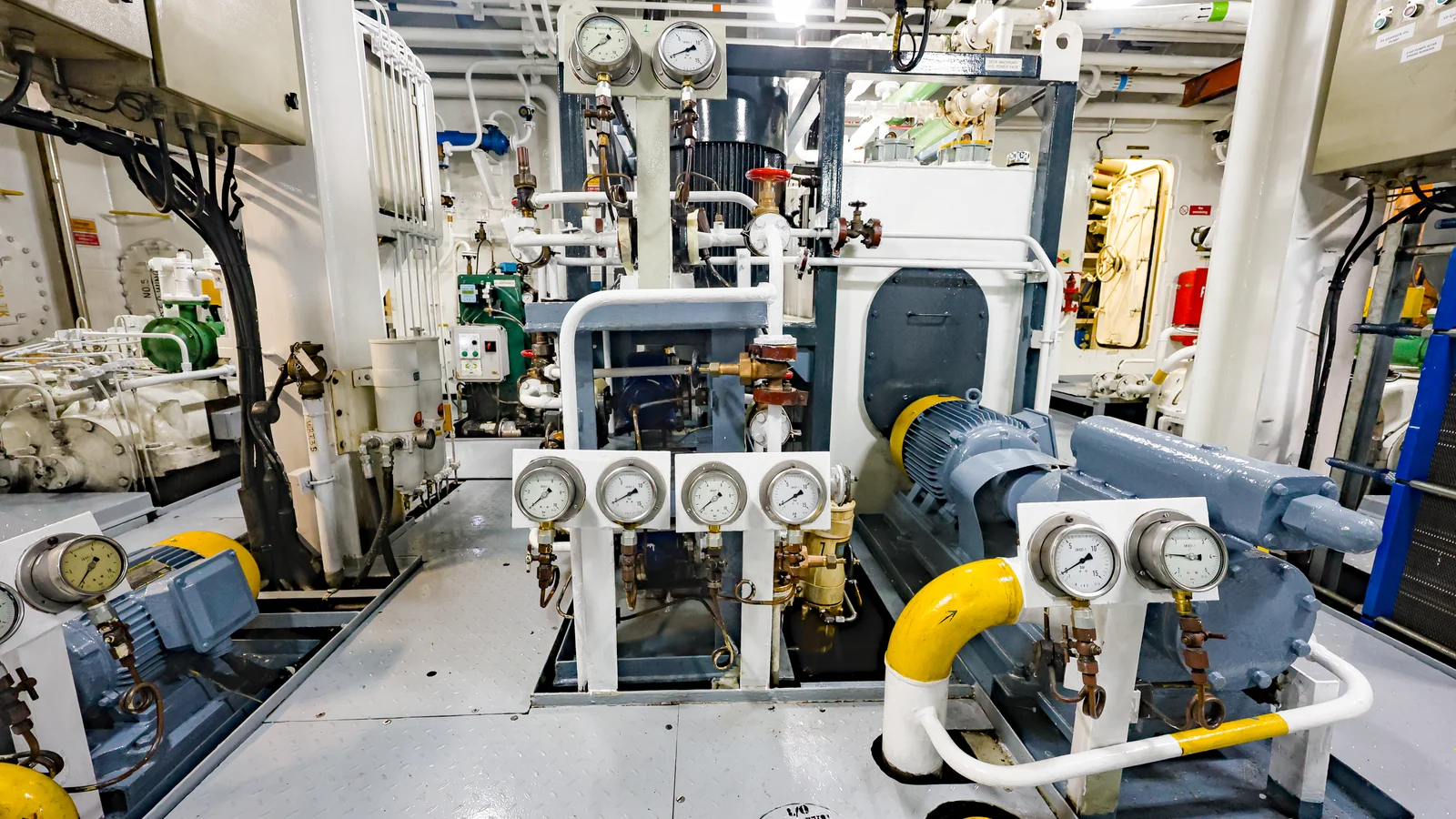
Marine globe valve — general arrangement
A licensed photograph of Nakakita equipment was not available at publication, so this technical reference illustrates the general arrangement shared by this equipment class.
Illustrative technical reference, not a photograph of Nakakita equipment or a Vessel Core installed reference — a licensed photo of this maker's equipment was not available. Vessel Core has no dealership, distribution or partnership agreement with Nakakita; it operates as an independent spare parts supplier.
Turning a valve nameplate into a quotable line
Part numbers help, but many of these valves are opened long after the manual has left the ship. The nameplate, the nominal size, the seat variant and the line the valve serves carry most of what is needed; photographs supply the rest. The seat variant is the item to send first, because it is the one detail that changes the parts list without changing anything visible from outside the valve.
- Valve type designation exactly as marked on the plate
- Nominal size of the valve body
- Seat variant: rubber, metal (Stellite) or PTFE seated
- Body, disc and shaft materials where the documentation states them
- Line the valve serves and the medium it carries
- Service temperature of the medium
- Hand-operated, remote-controlled, or control valve with positioner
- Actuator identification and control medium on remote-controlled valves
- Controller identification where a control valve is involved
- Nameplate photographed square-on
- Seat face and disc sealing edge photographed with the valve part-open
- Item numbers from the sectional drawing in the valve manual
- Class certificate references held with the ship's documentation
A valve request is a request about a seat, not about a size.
Two Nakakita valves of identical nominal size can take entirely different seat parts because they were built in different seat executions, and the remote-controlled ones carry a second identity in their actuation. What follows is how those two facts change the questions asked before any Nakakita item is quoted.
Seat variant confirmed before anything else
Rubber-seated, metal-seated and PTFE-seated executions are treated as three different valves for parts purposes. Requests that give only a size are queried back before any supplier outreach, because the answer changes the specification rather than merely refining it.
Disc and seat assessed together
Where the seat face is marked, the disc sealing edge is asked about in the same message. A new seat closing onto a damaged disc edge rarely restores tightness, and raising both on one enquiry avoids a second opening of the line.
Stem sealing kept as its own line
Gland packing, shaft seals and cover O-rings are quoted as a small separate line rather than folded into a seat order, so a valve that only weeps at the stem does not become a full overhaul on paper.
Actuation stated, not assumed
Whether the valve is hand-operated, driven by a remote-control actuator on a cargo, ballast or bilge line, or working as a control valve with a positioner is confirmed from a photograph or the drawing before actuator components are put on a list.
Controller and valve read as one loop
On engine-room control valves the controller and the valve are identified together. A symptom read at the valve often belongs to the control side, and specifying one half of the loop without the other is how the wrong part gets ordered.
Overhaul kits grouped the way ships plan
Overhaul and reconditioning kits are grouped by valve size and seat type, which is how a docking list is usually written. Several valves of one size and one seat execution can then be covered as a single request instead of line by line.
Nakakita valve enquiries - recurring questions
What information is needed to quote Nakakita valve parts?
Useful information includes the valve type designation and nominal size, the seat variant (rubber-seated, metal-seated or PTFE-seated on the NS-C series), the line the valve sits in, whether it is hand-operated, remote-controlled or a control valve working with a positioner, and photographs of the valve nameplate and the actuator. Vessel and IMO number, urgency, port and ETA help route the request.
Does the seat variant change which Nakakita spare parts are needed?
Yes, and it is the detail that most often decides the parts list. A rubber-seated, a PTFE-seated and a metal-seated NS-C double-eccentric butterfly valve of the same nominal size take different seats and seat rings, and the sealing arrangement around the shaft can differ with them. Stating the seat variant, or photographing the seat face and the nameplate together, keeps the request from being quoted against the wrong execution.
Can Nakakita valve remote control parts be quoted without a part number?
Often yes. For a remote-controlled cargo, ballast or bilge line valve the valve type designation and size, the actuator arrangement, the control medium and clear photographs of the actuator, its mounting bracket and any positioner or controller are usually enough to begin identification. Item numbers from the sectional drawing in the valve manual remove most of the remaining ambiguity.
Is Vessel Core connected to Nakakita Seisakusho?
No. Vessel Core is independent of Nakakita Seisakusho Co., Ltd. Nakakita names and series designations are used on this page only to help identify equipment already installed on board, so that a spare-parts request can be structured and routed for quotation; naming this equipment implies no dealer, distributor or partner relationship, and no endorsement by the manufacturer.
Send the nameplate and the seat evidence.
List the valve type designation and nominal size, the seat variant, the line and medium, the components required and the port. Seats and seat rings, the disc and shaft assembly, the stem sealing and the actuator or controller parts are then quoted as separate lines, so the ship can decide what to renew now and what to carry as a running spare.

