

Cylinder liners
New and reconditioned liners, O-ring kits, seat and landing-ring seals, and the cylinder-unit parts that come off with them.
Main engine overhaul spare parts supply built from clear vessel and engine evidence.
Vessel Core supplies main engine piston rings, pistons, cylinder liners, cylinder components, injectors, bearings, gaskets and related overhaul items.
The strongest requests include engine maker/model, serial number, part-book page, drawing, photos, old offer or invoice reference, quantity and vessel timing.
Focused around the component clusters that require careful cross-checking before quote work.
New and reconditioned liners, O-ring kits, seat and landing-ring seals, and the cylinder-unit parts that come off with them.
Piston crowns and skirts, complete piston assemblies, and on slow-speed engines the piston rod and crosshead parts that a trunk-piston part book does not list separately.
Compression ring sets — and on trunk-piston engines oil scraper rings too — matched to the engine designation and build, the liner oversize and the measured condition of the bore.
Cylinder covers, complete exhaust valves, valve cages, spindles and seats, guide bushes, cover studs, nuts and sealing rings.
Complete injectors and nozzles, plunger-and-barrel assemblies and injection pump parts, high-pressure fuel pipes, delivery and non-return valves.
Main and crankpin bearing shells, crankshaft thrust bearing setting half-rings, and overhaul gasket and sealing kits. See also seals, gaskets and bearings.


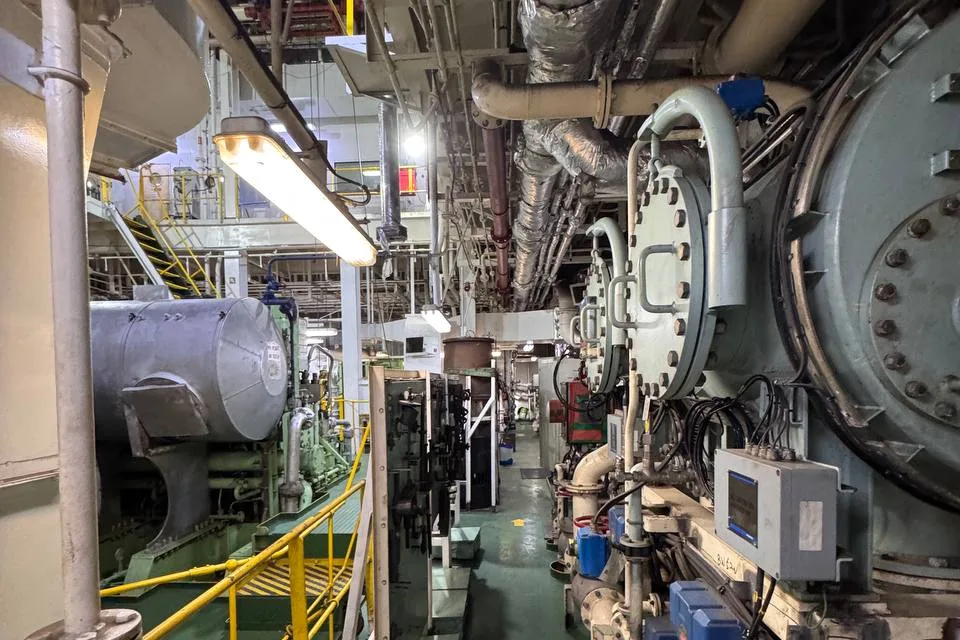
The first photograph is licensed and representative only, not a Vessel Core installed reference or completed job — photo: Michael Krahe, Wikimedia Commons, CC BY-SA 4.0. The second and third are Vessel Core's own, taken aboard a vessel during a yard visit in July 2026 and published with the owner's permission. No manufacturer is identified in any of the three, and none of this is a claim that Vessel Core supplied or worked on the equipment shown.
Even one clear part-book page, old quote line, photo of a marking, or packing list reference can reduce ambiguity before the supply route is reviewed.
Missing a part number is not a reason to hold the request. Send the engine nameplate, a part-book page, a drawing, a previous order reference or the wording from an invoice — see the RFQ evidence guide, the evidence checklist and RFQ without a part number. No line is confirmed on an engine series name alone.
OEM routes and verified alternatives are assessed on the part evidence, the owner's and class approval requirements, the documentation available and the vessel's schedule. A route is confirmed only after the RFQ is reviewed.
The part designation, the part-book page and the engine serial number are checked before any route is weighed. Neighbouring builds in one family differ on the part-book page, not by assumption.
An OEM-route review can be requested where class requirements apply or a class certificate is needed. Verified alternatives are reviewed for running spares. The comparison sits on OEM and alternative parts.
With pistons, liners and covers it is worth putting the rings, O-rings, gaskets, studs and fasteners into the same request — so an opened cylinder is not held up by a small item once the work has started.
Crosshead and trunk-piston part books are built differently: where a trunk-piston engine lists a single piston, a crosshead engine lists crown, skirt, piston rod and crosshead parts separately. Both are accepted, and the build is confirmed before matching — see the MAN and Wärtsilä sourcing guide.
Route, handover and freight are assessed against the RFQ evidence: port of call, ETA, documentation requirements. Lead time is confirmed only in the quotation for the specific line.
Vessel Core OÜ is registered in Estonia, registry code 17028043, VAT EE102773714 — public details, a named RFQ contact and a documented way for a buyer to verify the company.
Maker and full engine designation, serial number, a part-book page or drawing, the part number, a photograph of the marking on the piston or liner, quantity, port of call and ETA. That is enough to start matching without assuming the engine build.
Yes. Send a photograph of the engine nameplate, a part-book page, a drawing, a previous order reference or the wording from an invoice or packing list. No line is confirmed on an engine series name alone.
Yes, per RFQ, against the evidence, the owner's and class approval requirements and the vessel schedule. Where class requirements apply or a class certificate is needed, ask for an OEM-route review. Lead time is confirmed only in the quotation.
Liners with their O-ring kits, complete pistons, crowns and skirts, piston rod and crosshead parts on slow-speed engines, ring sets, cylinder covers with exhaust valves, spindles, seats and fasteners, and main and crankpin bearing shells with the gaskets and seals that go back with them.
Send engine data, part-book evidence, quantity, old commercial reference if available, and port/ETA. We will route the request for technical cross-checking.

