
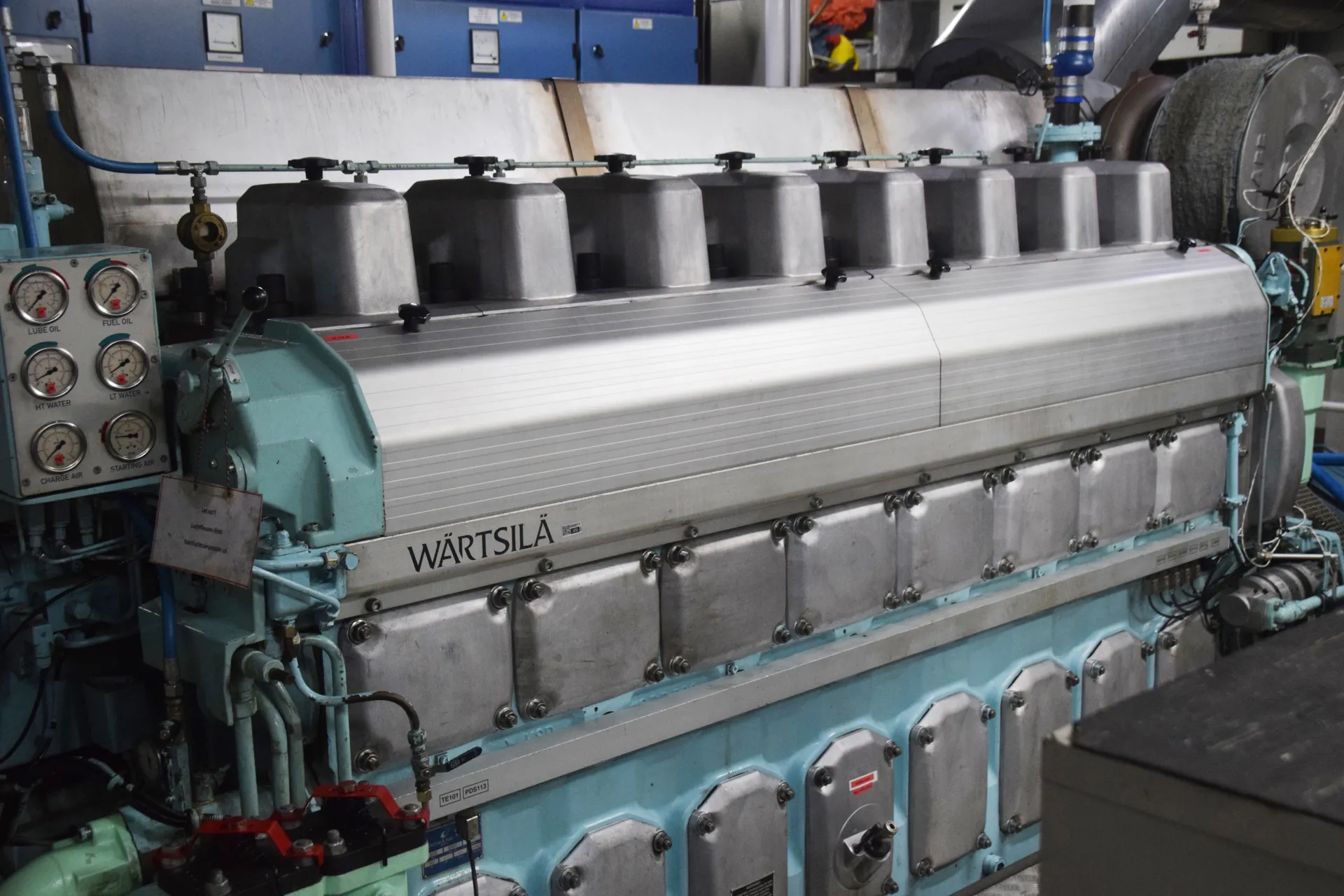
Wärtsilä W32
Spare Parts Supplier
Medium-speed 4-stroke engine · 320 mm bore
Wärtsilä W32 — RFQ identification
This is one of the longest-running designations in the Wärtsilä medium-speed programme. Wärtsilä dates the start of Vasa 32 production to 1976, engines from its first decade are still trading, and Wärtsilä counts several thousand engines of this bore delivered to the marine market alone. That length of run is the whole problem for a buyer: one number can mean an early-1980s machine, a later low-NOx build, or a current-generation Wärtsilä 32.
Which Wärtsilä 32 is on the plate
Four things can be true of a 32 plate at once: which generation it belongs to, whether it left the works with low-NOx combustion, which rating it was delivered to, and whether it burns diesel, gas or methanol. Each of the four moves the parts list.
The generation the family grew from
Where the family starts, and still a common sight. Wärtsilä describes its low-NOx combustion as a package of changes inside the engine — a higher compression ratio, later and shorter injection, finer atomisation and early inlet valve closing (Miller timing) — none of it visible from the outside or on the type designation. Which is why a Vasa plate says less than the year of build beside it.
6L32, 7L32, 8L32, 9L32
The in-line machines. Wärtsilä lists the 32 as a main engine, on mechanical or diesel-electric drive, and as an auxiliary engine, and names offshore supply and anchor-handling vessels, drilling units, dredgers, tugs, ferries and fishing vessels among its applications; on offshore tonnage it credits the engine's starting and load acceptance for its popularity. Work comes off one unit at a time, so a head or a liner tends to arrive as a complete unit set with a position attached.
12V32, 16V32, 18V32, 20V32
The V machines. Wärtsilä's current marine leaflet lists the V engine with 12 and 16 cylinders, so any other cylinder count on a plate should be copied exactly as stamped. Like the in-line engine, a V can be a main engine or one set in a diesel-electric plant, and the two banks do not always take the same part, so the bank has to travel with the position on every running-gear line.
The dual-fuel variant
The dual-fuel member of the family. Wärtsilä's later dual-fuel engine, the 34DF, is also based on the Wärtsilä 32 diesel engine, which makes the two easy to confuse in a request. Treat them as separate engines: gas admission valves, their control hardware and the pilot fuel equipment are quoted against the part book of the engine actually on board, and a 34DF number is not assumed to fit a 32DF, or the other way round. A gas-side line therefore has no diesel number to fall back on.
Wärtsilä W32 spare parts supply scope
The lines this family actually generates: unit sets for a generating engine that is overhauled one cylinder at a time, injection equipment on machines that have run a long while on heavy fuel, and the gas-side items only a 32DF carries. For an engine that has run on heavy fuel, the CCAI calculator gives the ignition quality of the bunker from its density and viscosity.
- Cylinder head unit sets, and heads supplied as components
- Cylinder liners and liner O-ring sets by seal position
- Piston crowns, skirts and ring sets ordered per unit
- Connecting rod bearing shells and rod bolts
- Main bearing shells, thrust washers and undersize pairs
- Injector nozzles, injector bodies and sealing parts
- Injection pumps, plunger and barrel assemblies, delivery valves
- Inlet and exhaust valves, springs, rotators and cotters
- Valve seat rings and guides for reconditioned heads
- Turbocharger cartridges, nozzle rings and labyrinth seals
- Charge air cooler tube stacks, covers and gaskets
- Gas admission valves, pilot injectors and gas-side control parts on 32DF engines
- Speed governors, actuators and control linkage parts
- Gasket and O-ring sets, including the gas-side seals a 32DF needs
The plate data that makes a Wärtsilä 32 line quotable
Here the year of build does the work the type designation cannot. A machine from before the mid-1990s low-NOx change, a Vasa 32LN and a current-generation Wärtsilä 32 can all be described the same way in an email, and all three take different parts.
- The name on the plate exactly as it reads: Vasa 32, Vasa 32LN or Wärtsilä 32, together with the cylinder count and the L or V beside it
- The build number and the year it left the works, which is what separates an engine built before the low-NOx change from one built after it
- Whether it is a ship's service generating set, a main engine, or one machine inside a diesel-electric plant — the duty decides which parts wear first
- The cylinder position the item was taken from, and the bank if the engine is a V
- The rated output and speed as stamped on the plate, and whether the engine runs at constant speed or on a combinator curve: the same designation is built for more than one speed, and Wärtsilä optimises a propulsion engine for one mode or the other
- The part number with the edition of the part book it was read from, because a run this long has several editions still in circulation
- Bearing shells with their undersize written out, and ring sets counted by unit and not by ring
- The turbocharger's own plate, which belongs to a different manufacturer and a different catalogue
- Hours since the unit was last opened, and whether the engine has been through a performance upgrade at any point
- Photographs of the plate and of the item as it sits in the engine
Wärtsilä W32 — general arrangement
A licensed photograph of Wärtsilä W32 equipment was not available at publication, so this technical reference illustrates the general arrangement shared by this equipment class.
Illustrative technical reference, not a photograph of Wärtsilä W32 equipment or a Vessel Core installed reference — a licensed photo was not available. Vessel Core has no dealership, distribution or partnership agreement with the manufacturer named; it operates as an independent spare parts supplier.
Supply route review for Wärtsilä 32 overhauls.
Most work on a 32 is planned rather than forced: a unit comes out on a schedule the chief engineer sets. That leaves room to weigh whether a line stays on the maker route or whether a verified alternative is worth reviewing against the approvals in force and the records the vessel has to keep.
Alternative Supply Options
On a family delivered over this many decades the alternative route tends to be strongest in the consumable groups — seals, O-rings, gaskets, cooler hardware — where the item has been made to one drawing for a very long time. Certificates and quality records are examined before anything is offered on that basis.
OEM or Alternative — Your Choice
Class-surveyed work and warranty-sensitive repairs belong on the maker route, and that is how they are reviewed. Routine unit overhauls carried out by the vessel's own staff are where a documented alternative earns a place in the same comparison.
Lead Time Confirmed at RFQ Stage
A 32 line is often a repeat item the vessel has bought before, which helps. It is still checked against the current route and the port before a date is written down, because the part-book edition behind an old purchase order may have been superseded since.
Technical Part Identification
A missing part number is not a blocker. The name on the plate, the year of build and one photograph of the item usually place a 32 line in the right part-book edition without it.
Port-Aware Delivery Planning
Offshore and short-sea tonnage on this engine does not keep a published timetable, so handover is planned against real movements: where the vessel is calling next, how long the window is, and whether an agent or a yard is receiving on her behalf. No date is fixed before the route is.
Time-Critical Priority Review
When a generating set on this engine goes down the vessel loses redundancy rather than propulsion, but the clock still runs: supply route checks, freight options and her movements are reviewed together on those lines.
Wärtsilä W32 parts — common questions
What identifies a Wärtsilä 32 for an RFQ?
The name on the plate and its generation, the build number and year, the duty on board, and the part number with the part-book edition if you have one. On a family this old the year carries as much weight as the type: it is what separates an engine built before the low-NOx change from one built after it.
What does a typical Wärtsilä 32 request contain?
Unit sets, mostly: a head with its valves, a liner with its O-rings, a piston with its rings, and the shells belonging to that same position. Injection equipment comes next — nozzles, pumps and plunger assemblies — and on a 32DF the gas admission and pilot fuel items form a group of their own that nothing else on board shares.
Do you supply parts for both the diesel and dual-fuel W32 variants?
Yes, both the diesel 32 and the 32DF. The gas side is where care is needed: gas admission valves, their control hardware and the pilot fuel injectors belong to the 32DF and have no counterpart on the diesel engine. Wärtsilä's later 34DF is also based on the Wärtsilä 32 diesel engine, so a 34DF number is not carried across to a 32DF line until the part book for the engine on board confirms it.
How long does delivery take for Wärtsilä W32 parts?
We confirm lead time and freight in the quotation. On the Wärtsilä 32 the diesel and the 32DF builds diverge in gas admission, pilot fuel and ignition equipment, so a line that looks common to both often is not, and we settle which build it belongs to before putting any date against it.
Our plate reads Vasa 32 rather than Wärtsilä 32. Is it the same engine?
Not for parts purposes. The Wärtsilä 32 is a later engine of the same bore, introduced in the mid-1990s, not a new name for the Vasa 32, whose production Wärtsilä dates to 1976. A machine from before the mid-1990s low-NOx change, a Vasa 32LN and a current-generation Wärtsilä 32 can all be described the same way in an email, and all three take different parts. Send the name exactly as it reads, with every letter after the number and the year of build, since the year is what separates an engine built before the low-NOx change from one built after it.
We have bought this part before. Can it be quoted from our old purchase order?
It is a useful start. A 32 line is often a repeat item, which helps, but it is still checked against the current route and the port before a date is written down, because the part-book edition behind an old purchase order may have been superseded since. Send the part number with the edition of the part book it was read from; on a family delivered for this long, several editions are still in circulation.
Is Vessel Core connected to Wärtsilä?
No, and there is no agreement of any kind. Vessel Core holds no dealership, distribution, representation or partnership agreement with Wärtsilä, and quoting a component against one of its designations implies no approval by the maker and no claim of interchangeability.
Why the maker name appears on this page
Maker names help identify equipment and prepare an RFQ. They do not imply any dealership, distribution, representation or partnership agreement between Vessel Core and the manufacturers named on this page; there is none. Wärtsilä and the Wärtsilä 32 designation are referenced solely so that a buyer can describe the engine on board and the component required.
Submit your RFQ now.
Send the plate as it reads — vessel name, Vasa 32 or Wärtsilä 32 with the year of build, diesel or 32DF, part numbers or descriptions, and the port with an ETA. Vessel Core reviews the supply route and prepares a structured supply quotation.
