
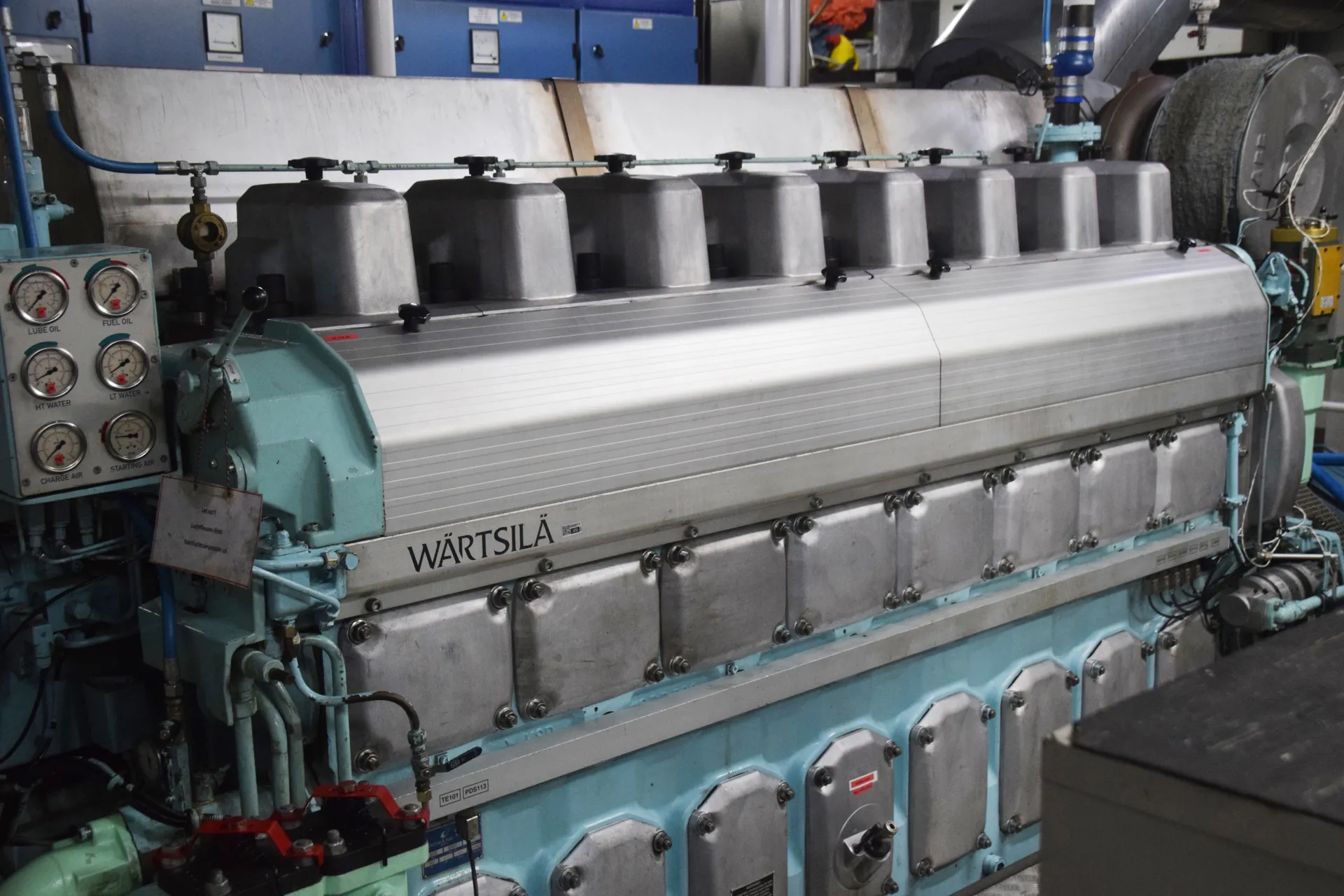
Wärtsilä 46
Spare Parts Supplier
Medium-speed marine engine spare parts supply · 460 mm bore
Wärtsilä 46 — RFQ identification
The 46 is Wärtsilä's large-bore four-stroke, met at sea as main power on cruise ships, large ferries, RoRo tonnage and dredgers, in diesel-electric as well as direct-drive installations. Three generations share the family name — the original 46, the 46F series that Wärtsilä dates from 2007, and the 46TS — and each one changed the fuel and air sides underneath it, so the letters after the number decide more than the number does.
Which Wärtsilä 46 is on the plate
Three machines carry this number: the original, the 46F that Wärtsilä dates from 2007, and the TS platform that followed it. The 46 in the name stayed the same. The injection equipment, the turbocharging and the fuels it was designed around did not.
The original large-bore four-stroke
The engine the family is named for, in in-line and V builds, on cruise ships, RoPax tonnage and large propulsion installations. Plenty of them are still in service, and their parts route is its own: a component from the F generation does not cross to it on the strength of the shared bore.
The F generation
The successor, which Wärtsilä rates as IMO Tier II compatible, with single-stage turbocharging and variable valve timing. It is now a series on one platform — 46F diesel, 46DF dual-fuel, 46F methanol-ready and 46F Methanol — and it is the plate most often confused with the original in a request, because the difference is a single letter at the end of the designation.
The current platform, and its fuel variants
The newer large-bore platform, built around two-stage turbocharging. At sea it is the 46TS-DF dual-fuel engine, with a digital common rail fuel system; the 46TS-SG spark-ignited lean-burn gas engine is offered for land-based power plants. Gas and dual-fuel machines carry admission and control components with no diesel counterpart, so the fuel variant belongs in the request alongside the type.
In-line and V builds
Both in-line and V engines are built across the family. On a V machine the A-bank and B-bank components are not always symmetrical, so the bank belongs in the line alongside the cylinder number — a detail that is easy to leave out and expensive to leave out.
Wärtsilä 46 spare parts supply scope
Grouped the way a large propulsion engine is actually worked on: running gear by unit, the fuel side by whichever injection arrangement the engine was built with, and the air side on a schedule of its own.
- Cylinder heads, complete or as head components
- Cylinder liners, liner O-rings and anti-polishing rings
- Piston crowns, skirts, crown bolts and ring sets per unit
- Connecting rod big-end shells and connecting rod bolts
- Main bearing shells with the undersize stated
- Injection pumps, plungers and delivery valves on conventional builds
- Injector nozzles, injector bodies and sealing rings
- Common rail components where the build carries them: rail blocks, high-pressure pipes and actuators
- Exhaust and inlet valves, valve cages, rotators, seat rings and guides
- Turbocharger rotor cartridges, nozzle rings and bearing sets
- Charge air cooler elements, water box covers and seals
- Engine control and safety system components
- HT and LT cooling water pump assemblies and seals
- Overhaul gasket and seal sets grouped by system
The plate data that makes a Wärtsilä 46 line quotable
On this family the serial does more work than the type, because two engines can wear the same designation and be a generation apart. The serial, the year of build and the works that delivered the engine are what place a component; the family name on its own places nothing.
- The designation exactly as stamped, with the letters left on it: plain 46, 46F, 46DF or 46TS-DF, and on a 46F whether it is the diesel, methanol-ready or methanol version
- Serial or build number, year of build, and the works named on the plate, copied as stamped rather than as remembered
- Whether the engine drives a propeller shaft, feeds a diesel-electric plant, or runs as fixed generating plant, since the duty behind the wear is not the same in each
- Unit number and, on a V machine, which bank the item came off
- The injection arrangement the engine was actually built with — common rail or conventional injection pumps — read from the engine or its part book, because the fuel side follows the build rather than the designation
- Whether the turbocharging is single-stage or the two-stage arrangement carried by the TS platform, because the charge air side is laid out around it
- On a DF or SG plate, the gas admission and ignition components, which have no diesel part number standing behind them
- Turbocharger make and type read off its own plate: a separate manufacturer, and a separate catalogue from the engine
- Hours run since the unit was last opened, and whether the item has been reconditioned before
- A photograph of the nameplate, and one of the component while it is still in the engine
Labelled Wärtsilä 46 components
Museum reference photography of real Wärtsilä 46 parts, explicitly labelled by model — useful for confirming the component before an RFQ is submitted.


Representative licensed photography of labelled, identified Wärtsilä 46 components, not a Vessel Core installed reference or completed job — not a photograph of a complete engine unit. Photos: MKFI, Wikimedia Commons, public domain. Vessel Core has no dealership, distribution or partnership agreement with Wärtsilä; it operates as an independent spare parts supplier.
Supply route review for Wärtsilä 46 overhauls.
A 46 overhaul is planned around a yard window or a turnaround date, so the OEM-route and the verified alternative options are set against each other on the things that decide it: what the approval requires, what documentation the surveyor will ask to see, and when the engine has to be back on load.
Verified Alternatives
On this engine the split usually falls between running gear and the consumable groups. Seals, gaskets, O-rings and cooler hardware are where an alternative route is most often worth reviewing, and the material certification and quality records are checked before it is put on the line.
OEM or Alternative — Your Choice
For a class-surveyed overhaul or work covered by a maker agreement, the OEM route is the one to review. For planned maintenance the ship's staff carry out themselves, both routes can be quoted on the same line.
Lead Time Confirmed at RFQ Stage
Lead time, availability and freight options are confirmed at RFQ stage based on part specification, approval requirements, vessel ETA and destination port.
Technical Part Identification
A missing part number does not stop the review. The generation, the build year, the works plate and a photograph of the component are usually enough to place a 46 line in the right part book.
Port-Aware Delivery Planning
Cruise and RoPax tonnage on this engine sails to a published schedule, so the handover point is chosen around it: which port the vessel is actually alongside, how long the window is, and whether the item can reach her before the next leg. Nothing is committed until the route is settled.
Time-Critical Priority Review
A failure on a 46 usually means propulsion or a plant unit is out, so those lines are taken first: supply route checks, freight options and the vessel's own schedule are looked at together rather than one after the other.
Wärtsilä 46 parts — common questions
What evidence is needed for a Wärtsilä 46 spare parts RFQ?
The designation with its generation letters, the serial and year of build, the unit and bank the item came off, and a part number or part-book page where one exists. A nameplate photograph settles most of the rest. Compatibility is confirmed against the build evidence, never against the family name.
Which Wärtsilä 46 lines come up most often?
Running-gear work leads: liners and their O-rings, piston crowns and ring sets, big-end and main bearing shells, heads and their valves. The fuel side depends on the build — injection pumps, plungers and nozzles where the equipment is conventional, rail and actuator components where the engine left the works with common rail.
Do you cover the 46F, the 46DF and the TS platform?
Yes — the original 46, the F generation including the 46DF, which Wärtsilä builds on the 46F platform, and the TS platform can all be reviewed. What separates them sits in the injection equipment, in the charge air arrangement, and on a DF or SG plate in gas admission and ignition hardware that has no diesel counterpart, so the fuel variant is settled before any line is quoted.
What lead times apply to Wärtsilä 46 spare parts orders?
We confirm lead time and freight in the quotation, line by line. On a Wärtsilä 46 the generation letter and any DF or SG suffix decide the component — a 46 and a 46F of the same configuration take different parts across the head, the injection equipment and the charge air side — so we settle the build first and put a date against a line only once a supplier has committed to it.
Is our Wärtsilä 46 common rail or conventional injection?
The designation will not tell you. The fuel side follows the build rather than the designation, so the injection arrangement, common rail or conventional injection pumps, is read from the engine or its part book. Injection pumps, plungers and delivery valves belong to a conventional build; rail blocks, high-pressure pipes and actuators to a common-rail one. State the injection arrangement the engine was actually built with alongside the designation and the serial.
Why do you ask which bank a part came off?
Because on a V machine the A-bank and B-bank components are not always symmetrical. Both in-line and V engines are built across the 46 family, so on a V engine the bank belongs in the line next to the unit number; it is an easy detail to leave out and a costly one to get wrong.
Is Vessel Core connected to Wärtsilä?
No, and there is no agreement of any kind. Vessel Core holds no dealership, distribution, representation or partnership agreement with Wärtsilä, and quoting a component against one of its designations implies no approval by the maker and no claim of interchangeability.
Why the maker name appears on this page
Maker names help identify equipment and prepare an RFQ. They do not imply any dealership, distribution, representation or partnership agreement between Vessel Core and the manufacturers named on this page; there is none. Wärtsilä and the Wärtsilä 46 designation are referenced solely so that a buyer can describe the engine on board and the component required.
Submit your RFQ now.
Send the plate as photographed — vessel name, the designation with its generation letters, the unit and bank, part numbers or descriptions, and the port with an ETA. Vessel Core reviews the supply route and prepares a structured supply quotation.
