Heat Exchangers & Freshwater Generators

Heat Exchanger & Freshwater
Generator Spare Parts

Engine-room supply for gasketed plate coolers, box and shell-and-tube coolers, plate distillers and flash evaporators — read from the frame plate, not from the duty.

Frame plate firstThe type code names the frame, not the pack
Plates, gaskets, tube stacksThree different kinds of request
HT · LT · SWThree circuits, three material questions
OEM + verified alternativesSupply route review by criticality
Heat exchanger and freshwater generator parts supplier

The type code names the frame. It does not name the pack.

Vessel Core supplies technical buyers with spare parts for marine heat exchangers and freshwater generators — gasketed plate coolers on the jacket-water, lube-oil and central-cooling circuits, box coolers and shell-and-tube coolers on machine cooling duty, and the plate distillers and flash evaporators that make freshwater on the same engine-room round.

Two machines that sit far apart in the machinery list often meet on one order line. A gasketed plate cooler and a plate-type freshwater generator resolve to the same two items, a plate pack and a gasket set, identified from what is stamped on the frame rather than from the duty they serve. What separates them from each other, and from a flash evaporator or a box cooler, is the letter in the designation — and the figure that follows it is a size or a connection, never the plate count. That is why this page is arranged around what the plate on the unit actually says.

Supply scope

Cooler and freshwater generator parts we can structure into an RFQ.

Commercially useful spare parts supply coverage for planned regasketing, opening-up inspection findings and engine-room supply review. Maker names and type codes appear on this page only to identify the equipment on board: Vessel Core holds no dealership, distribution, representation or partnership agreement with Alfa Laval, GEA, Kelvion, Sasakura or any other manufacturer, and does not present itself as holding one.

01

Gasketed plate frames

The frames met on jacket-water, lube-oil and central-cooling duty. Alfa Laval runs several parallel programmes rather than one range — M, MX and MK, the A group in which AK, AM and AX are separate families, and the older P frames — and the suffix after the size, as in M10-BFM, MX25-BFG or AX30-BW, carries the plate and gasket execution. Kelvion NT, NX and NL sit the same way: a request written from the NT code will not reach an NX pack even where the frames look alike.

02

Plate packs and gasket sets

The pack is what the frame was bought for and the one thing the type code does not describe. A gasketed cooler leaves the works with the plate stack chosen for its duty, so count the plates, or send the unit serial and the drawing number instead. To compare the duty a cooler is doing now with its data sheet, the heat exchanger duty calculator works it out from the flow and the inlet and outlet temperatures. Say as well how the gasket is fixed, because the fixing is maker-specific: Alfa Laval plates come with clip-on or glued gaskets, current Kelvion ranges use the adhesive-free EcoLoc system while older frames with a GEA plate may still carry glued sets, and the fixing method changes the item rather than the price.

03

Frame hardware and pressure plate items

Tightening bolts, the pressure plate items and the frame and pressure plate lining belong to the regasketing job rather than to the job after it. Plate and gasket references are series-specific, and a pack is only as good as the frame closing it: where the bolts, carrying bars or guide bar are worn, the tightening is uneven across the frame and shows as a new leak in a place the gasket was never responsible for.

04

Duty circuit decides the material

On a central cooling layout there are three circuits but not three coolers of one kind. Seawater passes through one exchanger only, the central cooler, usually one or two large plate units; the jacket-water cooler, the lube-oil coolers and the other coolers on the system are cooled by the low-temperature fresh-water circuit instead. The central cooler is therefore where titanium or another seawater-resistant plate grade is usual and where a like-for-like material match matters most, while a cooler with no seawater on either side is a different material question. Name the cooler, not only the circuit: the central cooler and the jacket-water cooler are separate frames with their own plate counts. The cooling-water guide follows the same circuits through the pumps and thermostatic valves.

05

Box coolers, plate fin and shell-and-tube

Not every heat exchanger request is a plate pack. The Bloksma line covers box coolers sitting in the sea chest, plate fin oil coolers and shell-and-tube coolers for engines, gearboxes and charge air. Tube stacks and bundles, anodes, covers and gaskets are the items here, and a box cooler is quoted from its type and the chest arrangement rather than from the engine it serves. For a charge air cooler, the charge air condensate calculator estimates the water that drops out of the air after it.

06

Plate-type freshwater generators

To a buyer these are the same kind of object as a cooler: a plate pack and a gasket set. Alfa Laval JWP, the earlier JWSP and SP designations and the Desalt DPU line are titanium plate distillers working under vacuum, DPU-2 naming the two-stage build, and Sasakura Aquario is the plate-type unit on that maker's plate. What differs from a cooler is that there are two assemblies rather than one: evaporator and condenser are separate plate packs, counted separately and quoted per assembly.

07

Flash evaporators are a different machine

Sasakura X and WX are the flash evaporator series, and the series letter on the plate is what decides which kind of request this actually is. Here the items are tube or plate packs against the series letter, with ejector parts and the pump wear set alongside them. A description written for a plate pack against an X or WX plate has to be reopened, so the letter is worth copying off the unit before the request is written.

08

Ejector, pump and salinometer items

On a freshwater generator the parts that fail are not all inside the pack. The ejector does two jobs at once, drawing the surplus seawater off as brine and making the vacuum, and the pump behind it supplies condenser coolant, evaporator feed water and the driving water for the ejector, so one worn wet end presents as three symptoms. Ejector parts and the pump wear set are named on the plate-type and the flash evaporator lines alike; on the Alfa Laval plate distillers the salinometer items are a recurring line as well.

Model index

20 models in this category, filterable.

Start typing a designation, a maker or a part and the rows filter as you go. The full list across every category and maker lives on the maker reference page.

20 models · 8 notes

Model index for this category: designation, series, maker and the parts typically requested.
ModelSeriesMakerTypical parts
JWP-16 · JWP-26JWP · titanium plate distillerAlfa LavalThe figure in the type designation is the connection flange size, not an output, and the plate quantity inside the unit is the one number the name does not carry. Evaporator and condenser plate packs, gaskets, ejector parts, the brine and distillate pump wear set and the salinometer items are the recurring lines, and a plate pack cannot be ordered from the type designation alone.
JWSP · SPEarlier designationsAlfa LavalUnits still in service carry designations the current programme no longer lists, and trade press of the period introduced these titanium plate distillers under the Nirex name, while the maker's own dimension table sets JWSP and SP beside JWP. Send the plate as written rather than matched to the nearest current type; the plate pack, the gasket set and the ejector are what the designation has to reach.
Desalt DPU · DPU-2 · DPU-36-CDPU · two-stage plate distillerAlfa LavalThe DPU units are titanium plate distillers working under vacuum, DPU-2 naming the two-stage build. Replacement evaporator and condenser plate packs, gaskets, ejector and pump parts are the usual scope; the Desalt name appears on this line beside the Alfa Laval one.
M3 · M6 · M10 · M15 · M20 · M30M · gasketed plateAlfa LavalThe M frames are the gasketed plate coolers met across jacket-water, lube-oil and central-cooling duty. Plates, gaskets, tightening bolts and the frame and pressure plate lining are the items; the suffix after the size, as in M10-BFM, separates plate and gasket executions and belongs in the request.
MX25 · MK15MX / MK · gasketed plateAlfa LavalThe MX and MK frames sit in the same programme with their own plate and gasket forms, written as MX25-B, MX25-BFG and similar. A plate ordered by frame size alone reaches more than one pressing, so send the full suffix and the plate material.
A10 · A15 · A20 · AK20 · AM20 · AX30A / AK / AM / AX · gasketed plateAlfa LavalThe A group covers the plate coolers written with a second letter, and AK, AM and AX are separate families rather than options of one. Executions such as AM20-B, AM20-N, AM20-S and AX30-BW carry the plate and gasket arrangement in the suffix, so copy the whole type code off the frame.
P series framesP · gasketed plateAlfa LavalThe P frames are the older gasketed line, written as a letter and a figure and still found on working coolers. Plates and gasket sets are the scope; where the type plate is unreadable, the plate pressing pattern and the port arrangement identify the unit from photographs.
FC80 · FC100 · FC120 · FC140 · FC160Oil coolersBowmanOil coolers in body sizes from FC80 to FC160, with marine builds using cupro-nickel tube stacks. Tube stacks, end covers, O-rings and gaskets are quoted against the full part number after the size.
EC80Tubular heat exchangersBowmanTubular heat exchangers for engines where no integral expansion tank is needed and the system uses a remote header tank. End covers, seals and tube stacks are matched to the complete number.
FG100Charge air coolersBowmanCharge air coolers that must run with the full flow of the engine water pump when used with a header tank heat exchanger. Tube stacks and seals are quoted against the full part number and the engine the cooler serves.
UX-10 · UX-20 · UX-90 · UX-100UX · gasketed plateHisakaUX models run from small plates to large ones under a single series letter, so UX-10 and UX-100 share a name but no plate. Each number is a plate type of its own, and replacement gaskets are offered against that plate type, for example an FKM gasket for the UX20 plate. Inside one frame the gaskets can also differ by position in the pack, so the plate arrangement drawing is worth sending with the order. Plates, gasket sets and tightening bolts are the usual lines.
RX seriesRX · gasketed plateHisakaRX is a separate Hisaka plate family with its own gasketting manual, and independent gasket makers list RX plates and gaskets under their own references. A UX gasket set will not seat on an RX plate even where the frames look alike, so the series letters on the nameplate decide the catalogue before the number does.
NT series framesNT · gasketed plateKelvionThe NT gasketed plate frames are found on jacket cooling and central cooling duty, written as NT50, NT80, NT100, NT150 and similar. Plates, gasket sets, tightening bolts and the pressure plate items are the scope, and the plate material belongs in the request with the frame.
NX series framesNX · gasketed plateKelvionNX was developed from the NT plate technology for duties calling for small temperature differences and higher pressure. Plate and gasket parts follow the frame and the pressing, so a request written from the NT code will not reach an NX pack even where the frames look alike.
VT · VarithermVT · gasketed plateKelvionThe VT plates and gaskets are asked for by the Varitherm name as often as by the letter code, and both find the same unit. Send the frame designation and the plate count together; on a cooler this old the gasket compound is worth stating as well.
Bloksma box coolers · K-type · PF plate finBloksma · machine coolingKelvionThe Bloksma line covers box coolers in the sea chest, plate fin oil coolers and shell-and-tube coolers for engines, gearboxes and charge air. Tube stacks and bundles, anodes, covers and gaskets are the items, and a box cooler is quoted from the type and the chest arrangement rather than from the engine.
X · WX · AquarioFreshwater generatorsSasakuraThe Sasakura plate is met on freshwater generators, where X and WX are the flash evaporator series and Aquario is the plate-type unit. Tube or plate packs, gaskets, ejector parts and the pump wear set are the items, and the series letter decides which of those the request is about.
NL SeriesCurrent range · PosLoc and EcoLocKelvionA related current gasketed range using PosLoc plate alignment together with the EcoLoc gasket, which the maker describes as fitted without tools or adhesive. Plate and gasket references are series-specific and are not interchangeable with the NT range without confirming both plate corrugation and tightening dimension.
S7A · S9A · S14A · S20AGasketed plate heat exchangersSondexGasketed plate coolers in which the letter after the figure marks a build of the type; the type code from the frame is copied in full. Plates, gasket sets and tightening bolts are quoted against the type, the plate count and the drawing number.
SPSPlate and shellSondexWelded plate and shell heat exchangers, where the plate pack sits inside a shell. Shell gaskets and connection parts are quoted against the serial; a damaged plate pack is answered with the options the serial allows.

Service and identification notes

Wear patterns, duty context and plate-reading advice from the maker pages. They help scope a request; they are not designations.

Service and identification notes for this category: topic, context, maker and detail.
TopicContextMakerDetail
Plate count is not in the type codePlate packs and gasketsAlfa LavalA gasketed cooler leaves the works with the plate stack chosen for its duty, so two units of the same type can hold different numbers of plates. Count the plates, or send the unit serial and the drawing number with the gasket request, and note whether the pack is glued or clip-on because that changes the item, not the price.
Glued and slit-in platesGasket fixingHisakaHisaka plates are built either for glued gaskets or as slit-in plates, on which the gasket is pressed into the plate without adhesive. Replacement sets are listed separately for the two fixings, as with the glued and slit-in versions of the UX10 plate, so a glued set is not the answer for a slit-in plate. Say which is fitted, or send a photograph of a removed plate along the gasket groove.
Lube oil cooler · generator fresh water coolerMarine dutiesHisakaHisaka plate heat exchangers serve on board as lube oil coolers and as fresh water coolers for the generator engines, and spare plates and gaskets are offered for both duties. Name the cooler in the enquiry, not only the circuit: each one is a separate frame with its own plate count and its own gasket compound.
GEA plate, Kelvion paperworkMaker identityKelvionThe heat exchanger business left the GEA group and trades as Kelvion, with the machine cooling line renamed from GEA Bloksma, while the plates in service still carry the older name. Both names reach the same unit, so send the plate as it reads and the type code with it.
HT (high-temperature) dutyJacket-water circuitKelvionThe jacket-water cooler: engine jacket water on one side and the low-temperature fresh-water circuit on the other, so seawater touches neither side. It runs hotter than the other coolers on the system, its plate material and gasket compound follow the jacket-water treatment chemistry in use, and its plate count is its own rather than the central cooler's.
LT (low-temperature) dutyCentral-cooling circuitKelvionNot one exchanger but the fresh-water circuit that cools the others: the jacket-water cooler, the lube-oil coolers and the other coolers on the system take their cooling from it, and it gives its heat up to seawater in the central cooler. Each of those coolers is a separate frame with its own plate count, so name the cooler as well as the circuit.
SW (seawater-cooled) dutySeawater circuitKelvionThe central cooler: on a central cooling layout the only exchanger with seawater on one side, usually one or two large plate units. Plate and gasket material carries the most weight here — titanium or another seawater-resistant grade is usual — and a like-for-like material match matters more than on the coolers served by the fresh-water circuit.
Frame size & plate countDuty contextKelvionTwo frames in the same series can carry very different plate counts depending on the vessel's cooling load, so the frame's own plate count — not a generic figure for the series — decides how large a plate-pack or gasket-set order should be.

This list indicates coverage. It is not stock on hand and not a claim of affiliation with any manufacturer.

In the field

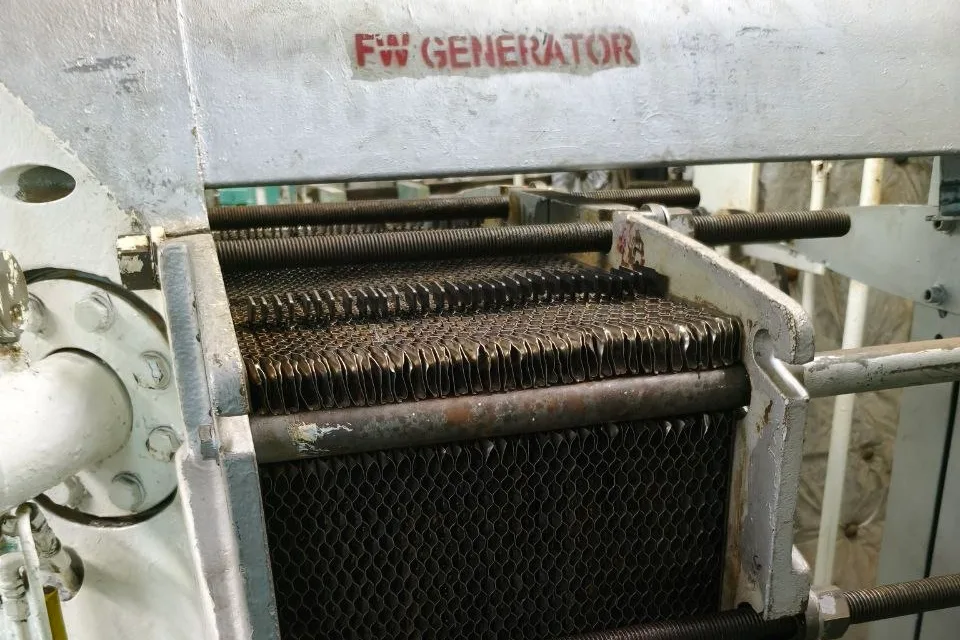
Two duties, one construction.

Both photographs are Vessel Core's own, taken aboard a vessel during a client visit in October 2026; the vessel is not named. The stencils give a duty, not a maker, and no frame plate is legible at published resolution. None of this is a claim that Vessel Core supplied or worked on the equipment shown.

What to send

Send the frame plate, then the number you had to go and count.

Part numbers are helpful, but the frame plate, the plate count, the duty circuit and a photograph of one removed plate with its gasket can be enough to start cross-checking before supply routes are reviewed.

Vessel and timing

  • Vessel name / IMO
  • Company name
  • Urgency level
  • Port / ETA

Unit reference

  • Maker and full type code
  • Suffix as stamped
  • Serial or frame number
  • Duty circuit

Pack reference

  • Plate count for that frame
  • Plate material
  • Gasket fixing method
  • Pack, gaskets or hardware

Attachments

  • Frame plate photograph
  • One removed plate and gasket
  • Drawing number
  • Excel list
Heat exchanger RFQ FAQ

Short answers for technical buyers.

Is a freshwater generator quoted the same way as a plate cooler?

For a plate-type unit, largely yes: it resolves to a plate pack and a gasket set and is identified from the plate the same way. Two things differ. The evaporator and the condenser are separate plate assemblies, so the count is taken twice and written down separately, and they are rarely in the same condition. And the ejector, the pump and the salinometer sit outside the pack on their own lines. A flash evaporator is not the same object at all — there the items are tube or plate packs against the series letter, with ejector parts alongside — and the series letter on the plate is what tells the two apart before anything else in the request is read.

Why ask for the plate count when the type code is already on the request?

Because on this family the type code names the frame, not the pack. A gasketed cooler leaves the works with the plate stack chosen for its own duty, so two units of the same type can hold different numbers of plates, and two frames in the same series can carry very different plate counts depending on the vessel's cooling load. On the Alfa Laval plate distillers the figure in the designation is the diameter of the connection flanges rather than an output, and the plate quantity inside the unit is the one number the name does not carry. Count the plates, or send the unit serial and the drawing number with the request.

The nameplate carries a name that is not in the current programme. Does that matter?

It is normal on working machinery and it is useful evidence. The heat exchanger business left the GEA group and trades as Kelvion, with the machine cooling line renamed from GEA Bloksma, while the plates in service still carry the older name. On the plate distillers, trade press of the period introduced them under the Nirex name, the maker's own dimension table sets JWSP and SP beside JWP, and the Desalt name appears beside the Alfa Laval one on the DPU line. Both names reach the same unit. Send the plate as it reads rather than matched to the nearest current type, and the type code with it.

Can you handle time-critical heat exchanger or freshwater generator failures?

Yes. Add vessel / IMO, port, ETA and whether the unit is a plate cooler, plate distiller or flash evaporator. This helps prioritize the supply route.

Send heat exchanger RFQ

Have a heat exchanger or freshwater generator parts request?

Send the frame plate, the plate count, the duty circuit, quantity and port/ETA. Photographs, drawing numbers, manual pages or Excel lists are welcome.