
Kelvion Heat Exchanger
Spare Parts Supplier
Gasketed plate heat exchangers for jacket-water and central-cooling duty — NT, NX & NL series plates, EcoLoc gaskets and Bloksma shell-and-tube coolers
Kelvion heat exchanger ranges seen in engine-room enquiries
Kelvion is the former GEA Heat Exchangers group, which Triton acquired from GEA in 2014; Kelvion Holding GmbH is registered in Bochum and has its head office in Herne, Germany. Apollo-managed funds took a majority stake in January 2026, and in August 2026 SLB agreed to acquire the company, with completion expected in the first half of 2027. Kelvion continues to supply gasketed plate heat exchangers, box coolers and shell-and-tube coolers for ship cooling systems. On a typical central-cooling layout, jacket water from the main and auxiliary engines runs through a high-temperature (HT) circuit, which is cooled by a low-temperature (LT) fresh-water circuit, which is in turn cooled by seawater — each stage usually a separate plate heat exchanger. The series stamped on the frame plate, and the plate count for that specific frame, decide which plate and gasket actually fit; the pipe size and duty alone do not.
NT series
NT is the series Kelvion presents as its general-purpose gasketed range, offered with titanium-palladium, 254 SMO and C-276 plates as well as stainless steel. Kelvion states that all N-series plates can be used in the same frame with varying plate numbers, so the frame plate alone does not prove which plate hangs in the pack: read the full designation including any letter suffix, and check one removed plate. Plates, gasket sets, tightening bolts and the pressure plate items are the scope.
NX series frames
Kelvion describes NX as a narrow-gap, small-pitch plate for very small temperature differences, high NTU values and higher pressure resistance, aimed mainly at district heating and cooling networks and data-centre cooling. Plate and gasket parts follow the frame and the pressing, so a request written from the NT code will not reach an NX pack even where the frames look alike.
NL Series
Kelvion builds the NL plate with a larger flow channel and deeper corrugation for viscous, shear-sensitive or particle-bearing media, a different duty profile from clean cooling water. If NL is what the frame plate says, quote from that plate. PosLoc plate alignment and the clip-in EcoLoc gasket are features of the whole N series, not of NL alone, so neither one identifies the series.
VT · Varitherm
The VT plates and gaskets are asked for by the Varitherm name as often as by the letter code, and both find the same unit. Send the frame designation and the plate count together; on a cooler this old the gasket compound is worth stating as well.
Box coolers · engine and gearbox coolers
A Kelvion box cooler is a U-tube bundle in the sea chest, bolted with a gasket to a mounting ring, with a water box that can be removed while the bundle stays on the hull. It is built round, rectangular or stepped, as a single- or double-circuit unit, installed top-pull or bottom-pull, and optionally fitted with an impressed-current anti-fouling (ICAF) system using copper anodes. Bundles, water boxes, mounting-ring gaskets and ICAF anodes are the usual items, so state the shape, the circuit arrangement and the pull direction with the type.
GEA plate, Kelvion paperwork
The heat exchanger business left the GEA group and trades as Kelvion, with the machine cooling line renamed from GEA Bloksma, while the plates in service still carry the older name. Both names reach the same unit, so send the plate as it reads and the type code with it.
HT (high-temperature) duty
The plate exchanger cooling engine jacket water directly. It runs hotter and is typically smaller in plate count than the LT stage on the same vessel, with plate material and gasket compound chosen for the jacket-water treatment chemistry in use.
LT (low-temperature) duty
The low-temperature fresh-water circuit is the middle loop rather than an exchanger of its own: it takes heat from the jacket-water cooler and from lube-oil and charge-air coolers and gives it up to seawater in the central cooler. For an LT-duty line, name the exchanger concerned (the jacket-water cooler, a lube-oil cooler or the central cooler itself), because each has its own frame plate.
SW (seawater-cooled) duty
The final stage rejecting heat to seawater, where plate and gasket material selection carries the most weight — titanium or high-alloy stainless plates are common here specifically because of seawater corrosion risk, and a like-for-like material match matters more on this circuit than on the fresh-water stages.
Frame size & plate count
Two frames in the same series can carry very different plate counts depending on the vessel's cooling load, so the frame's own plate count — not a generic figure for the series — decides how large a plate-pack or gasket-set order should be.
Where a Kelvion plate heat exchanger actually gives up
Most enquiries that reach us on this equipment trace back to one of four things, and knowing which one narrows the parts list a long way before a photograph is even needed. Gaskets harden and lose compression over years of heat cycling, and once a gasket starts to leak internally rather than externally, fluid from one circuit finds its way into the other — jacket water into seawater, or the reverse — often before any external weeping is visible at the frame; a rising level in one circuit's expansion tank with no obvious external leak is the classic symptom, and it points straight at the plate pack rather than at the pipework around it. Scale on the fresh-water side and biological or particulate fouling on the seawater side both reduce the effective heat-transfer area without necessarily causing a leak, showing up as a slowly rising outlet temperature well before any gasket problem appears — a cleaning and inspection issue before it is a spare-parts one. A plate material mismatched to the actual seawater chemistry, or a plate pack left stagnant for long periods, can pit or suffer crevice corrosion at the gasket contact line — specifically a seawater-circuit risk rather than a fresh-water one, and the reason plate material belongs in every seawater-duty enquiry. Finally, a plate pack reopened for regasketing more than once can lose uniform tightening pressure across the frame if the bolts, carrying bars or guide bar are worn or corroded, and uneven tightening after a service shows up as a new leak point appearing somewhere the gasket itself was never the problem.
- Heat-transfer plates by series and pressing pattern
- EcoLoc clip-in gasket sets for N-series plates (NT, NX and related series)
- Glued gasket sets for older plate types, confirmed on a removed plate
- Box cooler U-tube bundles, water boxes, mounting-ring gaskets and ICAF copper anodes
- Complete plate packs, matched by frame and plate count
- Frame tightening bolts & nuts
- Carrying bar & guide bar hardware
- Fixed frame & pressure plate (end plates)
- Connector studs & port gaskets
- Corner rings & port ring seals
- Shell-and-tube cooler tube bundles & end covers
- Shell-and-tube gaskets & sacrificial anodes
- Frame paint & corrosion-protection touch-up sets
A regasketing job and a full plate-pack replacement call for different scopes — the items above cover both, grouped by what belongs to the plate pack itself and what belongs to the frame around it.
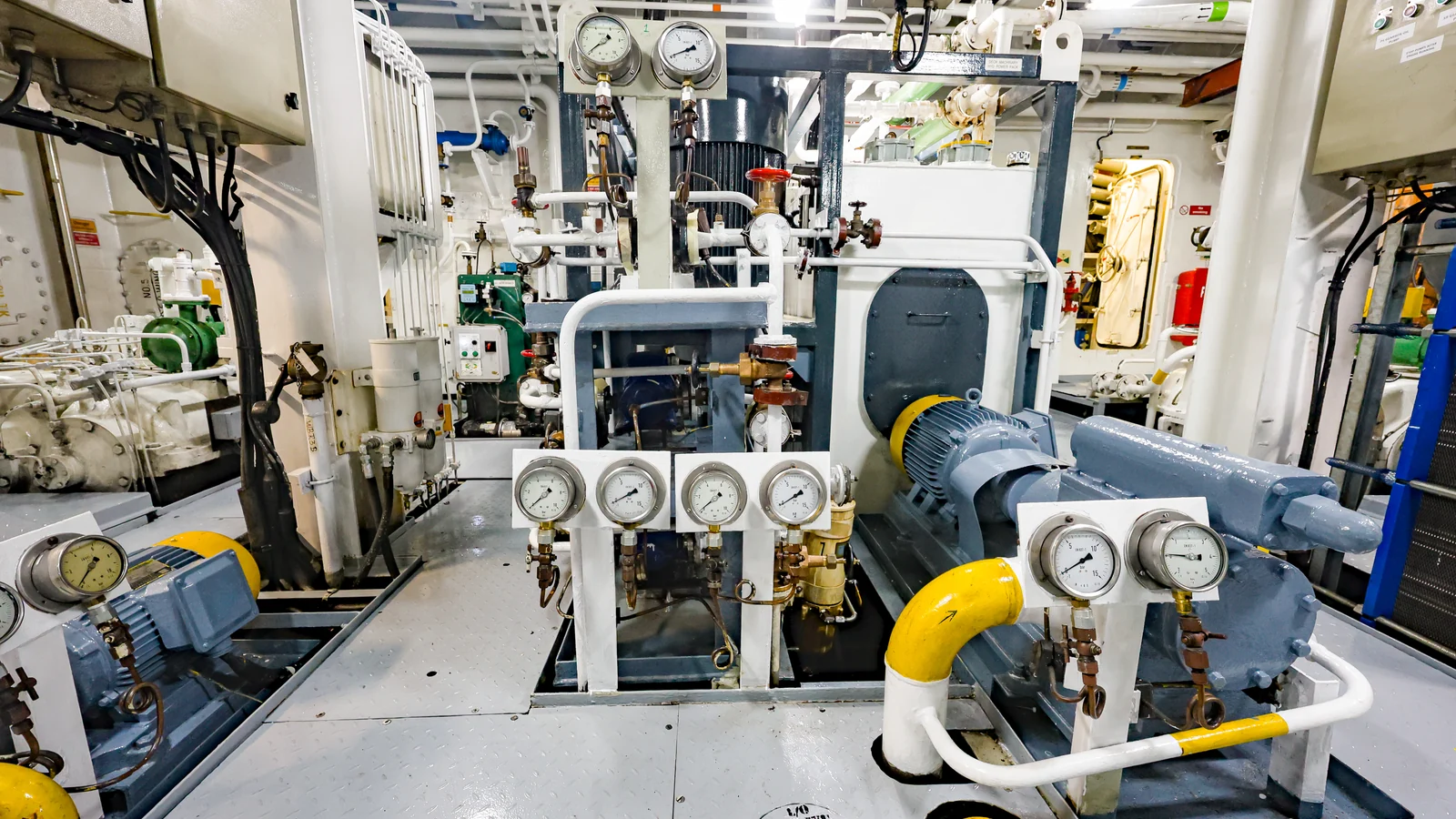
Gasketed plate heat exchanger — general arrangement
A licensed photograph of Kelvion equipment was not available at publication, so this technical reference illustrates the general arrangement shared by this equipment class.
Illustrative technical reference, not a photograph of Kelvion equipment or a Vessel Core installed reference — a licensed photo of this maker's equipment was not available. Vessel Core has no dealership, distribution or partnership agreement with Kelvion Holding GmbH or any other manufacturer named here; it operates as an independent spare parts supplier.
Frame-plate data that makes a Kelvion enquiry quotable
The frame plate is usually mounted on the fixed end plate and carries the information that decides fit. With the items below an enquiry can be priced in one pass; without them it usually comes back with a clarifying question first. How a plate photograph becomes a priced list is set out on the how we work page.
- Full type designation exactly as stamped, including any letter suffix (Kelvion's NX datasheet lists types such as NX100X and NX250L), or the older GEA type
- Frame or works number from the frame plate
- Plate count for that specific frame
- Duty circuit — jacket-water (HT), central-cooling (LT) or seawater (SW)
- Plate material — titanium, SMO or stainless
- Gasket type (clip-in EcoLoc or glued) and plate type, both read from one removed plate: Kelvion states that all N-series plates can be used in the same frame, so the frame alone settles neither
- For a box cooler: round, rectangular or stepped bundle, single or double circuit, top-pull or bottom-pull mounting, and whether an ICAF system is fitted
- Port connection size and orientation
- Whether the scope is a full plate pack, gasket set only, or frame hardware
- A previous order line or service report for the same frame
- Photograph of the frame plate and of one removed plate with its gasket
Tools for this equipment: the flange identifier for the port connections. For a cooler that no longer holds its temperatures, the heat exchanger duty calculator works out the duty from the flow and the inlet and outlet temperatures of one side. For a charge air cooler, the charge air condensate calculator estimates the water that condenses after it, from the intake air, the charge air pressure and the outlet temperature.
Supply route review for Kelvion heat exchangers.
A plate and its gasket only fit together if the corrugation and the tightening dimension both match the frame. The series, the plate count and the duty circuit get settled before anything else.
Plate-level identification
Corrugation pattern, port position and tightening dimension differ between series and between build years, so enquiries are worked at plate level rather than at series-name level alone — a current NT plate and a legacy GEA-nameplated plate of similar size are not interchangeable.
Which route suits a seawater-circuit exchanger
Where a class surveyor is reviewing a seawater-cooled circuit, the maker's own reference on plate material is usually the one to ask for. For fresh-water circuit gasket sets going into the ship's own store, a verified alternative route can be reviewed instead, subject to what the buyer's approval list allows.
Regasketing and frame hardware read as one scope
Gaskets, tightening bolts and carrying-bar hardware are read together rather than item by item, so a worn tightening bolt that would otherwise leave the pack unevenly clamped gets named in the reply rather than being discovered on the next service.
Older, GEA-nameplated frames
A frame that has spent a decade or more at sea may still be nameplated under the GEA name from before the 2015 renaming. Where the current NT/NX/NL catalogue does not settle it, the original type designation and the frame plate's own works number do — and where the plate has been repainted over, a removed plate itself is the next best witness.
A fouled exchanger is not always a leaking one
A central-cooling exchanger running hot on outlet temperature is a cleaning and inspection question, not automatically a parts one. The enquiry is read that way, so a cleaning-only scope is not turned into a full regasketing quote unless the plate condition actually calls for it.
Estonian company, registered in Tallinn
Vessel Core OÜ trades from Tallinn as an Estonian company, Reg. 17028043, VAT EE102773714. A gasket set or a plate typically travels as hand-carry with a joining engineer; a full plate pack is crated. Supply route, handover option and documentation are confirmed in the quotation.
Kelvion heat exchanger parts — questions from the engine room
Which Kelvion heat exchanger series come up most often in engine-room RFQs?
Gasketed plate heat exchangers lead — mostly NT, with NX where the duty calls for very small temperature differences, plus older GEA-nameplated frames still running on vessels built before the Kelvion name (Kelvion is the former GEA Heat Exchangers group, acquired by Triton in 2014). Box coolers in the sea chest and shell-and-tube coolers on engine, gearbox and thruster cooling circuits are the other recurring reference point. Send the series or type from the frame plate together with the plate count or frame size before a parts list is worked up.
Can a Kelvion gasket or plate be identified without a part number?
Often yes. The plate series or type designation from the frame plate, the plate count, the duty circuit — jacket-water, central-cooling or seawater — and a photograph of one removed plate and its gasket together narrow an enquiry a long way. Where a previous order line or a service report for the same frame exists, that carries more weight than the series name alone.
Does regasketing a Kelvion plate pack require the exact original gasket type?
The gasket profile has to match the plate corrugation and the frame's tightening dimension exactly, so the gasket type is read against the plate series rather than assumed from the frame size alone. Kelvion's N-series plates take the EcoLoc gasket, which fits without tools or adhesive; a glued gasket is fitted differently, so check one removed plate for adhesive in the groove before a gasket set is ordered, whatever name is on the frame.
What should a Kelvion heat exchanger RFQ contain?
A workable request lists the plate series or type from the frame plate, the plate count or frame size, the duty circuit and the plate material — titanium, SMO or stainless — and whether the scope is a full plate pack, a gasket set only, or frame hardware such as tightening bolts and carrying bars. A photograph of the frame plate and of one removed plate settles most of the remaining questions in one pass.
An expansion tank level is rising with no outside leak. Is it the plate heat exchanger?
It usually points there. Gaskets harden and lose compression over years of heat cycling, and once a gasket leaks internally rather than externally, fluid from one circuit finds its way into the other, often before any weeping is visible at the frame. A rising level in one circuit's expansion tank with no obvious external leak points at the plate pack rather than at the pipework around it. Send the frame plate data, the plate count and the duty circuit, and say whether the scope is a gasket set or a full plate pack.
Can Kelvion plates and gaskets go on an alternative route?
It depends on the circuit. For fresh-water circuit gasket sets going into the ship's own store, a verified alternative route can be reviewed, subject to what your approval list allows. Where a class surveyor is reviewing a seawater-cooled circuit, the maker's own reference on plate material is usually the one to ask for, since plate material carries the most weight on the seawater stage.
Is Vessel Core connected to Kelvion?
No, and there is no agreement of any kind. Vessel Core holds no dealership, distribution, representation or partnership agreement with Kelvion, and quoting a component against one of its designations implies no approval by the maker and no claim of interchangeability.
Send the frame plate — the parts list follows from it.
Send the series or type (for example NT or a legacy GEA designation), the plate count or frame size, the duty circuit and the port or ETA. Each line is then read back against the frame it belongs to before a plate, gasket or hardware reference is fixed against it.
