
MAN B&W S60ME-C
Spare Parts Supplier
HCU · FIVA and ELFI · Alpha Lubricator · Exhaust valve actuator
Electronically controlled does not mean one engine
The S60ME-C is the electronic successor to the camshaft engines the MAN engine route overview lists. The maker has been named Everllence since June 2025, while plates in service still read MAN B&W. For a spares list the point is that the letters after ME say how much of the engine is electronic.
Electronic on both sides of the cover
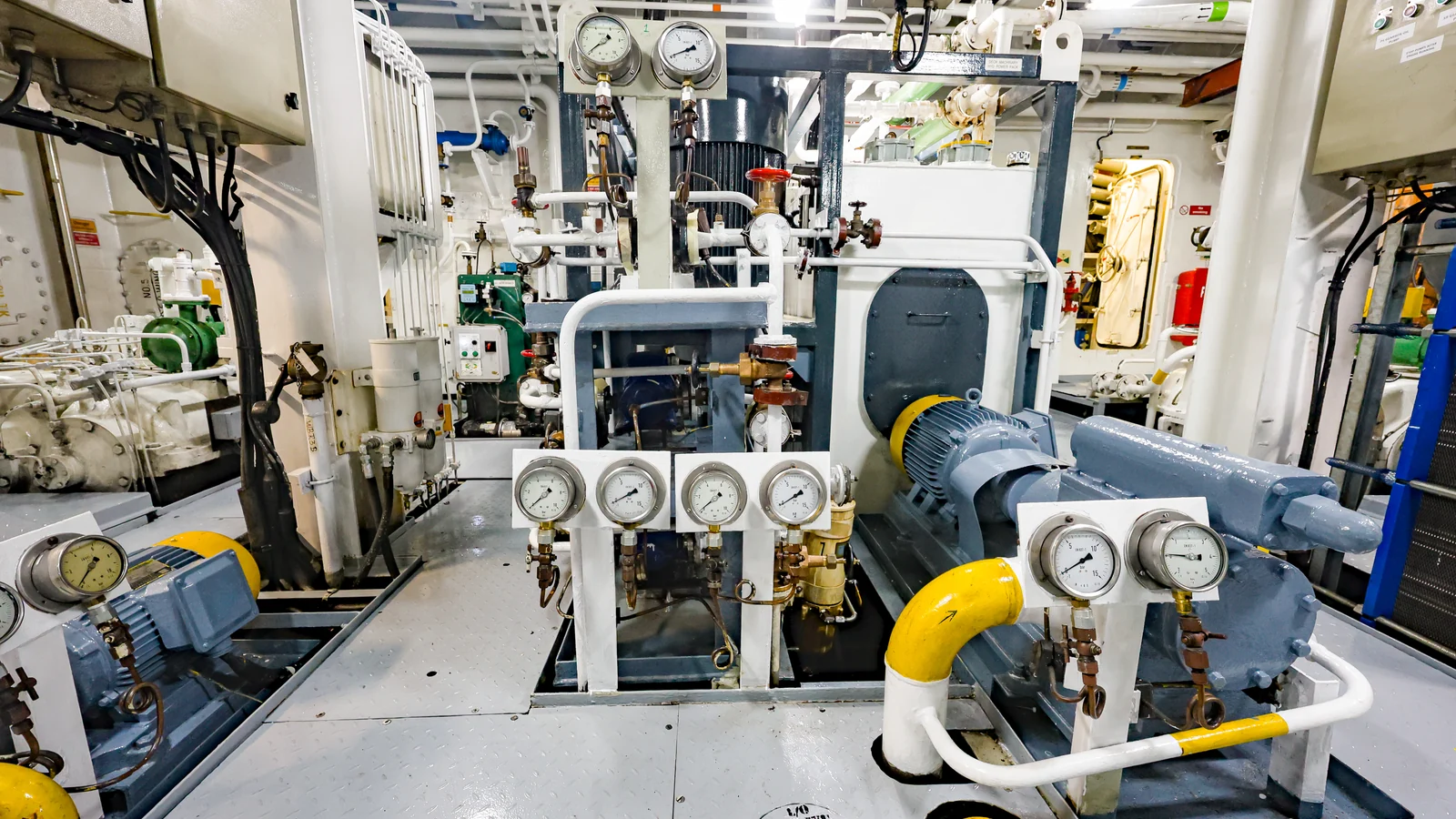
Injection and exhaust valve actuation are both hydraulic and both electronically timed. The maker's engine description gives one hydraulic cylinder unit per cylinder: a base plate with a distributor block, accumulators on it to hold the peak flow injection needs, and the block supporting the hydraulically activated fuel oil pressure booster and exhaust valve actuator. Its latest large-bore description, for the G95–G80ME-C10.5, moves the HCU onto the exhaust valve itself and builds the fuel booster into each fuel booster injection valve, so which arrangement an engine carries is decided by type and Mark, not by the letters ME-C. Reversing is done by re-timing injection, exhaust valve activation and the starting valves, so the older engines' reversing servomotors are absent.
Electronic fuel, mechanical exhaust
In the maker's separate ME-B description, the engine keeps a camshaft made in one piece with its exhaust cams, chain driven from the crankshaft. Its hydraulic cylinder unit serves a pair of cylinders rather than one, carries pressure boosters, ELFI valves and lubricators but no exhaust valve actuator, and its starting air distributor is stated to be the same item used on the MC-C. Where those lubricators are set by feed rate, the cylinder oil feed rate calculator gives the litres per day for a chosen g/kWh, per engine and per cylinder. An ME-B plate is neither an MC nor an ME-C on the parts side.
The figure after the letters is a revision, not a rating
Project guides are published per Mark, and what is basic design on one Mark is an option on another: an axial vibration monitor with alarm and slow-down terminals is required from Mark 9 upward. The exhaust valve spindle is a DuraSpindle with a Nimonic spindle as an option, and liners prepared for temperature sensors are basic design only on the 95–80 bores — on other bores, the 60 among them, they are an option, so the engine file has to say whether they were taken.
Three makes, three catalogues
The maker's engine description states these engines can be fitted with Everllence, Accelleron or MHI turbochargers — Accelleron being the former ABB turbocharging business, with its own turbocharger parts route — and the earlier edition of the same description names them MAN, ABB and MHI, the names a turbocharger plate from before the renamings carries. The machine carries its own plate and designation, and a turbocharger line quoted from the engine type alone has not been quoted at all.
Two engines with the same designation can carry different hydraulics
On a camshaft engine the designation more or less describes the fuel system. Here it does not: three things were decided when the engine was ordered, not when it was designed.
Start with the valve, because it is the line most often written wrong. Injection is activated by a multi-way valve the maker's engine description names as ELFI or FIVA; the exhaust valve by one named as ELVA or FIVA; and a project guide section for the hydraulic power supply names the pair Electronic Fuel Injection and Proportional Exhaust Valve Actuator, abbreviated ELFI and PEVA. One duty, three published abbreviations. A FIVA does both jobs from a single valve; an ELFI-and-ELVA build splits them. What a request needs is therefore the lettering on the valve in front of you, plus which duty it serves.
Then the hydraulic power supply. The medium is not a special fluid: it is the engine's own lubricating oil, taken from the main system and filtered inside the unit, which is why hydraulic cleanliness and lube oil housekeeping are one subject here. An ISO 4406 code from the oil analysis report is read by the oil cleanliness code reader. The pumps are driven either mechanically from the crankshaft through a step-up gear or electrically, and the unit sits on the engine either way. With mechanical drive it carries an automatic filter and a redundant one, engine-driven main pumps, electrically driven start-up pumps and a safety and accumulator block; with electric drive the pumps are combined main and start-up pumps. The maker lists three configurations and identifies them by extent-of-delivery numbers rather than by engine designation.
Finally the pipework and the wear items around it. The engine description notes that single-wall hydraulic piping came in with the later hydraulic generation, while the fuel oil high-pressure pipes are double-walled, insulated and unheated; the exhaust valve is closed by an air spring and its spindle guide sealed by an oil bath in the air cylinder; the top piston ring is always a Controlled Pressure Relief type, the rings below it are CPR or oblique-cut depending on the engine type, and on some types the top ring is the taller one. A ring set here is a set for a cylinder.
What an S60ME-C list is made of
Grouped by where the work happens: hydraulic and control hardware first, because that is what this engine has and the older ones do not, then the cylinder unit, the running gear and the air side.
- HCU base plates and distributor blocks
- Fuel oil pressure boosters, complete or as parts
- Exhaust valve actuators and their pistons
- Control valves — ELFI, ELVA, FIVA or PEVA as labelled — with seals and connectors
- Accumulators and safety block items
- Power supply pumps, step-up gear parts, filter elements
- High-pressure pipe assemblies, supports and seals
- Alpha lubricator pumps, feed pipes, non-return valves, quills
- Cylinder control and interface unit hardware, angle encoder and pick-ups
- Cylinder liners, O-rings and temperature sensor fittings where fitted
- Cylinder covers, studs and nuts
- Fuel valves, vent slides, starting air valves
- Exhaust valve spindles, seats, bottom pieces, housings, complete cages
- Air spring items and spindle guide seals
- Piston crowns, skirts, ring sets and cleaning rings
- Piston rods, stuffing box and scraper rings
- Crosshead and crankpin shells, rod studs and nuts
- Main bearing shells and thrust bearing segments
- Chain drive, guidebar and tightener parts on a camshaft build
- Turbocharger cartridges, nozzle rings and diffusers
- Scavenge air cooler elements, auxiliary blower and non-return valves
- Overhaul gasket, O-ring and seal kits
Two lines here are habitually written as one word and quoted as another: an exhaust valve can mean a spindle, a seat, a bottom piece, a housing or a complete cage, and a piston can mean a crown, a skirt, a rod or an assembly. Both are read back to you before anything is priced. The RFQ evidence guide covers what to attach.
What has to be sent before an ME-C line is answerable
The plate gives the type and the Mark. Everything separating one ME-C build from another is on the components or in the engine file.
- Full designation as stamped, with the Mark figure including any decimal (S60ME-C10.5 rather than S60ME-C) and any suffix after it such as -GI, and whether it reads ME-C or ME-B
- Engine or works number and the builder beside it — the maker notes that licensee-built engines follow its drawings and standards while some components may differ through local production
- The lettering on the control valve itself, and whether that valve serves injection, the exhaust valve, or both
- Whether the hydraulic power supply is engine driven or electrically driven, and where it sits
- Extent-of-delivery (EoD) numbers from the order documentation for any hydraulic line — the maker's guide, for instance, lists the standard engine-driven power supply as EoD 4 40 160 and the combined version as 4 40 167
- Lubricator generation as marked on the lubricator
- For an exhaust valve line, which spindle material the engine file records
- Whether the line is on the hydraulic oil side or the fuel oil high-pressure side, since pipe construction differs
- Cylinder number for any running-gear or cylinder-unit line
- Control system module designation as labelled — the cylinder control unit, for instance, is marked CCU — and software version where automation is involved
- Turbocharger designation from its own plate, and which of the three makes it is
- For a shell bearing, the undersize already in the journal; for a ring set, the cylinder
- Running hours on the item and any earlier reconditioning of that unit
- Photographs of the plate and of the component's own label, which here carries more than the plate
Where reconditioning beats replacement, and where it does not
One list mixes ordinary marine engineering with precision hydraulics matched to a control system. They do not take the same route.
The hydraulic assemblies are the interesting half. The maker's own service material treats reconditioning of a removed unit as a normal route rather than a fallback, and for pressure boosters, exhaust valve actuators and control valves that is often the sensible answer: the unit in your hand is the specification, its hours are the deciding fact, and no cross-reference is needed. That material also puts hydraulic oil cleanliness at the centre of how long any of it lasts, which is why power supply filter elements belong with the units they protect rather than in the consumables tail of a requisition. For those elements, the filter rating reader reads the beta ratio or micron rating given on the old element or in its data. Vessel Core reviews these lines on an OEM route by default.
The rest behaves like any slow-speed overhaul. Liners and O-rings, piston crowns and skirts, ring sets, stuffing box rings, crosshead and crankpin shells, main bearing shells, exhaust valve seats and housings, gaskets and seal kits all have measurable geometry and stated material, and a verified alternative route can be reviewed on them where your approval requirements permit. Class-surveyed overhauls and warranty-sensitive repairs go the other way, and an OEM-route review can be requested line by line rather than for the whole order. One boundary is worth stating plainly: anything carrying control electronics stays on the OEM route. The OEM or verified alternative comparison sets out what evidence each needs. Where the main bearing shells are on the list, the crankshaft deflection calculator sets the dial gauge readings for each crank against the limit you enter.
S60ME-C parts — what buyers ask first
My valve is labelled FIVA but the requisition says ELFI. Which is right?
Both are the maker's own words, for different builds. A FIVA is a single multi-way valve that triggers injection and works the exhaust valve actuator; an ELFI-and-ELVA build uses one valve per duty, and one MAN project guide writes the exhaust-side valve as PEVA. The acronym in an old requisition says what somebody once had; the lettering on the valve says what you have.
Will an MC or MC-C part number work on an ME-C?
Around the running gear it is a fair question and often productive. On the fuel and exhaust actuation side it is not: the camshaft, the injection pumps, the actuator pumps and the reversing gear were replaced by the hydraulic cylinder units and the power supply unit. The one documented crossing runs the other way — on the ME-B the maker states the starting air distributor is the same item as on the MC-C.
Why do you ask what the hydraulic power supply looks like?
Because the maker publishes three configurations and identifies them by extent-of-delivery number rather than by engine type. Mechanically driven units carry engine-driven main pumps with electrically driven start-up pumps, two filters and a safety and accumulator block, and in the combined version those start-up pumps are sized to give back-up power; electrically driven units use combined main and start-up pumps. Filters, pumps and accumulator items differ accordingly, and the plate does not say which was ordered.
Can Vessel Core supply ME-C parts against the engine designation alone?
For running spares and planned maintenance items, usually yes, once the Mark, the builder and the cylinder number are known. For hydraulic and control hardware the designation alone is not enough and we ask for the item's own label rather than guess, because one designation covers more than one build of several assemblies. Availability and route are confirmed in the quotation.
Should a failed pressure booster or exhaust valve actuator be replaced or reconditioned?
Often reconditioned. The maker's own service material treats reconditioning of a removed hydraulic unit as a normal route rather than a fallback, and for pressure boosters, exhaust valve actuators and control valves it is often the sensible answer: the unit in your hand is the specification, and its running hours are the deciding fact. Vessel Core reviews these lines on an OEM route by default. Add the power supply filter elements to the same request, since hydraulic oil cleanliness decides how long any of it lasts.
Is an ME-B the same as an ME-C on the parts side?
No. On the ME-C both injection and exhaust valve actuation are hydraulic and electronically timed, with one hydraulic cylinder unit per cylinder. The ME-B keeps a chain-driven camshaft for the exhaust valves, and its hydraulic cylinder unit serves a pair of cylinders and carries no exhaust valve actuator. The maker states that the ME-B starting air distributor is the same item as on the MC-C, but otherwise an ME-B plate is neither an MC nor an ME-C for parts, so the request should say which it is.
Is Vessel Core connected to MAN B&W?
No, and there is no agreement of any kind. Vessel Core holds no dealership, distribution, representation or partnership agreement with MAN B&W, and quoting a component against the ME-C, ME-B or MC designations implies no approval by the maker and no claim of interchangeability.
Submit your RFQ now.
Send the full designation with the Mark figure, the engine or works number, and the lettering on the control valve itself: ELFI, ELVA, FIVA or PEVA. Vessel Core reviews the supply route and prepares a structured quotation.
