
MAN Turbocharger
Parts Supplier
Axial and radial turbocharger programmes — NA · NR · TCA · TCR series
MAN turbocharger series seen in engine-room enquiries
MAN turbochargers are fitted across a wide range of two-stroke and four-stroke engines, and on an engine of any real size the turbocharger is a separate assembly with its own type designation, serial number and parts list. The axial NA and TCA programmes and the radial NR and TCR programmes cover decades of installations still in service; newer engines may carry the axial TCT, the radial TCP or TCF, or a TCX as the high-pressure stage of two-stage charging. Reading the unit's own plate — not the engine's — is what actually identifies which parts list applies.
NA series
The NA units have been in service for decades on two-stroke and four-stroke engines and are still the plate read on many installations. Rotor blades, nozzle rings, labyrinth seals, diffusers, journal and thrust bearings and complete cartridge assemblies are the recurring lines.
NR series
NR is a radial programme, and it has not left the maker's catalogue: Everllence still lists NR turbocharging as a variant of its 32/40 GenSet. Nozzle rings, compressor wheels, bearing bushes and thrust rings, seal sets and cartridge assemblies are what an overhaul on these units usually needs, and the full designation on the plate decides which parts list applies.
TCA series
TCA is the axial-flow programme for two-stroke and four-stroke diesel, dual-fuel and gas engines, built in frame sizes from TCA33 to TCA88. Wide-chord turbine blades, nozzle rings, compressor wheels and volutes, bearing housings and seal sets are the usual scope; the type plate on the casing carries the frame size the parts follow.
TCR series
TCR is the radial programme, built in four-stroke versions and in a two-stroke version that the maker marks with a suffix after the frame size — TCR18-41, TCR18-42 and TCR18-2 are the standard four-stroke, high-pressure four-stroke and two-stroke versions of one frame. Like the TCA, it can carry VTA, the maker's variable turbine area, which changes the turbine end, so state the full designation and whether VTA is fitted before a nozzle ring, rotor or cartridge is quoted.
The turbocharger has its own plate
On an engine of any real size the turbocharger is a separate assembly with a type designation and a serial of its own, and the engine identity alone does not reach the parts. Read the unit plate, and note whether the request is for a cartridge exchange or for loose components, because the two are quoted differently.
Where a MAN turbocharger enquiry actually gets stuck
Most enquiries that reach us on this equipment trace back to reading the engine's identity instead of the turbocharger's own. The engine plate names the engine, not the turbocharger fitted to it, and a request built only from the engine type risks the wrong frame size entirely. The second common gap is not stating whether the enquiry is for a cartridge exchange or for loose components — the two are quoted differently, and on TCA and TCR units, whether VTA (variable turbine area) is fitted changes the turbine-end parts as well. Both are avoided by reading the turbocharger's own plate first and stating the scope — cartridge or loose parts — alongside it.
- Rotor blades & turbine wheels
- Compressor wheels & volutes
- Nozzle rings
- Labyrinth seals & seal sets
- Journal & thrust bearings
- Bearing bushes & housings
- Diffusers
- Complete cartridge assemblies
A cartridge exchange and a loose-component order draw from the same parts list but are quoted differently, so the enquiry states which scope applies alongside the full type designation from the turbocharger's own plate.
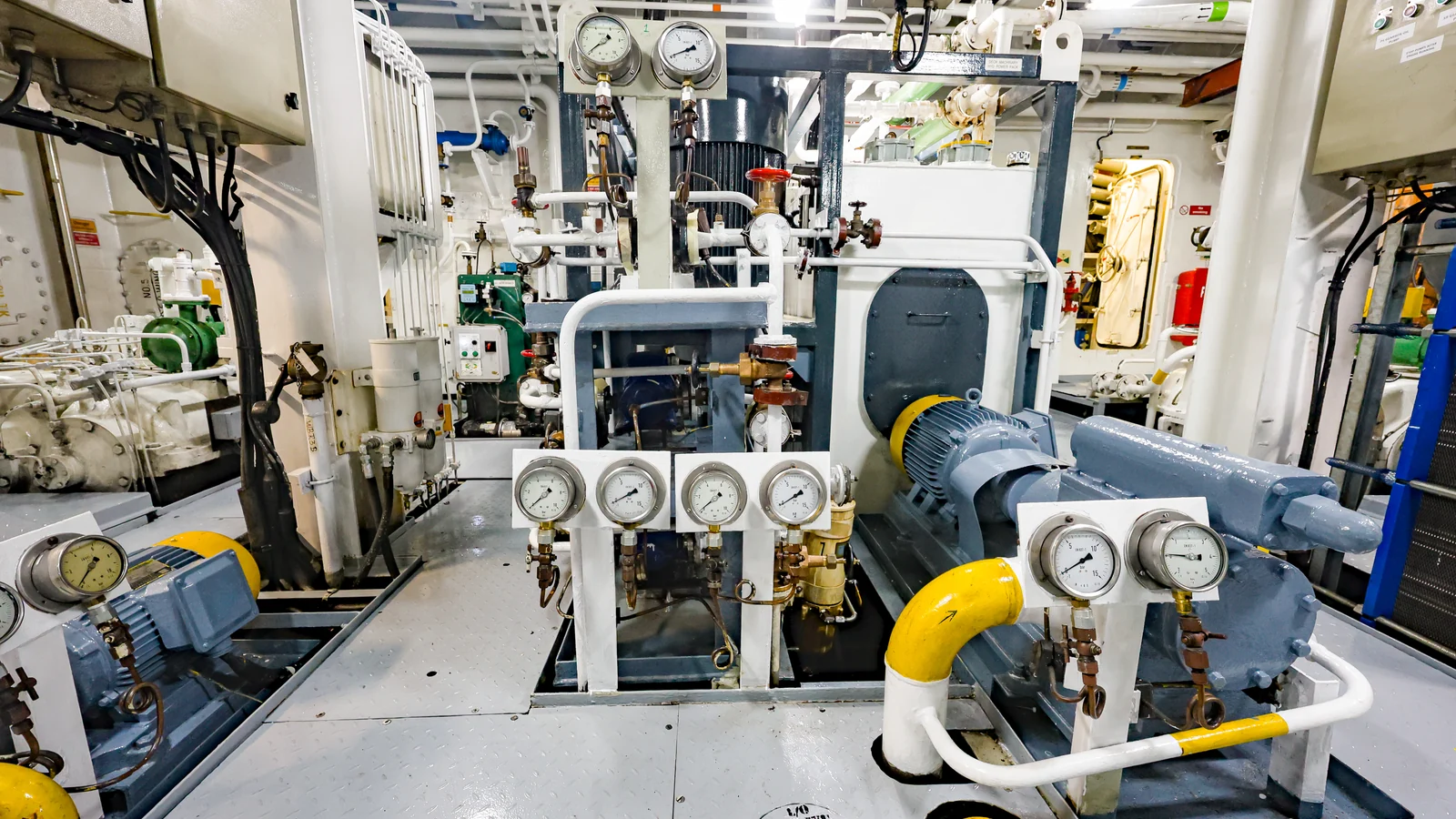
Turbocharger & designation plate — general arrangement
A licensed photograph of MAN turbocharger equipment was not available at publication, so this technical reference illustrates the general arrangement shared by this equipment class.
Illustrative technical reference, not a photograph of MAN turbocharger equipment or a Vessel Core installed reference — a licensed photo of this maker's equipment was not available. Vessel Core has no dealership, distribution or partnership agreement with Everllence, formerly MAN Energy Solutions, or any other manufacturer named here; it operates as an independent spare parts supplier.
Plate data that makes a MAN turbocharger enquiry quotable
The turbocharger's own plate is what a correct match is made from, and it is a different plate from the engine's. With the items below an enquiry can be priced in one pass; without them it usually comes back with a clarifying question first. How a plate photograph becomes a priced list is set out on the how we work page.
- Full type designation from the turbocharger's own plate, with any suffix after the frame size (e.g. TCA55, or TCR18-41 rather than TCR18), not the engine type
- Serial number of the turbocharger, and the maker named on its plate — Everllence licenses turbocharger production to Mitsui E&S, Kawasaki and HD Hyundai, and PBS Turbo, a company of the same group, also builds them, so the plate may not read MAN
- Scope — cartridge exchange or loose components, quoted differently
- Whether VTA (variable turbine area) or another turbine-end option is fitted — VTA is offered for TCA and TCR units, also as a retrofit
- Engine type and cylinder count, for cross-reference only
- Photograph of the turbocharger plate and of the part being requested
Tools for this equipment: the Pt100 and thermocouple reader for the exhaust gas thermocouples. For the charge air cooler downstream, the charge air condensate calculator gives the condensate from the intake air, the charge air pressure and the cooler outlet temperature.
Supply route review for MAN turbocharger equipment.
A separate assembly with its own plate, a scope that changes how the same parts list is quoted, and options that alter the turbine end on some units — the turbocharger's own type, serial and scope get settled before anything else.
Turbocharger's own plate read first
The engine identity alone does not reach the turbocharger parts, so the unit's own type designation and serial are read before anything is quoted.
Cartridge or loose parts confirmed
A cartridge exchange and an order for loose components draw from the same parts list but are quoted differently, so the scope is confirmed alongside the type designation.
TCR options checked before quoting
VTA, the maker's variable turbine area, is offered for TCA and TCR units and as a retrofit; it changes the turbine-end parts, so whether it is fitted is confirmed before a nozzle ring, rotor or cartridge is quoted.
Axial and radial ranges kept distinct
NA and TCA are axial-flow programmes, NR and TCR are radial, and the internal parts follow the flow arrangement, not just the generation.
Older NA/NR units still supported
NA and NR units still fitted decades after commissioning are read from their own plate rather than assumed from the later TCA/TCR programmes.
Estonian company, registered in Tallinn
Vessel Core OÜ trades from Tallinn as an Estonian company, Reg. 17028043, VAT EE102773714. A turbocharger component typically travels as hand-carry with a joining engineer; a full cartridge is crated. Supply route, handover option and documentation are confirmed in the quotation.
MAN turbocharger parts — questions from the engine room
Which MAN turbocharger series come up most often in spare-parts requests?
The NA axial units lead, still the plate read on many decades-old installations across two-stroke and four-stroke engines. The NR radial units and the later TCA (axial) and TCR (radial) programmes follow. Send the full type designation exactly as stamped on the turbocharger's own plate before a parts list is worked up.
Why is the turbocharger's own plate needed separately from the engine plate?
On an engine of any real size the turbocharger is a separate assembly with its own type designation and serial number, and the engine identity alone does not reach the parts. Reading the unit's own plate is what actually identifies which turbocharger parts list applies.
Why does it matter whether TCR options are fitted?
TCR units are built in several versions, marked by a suffix after the frame size, and both TCA and TCR can carry VTA, the maker's variable turbine area, which changes the turbine end of the unit. The full designation and whether VTA is fitted have to be confirmed before a nozzle ring, rotor or cartridge assembly is quoted, since the parts differ between builds.
What should a MAN turbocharger spare-parts RFQ contain?
A workable request lists the full type designation and serial exactly as stamped on the turbocharger's own plate, and states whether the request is for a cartridge exchange or for loose components, since the two are quoted differently. A photograph of the plate and of the part being requested settles most of the remaining questions in one pass.
Our turbocharger is an older NA or NR unit. Can it be quoted from the TCA or TCR parts list?
Not by assumption. NA and TCA are axial-flow programmes and NR and TCR are radial, and the internal parts follow the flow arrangement as well as the generation. NA and NR units still in service decades after commissioning are read from their own plate rather than inferred from the programmes that followed them, so send the full type designation and serial exactly as stamped on the turbocharger.
How does a MAN turbocharger part travel to the vessel?
That depends on the scope. A single turbocharger component typically travels as hand-carry with a joining engineer, while a full cartridge is crated. The supply route, the handover option and the documentation are confirmed in the quotation, which is one more reason to state at the outset whether the order is a cartridge exchange or loose components.
Is Vessel Core connected to MAN?
No, and there is no agreement of any kind. Vessel Core holds no dealership, distribution, representation or partnership agreement with MAN, and quoting a component against one of its designations implies no approval by the maker and no claim of interchangeability.
Send the turbocharger's own plate — the parts list follows from it.
Send the full type designation and serial exactly as stamped on the turbocharger's own plate, not the engine's, and state whether the request is for a cartridge exchange or loose components. Each line is then read back against the type and scope it belongs to before a component reference is fixed against it.
