
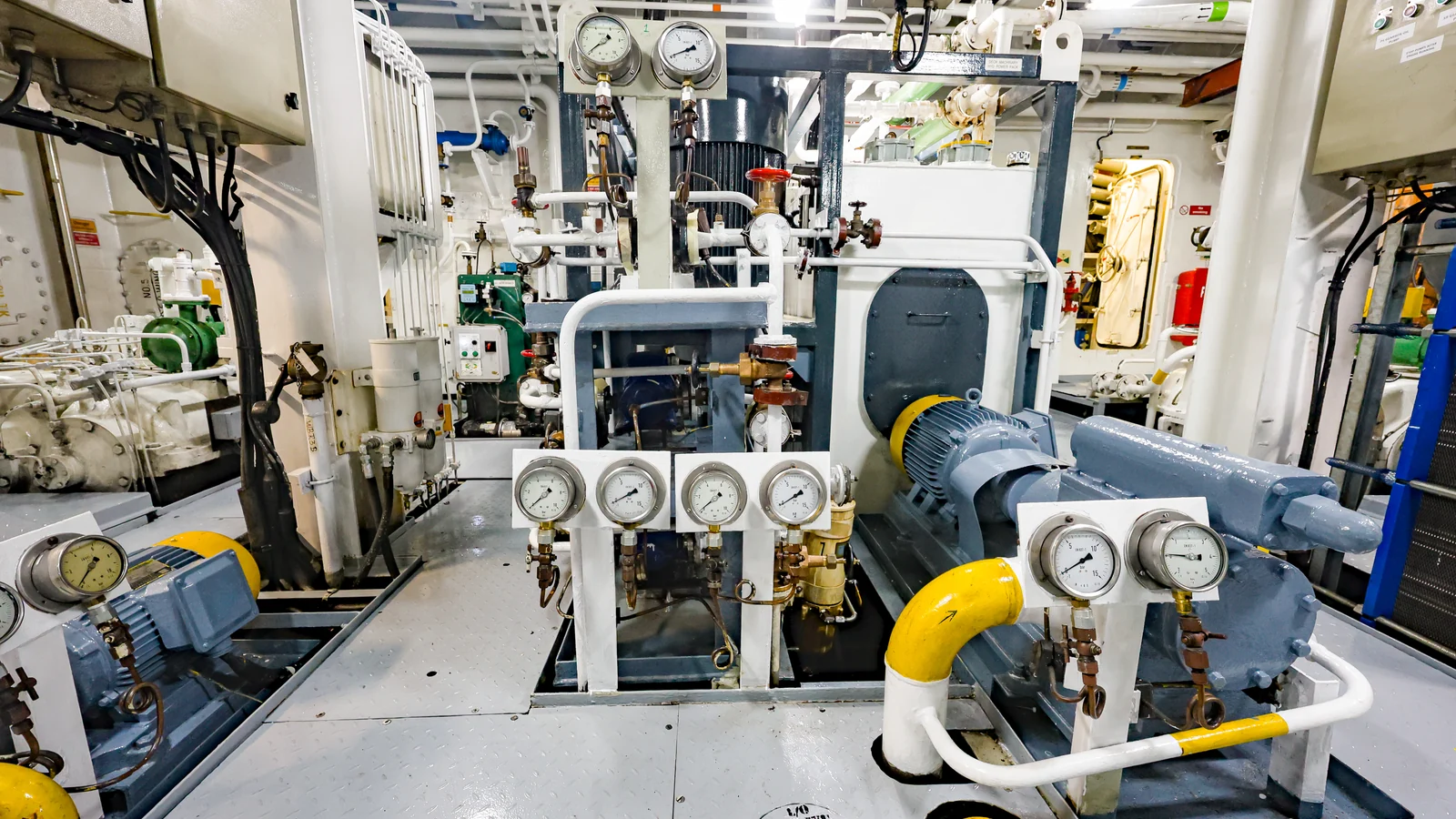
MaK M 32 C
Spare Parts Supplier
Segmental camshaft · Flexible Camshaft Technology · Cat Common Rail
The M 32 designations a Kiel-built engine can carry
MaK is a Caterpillar programme supported from Kiel, and the ownership story and the reading of a Caterpillar serial prefix and arrangement number sit on the Caterpillar marine parts route. This page starts one level down, with the four designations a 32-series request turns out to be. They are separate builds, not spellings of one another.
The in-line long-stroke engine
Introduced in 1994 as a heavy-fuel medium-speed engine for main propulsion and for generator drive. On generating-set builds engine and generator are delivered on a common base frame and tested together, which matters when a request arrives against an M 32 C plate but concerns the electrical end — that belongs to the generator maker's documentation, not this one.
The V engine is a separate build
Introduced in 2000 and published as its own product with its own brochure, not as a configuration of the in-line engine. The maker's description is the useful part: it incorporates as many in-line engine components as possible. As many as possible is not all, and the difference is what has to be checked against the engine number.
A documented crossing between two models
The maker described this later development as based on the M 32 C series, using the piston and other proven components from the VM 32 C while keeping the same footprint as the M 32 C. That is rare in this trade: a component crossing between two named models, stated by the maker. It also means a piston enquiry has to say which of the three is on the plate.
Three digits instead of two
MaK's earlier programme numbered its engines in three digits, types such as the M 453 C; the current one uses two. At least one older type sits in the same bore group as the M 32 C on a different stroke, so it is no coincidence when both turn up in one fleet. A line reading MaK 32 has not yet named an engine, and the digit count is the first check.
On this engine the option list is the parts list
The maker's brochure for the M 32 C sets out its design features, and several of the most parts-relevant ones are marked optional. That single word is why two engines with the same designation can need different orders.
Three options change large groups at once. A pulse charging system is offered for the in-line variants, recommended for propulsion plant working through frequent load changes. Flexible Camshaft Technology is offered, a different valve-timing arrangement rather than a setting. And a Cat Common Rail fuel system is offered, so an M 32 C plate can sit above pump-and-nozzle injection or above a common-rail installation. There is also a Low Emission Engine version with a brochure of its own. Nothing in the designation separates these, so a fuel-system or air-side line quoted from it alone is quoted against a guess.
The camshaft shows why the design has to be understood before the line is written. It is segmental: individual segments, one per cylinder, made to be assembled and dismantled as sections. A camshaft request here is a section and a position, not a shaft.
Several other named features cut the other way, turning a vague line into a precise one. The block is nodular cast iron with the lubricating oil and charge air ducts cast into it, carrying no cooling water and no external piping for those duties. The exhaust gas ducting is single-pipe, which the brochure describes as simplifying the parts spectrum by giving identical cylinder parts. The cooling water system runs on plug-in connections with standard closure fittings. The liner is cooled only outside the block and runs against a calibration ring at its top. The lubricating oil automatic filter is fitted to the engine in place of a duplex filter and separate automatic filters. The lower valve drives and injection pump drives sit in one compact module with cam followers. The connecting rod is a split-off design. Each can be asked for by its own name.
What gets ordered against an M 32 C plate
Listed the way this engine is worked: down through the cylinder unit, then the valve and injection drives, the running gear, then the media systems mounted on the engine rather than around it. Items belonging to one option build are marked.
- Cylinder heads, complete or as components
- Inlet and exhaust valves, seat inserts, guides, rotators
- Cylinder liners, sealing rings and the calibration ring at the liner top
- Pistons, piston crowns, skirts and ring sets
- Piston pins and small-end bushes
- Injection pumps and plunger-and-barrel elements on pump-and-nozzle builds
- Common rail components where a Cat Common Rail installation is fitted
- Injector nozzles, nozzle holders and high-pressure fuel lines
- Camshaft segments by cylinder position, and camshaft bearings
- Cam followers and lower valve drive module parts
- Flexible Camshaft Technology components where fitted
- Split-off connecting rods, rod bolts and big-end shells
- Main bearing shells and thrust bearing parts
- Turbocharger cartridges, nozzle rings and diffusers
- Pulse charging components on in-line engines built with it
- Charge air cooler elements, covers and O-rings
- Engine-mounted lubricating oil filter elements and inserts
- Lubricating oil and cooling water pumps, impellers, shafts and seals
- Cooling water plug-in fittings and closure parts
- Engine control terminal instruments and sender items
- Resilient foundation mounting elements
- Overhaul gasket, O-ring and seal kits
The heavy-fuel duty this engine was built for shapes the list: nozzle, plunger and liner items come round on their own rhythm, and a request saying which fuel the engine has been burning is easier to answer than one that does not. The marine fuel grade reader decodes the ISO 8217 grade on the bunker delivery note, and the CCAI calculator gives the ignition quality of a residual fuel from its density and viscosity. Running-gear detail sits on the piston, liner and cylinder parts page.
The options a request has to name, and where to find them
The plate settles the designation and the engine number. The options are not on it, and here they separate one parts list from another.
- Designation with its spacing as stamped — M 32 C, VM 32 C or M 32 E, and not simply MaK 32
- Engine number from the builder's plate, photographed rather than written out by hand
- Builder's name and logo exactly as on the plate — MaK, Caterpillar Motoren or both — since the Kiel engine business has been Caterpillar Motoren since 1997 while the engines kept the MaK name
- Whether the engine is a Low Emission Engine build, which has its own documentation
- Which fuel system is fitted: injection pumps with nozzles, or a common rail installation
- Whether Flexible Camshaft Technology is fitted, for any valve-timing or camshaft line
- Whether pulse charging is fitted, for any air-side line on an in-line engine
- Camshaft segment position, since the shaft is ordered in sections
- Duty: propulsion through a gearbox, generator drive on a common base frame, or diesel-electric
- Cylinder number, and on a VM 32 C the bank as well as the cylinder
- Turbocharger designation from its own plate, and how many are installed
- Fuel actually burned in service, which drives wear on nozzles, plungers and liners
- The number from the parts book with its edition, since the edition dates the drawing
- Undersize for any shell bearing, and ring sets counted in cylinders
- Hours since the last overhaul of the item, and any earlier reconditioning
An engine still in service after its programme closed
New M 32 engines are no longer sold, the installed fleet is not going anywhere, and both facts shape how a spares list is written.
Caterpillar announced in October 2021 that it would stop selling MaK prime-product engines, with service for the fleet continuing through its own network; the Caterpillar route page carries that background. The practical effect is not scarcity so much as precision. Documentation for an engine of this age is scattered across the engine file, the yard's build records and whichever option sheets survived the last change of owner, and the option questions above are the ones most likely to be unanswered on board. Photograph the fuel system and the air side before the list is written; where an option cannot be established from the vessel's papers, the assembly in place is the evidence we work from.
The split between routes here is unusually clean. Wear items with measurable geometry and stated material — liners and sealing rings, piston rings, valves and seat inserts, bearing shells, gaskets, O-rings, filter elements, plug-in connection fittings — are ordinary supply questions, and a verified alternative route can be reviewed on them where approval requirements allow, with dimensional and material documentation checked at RFQ stage. Cylinder heads, camshaft segments, common-rail hardware, Flexible Camshaft Technology components, turbocharger internals and anything inside a class-surveyed scope go to an OEM-route review, because there the drawing matters more than the dimension. Vessel Core is an independent spare parts supplier and puts the route against each line, so a list of both kinds can be sent as one request.
MaK M 32 C parts — common questions
Is a MaK M 32 C part the same as a VM 32 C part?
Sometimes, and the maker is the reason to check rather than assume. The V engine was published as its own product in 2000, and the maker describes it as incorporating as many in-line engine components as possible — a design ambition, not a compatibility list. The later M 32 E is described as taking the piston and other proven components from the V engine while keeping the in-line footprint. Real crossings exist, they are documented, and they are established from the engine number and the drawing.
Why do you ask whether a common rail system is fitted?
Because a Cat Common Rail fuel system is listed as an option rather than as a generation of the engine. Two M 32 C plates can sit above two quite different fuel systems, and injection pumps, plunger elements, nozzles and high-pressure lines follow the installation rather than the designation. A photograph along the fuel side answers it more reliably than a search through the paperwork.
How is a camshaft ordered for an M 32 C?
By segment and by position. The maker's brochure describes the camshaft as segmental with individual segments per cylinder, assembled and dismantled section by section. That is good news for a repair, since a damaged cam need not mean a complete shaft, but the request has to say which cylinder position the segment serves — and whether Flexible Camshaft Technology is fitted, because that changes what is on the drive.
Can MaK parts still be supplied now the engines are out of production?
Yes. Caterpillar's 2021 announcement concerned sales of new prime-product engines and left service and spares support for the installed fleet in place through its network; independent supply for wear items runs alongside it. Vessel Core reviews OEM-route and verified alternative options for M 32 C, VM 32 C and M 32 E requests according to the evidence supplied and the buyer's approval requirements.
Which M 32 C parts can be reviewed on a verified alternative route?
The wear items with measurable geometry and stated material: liners and sealing rings, piston rings, valves and seat inserts, bearing shells, gaskets, O-rings, filter elements and plug-in connection fittings, where approval requirements allow, with dimensional and material documentation checked at RFQ stage. Cylinder heads, camshaft segments, common-rail hardware, Flexible Camshaft Technology components, turbocharger internals and anything inside a class-surveyed scope go to an OEM-route review, because there the drawing matters more than the dimension. Both kinds can go in one request, with the route stated against each line.
The request concerns the generator end of an M 32 C generating set. Is that quoted from the engine plate?
No. On generating-set builds the engine and generator are delivered on a common base frame and tested together, but the generator end belongs to the generator maker's documentation. Bearings, diodes and voltage regulator items there are read from the generator's own plate, and they follow the marine electrical and control components route.
Is Vessel Core connected to MaK?
No, and there is no agreement of any kind. Vessel Core holds no dealership, distribution, representation or partnership agreement with MaK, and quoting a component against the M 32 C designation implies no approval by the maker and no claim of interchangeability.
Submit your RFQ now.
Send the designation with its spacing as stamped, the engine number from the builder's plate, and which fuel system and camshaft options are fitted. Each line comes back with its route named: wear items with measurable geometry for a verified alternative review where your approvals allow, cylinder heads, camshaft segments and common-rail hardware for an OEM-route review.
