
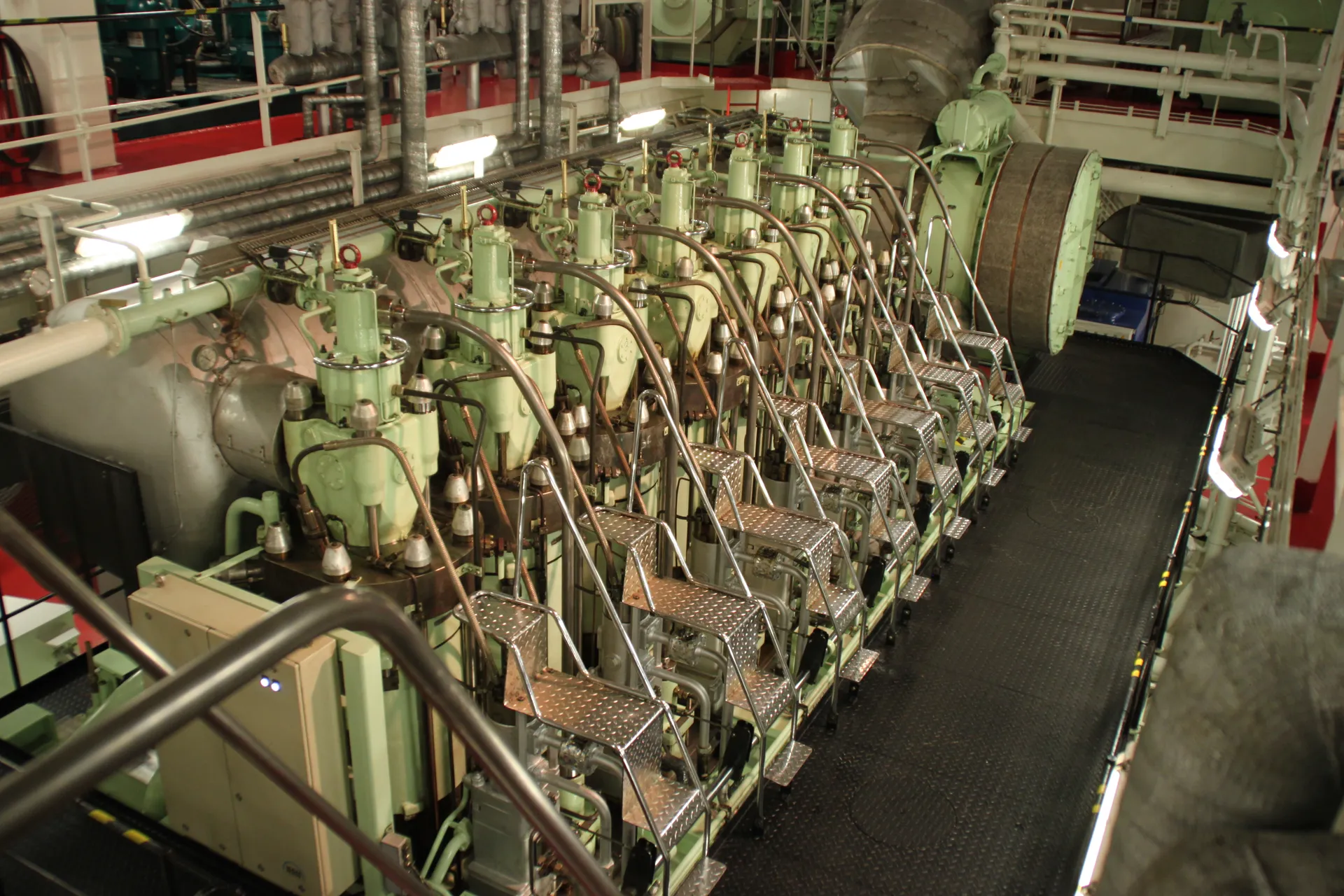
Makita Marine Engine
Spare Parts Supplier
Parts for the two-stroke crosshead main engines that Makita Corporation builds in Takamatsu, Japan, under B&W licence — the L35MC and the S-type MC frames, and the S30ME-B, S35ME-B and S46ME-B. Every line starts from the engine plate.
Makita engine types a spare parts request can name
Makita Corporation traces its business in Takamatsu back to 1910. A technical assistance agreement with Mitsui Engineering & Shipbuilding followed in 1973, and since the early 1980s the main line has been the B&W two-stroke crosshead engine, built under a sub-licence granted by Mitsui with the designer's approval; the current Everllence licensee list still shows Makita as Mitsui's sub-licensee. The engines are small-bore designs, every one of them turbocharged, and they go mainly into ocean-going cargo ships. Reading the designation: the leading digit is the cylinder count, S marks the super-long-stroke family, the number is the bore in centimetres, MC means camshaft control and ME-B electronic control, and a Mark figure at the end is the revision.
6L35MC · 5L35MC MK6
The engine Makita's two-stroke business grew from. B&W approval for the L35MC/MCE came in 1981, the first 6L35MC built anywhere left the Takamatsu works in 1982, and the 5L35MC MK6 power-up version followed in 1993. Makita still calls the L35MC the world standard for small bore. Fuel injection, starting air and exhaust timing all run off the camshaft, so a fuel pump or cam line on this engine has no ME-B counterpart.
4S26MC · S42MC · 6S50MC MK6
The S frames Makita built on the camshaft principle: the 4S26MC completed in 1988, the S42MC that still appears on its MC product page, and the 6S50MC MK6, which Makita's history records in 2001, the year a test bed for the S50MC was completed at the works. An S50MC from Makita is reviewed against the type described on our S50MC page, with Makita's own build data added.
S30ME-B9 · 6S30ME-B
Makita completed the first 6S30ME-B anywhere in 2014 and presents the S30ME-B as the successor to the L35MC. Injection and cylinder lubrication are timed electronically instead of by cam, which brings control and actuation components that no MC engine carries, and an Alpha lubricator, for which Makita has published its own emergency-operation video.
6S35ME-B · 6S46ME-B
Both were completed at Makita in 2013 as the first of their type built in Japan, the year the company began producing electronically controlled engines. An ME-B plate is a parts route of its own: a part number taken from an MC engine of similar bore is not carried across without a check.
L30M
Not every Makita plate carries a B&W design. The L30M is a low-speed four-stroke that Makita developed itself, completed in 1994 with cleaner running and better conditions on board in mind; the first one went into a twin-engine, twin-shaft car ferry. It has no B&W counterpart, so it is reviewed against Makita's drawings alone and never quoted from a two-stroke part book.
Where a small-bore Makita two-stroke wears
The wear points are those of any crosshead two-stroke. The difference on a Makita engine is that the builder issues its own service notes and retrofits for several of them, so the part on board may no longer match the drawing printed at delivery.
Liner and ring wear follow the cylinder oil
Liner wear and ring wear track the cylinder oil and its feed rate more closely than running hours alone. Where the feed rate is checked against the oil actually used, the cylinder oil feed rate calculator gives it in g/kWh from the consumption, the engine power and the hours. Makita has issued a service note on Category II cylinder oil, and an engine that has changed oil category or lubricator type shows it at the next piston overhaul.
Fuel valves and their opening pressure
Fuel valve nozzles and spindles wear, and the opening pressure drifts with them. Makita offers a slide-type fuel valve as a retrofit for low-load running and has a service note on adjusting its opening pressure, so a fuel valve line has to say which valve is actually fitted to the cover.
Spindle and seat faces
Exhaust valve spindles and bottom pieces lose their seat faces to burning and hot corrosion over the overhaul interval. Spindle, seat, housing and the complete valve are four different lines, and the request names the one that is meant.
Stuffing box ring packs
The piston rod stuffing box keeps scavenge air and cylinder oil residue out of the crankcase. As the sealing and scraper rings wear, contamination of the system oil is one of the first signs. A ring pack is quoted per box, springs included, not ring by ring.
Pneumatic manoeuvring and starting air
Makita has issued a service note on maintenance of the pneumatic manoeuvring system. The small valves and seals in that system, and the starting air valves on the cylinder covers, are small items that can still stop the engine from starting or reversing.
Makita engine parts a request can cover
A Makita list is easiest to work when it follows the engine: cylinder unit, crosshead and running gear, fuel and exhaust valve gear, lubrication, then starting and manoeuvring. Each line is reviewed against the build, and nothing on this list is a statement of availability.
- Cylinder liners, liner sealing rings and cooling jacket seals
- Piston crowns, piston rods and piston ring sets, quoted per cylinder
- Piston rod stuffing box sealing and scraper rings, springs and complete ring packs
- Exhaust valve spindles, bottom pieces, housings and actuator parts
- Fuel valves, nozzles and spindles, including the slide-type fuel valve
- Fuel injection pumps, plungers and barrels on MC engines
- Electronically controlled injection and lubrication components on ME-B engines
- Cylinder lubricator parts — mechanical, Alpha and MPL lubricators
- Crosshead, crankpin and main bearing shells, with the bearing position stated
- Starting air valves, the starting air distributor and pneumatic manoeuvring valves
- Cylinder cover gaskets, O-rings and overhaul seal kits
What to read off a Makita engine before the RFQ
Makita has built B&W types across several generations and Mark revisions, and one designation such as L35MC covers engines built decades apart. The serial number and the plate do the identifying; the type name only narrows the search.
- Full designation as stamped, with cylinder count and Mark — 5L35MC MK6 or 6S30ME-B, not the family name alone
- Engine serial number and year of build
- The builder named on the plate and in the machinery particulars, and the licence wording beside it
- Control type: MC (camshaft) or ME-B (electronic), which decides the part book
- Cylinder lubricator fitted — mechanical, Alpha, or a retrofitted MPL lubricator
- Fuel valve fitted — the original design or the slide-type fuel valve retrofit
- Emissions build — Tier II or Tier III, and whether a high-pressure SCR is fitted
- Turbocharger make and type from its own plate, for any turbocharger line
- Part-book page and item number, and the number of any Makita service note the job follows (MWSN- prefix)
- Cylinder or bearing position, running hours since the last overhaul, and photographs of the plate and the part in place
Tools for this equipment: the Pt100 and thermocouple reader for the temperature sensors, the pressure gauge selector for the engine gauges and the O-ring size finder for loose O-rings. What the ISO 8217 grade or the trade name of a bunker stands for is explained by the marine fuel grade reader. Where a speed change is planned, the admiralty coefficient calculator gives the power it needs by the cube law, and the fuel per day and per mile. For a fuel valve whose opening pressure has drifted, the compression spring calculator gives the rate and the load at the fitted length of the spring in it and of a replacement, so the two can be compared.
How a Makita engine RFQ is handled
A Makita engine is a B&W design built by Makita, so each line is checked against both: the type for what the part is, the build for which drawing it was made to.
Designer's type, builder's drawing
The B&W type tells us what the component is; the Makita serial tells us which drawing revision the engine was built to. A part number from another builder's engine of the same type is checked against the Makita build, not assumed to match.
MC or ME-B before anything else
A camshaft engine and an electronically controlled one are separate parts routes on the injection and control side, even at the same bore. The control type is settled first, so an ME-B line is never worked from an MC list.
Retrofits change the line
MPL lubricators and slide-type fuel valves are offered by Makita as retrofits. Where one has been fitted, the part book printed at delivery no longer describes that position, and the quotation follows what is on the engine now.
OEM route or verified alternative
Liners, piston crowns, exhaust valve parts and injection equipment going into a class-surveyed repair normally stay on the OEM route. Ring packs, stuffing box rings, gaskets and seal kits are where a verified alternative is worth comparing; the trade-offs are set out on OEM or verified alternative.
Heavy items planned against the port call
A liner or a piston crown for a crosshead engine is a crating and lifting job before it is a catalogue number. Weight, dimensions and what the berth can receive are checked against the vessel's ETA before a handover point is proposed.
A counterparty that can be checked
Vessel Core OÜ is registered in Estonia under registry code 17028043, VAT EE102773714. The company verification page holds the documents a vendor check usually asks for.
Makita engine parts — questions from buyers
Is this the Makita that makes power tools?
No. Two separate Japanese companies are called Makita Corporation. The one on this page builds marine diesel engines in Takamatsu, Kagawa, and traces its business back to 1910; the power-tool maker has its head office in Anjo, Aichi. A Makita in a ship's machinery list is the main engine.
Which Makita engines are found on merchant ships?
Mostly B&W two-stroke crosshead main engines built by Makita under licence, in ocean-going cargo ships. On the camshaft side these include the L35MC, 4S26MC, S42MC and 6S50MC MK6; on the electronic side, the S30ME-B, S35ME-B and S46ME-B, built since 2013. Makita has also built four-strokes of its own design, such as the L30M, which follow none of the B&W part books.
How do you read a Makita designation such as 5L35MC MK6 or S30ME-B9?
The leading digit is the number of cylinders, the letter gives the stroke family, the number after it is the bore in centimetres, and MC or ME-B gives the control type. The Mark comes last: Makita writes it as MK6 on an MC engine and as a figure after ME-B, as in S30ME-B9. Copy the whole string, because the Mark changes parts within one type.
Why does it matter that the engine was built by Makita and not by MAN?
Because the type and the build are two different pieces of evidence. Makita builds B&W designs under a sub-licence from Mitsui, makes the crosshead and crankshaft in its own works, and issues its own service notes and retrofits. The type says what a part is; the Makita serial and build data say which version of it is on your engine.
What does a Makita RFQ need beyond the engine type?
The engine serial number, the control type, MC or ME-B, and anything fitted after delivery: an MPL lubricator, slide-type fuel valves, a high-pressure SCR. Add the cylinder or bearing position, running hours since the last overhaul, and photographs of the engine plate and the part. For a turbocharger line, send the turbocharger's own plate, since it is a separate make.
Is Vessel Core connected to Makita?
No, and there is no agreement of any kind. Vessel Core holds no distribution, representation or partnership agreement with Makita, and quoting a component against one of its designations implies no approval by the maker and no claim of interchangeability.
Start with the engine plate, then the list.
Send the full designation with its Mark, the serial number, MC or ME-B, any retrofits, and the parts concerned — liner, crown and rings, stuffing box, exhaust valve, fuel valves, bearings or manoeuvring valves — with the port and ETA. The designation and serial are confirmed back to you before pricing, so a ring set is quoted for the right cylinder and the right Mark.
