
Scania Marine Engine
Spare Parts Supplier
Main propulsion and auxiliary genset diesels for workboats, tugs, pilot and patrol vessels — DI09 · DI13 · DI16 and legacy DI-prefixed blocks
Scania engine ranges seen in engine-room enquiries
Scania's diesel engines power workboats, tugs, pilot boats, patrol craft and fishing vessels across the fleet, and drive auxiliary gensets on a wide range of other vessel types. The engines are sold today as the DI09, DI13 and DI16 marine and industrial range, and decades of earlier DI-, DC- and D-prefixed blocks are still running in engine rooms. Because Scania's marine range shares its engine blocks with the company's trucks and buses, the full alphanumeric type code stamped on the engine's own data plate — not the leading number, and not the displacement class alone — is what actually decides which parts list applies.
DI16 series
The largest engine in Scania's current marine range, a V8 used for propulsion and as an auxiliary engine. The 16-litre name has covered two V8 generations, one introduced in 2000 and the current engine from 2010, so a plate reading DC16 or DI16 is read with its build year and full code. Current marine codes run from DI16 070M upwards, and some auxiliary codes meet IMO Tier III only with a certified aftertreatment system fitted, so say whether one is installed.
DI13 series
An in-line six positioned below the DI16. Scania rates it for propulsion in continuous (ICFN) and intermittent (IFN) duty, for patrol craft and for pleasure craft, and sells it as an auxiliary engine; each rating and emission level has its own code, from the DI13 070M family to codes in the 500 range such as DI13 509M, and most are offered with a heat exchanger or for keel cooling. The complete type designation is therefore the reference point, not the base number.
DI09 series
The smallest engine in Scania's current marine range, an in-line five built on the nine-litre platform Scania shares with its road engines. Scania lists it for propulsion (DI09 070M and 072M) and as the DI09 074M auxiliary engine, which also comes as a harbour and emergency-set build without a heat exchanger. Scania states that this nine-litre platform can be ordered until the end of 2026, with support and parts continuing after that; the code ending in M is what confirms a marine build rather than a repurposed road unit.
DI11 · DC11 · D11 family
The 11-litre name covers two different in-line six-cylinder engines. The first, in use from 1963, was built as the D11, DS11 and DSI11 among other versions; the DC11 of 1999 is a later and different engine, not another stage of the same block. Both are still met on older workboats, fishing vessels and auxiliary sets, so the full code, serial number and build year decide which of the two a part belongs to.
DI14 · DSI14 · DS14 family
Scania's 14-litre V8, introduced in 1969, which filled the role the 16-litre now has on larger workboats and heavier auxiliary sets. It was built as the DS14, DSC14, DSI14 and DI14: the letters mark versions of one engine, not separate generations, and parts are matched to the version stamped on the plate.
DI9 · DC9 · D9 and DI12 · DC12 family
Older in-line engines that preceded today's 9- and 13-litre lines. The single-digit 9 name was used on a six-cylinder engine from 1984, a revised six-cylinder from 1996 and a five-cylinder from 2004, before today's DC09 and DI09; the 12-litre was built from 1996 as the DI12, DSI12, DSC12 and other versions. Because one name spans different engines, the cylinder count and build year are sent with the code, and a worn or painted-over plate is photographed rather than retyped.
Scania-Vabis and pre-rebrand nameplates
On genuinely old installations the engine's own plate may read "Scania-Vabis" rather than "Scania" — the company's earlier name, not a different manufacturer. The same rule applies: the full designation and serial number on the plate, read exactly as stamped, are the starting point for the enquiry.
Shared blocks with road-going Scania engines
Scania's marine and industrial engines are derived from the same blocks used in its trucks and buses, so a bare block or casting number alone does not confirm a marine build. The type designation does: every engine in Scania's current marine range, propulsion or auxiliary, carries a code ending in M, such as DI13 070M, and that complete code is what tells a marine build apart from a road or industrial engine on the same block.
Where a Scania marine engine enquiry actually gets stuck
Most enquiries that reach us on this equipment trace back to one of three things, and knowing which one narrows the request a long way before a photograph is even needed. Because Scania's marine and industrial engines are built on the same blocks as its trucks and buses, a bare engine or casting number is read as inconclusive on its own — the same displacement class was sold across road, marine and genset duty with different internals, so a marine-specific plate or the full type code is what actually confirms the application rather than the block number alone. The same base number is also sold across a family of suffix-coded variants tuned for different duty profiles, and a request that quotes only the leading digits risks a part matched to the wrong variant — the complete alphanumeric code from the data plate is what the parts list is actually keyed to. Finally, an installation old enough to carry a D-, DC- or DI-prefixed block, or a plate reading the earlier "Scania-Vabis" name, is not always recognised as current-range-compatible by whoever is preparing the request — these are genuine Scania engines and genuine designations, and the prefix and generation matter as much as the number that follows it.
- Cylinder heads & head gasket sets
- Pistons, liners & piston ring sets
- Fuel injectors & injection pump components
- Turbocharger cartridges & service kits
- Water pumps, oil pumps & pump repair kits
- Charge-air coolers & heat-exchanger elements
- Starter motors & alternators
- Engine control units & sensor sets
- Camshafts, followers & valve-train components
- Gasket sets & seal kits by generation
- Genset-specific mounting & coupling components
- Complete overhaul kits by full type code and serial
A main-propulsion engine and an auxiliary genset drive built on the same block can call for different parts — the items above are grouped loosely by system, but the full type code from the data plate is what the correct scope actually follows from.
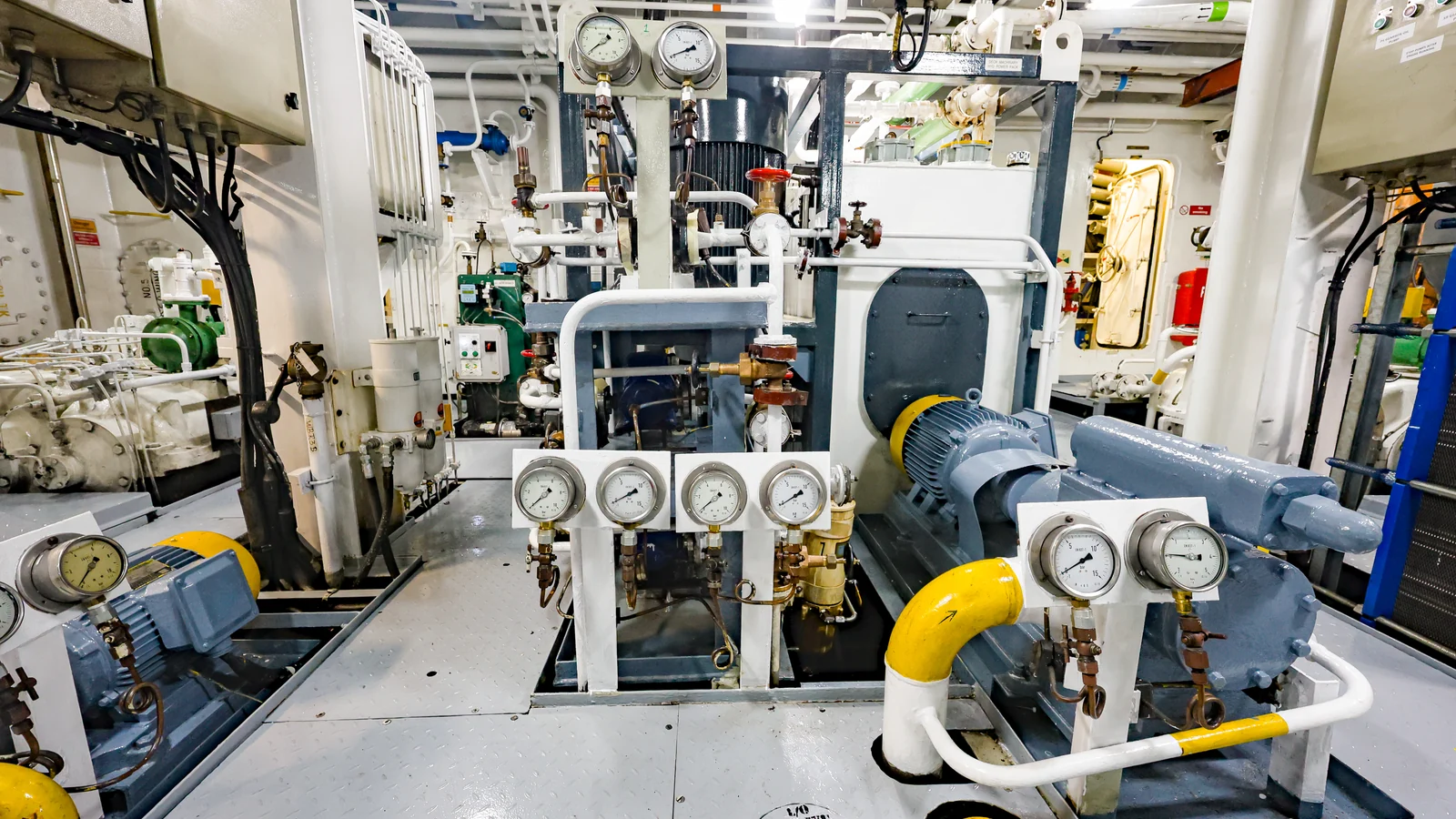
Marine diesel engine & data plate — general arrangement
A licensed photograph of Scania marine engine equipment was not available at publication, so this technical reference illustrates the general arrangement shared by this equipment class.
Illustrative technical reference, not a photograph of Scania equipment or a Vessel Core installed reference — a licensed photo of this maker's equipment was not available. Vessel Core has no dealership, distribution or partnership agreement with Scania CV AB or any other manufacturer named here; it operates as an independent spare parts supplier.
Data-plate details that make a Scania enquiry quotable
The data plate sits on the engine block and is usually the fastest route to a correct match. With the items below an enquiry can be priced in one pass; without them it usually comes back with a clarifying question first. How a plate photograph becomes a priced list is set out on the how we work page.
- Full type code exactly as stamped, including the letter-and-digit suffix
- The letters ahead of the number exactly as stamped (for example D, DS, DSI, DC or DI): they are version letters, not a generation mark, and the same number has carried several of them at once, as with today's DC13 and DI13
- Serial number from the same data plate
- The application letter at the end of the code: every engine in Scania's current marine range ends in M (DI09 074M, DI13 070M, DI16 077M), and a plate reading "Scania-Vabis" points to an engine built before the company dropped that name in 1968
- Application — main propulsion or auxiliary genset —, the vessel type and the cooling arrangement: Scania builds the same marine type code with a heat exchanger or for keel cooling, single or double circuit, so the code alone does not settle the cooling-side parts
- Component position, e.g. cylinder or bank number, for running-gear parts
- A previous order line quoting the same engine serial, where one exists
- Photograph of the data plate and of the part being requested
Tools for this equipment: the Pt100 and thermocouple reader for the temperature sensors, the pressure gauge selector for the engine gauges and the O-ring size finder for loose O-rings. Where the engine drives a generator, the motor speed calculator gives the supply frequency from the engine speed and the number of poles.
Supply route review for Scania marine engine equipment.
A main-propulsion engine and an auxiliary genset drive sharing the same base block do not have interchangeable parts lists. The full type code, the serial and the application get settled before anything else.
Full type code read before quoting
The same base number in Scania's marine range is sold in several suffix-coded variants for different duty profiles, so a request is read against the complete code from the data plate rather than the leading digits alone.
Marine build confirmed, not assumed
Because Scania's marine and industrial engines share their blocks with the company's trucks and buses, a bare engine or casting number is treated as inconclusive until a marine-specific plate or type code confirms the application.
Same displacement name, different engines, kept apart
Scania has reused the same displacement names for different engines: the 9-litre name covers six- and five-cylinder engines, the 11-litre the 1963 engine and the DC11 of 1999, and the 16-litre two V8 generations. An older installation is therefore matched on the full code, serial number and build year, not on the closest current-range name.
Propulsion and genset scopes handled separately
A main-propulsion engine and an auxiliary genset drive built on the same block can call for different parts, so the application named in the enquiry — not just the engine family — decides which list a request is worked against.
Worn or overpainted nameplates, read carefully
On engines old enough to carry a "Scania-Vabis" badge, or any plate that has spent decades in a damp engine room, a careful reading of whatever prefix and digits remain is the starting point, with a photograph of the plate itself the most useful thing a buyer can send.
Estonian company, registered in Tallinn
Vessel Core OÜ trades from Tallinn as an Estonian company, Reg. 17028043, VAT EE102773714. An engine component typically travels as hand-carry with a joining engineer; larger overhaul kits are crated. Supply route, handover option and documentation are confirmed in the quotation.
Scania marine engine parts — questions from the engine room
Which Scania marine engine series come up most often in spare-parts requests?
The current DI09, DI13 and DI16 in-line and V8 ranges lead, fitted for propulsion on workboats, pilot boats, tugs and patrol vessels and as auxiliary engines. Older 9-, 11-, 12- and 14-litre engines in versions such as DS11, DSI11, DC11, DI12, DSI14 and DC9 are still common on vessels that have been in service for decades. Send the full type code exactly as stamped on the engine's data plate together with the serial number and, for an older engine, the build year before a parts list is worked up.
Can a Scania marine engine be identified without a part number?
Often yes. The full type code and serial from the data plate, the application — main propulsion or auxiliary genset — and the vessel type together narrow an enquiry a long way. Because the same base number covers several suffix-coded variants, the complete code matters more than the leading digits alone.
Does a Scania-Vabis badge mean the engine isn't a genuine Scania?
No — it reflects the company's name before its modern Scania branding was adopted, not a different manufacturer. These older units are read the same way as any other Scania engine: the full designation and serial number on the plate are the starting point.
What should a Scania engine spare-parts RFQ contain?
A workable request lists the full type code from the engine's own data plate, the serial number, whether the engine is fitted for main propulsion or as an auxiliary genset drive, and the vessel type it serves. A photograph of the data plate and of the part being requested settles most of the remaining questions in one pass.
Can a Scania truck or bus engine number confirm a marine part?
Not on its own. Scania's marine and industrial engines are built on the same blocks as its trucks and buses, and the same displacement class was sold for road, marine and genset duty with different internals. A bare block or casting number is therefore treated as inconclusive until a marine-specific plate or the full type code confirms the application.
Are D, DC and DI engines of the same size interchangeable?
Not on the strength of the size in the name. Scania has given one displacement name to different engines more than once: the 11-litre name covers the engine in use from 1963, built as the D11, DS11 and DSI11 among other versions, and the DC11 of 1999, a later and different engine rather than another stage of the same block. An older installation is therefore matched by its full type code, serial number and build year rather than the nearest current-range name, so copy the code exactly as it appears on the data plate.
Is Vessel Core connected to Scania?
No, and there is no agreement of any kind. Vessel Core holds no dealership, distribution, representation or partnership agreement with Scania, and quoting a component against one of its designations implies no approval by the maker and no claim of interchangeability.
Send the data plate — the parts list follows from it.
Send the full type code exactly as stamped, the serial number from the data plate, and whether the engine is fitted for main propulsion or as an auxiliary genset drive. Each line is then read back against the type it belongs to before a component reference is fixed against it.
