
Hanshin Engine
Spare Parts Supplier
Hanshin Diesel Works low-speed four-stroke main engines · LH26G · LH28L · LH34L · LH38L · LH41LA · LH46LA · LA28G · LA32G · LA34 · electronically controlled LA32E, LH41LAE and LH46LAE
Hanshin frames a spare parts RFQ can reference
The Hanshin Diesel Works, Ltd. was established in January 1918 as the Hanshin Ironworks, started building diesel engines in 1929, completed its first engine of its own design in 1937 and took its present name in 1944. It is headquartered in Kobe, builds at Akashi, Tamatsu and Harima in Hyogo Prefecture, and is listed in its own right on the Tokyo Stock Exchange. Its core product is a low-speed four-stroke trunk-piston main engine of its own design, built for Japanese domestic coastal vessels running at low and medium load with large load fluctuations, and the count of diesel engines built passed 12,000 in 2023. That is why a Hanshin plate is nearly always the main engine of a Japanese-built coaster, and why the request behind it is usually a propulsion problem rather than a generating-set one.
LH26G, LH28G and LH28L to LH46LA
The core of the range and the frames behind most Hanshin requests. LH26G and LH28G are the two smallest frames and come with the hydraulic reversing gearbox. The long-stroke LH-L series runs LH28L and LC28L, LH34L and LH34LA, LH38L, LH41L and LH41LA, LH46L and LH46LA — the frame number rises with the bore and the rated speed falls as it does, so a part that fits one frame does not fit its neighbour. The maker calls it a long-selling product with over 30 years since release, developed as a main engine for 499 GT class general cargo vessels, tankers and fishing vessels — so the same letters cover three decades of revisions.
LA26G, LA28G, LA30, LA32G and LA34
Developed from the LH and LH-L with a still longer stroke for the same frame sizes, so the engine turns slowly enough to be coupled directly to the propeller shaft without a reduction gearbox, which is the series’ standard specification. The models marked G are supplied with a reversing gearbox. All LA frames use the hydraulic valve driving system, so a valve-gear line here is a different component group from a push-rod LH.
LA32E, LH41LAE, LH46LAE, G30 and LA28M
The E variants — LA32E, LH41LAE and LH46LAE — keep the base engine on its frame but drive the fuel injection pump hydraulically, so injection timing and pressure are set by control rather than by cam profile; Hanshin completed the first electronically controlled low-speed four-stroke engine in 2015. An E plate therefore adds a control and hydraulic group that has no counterpart on the mechanical engine of the same frame. The G30 gas engine and the LA28M methanol engine each carry a fuel system with no diesel counterpart at all, so neither can be quoted from a diesel part book.
LU, LUN, LUD, LUS, EL and ELS · MX · L35MC and S35MC
Vessels still trading carry earlier Hanshin plates — 6LU32, 6LU35, 6LU38, 6LU46A, 6LU54, 6LUN28, 6LUD26G, 6EL32, 6EL40, 6EL44 with their S variants, and the LH31 — none of which appear in the current catalogue, and none of which should be quoted from a current LH or LA part book. Separately, the MX series is a geared medium-speed engine — 6MX28 and 8MX28 — built for fishing vessels, tugs and ferries, and the L35MC6 and S35MC7 are two-stroke crosshead engines built in cooperation with Kawasaki Heavy Industries, a tie-up dating from 1986; those follow the MAN B&W MC parts route, not the Hanshin four-stroke one.
Component groups quoted on Hanshin engines
A Hanshin low-speed four-stroke is quoted across the running gear, the cylinder cover and valve gear, the injection side, starting and control, and the pumps and coolers that keep it alive. Long strokes mean heavy liners and pistons, so weight and crating belong to the review from the first line rather than after the price.
- Cylinder covers, complete or as reconditioning sets
- Inlet and exhaust valves, valve seats, guides and rotators
- Hydraulic valve driving components, or push rods and rocker gear, by the arrangement fitted
- Cylinder liners
- Pistons, piston crowns, skirts and ring sets
- Gudgeon pins and small-end bushes
- Connecting-rod bearing shells and main bearing shells, with the undersize stated
- Camshaft sections, cams, rollers and tappets
- Fuel injection pumps, plungers, barrels and delivery valves, and the hydraulically operated pump units on E-variants
- Fuel valves, nozzles and high-pressure pipes
- Starting air valves, the starting air distributor and its control components
- Governor and actuator components, and speed pick-ups
- Attached lube oil and cooling-water pumps
- Lube oil and charge-air coolers, thermostatic valves and filter elements
- Gaskets, O-rings, seal rings and complete seal kits
- Top-overhaul kits and full overhaul kits, matched to the running hours
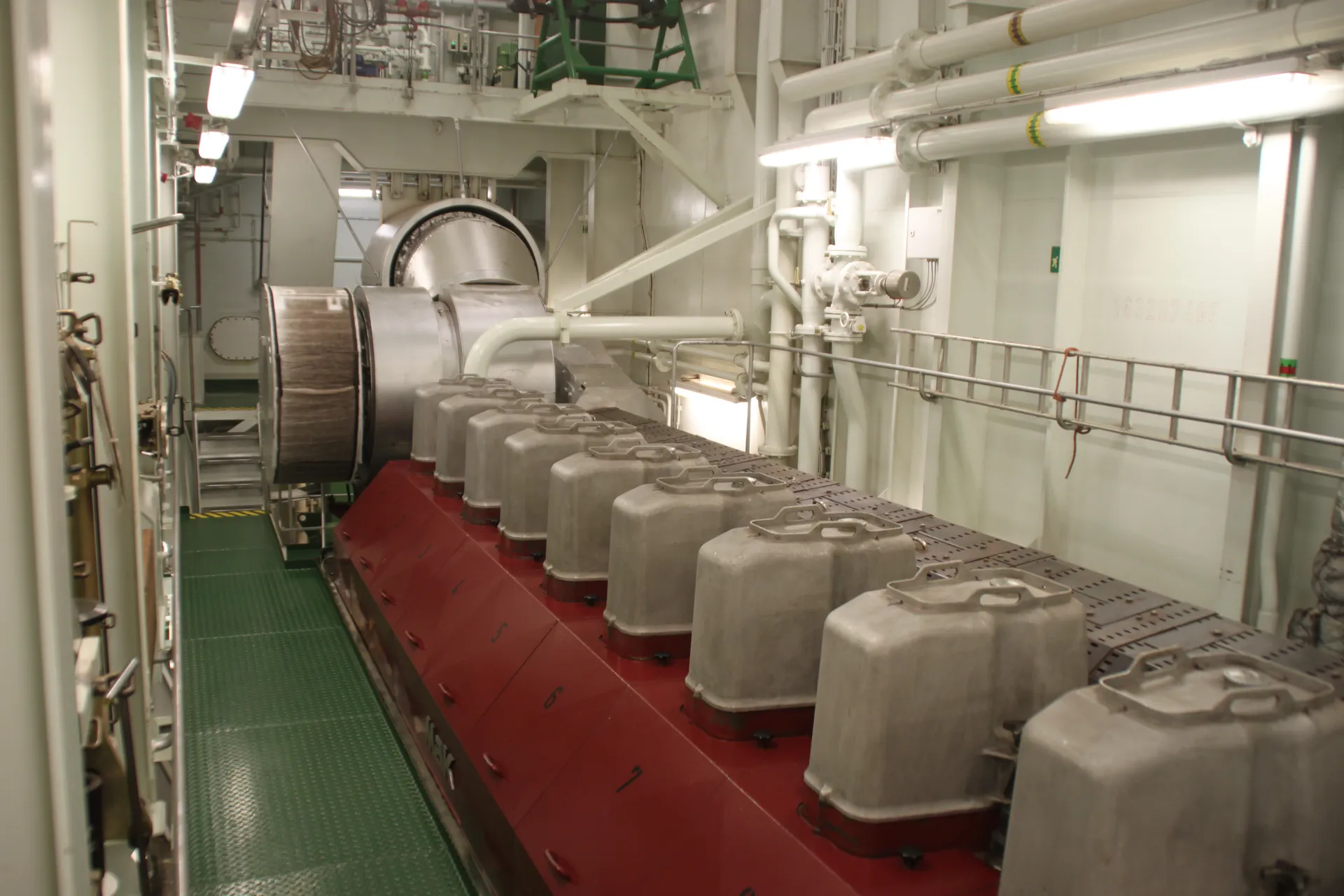
Low-speed four-stroke engine — general arrangement
A licensed photograph of Hanshin equipment was not available at publication, so this technical reference illustrates the general arrangement shared by this equipment class.
Illustrative technical reference, not a photograph of Hanshin Diesel Works equipment or a Vessel Core installed reference — a licensed photo of this maker’s equipment was not available. Vessel Core has no dealership, distribution, representation or partnership agreement with The Hanshin Diesel Works, Ltd.; it operates as an independent spare parts supplier.
The plate data that makes a Hanshin line quotable
An LH-L plate can be thirty years old, an LU plate older still, and component revisions move within a frame. The serial number and build year separate one revision from another, which is why they do more work in review than the type designation on its own.
- Engine type exactly as stamped, with the cylinder count and every suffix letter — 6LH41LA, 6LA34G, 6LH46LAE, 6LU35
- Engine serial number and build year from the nameplate
- Rated output and speed shown on the plate
- Valve gear fitted on an LH38L, LH41L or LH46L: hydraulic valve driving or push rod
- Whether a hydraulic reversing gearbox (G) is fitted, and its own plate where the line concerns it
- Turbocharger make and designation from its own plate, if the line concerns the turbocharger
- Governor or actuator make and type, if the line concerns speed control
- Fuel: on a G30 gas or LA28M methanol unit, or an E-variant, say so — the injection side is not the diesel one
- Part-book page and item number where held, treated as a starting point rather than a conclusion
- Running hours since the last top overhaul or full overhaul
- Photographs of the engine nameplate and of the component in place
How a Hanshin engine RFQ is handled.
A Hanshin line is worked from the plate outwards — type with every suffix and the serial number first, then which generation the engine belongs to, then whether the item sits on the engine at all or on the turbocharger, the gearbox or the propeller. Where an old part number exists it is treated as a clue, not as the answer.
Three generations under similar numbers
An LU35, an LH34L and an LA34 are three different engines whose designations sit close together. A line is placed in its generation before it is priced, so a liner for an LU plate is not quoted from an LH-L drawing, and an LH-L part is not offered against an LA.
Which Hanshin lines survive an alternative route
Bearing shells, ring sets, valves, seals and filter elements are where a verified alternative is usually worth reviewing on price and availability. Cylinder covers, liners, injection equipment, anything on the hydraulic injection side of an E-variant and anything going into a class-surveyed repair normally stay on the OEM route. Where the two routes are not equivalent on a line, the difference is stated rather than smoothed over.
A stopped main engine is read first
A Hanshin plate is nearly always the main engine, and a coaster with its main engine down is off its schedule from the first hour. Those lines are separated from the scheduled overhaul list so the urgent item is not held behind a full top-overhaul kit that is being priced at the same time.
Frames listed here are RFQ context
The Hanshin frames and variants on this page describe the equipment a request may concern. They do not imply holdings, interchangeability between frames or generations, or any status with the manufacturer.
Handover reviewed against the port call
A cylinder liner off one of the larger frames is a weight and crating item before it is a catalogue item. Dimensions, weight and whether the berth can take the delivery are checked against the port call and ETA before a handover point is written down. Nothing about the date is treated as settled until it is in the quotation.
EU-registered counterparty
A main-engine overhaul kit is an order most purchasing departments want the counterparty checked against before it is raised. Estonian registry 17028043 and VAT EE102773714 are open entries, and the buyer-verification page carries the documents a vetting request usually asks for.
What buyers ask before sending a Hanshin list
What is Hanshin Diesel Works, and where are its engines fitted?
The Hanshin Diesel Works, Ltd. is a Japanese engine builder established in January 1918 as the Hanshin Ironworks, renamed in 1944, headquartered in Kobe with factories at Akashi, Tamatsu and Harima in Hyogo Prefecture, and listed in its own right on the Tokyo Stock Exchange under code 6018. Its core product is a low-speed four-stroke trunk-piston main engine of its own design, for domestic coastal vessels running at low and medium load with large load fluctuations; the LH series was developed as a main engine for 499 GT class general cargo vessels, tankers and fishing vessels. The count of engines built passed 12,000 in 2023. The company also builds geared medium-speed MX engines for fishing vessels, tugs and ferries, and L35MC and S35MC two-stroke engines in cooperation with Kawasaki Heavy Industries.
How do you read a Hanshin designation such as 6LH41LA?
The leading digit is the cylinder count — every current Hanshin low-speed four-stroke frame is a six-cylinder in-line engine. The letters are the family, LH or LA, and the frame number is the bore in centimetres, so read the exact figure off the plate rather than from the name. An L after the frame number marks the long-stroke LH-L series, which the maker reads as Low-speed, High-efficiency, Long stroke. A following A is the higher-rated build of the same frame in the maker's table, so LH41LA and LH41L are not interchangeable on every line. A G means the engine is supplied with a hydraulic reversing gearbox, and an E marks the electronically controlled variant with hydraulically operated fuel injection pumps, as in LH41LAE. Copy the whole string, suffixes included: the A and the E change the parts list.
Which Hanshin series is which, and what separates them?
LH26G and LH28G are the smallest frames and come with the hydraulic reversing gearbox. The long-stroke LH-L series sits above them and runs from LH28L up to LH46LA: the frame number rises with the bore, the rated speed falls as it does, and the A suffix marks the higher-rated build of the same frame. The LA series took the long stroke further and turns slowly enough to be coupled directly to the propeller shaft without a reduction gearbox, which is its standard specification, and it uses hydraulic valve driving where an LH may use push rods. The practical split is therefore gearbox against direct drive, push-rod against hydraulic valve gear, and mechanical against electronically controlled injection. The rating that matters for a spare part is the one on the plate, and an older LU or EL plate with a similar number is a different engine with its own part book.
What does a Hanshin RFQ need beyond the engine type?
Four things are missed most often. First, the engine serial number and build year: the LH-L series has been sold for over 30 years and component revisions move within a frame. Second, the valve gear on an LH38L, LH41L or LH46L, which the maker supplies with either a hydraulic valve driving system or the conventional push-rod arrangement — two different component groups. Third, the suffixes: G for the hydraulic reversing gearbox and E for the electronically controlled injection each add a component group of their own. Fourth, the turbocharger, which is a separate make with its own plate; a nozzle ring or a bearing cannot be quoted from the engine designation. On an older LU or EL plate, an overhaul report and a photograph of the part usually do more than the type alone.
Why the maker name appears on this page
Maker names help identify equipment and prepare an RFQ. They do not imply any dealership, distribution, representation or partnership agreement between Vessel Core and the manufacturers named on this page; there is none. The Hanshin Diesel Works, Ltd. and the LH, LA, LU and EL designations are referenced solely so that a buyer can describe the engine on board and the component required.
Send the plate, then the list.
Give the engine type with every suffix letter and the cylinder count, the engine serial number and build year, the rated output and speed, and the components concerned — cylinder cover, liner, piston and rings, bearing shells with the undersize, injection equipment, valve gear, starting air or seals — plus the port and ETA. Where the line sits on the turbocharger, the reversing gearbox or the propeller instead, send that plate too. The type, serial and generation are read back to you before anything is priced, so a line written as “piston ring” does not come back quoted as one ring when the engine needs a set per cylinder.

