
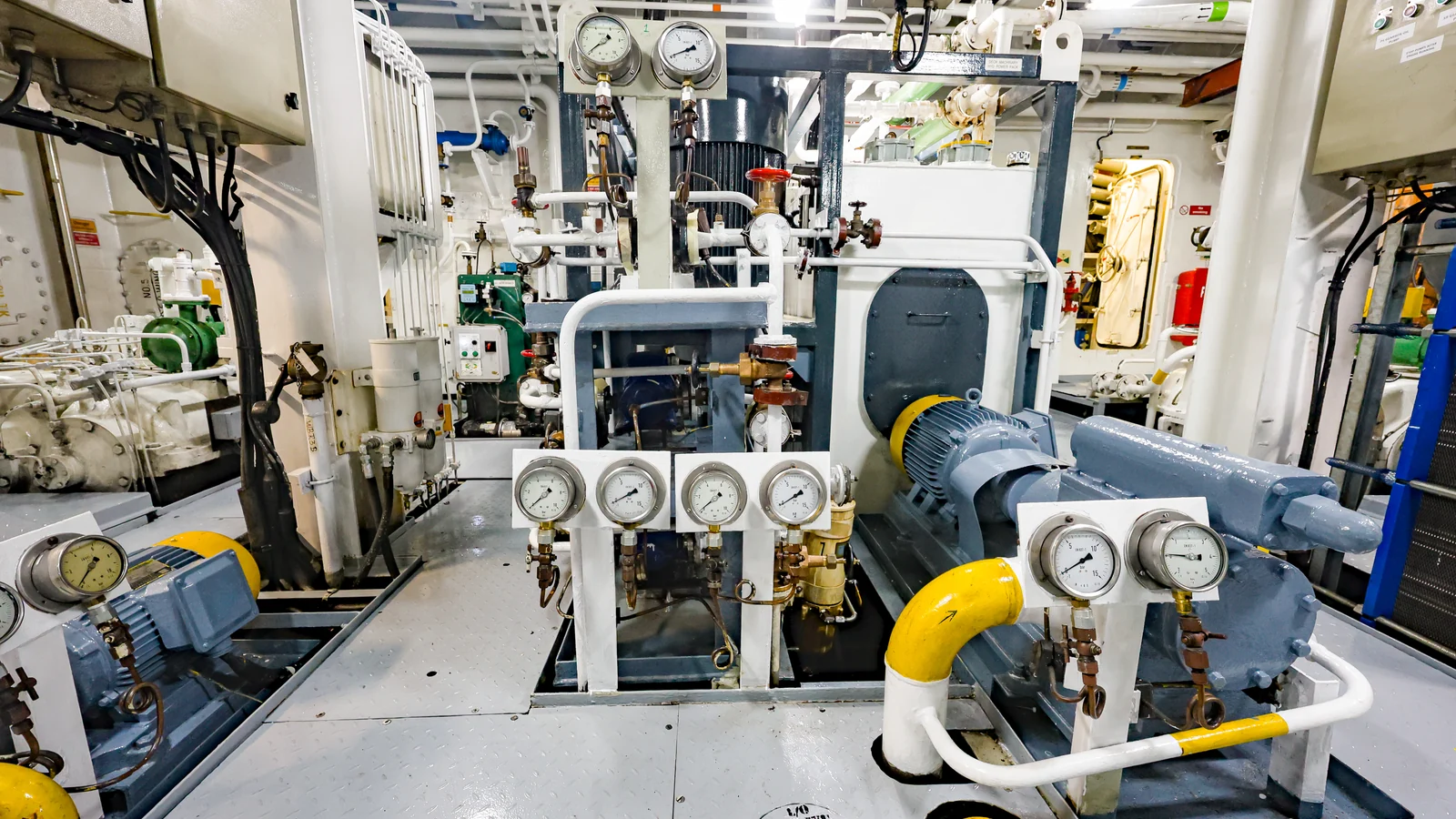
MAN L21/31 GenSet
Spare Parts Supplier
The L21/31 is a medium-speed generating-set engine from the Holeby programme of MAN B&W, now Everllence, run as auxiliary power and as the main power source on diesel-electric ships. It has been offered as an original build, a Mk2, a part-load optimised Mk2 and a methanol dual-fuel derivative, and parts are quoted against whichever of them is on your plate.
The L21/31 builds, and the two sisters it gets confused with
Four cards follow the L21/31 from its first build to the methanol version; the last two place it between the smaller and the larger engine of the same GenSet range. The MAN engine overview covers the programme from two-stroke main engines downwards, while this page stays inside one bore class.
L21/31
The original build. Trade press reported the first L21/31 contracts in the early 2000s, when MAN B&W put the new design on the market as a marine auxiliary, and within a few years the type was also ordered as the main power source of diesel-electric ships, written on the contract as 9L21/31 Holeby gensets. A plate that shows nothing after the pair is not read as a later build until the engine number confirms it.
L21/31 Mk2
The build the maker catalogues today, under the Everllence name, as its GenSet for heavy fuel and biofuel auxiliary power. A recent order fits it as the generating sets of a polar expedition ship, built at the maker's plant in India. Write Mk2 on every line: a part drawn for the first build is not taken to suit this one without the engine number behind it.
L21/31 Mk2 PLO
PLO stands for part-load optimised, the maker's Mk2 version tuned for lower fuel consumption at part load. Sets ordered this way are also delivered methanol-ready, with a later conversion foreseen. PLO belongs in the request whenever the plate or the engine documents carry it, because it is part of how the engine was built.
L21/31DF-M
The methanol GenSet, built on the L21/31 Mk2 and adding methanol through port fuel injection while keeping conventional fuels available. Methanol injectors and the methanol supply hardware have no counterpart on a diesel-only set, so a DF-M is quoted against its own documents even where the base engine looks familiar.
L16/24
The smaller sister, on the market since the 1990s and found in the same engine rooms, for instance as the harbour set running in parallel with L21/31 main sets. Both types share a maker and a programme name and nothing in the cylinder unit, so every line names its own type rather than the plant as a whole.
L27/38
The larger sister, whose first orders were generating sets for container ships, and which the maker still lists as a heavy fuel and biofuel GenSet. On a mixed plant the 27/38 book and the 21/31 book stay apart; this card is here so that a line copied from the wrong engine is caught before it is priced.
Holeby on the paperwork, another works on the plate
Where an L21/31 was built affects which records the engine number opens. The name on old documents and the name on a newer plate are often not the same.
Holeby is a Danish town whose engine works supplied Burmeister & Wain with diesel generators in the 1920s and was bought by B&W in 1930, becoming its centre for four-stroke engines. After MAN took over the B&W engine business in 1980, generating sets from there went out under the MAN B&W Holeby name, and early L21/31 orders were written that way.
Engine production at Holeby was phased out in the mid-2000s and concentrated in Frederikshavn, while Holeby stayed on as a GenSet competence centre for sales, engineering and customer support. Later L21/31 sets therefore come from other works: the maker's plant at Aurangabad in India assembles and tests the type, and licensees build it as well, CSSC Marine Power in China among them. On old paperwork Holeby names the programme; the builder on the plate is who the engine number belongs to.
The fuel is the other moving part. The maker positions the Mk2 for heavy fuel and biofuel, recent sets are specified for distillates, HVO and FAME too, and the newest leave the yard methanol-ready. Tell us what the engine burns today rather than what it was delivered for, because injection equipment and filters are ordered for the service the set is actually in.
Parts asked for against an L21/31 plate
Grouped as an engine room would order them for a planned overhaul carried out by the crew or a service company of the owner's choice: cylinder unit, running gear, fuel side, then the systems hung on the engine.
- Cylinder heads with inlet and exhaust valves, seat rings and valve rotators
- Cylinder liners and their sealing rings
- Pistons, piston ring sets and gudgeon pins
- Connecting rods, rod bolts, big-end and small-end bearings
- Main bearing shells and thrust washers
- Camshaft parts, cam followers, push rods and rocker arms
- Fuel injection pumps, pump elements and delivery valves
- Fuel injectors, nozzles and high-pressure pipes
- Methanol injectors and supply-side items on DF-M sets
- Lubricating oil and fuel filter elements
- Lubricating oil and cooling water pump parts
- Charge air cooler elements and their gaskets
- Turbocharger cartridges and wear parts, identified from the turbocharger's own plate
- Starting air valves and starting equipment
- Resilient mounts and flexible coupling elements
- Gasket, O-ring and seal kits for planned overhauls
What settles an L21/31 line
The plate gives the type and the number; the rest comes from the engine documents and from the plates of the equipment bolted to the set. The RFQ evidence guide explains how to photograph each.
- Type exactly as stamped, with the cylinder count first and every suffix after the pair: Mk2, PLO or DF-M
- Engine number and the builder named on the plate, whether MAN B&W Holeby, MAN, Everllence or a licensee
- Year of build, which places the set before or after engine production left Holeby
- Duty: auxiliary set, harbour set, or main power on a diesel-electric ship
- Fuel burned in service today: heavy fuel, distillate, a biofuel blend or methanol
- Part number together with the part-book page it was taken from
- Cylinder number for any cylinder-unit or running-gear item, and the undersize of bearing shells already fitted
- Turbocharger make and type read from its own plate
- Alternator make and type for anything at or past the coupling
- Photographs of the engine plate, the part in place and any marking on the part itself
One type, read in full before anything is priced
The answer to an L21/31 enquiry is built from the plate outwards, and the route for each line is written down rather than assumed.
Suffix first
The type is answered together with its suffix, never as a family name. Where the plate is missing or painted over, the engine number and the part-book page carry the identification, and the quote says so.
Builder before part number
A set from Holeby, from the maker's Indian plant or from a licensee is matched against the records of the works that built it, so the builder named on the plate is read before any part number is relied on.
Route written per line
Liners, rings, bearing shells, valves, seals and filter elements can be reviewed on a verified alternative where your approval rules allow, with dimensional and material records attached. Injection equipment, DF-M methanol items, turbocharger internals and control hardware stay on an OEM-route review. The OEM or verified alternative comparison sets out the evidence each needs.
Parts only
Vessel Core identifies and supplies spare parts. The work on the engine stays with your crew or the service company you choose, and nothing on this page offers it.
MAN L21/31 parts: common questions
What does 21/31 in the type stand for?
It is the type's bore-and-stroke pair, written the way MAN names its four-stroke engines, with L in front for the in-line arrangement. Treat it as a name. Liners, pistons and rings are identified from the engine number and the part book, never from the figures in the type.
My plate reads L21/31 with nothing after it. Is that a Mk2?
Not until the engine number says so. The maker catalogues the Mk2, the part-load optimised Mk2 and the methanol DF-M side by side, and the original build sits behind all three. Send the plate photograph, the engine number and the year of build, and the build is confirmed before a line is priced.
Do parts for a diesel L21/31 suit an L21/31DF-M?
The DF-M is built on the L21/31 Mk2, so part of the base engine is common ground, but the methanol side is new and the engine number decides which base-engine items match. Each line is identified against the DF-M's own documents rather than offered on the assumption that a diesel-set part will do.
Why does the builder on the plate matter?
Because the type has been built in more than one place. Engine production left Holeby in the mid-2000s, later sets come from the maker's Aurangabad plant or from licensees such as CSSC Marine Power, and the engine number is keyed to the records of the works that built it.
Do you overhaul or service L21/31 engines?
No. Vessel Core identifies and supplies spare parts only, for work your crew or your chosen service company carries out. Send the parts list through the RFQ form and each line comes back with its route stated.
Is Vessel Core connected to MAN?
No, and there is no agreement of any kind. Vessel Core holds no distribution, representation or partnership agreement with MAN, and quoting a component against one of its designations implies no approval by the maker and no claim of interchangeability.
Send the L21/31 plate and the part-book page
A photograph of the engine plate, the engine number and the page the part was taken from are enough to begin. Use the RFQ form; each line is read back with its build and route before a price is attached.
