
KBB Turbocharger
Spare Parts Supplier
Radial machines on medium-speed engines · ST · HPR · legacy R
Radial KBB machines — a different wear scope from the axial families
Kompressorenbau Bannewitz builds exhaust gas turbochargers with both radial and axial turbines in Germany, and they are fitted in large numbers to medium-speed auxiliary sets and to main engines. This page covers the radial families — ST, HPR and legacy R; the axial M-series and the K2B two-stage product are handled through the same RFQ route. The reason the distinction matters at request stage is mechanical, not commercial: the way a radial machine is put together decides which items are consumable, which are life-limited, and which cannot be renewed on their own at all.
One-piece turbine wheel
Exhaust gas enters the wheel radially at its periphery through the gas inlet casing and nozzle ring, turns, and discharges axially through the exducer at the wheel eye. The wheel is a single nickel-alloy casting joined to the shaft, so a bent or eroded blade is not an individual blade order — it moves the request to a shaft assembly or a cartridge.
Radial compressor wheel
The aluminium compressor wheel is a life-limited item on many KBB installations, counted in running hours rather than replaced on condition. Bore and back-face fatigue, plus foreign-object damage drawn through a tired filter silencer, are the usual reasons a wheel comes off before its hour limit.
Bearing bushes and thrust bearing
Radial bearing bushes run in the bearing casing on engine lube oil, with an axial thrust bearing taking the pressure difference across the rotor. Clearance growth here typically shows up as rising vibration and noise, increased oil throughput, and — once rotor position degrades enough to allow rubbing — loss of charge air pressure. Report rotor axial and radial clearance readings with the RFQ.
Sealing bushes at both ends
Sealing bushes separate the oil space from the gas and air sides. When they wear, oil migrates towards the compressor casing or into the exhaust — oily charge air, deposits in the cooler, or a smoking uptake are the symptoms an engineer reports before the parts list is written.
Casings, nozzle rings and shroud rings
The gas inlet casing carries a turbine nozzle ring that sets the flow geometry into the wheel, with a separate shroud ring protecting the casing itself. Thermal cycling on heavy fuel distorts and cracks these parts, and deposits on the nozzle ring reduce effective turbine area, which drives turbocharger speed and charge air pressure up and shifts exhaust temperatures across the engine.
Filter silencer and oil supply
The filter silencer element is the simplest part on the machine to renew and the one most often left too long; a blocked mat raises exhaust temperatures across every cylinder. Oil inlet fittings, restrictors and screens belong in the same RFQ, because bearing life follows oil condition.
KBB designations seen on marine nameplates
KBB machines reach vessels through the engine builder, so the unit on board may be catalogued under the engine maker's own reference as well as the KBB designation. Both are useful in an RFQ; neither replaces the nameplate.
ST frames — the principal radial family
ST-series machines, including the current ST27 and ST27-EP, are KBB's principal radial family, covering roughly 500–6,000 kW per unit on medium-speed auxiliary sets and main engines. Typical items are cartridges, shaft assemblies, plain bearings, sealing bushes, nozzle rings and filter silencer elements.
HPR frames — the earlier radial generation
HPR designations are the family letters plus a size number, for example HPR3000 through HPR6000, covering roughly 500–3,000 kW per unit — the duty band the later ST generation went on to cover at higher pressure ratio. ST designations may additionally carry a variant suffix. Either way it is the specification number on the plate, not the designation, that defines the build.
Legacy R-series
Older R-series machines are still running on long-lived medium-speed installations, and they use a water-cooled bearing housing, so cooling-side parts belong in the same request. These requests usually need more evidence than current frames — plate photographs, a component photograph and the engine type, because the printed spares documentation on board is often the only remaining reference.
Cartridge group requests
A cartridge group carries the rotor, bearing casing, bearing bushes and sealing bushes as one balanced assembly. State in the RFQ whether the vessel plans an exchange overhaul or a component-level rebuild, because the two produce completely different item lists.
Nozzle ring and diffuser variants
Turbine nozzle rings and compressor-side diffusers exist in more than one variant per frame, and the specification number is what separates them. A part that bolts up correctly can still shift the matching of the engine, so the matching reference from the technical file belongs in the RFQ next to the designation.
Auxiliary and main engine fits
The same frame size behaves differently on a constant-speed generator set and on a variable-load propulsion engine. Tell us the duty, the fuel in use and the hours since the last overhaul — it changes which wear items are worth reviewing together.
What comes off a KBB machine at overhaul
Listed in the order the machine strips: the rotating group first, then the bearing and sealing parts that come out with it, then the casings and intake items that are only worth touching while the unit is already open.
- Cartridge group, balanced and handled as one unit
- Turbine wheel joined to its shaft as a rotor assembly
- Compressor wheel with shaft nut and clamping sleeve
- Radial plain bearing bushes running on engine lube oil
- Axial thrust bearing and thrust collar for the radial rotor
- Sealing bush set, gas end and air end
- Turbine nozzle rings, uncoated or coated for heavy fuel duty
- Shroud rings protecting the gas casing behind the wheel
- Gas inlet casing and gas outlet casing for radial flow
- Compressor casing with diffuser and compressor-side insert
- Bearing casing with oil inlet flange and restrictor
- Filter silencer mat and silencer insert for the intake
- Cooling water connections, gaskets and plugs for water-cooled legacy R-series casings
- Overhaul gasket set to KBB cartridge scope
- Mounting studs, nuts and locking plates at the engine flange
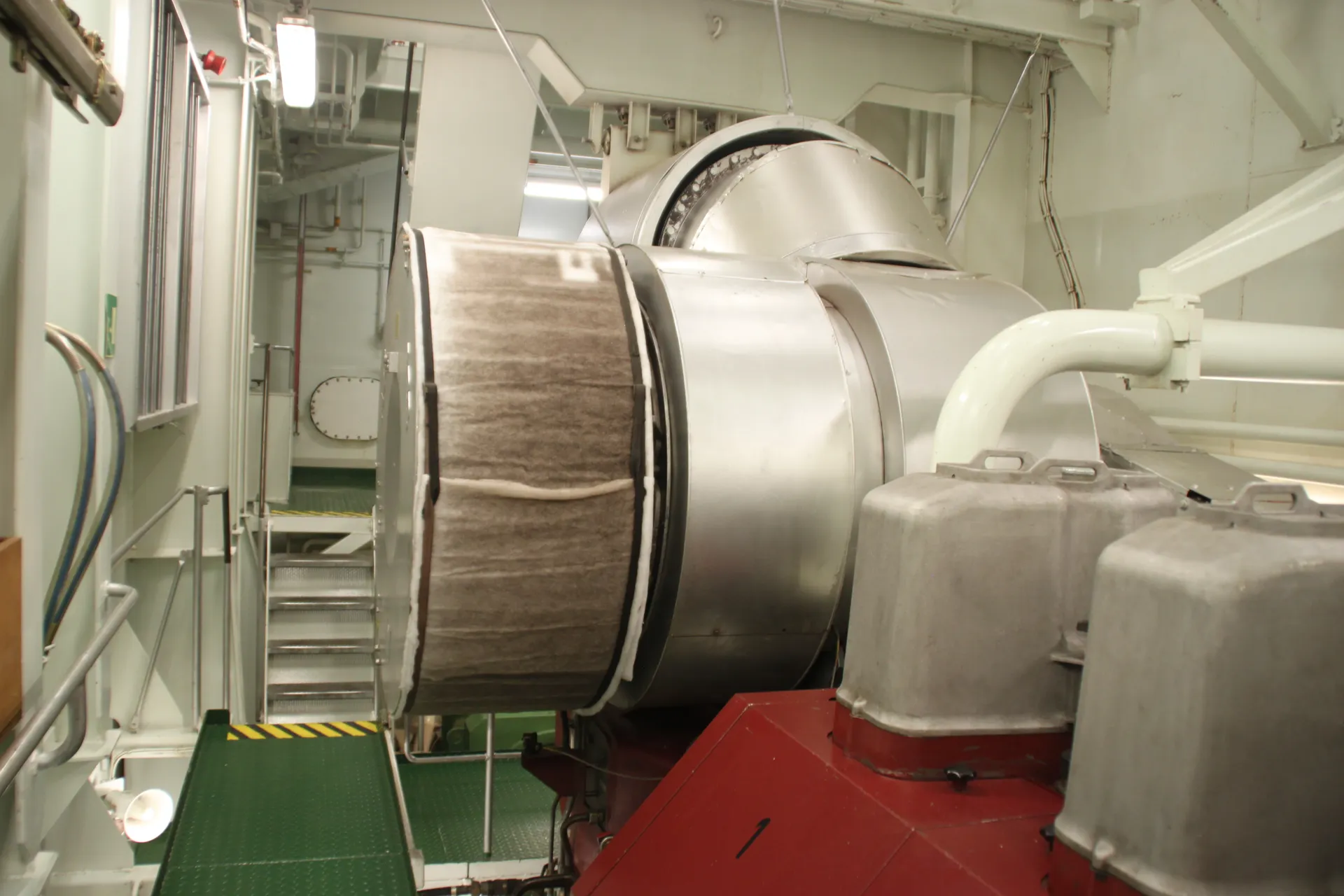
Marine turbocharger — general arrangement
A licensed photograph of KBB equipment was not available at publication, so this technical reference illustrates the general arrangement shared by this equipment class.
Illustrative technical reference, not a photograph of KBB equipment or a Vessel Core installed reference — a licensed photo of this maker's equipment was not available. Vessel Core has no dealership, distribution or partnership agreement with KBB; it operates as an independent spare parts supplier.
Reading the plate before writing the request
Most delays on KBB requests come from a designation without a specification number, or a serial without the engine it belongs to. Five pieces of evidence normally settle the identification.
Type, spec. and serial from the rating plate
Three fields decide the build: the type — an HPR or ST27 designation, for instance — the specification number, and the works serial. Family letters on their own cover several physically different machines, and it is the spec number that fixes the nozzle ring, the diffuser and the compressor-side build.
What to send when the plate is unreadable
Where the plate is painted over or corroded away, photographs of the bearing casing and gas casing markings are accepted as a starting point, together with whatever the engine builder's own documentation calls the unit.
Engine maker and engine type
KBB units are supplied to engine builders, so the engine type and the builder's own turbocharger reference often unlock a part that the KBB designation alone does not resolve.
Matching data
Nozzle ring and compressor-side references from the technical file. If the engine has been re-matched after a conversion or a fuel change, say so — the original spares list may no longer describe the machine on board.
Running hours and last overhaul
Hours since the last cartridge change decide whether a single bearing bush is sensible or whether the whole rotating group should be reviewed in the same request.
Photographs of the failed part
A photograph of the damaged wheel, bush or nozzle ring frequently identifies the item faster than a partial number copied from a worn label. Send it with the RFQ rather than after the first reply.
Where KBB requests actually get stuck.
On a KBB unit the hard question is rarely which supplier — it is which assembly level. A worn sealing bush and a cracked nozzle ring reach us as the same complaint from the engine room, and only the strip-down separates them. Both the cartridge and the loose-component route are worked up from the same evidence set, so the chief can put the two options to the superintendent in one message rather than waiting for a second review.
What the strip-down report has to carry
Rotor axial and radial clearance readings, the condition of both wheels, and whether the gas casing is cracked at the nozzle ring seat. Those three observations separate a bush-and-seal repair from a rotating-group renewal.
Why the rotating group stays on the OEM route
Anything that turns at speed — wheel, shaft assembly, complete cartridge — is balanced as an assembly and carries the documentation that goes with it, which is the reason the OEM route survives scrutiny on class-surveyed work. Silencer mats, O-rings, studs and locking plates carry no such record and are routinely reviewed on the verified alternative route. Nozzle rings sit between the two and are decided job by job, because the wrong ring quietly changes turbine area.
Identification without a part number
Type, specification number, serial and a component description are enough to open the review. Read more about preparing an RFQ when the spares book reference is missing or the plate is unreadable.
Cartridge crating and core return
A cartridge group travels as one balanced, crated assembly and a loose bearing bush does not, so the handover is planned per item rather than per request. Tell us whether the machine stays on the engine while the rotor travels, and whether the yard wants the old cartridge collected. Crate dimensions, the documentation that has to travel with a rotating assembly, and the return leg for the core are settled before a quotation is issued.
The plate settles what the order does not
Two machines can share family letters and frame size and still take different wheels, because the specification number carries the change — and on the ST family a variant suffix as well. Read both off the plate rather than off the purchase order, which is usually a generation behind. Where the plate is gone, the engine builder's own turbocharger reference is the next best key.
Filter and oil-side items reviewed with the rotor
A bearing bush ordered on its own, with the silencer mat and the oil restrictor left alone, buys the vessel a second failure at the next survey. Intake and oil-supply wear items are added to the same review as the rotating group, so the engineer receives one list instead of three separate requests spread over a year.
Questions engineers ask during a KBB strip-down
What does the balancing documentation on a KBB rotating assembly do for a class survey?
A wheel, a shaft assembly or a complete cartridge is balanced as an assembly, and the paperwork identifying that assembly is what a surveyor looks for once a rotor has been renewed or repaired. Ask for it to travel with the part rather than to follow it. Where it is absent, the yard is normally asked to balance and document the rotor again before the machine returns to service, which is the practical reason the rotating group tends to stay on the OEM route while mats, seals and fasteners do not.
The vessel only holds the engine builder's part number, not a KBB reference. Is that enough to start?
Yes, it is enough to open the review. KBB machines are delivered inside an engine builder's package and are usually catalogued against that builder's numbers, so a chief engineer often has no KBB paperwork on board at all. Send the builder's number together with the engine type and a photograph of the turbocharger rating plate; the type, specification number and works serial then resolve the request to a specific component.
The engine was re-matched after a fuel change. Does the old spares list still apply?
Often not. Re-matching changes the turbine nozzle ring and sometimes the compressor-side build, while the type designation stamped on the plate does not change with it. Say in the RFQ that the unit has been re-matched, give the date or the yard period, and send the current matching data from the technical file. Working from a spares list written before the conversion is the most common way a correct-looking part turns out to be the wrong one.
Are KBB M-series axial and K2B two-stage units handled through this route as well?
Yes. KBB builds turbochargers with both radial and axial turbines, and the K2B two-stage product sits alongside them. This page describes the radial families because their wear scope and overhaul kit content differ item for item from an axial machine. The identification data required is the same in every case: type, specification number and works serial from the rating plate, plus the engine maker and engine type.
How the KBB name is used on this page
KBB machines almost never arrive on board under KBB's own paperwork — they arrive inside an engine builder's delivery, catalogued against that builder's part numbers, which is why this page names both. Maker names help identify equipment and prepare an RFQ. They do not imply that Vessel Core is an authorised dealer, representative or partner of Kompressorenbau Bannewitz or of any engine builder that fits its machines. Kompressorenbau Bannewitz is named here only as the manufacturer of the equipment a buyer may need identified, and designations listed on this page do not imply stock, compatibility or authorised dealer status. See the full maker reference index for the same framing across the site.
Send the plate photograph with the request.
The KBB requests that need the fewest follow-up questions arrive with three attachments — the nameplate, the worn component, and the spares-book page if the vessel still holds one. Add the engine type, the duty the set actually runs at, and the hours since the last cartridge change. What comes back is a cartridge-versus-component comparison, not a single line item.

