
Mitsubishi MET Turbocharger
Spare Parts Supplier
Axial machines on two-stroke main engines · MET-MB and MET-MBII · MET-MA · MET-SD and MET-SE still in service · MET33–MET90 frames
MET generations a turbocharger RFQ can reference
MET is the turbocharger line of Mitsubishi Heavy Industries Marine Machinery & Equipment Co., Ltd. Axial-turbine production began in 1960, the first uncooled MET followed in 1965, and by 2017 more than 30,000 units had been delivered. Sixty years of production is the reason a MET request needs the series suffix as well as the frame number: machines from four different generations are trading at the same time, and they do not share a parts route.
Current axial machines for two-stroke engines
MET-MB was developed in 2008, first delivered in 2011, and now runs to ten frame sizes — MET33MB, MET37MB, MET42MB, MET48MB, MET53MB, MET60MB, MET66MB, MET71MB, MET83MB and MET90MB. MET-MBII was announced in 2018 as a smaller, lighter machine with roughly 16 per cent more air flow than MET-MB. The MB family is applicable across all three two-stroke engine brands: J-ENG, MAN Energy Solutions and WinGD.
The high-efficiency generation MET-MB replaced
MET-MA was the high-efficiency axial generation developed for large-bore engines and turbo-compound arrangements, with a three-dimensional curved turbine blade. It carries the same frame ladder with the MA suffix — MET33MA, MET42MA, MET53MA, MET60MA, MET66MA, MET71MA, MET83MA and MET90MA. MA plates are still common on vessels built before the MB changeover.
Earlier axial generations still in service
Before MET-MA came MET-SB and MET-SBII, then MET-SC, then MET-SD from 1990, then MET-SE from 1995 and MET-SEII from 2000. All are axial machines and all are still found on trading vessels. The impeller and blading design changed across these generations — compressor wheels went from two-piece to backward-swept two-piece, then to one-body impellers and one-body impellers with split blades, while turbine blading went from damping-wire designs to free-standing blades — so a part identified only by frame number can land in the wrong generation.
Radial machines for four-stroke duty
Alongside the axial line, MHI-MME builds radial-flow turbochargers for four-stroke main and generator engines: the MET-SRC series, and the MET-ER series launched in 2018 together with MET-MBII. A radial machine on an auxiliary engine and an axial machine on the main engine can both carry MET on the plate while sharing nothing in the parts book.
Component groups quoted on MET machines
A MET unit is quoted across the rotating assembly, the hot gas path, the air path, the oil supply that keeps the bearings alive, and the cleaning arrangement that keeps both paths from fouling. A request grouped that way stays readable when one docking covers a main engine turbocharger and an auxiliary machine on different overhaul records.
- Rotor shaft assemblies, balanced as one unit
- Turbine (gas) casings and gas outlet casings
- Blower (compressor) casings
- Bearing casings
- Nozzle rings — full rings and vane segment repairs
- Journal bearings, turbine-end and blower-end
- Thrust bearings and axial-location hardware
- Seal rings, seal air arrangements and labyrinth seals
- Heat shields and casing insulation
- Compressor impellers matched to the frame build record
- Diffusers for the compressor air path
- Turbine blades and blade sets, with the blade damping arrangement where the build has one
- Lube oil pumps, sight glasses and oil system components on self-lubricating frames
- Silencer bodies and suction filter elements
- Water-washing and dry-cleaning device components
- Overhaul and repair kits — gaskets, O-rings, bearings and seal rings
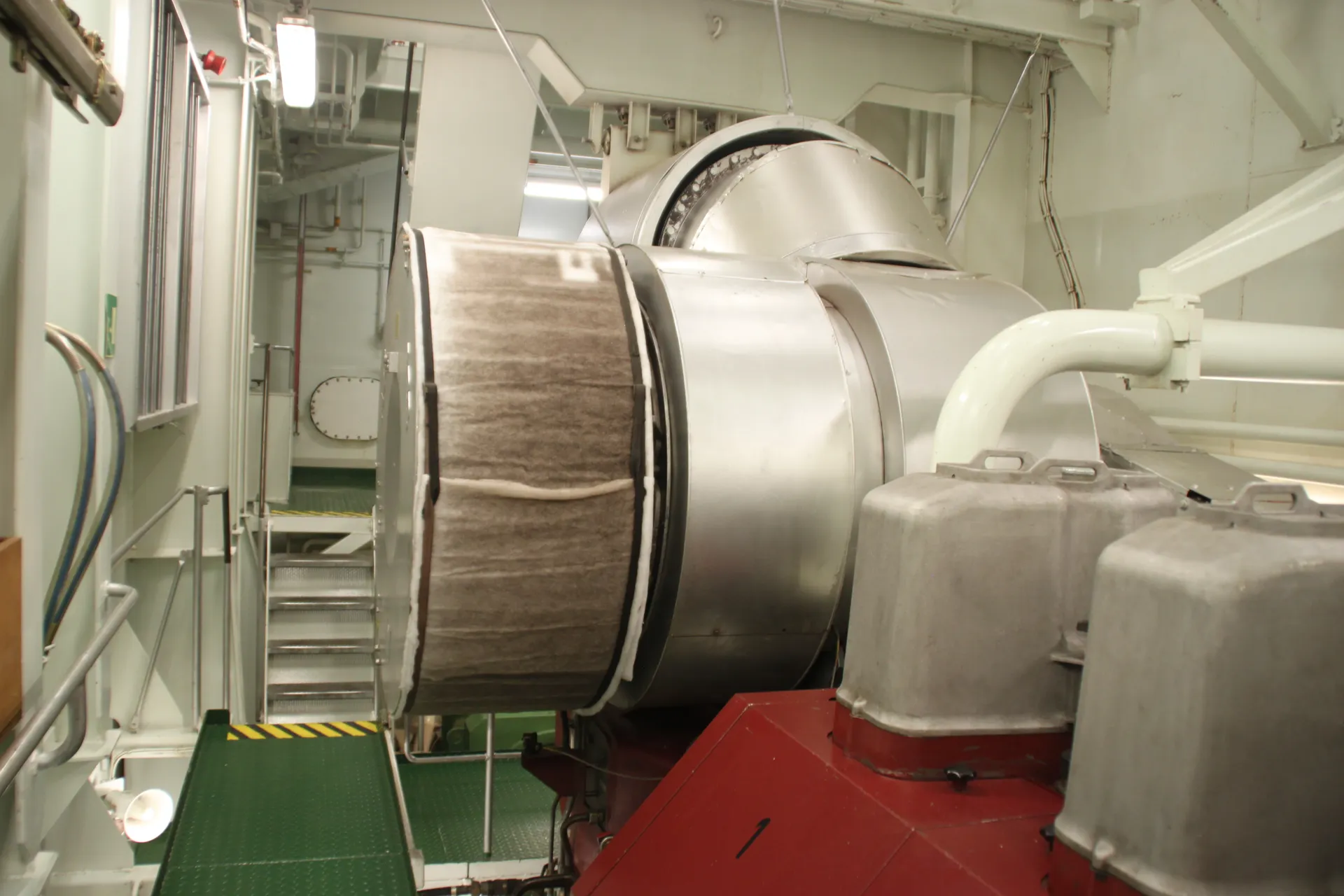
Marine turbocharger — general arrangement
A licensed photograph of Mitsubishi MET equipment was not available at publication, so this technical reference illustrates the general arrangement shared by this equipment class.
Illustrative technical reference, not a photograph of Mitsubishi equipment or a Vessel Core installed reference — a licensed photo of this maker's equipment was not available. Vessel Core has no dealership, distribution or partnership agreement with Mitsubishi Heavy Industries; it operates as an independent spare parts supplier.
The plate data that makes a MET line quotable
A MET machine is identified by frame number plus generation suffix, and the same frame number appears across generations that do not share parts. Rotor shaft assemblies are supplied balanced, so the machine serial number and the direction of rotation carry as much weight in review as the designation itself.
- Designation exactly as stamped — frame number and generation suffix together, for example MET53MB, MET71MA or MET66SE
- Machine serial or manufacturing number from the nameplate
- The builder shown on the plate — MHI-MME or a licensee — because MET units are produced under licence as well as in-house
- Engine make, type and duty — the MAN B&W, WinGD or J-ENG two-stroke main engine with its model and engine number, or the four-stroke main or generator engine where the machine is a radial one
- Direction of rotation, stated with the end it is viewed from
- Casing arrangement, gas inlet and outlet orientation
- Whether the rotor has been overhauled, re-bladed or renewed before, and by whom
- Photographs of the nameplate, of the impeller and diffuser on the air side, and of the nozzle ring and turbine blades on the gas side — the views that separate compressor-side fouling from gas-side fouling
- Clearance records, overhaul reports, or surge and vibration notes if held
How a Mitsubishi MET turbocharger RFQ is handled.
A MET line is worked backwards from the machine rather than forwards from the requisition — plate first, generation second, rotation third, then the item. Where an old part number exists it is treated as a clue, not as the answer.
The generation suffix is read before the frame number
MET33 through MET90 exist in more than one generation, and a line that names only the frame number is ambiguous across sixty years of production. The suffix is confirmed back to you — MB, MBII, MA, SE, SD or earlier — before anything is priced.
Which MET lines survive an alternative route
A rotor shaft assembly, nozzle ring or blade set going back into a class-surveyed machine normally stays on the OEM route, because the balance record and drawing revision have to travel with the part. Silencer and suction filter elements, casing hardware, gaskets and seal rings are where an alternative route is usually worth reviewing. Whichever route is offered, the balance grade and rotation hand it was matched against are written into the line.
Breakdown lines reviewed first
When the machine is opened and the vessel is waiting, surging symptoms are read back against compressor-side or gas-side fouling first, so the rotor, nozzle ring and blading lines need not wait while casing hardware and filter elements are still being priced.
Ranges listed here are RFQ context
The MET series and frame numbers on this page describe the equipment a request may concern. They do not imply holdings, compatibility between frames or generations, or any status with the manufacturer.
Handover reviewed against the docking window
A rotor shaft assembly for a large frame is a balance-sensitive item before it is a freight item — crate dimensions, weight and whether the yard has the lift are checked against the docking window before a handover point is written down. Nothing about the date is treated as settled until it is in the quotation.
EU-registered counterparty
A MET rotor shaft assembly or nozzle ring is an order most purchasing departments want the counterparty checked against before it is raised. Estonian registry 17028043 and VAT EE102773714 are open entries, and the buyer-verification page carries the documents a vetting request usually asks for.
What buyers ask before sending a MET list
Which engines run Mitsubishi MET turbochargers?
MET is the turbocharger line of Mitsubishi Heavy Industries Marine Machinery & Equipment Co., Ltd. (MHI-MME), and its current MET-MB series is applicable to all three two-stroke engine brands: Japan Engine Corporation (J-ENG, the former Mitsubishi UE line), MAN Energy Solutions and WinGD. That is why a MET plate is most often found on a slow-speed main engine rather than on an auxiliary. MHI-MME also builds radial machines — the MET-SRC series and, since 2018, the MET-ER series — for four-stroke main and generator engines. Read the plate rather than the engine: the same engine model can leave different yards with different turbocharger makes.
Which MET series exist, and which are still in service?
MHI began building axial-turbine turbochargers in 1960 and introduced the first uncooled MET in 1965; by 2017 more than 30,000 MET units had been delivered. The generations run from the original MET of the 1960s and MET-S/SA of the 1970s through MET-SB and MET-SBII, MET-SC, MET-SD, then MET-SE from the mid-1990s and MET-SEII from 2000, then the high-efficiency MET-MA, the MET-MB series developed in 2008 and first delivered in 2011, and MET-MBII announced in 2018 as a smaller and lighter machine with about 16 per cent more air flow than MET-MB. All of these are axial. An MET-SD or MET-SE plate is not unusual on a vessel still trading, and the parts route for those generations differs from the current one, so the series suffix matters as much as the frame number.
What does the number in a designation such as MET53MB mean?
It is a frame size — a size class in a ladder, not a power rating. The MET-MB family has ten frame sizes: MET33MB, MET37MB, MET42MB, MET48MB, MET53MB, MET60MB, MET66MB, MET71MB, MET83MB and MET90MB. MET37MB was added to the family later specifically to cover the air-flow range between MET33MB and MET42MB, which shows how the ladder works: the number rises with flow capacity and neighbouring frames overlap. Two machines carrying the same frame number but different generation suffixes are not the same machine, and output should be read from the engine and the turbocharger specification rather than inferred from the frame number.
Which MET lines are worth reviewing on an alternative route?
A rotor shaft assembly, a nozzle ring or a turbine blade set going back into a class-surveyed machine normally stays on the OEM route, because the balance record and the drawing revision have to travel with the part. Silencer and suction filter elements, casing hardware, gaskets, O-rings and seal rings are where an alternative route is usually worth reviewing on price and availability. Whichever route is offered, the line states the balance grade and the direction of rotation it was matched against, and where no acceptable alternative exists the line is quoted OEM only and said so.
Why the maker name appears on this page
Maker names help identify equipment and prepare an RFQ. They do not imply any dealership, distribution, representation or partnership agreement between Vessel Core and the manufacturers named on this page; there is none. Mitsubishi Heavy Industries and the MET designation are referenced solely so that a buyer can describe the machine on board and the component required.
Send the plate, then the list.
Give the full designation with its generation suffix, the machine serial number, the builder shown on the plate, the engine the machine serves, the direction of rotation and the components concerned — rotor shaft assembly, casing, nozzle ring, bearings, seals, impeller, diffuser or blading — plus the port and yard window. The designation, generation and rotation note are read back to you before anything is priced, so a line written as “turbine blade” does not come back quoted as one blade when the machine needs a set.

