
HiMSEN Engine
Spare Parts Supplier
Hyundai four-stroke medium-speed engines · H17/28 · H21/32 · H25/33 · H32/40 · H32/40V · H46/60V · dual-fuel H27DF, H35DF and H54DF
HiMSEN frames a spare parts RFQ can reference
HiMSEN is Hyundai Heavy Industries' own four-stroke medium-speed engine family — designed in house rather than licence-built from another designer's drawings, which is why its parts route does not overlap with the European four-stroke makes. More than 15,000 units have gone to customers in some 60 countries since production began in 2001. Most HiMSEN plates met at sea are on auxiliary generating sets, and that is what usually makes the request urgent: a stopped generating set is a port and class problem before it is a parts problem.
H17/28, H21/32 and H25/33
The auxiliary band, and the frames behind most HiMSEN requests. The frame number rises with the bore, and output within one frame still moves with cylinder count, rating and speed. Requests here usually open as a cylinder head, a liner and piston set, a bearing set or an injection component rather than a single fastener.
H32/40, H32/40V and H46/60V
Where the larger propulsion installations sit, and where the V-configurations appear: a V engine of the same frame is a substantially bigger machine than its in-line namesake. The smaller frames also exist in P propulsion variants such as H21/32P and H25/33P. The same frame is built to different specifications for generating-set and propulsion duty, so the duty belongs in the request alongside the type.
H35/40G, H27DF, H22CDF, H35DF and H54DF
The gas and dual-fuel side of the family, including the V-configurations H35/40GV, H35DFV and H54DFV. Dual-fuel units add gas admission valves, their own control components and a separate service history to the request, so a DF plate should never be treated as its diesel namesake with a different label.
IMO Tier II and Tier III builds
HiMSEN engines are offered to IMO Tier II and Tier III. Which one a given unit was built to affects the injection and aftertreatment components far more than the frame number does, so where a Tier III arrangement with SCR or EGR is fitted, say so in the request rather than leaving it to be inferred.
Component groups quoted on HiMSEN engines
A HiMSEN engine is quoted across the running gear, the combustion and injection side, the starting and control side, and the pumps and coolers that keep it alive. Grouped that way, a list covering a scheduled top overhaul and an unplanned failure on the same engine stays readable.
- Cylinder heads, complete or as reconditioning sets
- Inlet and exhaust valves, valve seats, guides and rotators
- Cylinder liners
- Pistons, piston crowns, skirts and ring sets
- Connecting-rod bearing shells and main bearing shells, with the undersize stated
- Camshaft sections, cams, rollers, push rods and rocker gear
- Fuel injection valves and nozzles
- Fuel injection pumps, plungers, barrels and high-pressure pipes
- Starting air valves, the starting air distributor and its control components
- Governor and actuator components, and speed pick-ups
- Attached lube oil and cooling-water pumps
- Lube oil and charge-air coolers, thermostatic valves and filter elements
- Gaskets, O-rings, seal rings and complete seal kits
- Top-overhaul kits and full overhaul kits, matched to the running hours
- Gas admission valves and dual-fuel specific control components on DF units
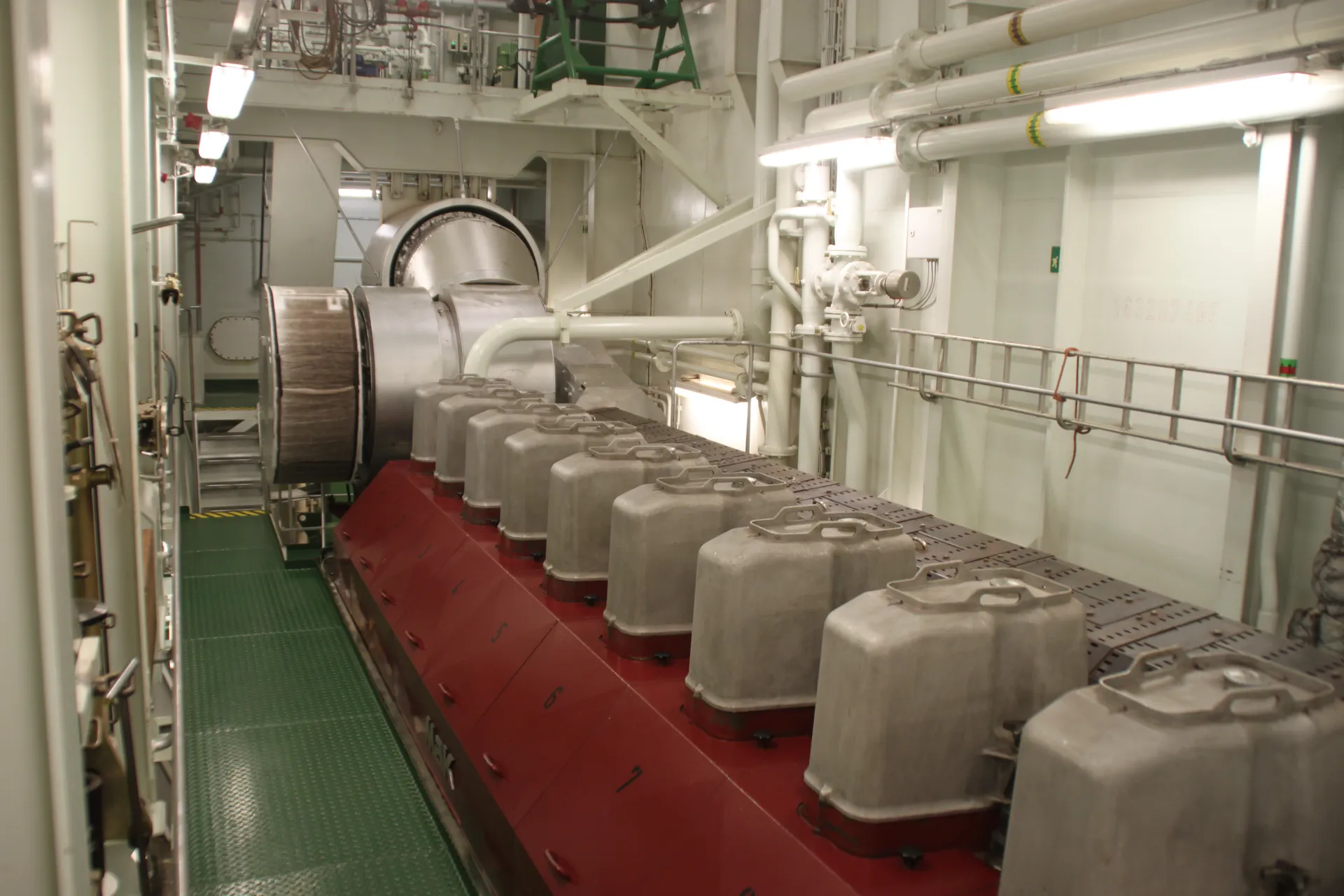
Medium-speed engine — general arrangement
A licensed photograph of HiMSEN equipment was not available at publication, so this technical reference illustrates the general arrangement shared by this equipment class.
Illustrative technical reference, not a photograph of Hyundai equipment or a Vessel Core installed reference — a licensed photo of this maker's equipment was not available. Vessel Core has no dealership, distribution, representation or partnership agreement with Hyundai Heavy Industries; it operates as an independent spare parts supplier.
The plate data that makes a HiMSEN line quotable
A HiMSEN frame stays in production for two decades, and component revisions move within a frame. The engine serial number is what separates one revision from another, which is why it does more work in review than the type designation on its own.
- Engine type exactly as stamped, with the cylinder count — 6H21/32, 8H25/33, 9H32/40V
- Engine serial number and build year from the nameplate
- Duty: auxiliary generating set or propulsion, and the rated output and speed shown on the plate
- Alternator maker, type and serial where the request touches the alternator end
- Turbocharger make and designation from its own plate, if the line concerns the turbocharger
- Governor or actuator make and type, if the line concerns speed control
- Emissions build — Tier II or Tier III, and whether SCR or EGR is fitted
- Part-book page and item number where held, treated as a starting point rather than a conclusion
- Running hours since the last top overhaul or full overhaul
- Photographs of the engine nameplate and of the component in place
How a HiMSEN engine RFQ is handled.
A HiMSEN line is worked from the machine outwards — type and serial first, duty second, then which of the three plates on the skid the item actually belongs to. Where an old part number exists it is treated as a clue, not as the answer.
The three plates on one generating set
Engine, alternator and turbocharger are separate manufacturers with separate catalogues. A line is assigned to the right one before it is priced, so an alternator bearing is not quoted against an engine part number and a nozzle ring is not quoted against neither.
Which HiMSEN lines survive an alternative route
Bearing shells, ring sets, valves, seals and filter elements are where an alternative route is usually worth reviewing on price and availability. Cylinder heads, liners, injection equipment and anything going into a class-surveyed repair normally stay on the OEM route. Where the two routes are not equivalent on a line, the difference is stated rather than smoothed over.
A stopped generating set is read first
Auxiliary duty is where most HiMSEN requests come from, and a set out of service changes the vessel's operating condition. Those lines are separated from the scheduled overhaul list so the urgent items are not held behind a full top-overhaul kit that is being priced at the same time.
Frames listed here are RFQ context
The HiMSEN frames and variants on this page describe the equipment a request may concern. They do not imply holdings, interchangeability between frames or duties, or any status with the manufacturer.
Handover reviewed against the port call
Cylinder heads and liners are weight and crating items before they are catalogue items. Dimensions, weight and whether the berth can take the delivery are checked against the port call and ETA before a handover point is written down. Nothing about the date is treated as settled until it is in the quotation.
EU-registered counterparty
An overhaul kit for a generating set is an order most purchasing departments want the counterparty checked against before it is raised. Estonian registry 17028043 and VAT EE102773714 are open entries, and the buyer-verification page carries the documents a vetting request usually asks for.
What buyers ask before sending a HiMSEN list
What is a HiMSEN engine, and where is it fitted?
HiMSEN is Hyundai Heavy Industries' own four-stroke medium-speed engine family, developed in house rather than licence-built from another designer's drawings. Hyundai passed 10,000 HiMSEN units delivered in 2016 and now puts the count at more than 15,000, to customers in some 60 countries since the first units were produced in 2001. Most HiMSEN plates encountered at sea are on auxiliary generating sets on Korean-built tonnage, with the larger frames used for propulsion; the family also covers gas and dual-fuel variants and is offered to IMO Tier II and Tier III.
How do you read a HiMSEN designation such as 6H21/32?
The leading digit is the cylinder count, H is the family, and the two numbers are the bore and the stroke in centimetres: 6H21/32 is a six-cylinder engine of the 21/32 frame. A V in the designation is a V-configuration rather than in-line, and DF is the dual-fuel variant. The dual-fuel names are read differently again — they carry the bore but not the stroke, and H22CDF and H27DF share a stroke despite the different numbers — so take both figures off the plate rather than from the name. Copy the designation with its cylinder count: an 8H25/33 and a 6H25/33 share a component set but not a parts list.
Which HiMSEN frame is which, in output terms?
H17/28, H21/32 and H25/33 are the auxiliary generating-set frames on most vessels; H32/40, its V-configuration H32/40V and H46/60V are where the larger propulsion installations sit, and the smaller frames also come in P propulsion variants. Output depends on cylinder count, rating and speed, so the figure that matters for a spare part is the one on the plate in front of you, not the band the frame sits in.
What does a HiMSEN RFQ need beyond the engine type?
Three things are missed most often. First, the engine serial number: frames run for two decades and component revisions change within a frame. Second, whether the unit is an auxiliary generating set or propulsion, because the same frame is built to different specifications for each. Third, the alternator: on a generating set the alternator is a different manufacturer from the engine, and a request for a bearing or a diode on the alternator end cannot be quoted from the engine plate. The turbocharger and governor are separate makes as well, and their own plates carry their own designations.
Why the maker name appears on this page
Maker names help identify equipment and prepare an RFQ. They do not imply any dealership, distribution, representation or partnership agreement between Vessel Core and the manufacturers named on this page; there is none. Hyundai Heavy Industries and the HiMSEN designation are referenced solely so that a buyer can describe the engine on board and the component required.
Send the plate, then the list.
Give the engine type with its cylinder count, the engine serial number, whether the unit is a generating set or propulsion, and the components concerned — cylinder head, liner, piston and rings, bearing shells with the undersize, injection equipment, starting air or seals — plus the port and ETA. Where the line sits on the alternator or the turbocharger instead, send that plate too. The type, serial and duty are read back to you before anything is priced, so a line written as “piston ring” does not come back quoted as one ring when the engine needs a set per cylinder.

