
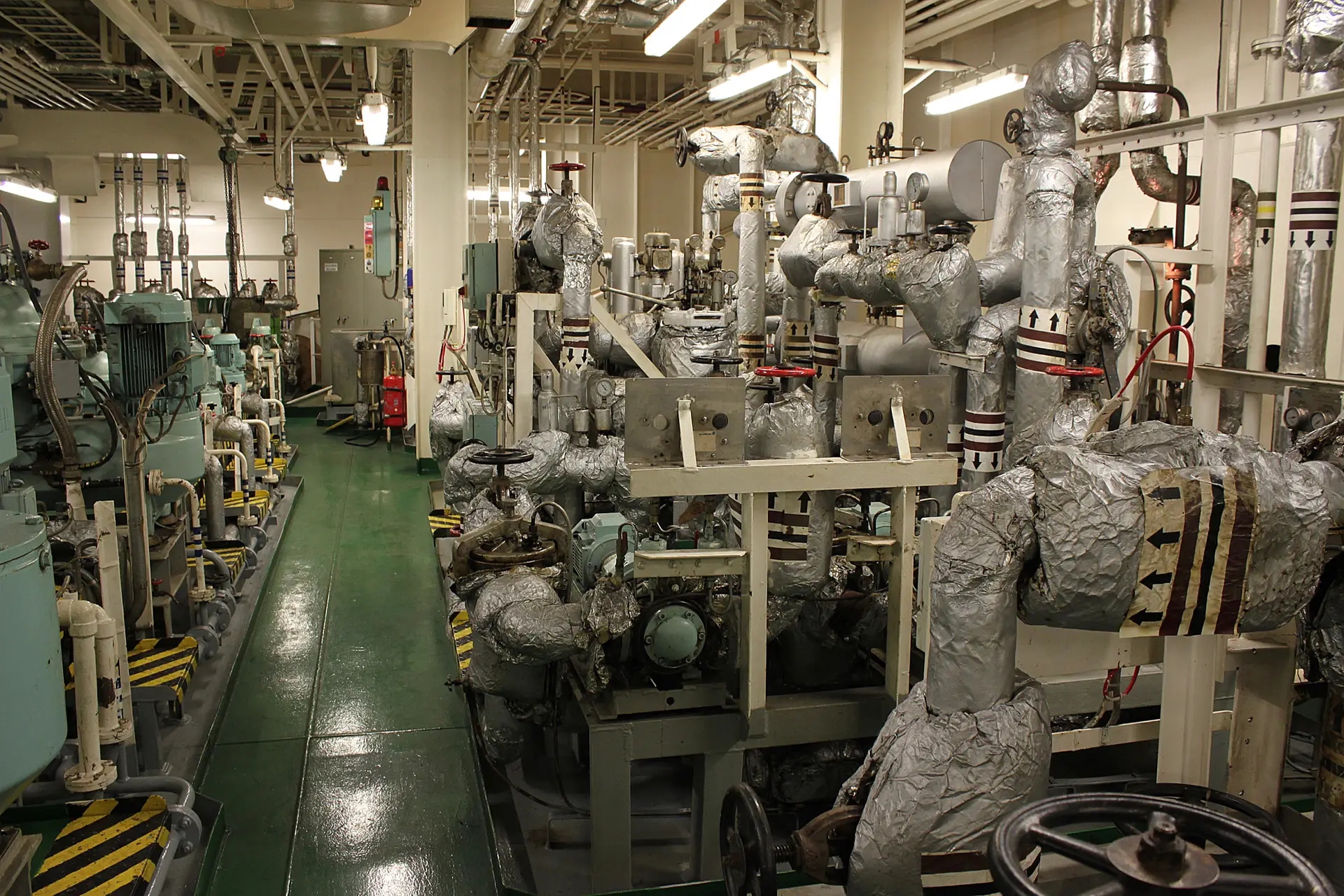
Framo Cargo Pump
Spare Parts Supply
Submerged hydraulic cargo, ballast and anti-heeling pumps · SD and SB types
The Framo pump types behind a tanker enquiry
A Framo installation is one hydraulic ring line feeding many independent pumps. Each cargo tank carries its own submerged unit whose hydraulic motor sits directly on top of the pump head, deep in the tank, with the discharge pipe doubling as the structural support column — there is no line shaft running down from a deck-mounted prime mover. That layout is the reason a Framo enquiry behaves nothing like a bolt-on engine-room pump enquiry: the wear items sit inside the cargo, and the drive side sits inside a closed oil circuit.
SD Series Submerged Cargo Pumps
Single-stage centrifugal cargo pumps hung in the tank on the discharge pipe, designated as series plus size — SD100, SD125, SD150, SD200, SD250, SD300. The series covers full cargo tanks down to slop and small parcel tanks. Impeller and wear ring, top and bottom bearings, cofferdam seal arrangements, hydraulic motor internals.
SB Series Submerged Ballast Pumps
Hydraulically driven ballast pumps — SB125, SB200, SB300 — in segregated ballast tanks and on anti-heeling service. Seawater duty changes the corrosion picture: bearing wear, impeller erosion and shaft sleeve condition dominate the parts list, alongside seal kits and hydraulic motor service components.
Anti-Heeling Pumps
Submerged pumps able to run in both directions, so heel is corrected by reversing the pump rather than by a changeover valve arrangement. Enquiries usually mix pump wear parts with heel-sensor and control-system components.
TK Series Portable Hydraulic Pumps
Hose-fed TK80, TK100 and TK150 units used for stripping, residue and washings removal, dewatering and emergency transfer, driven from the ship's hydraulic system or a portable power pack. Service kits, quick-couplings, hose sets, impeller and seal components are the recurring items.
Hydraulic Power Packs
Engine-driven or electrically driven pack feeding a constant-pressure ring line through pressure-compensated main pumps that destroke on demand. Feed and main pump elements, pressure and return filter elements, relief valves, oil coolers and header-tank components.
Hydraulic Motor Assemblies
The motor on top of each pump head. Piston and cylinder-block wear, valve plate scoring, shaft seal leakage and bearing play are the usual reasons a unit is landed for overhaul.
Cofferdam Barrier and Drain Arrangement
The dry barrier space between hydraulic oil and cargo, drained to a shut-off valve and collecting point at deck level. Cofferdam drain lines, drain valves and deck drain-point fittings, with the purging connection used to clear the line.
What actually wears on a Framo cargo pumping system
Most enquiries cluster around four failure stories: a cofferdam drain producing hydraulic oil, a cofferdam drain producing cargo, a pump losing head after an abrasive or crystallising cargo, and a hydraulic motor turning slow or hot after oil contamination. The parts below follow those stories rather than a generic pump catalogue.
- Cofferdam seal kits — upper and lower seal positions
- Cargo-side mechanical seal faces & seal housings
- Elastomer sets matched to the cargo grade carried
- Impellers, wear rings, suction covers & pump housings
- Top and bottom pump bearings & bearing sleeves
- Pump shafts, shaft sleeves & coupling parts
- Hydraulic motor pistons, cylinder blocks & valve plates
- Hydraulic motor shaft seals & bearing sets
- Cofferdam drain lines, drain valves & deck drain-point fittings
- Collecting-box parts & purging-connection fittings
- Ring-line control valves, servo & solenoid components
- Hydraulic oil pressure and return filter elements
- Power-pack feed and main pump elements & relief valves
- TK portable pump service kits, couplings & hose fittings
Pinning a part to one tank, one pump, one cargo
Two pumps of the same type on the same ship can need different seal materials because they serve tanks with different cargo histories and different coating systems. That is why a Framo enquiry is identified per tank, not per vessel class. The items below are what let a request move from a description to a defined component.
- Pump type and size designation from the nameplate
- Pump serial number and build revision
- Tank number and duty — cargo, slop or ballast
- Cargo grades carried and the current trading pattern
- Tank coating system and any coating restrictions
- Elastomer and seal-face materials currently fitted
- Hydraulic system working pressure at the ring line
- Power-pack drive — engine driven or electrically driven
- Cofferdam drain findings — oil, cargo, water or dry
- Cofferdam drain log — date, quantity and appearance of what the drain produced
- Running hours since the last landed overhaul
- Photographs of the nameplate and the removed component
A chemical tanker pump request is reviewed on its own terms
Cargo pump work carries constraints an engine-room pump job does not: the barrier space has to stay provable, the wetted materials have to survive the next parcel, and the hydraulic circuit that drives every pump on deck cannot be contaminated by one careless component. Route review starts from that reality.
Cofferdam Barrier Evidence First
The cofferdam is what keeps hydraulic oil out of the cargo and cargo out of the oil. Before a seal kit is quoted we ask which drain produced what, in what quantity, and over how many running hours — because that determines whether the upper seal, the lower seal or both are the real subject of the request.
Cargo Compatibility Treated as Identification
Elastomer grade, seal-face material, impeller alloy and any applied coating are checked against the parcels the tank actually carries. A component that is technically correct for the pump type can still be wrong for a solvent, an acid, a methanol trade or a hot vegetable oil trade, so the cargo list travels with the part reference.
Hydraulic Side Reviewed With the Pump Head
A worn valve plate or a collapsed filter element can present as a weak pump. Where the symptom points to the drive rather than the wet end, motor internals, ring-line control valves and filter elements are reviewed in the same enquiry so a landed overhaul is not opened twice.
Barrier-Critical Parts Take the OEM Route
OEM-route review suits class-attended work, barrier-critical seal renewals and cases where documentation must trace back to the original component. Verified alternative routes can be reviewed for filter elements, hose fittings and comparable consumables where buyer approval and the cargo profile allow it.
Discharge-Window Aware Planning
A submerged pump cannot be landed until the tank is stripped, cleaned and gas-freed, and that sequence is set by the discharge programme and the next parcel nomination rather than by an engine-room docking window. We plan backwards from the tank-cleaning slot the charterer has agreed, so route, handover point and the documentation the component needs are reviewed against the sequence that actually governs when the pump can be lifted.
EU-Registered Entity
Reg. 17028043 · VAT EE102773714, Tallinn. Cargo-pump enquiries are handled by a named contact, and buyers running vendor approval can request the registry extract and bank details directly.
Framo pump parts — what buyers ask first
What evidence do you need before quoting a Framo cofferdam seal kit?
Send the pump type and size designation, the pump serial number, the tank number it serves, and the elastomer grade currently fitted. Add the cargo grades the tank has carried and the tank coating, because seal material selection follows the cargo, not the pump size. Cofferdam drain observations — whether hydraulic oil or cargo was found — tell us which seal position is being renewed.
Which Framo pump types can appear on an RFQ?
RFQs may reference SD series submerged cargo pumps, SB series submerged ballast and anti-heeling pumps, TK series portable hydraulic pumps, and the hydraulic power pack and ring line that supply them. The exact type designation, size and serial are needed before any route is confirmed.
Why is cargo compatibility part of a Framo pump parts enquiry?
A submerged cargo pump sits inside the product. Elastomers, impeller and casing materials, and any applied coating all have to tolerate the cargo grades in the trading pattern. A seal ring that suits a vegetable oil trade can swell or harden in an aggressive solvent, so cargo history is treated as identification data alongside the serial number.
Can you review parts for the hydraulic side as well as the pump head?
Yes. Hydraulic motor components, ring line control valves, return and pressure filter elements, and power pack items can be reviewed together with pump head parts. Provide the system working pressure, whether the power pack is engine driven or electrically driven, and recent oil cleanliness or analysis results where these exist.
Why the Framo name appears on this page
Maker names help identify equipment and prepare an RFQ. They do not imply that Vessel Core is an authorised dealer, representative or partner of the manufacturers named on this page. Pump types listed here describe installed equipment a buyer may need identified; they do not imply compatibility with any particular component until the serial, tank duty and cargo evidence have been reviewed.
Send the tank, the type and the cargo.
Submit the pump type and size, serial number, tank number and duty, the cargo grades carried, the component required, and your discharge port or ETA. Cofferdam drain findings and nameplate photographs make identification faster. Vessel Core establishes which seal position the drain evidence points to, whether the cargo grades permit the elastomer currently fitted, and whether the symptom belongs to the wet end or the ring line — then prepares the quotation against that answer.

